Twelve-year-old Noah Price stood beside the platform holding a dented metal savings tin against his chest.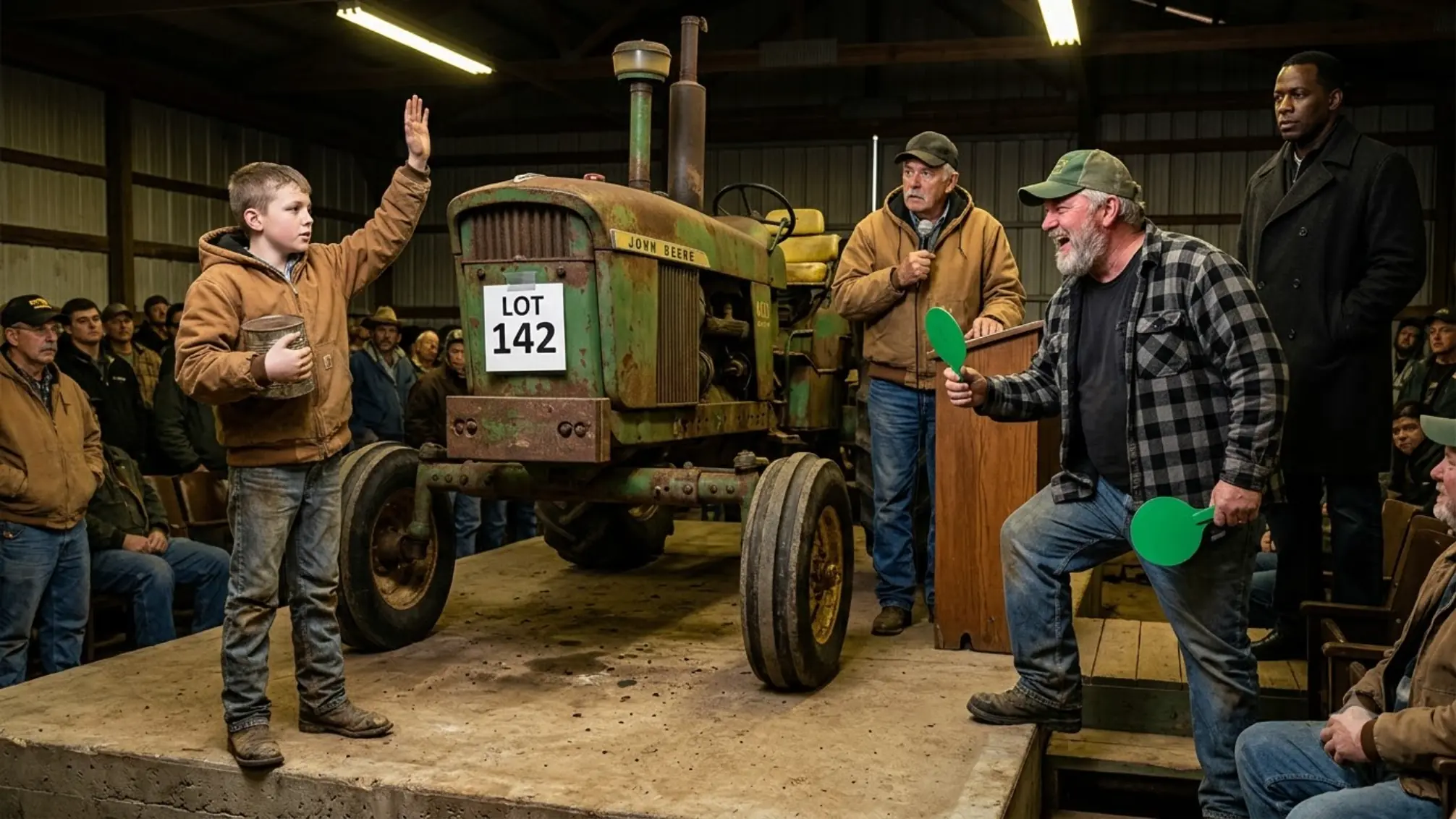
He was a white American farm boy with short light-brown hair, blue eyes, and mud dried around the soles of his boots. His brown hooded jacket had once belonged to his grandfather, Earl Price, and the sleeves still hung slightly past his wrists. Inside the tin was every dollar Noah had earned feeding chickens, splitting firewood, repairing lawn mowers, and helping neighboring farmers clean barns.
Four hundred and fifty dollars.
That money represented nearly two years of work.
Across the crowded Oklahoma auction barn, fifty-five-year-old Floyd Meeker raised a bright green bidding paddle and laughed.
Floyd was a heavyset white American cattle farmer with a gray beard, a red face, and the confidence of a man accustomed to being heard whenever he opened his mouth. He had no real need for the tractor. He already owned three working machines and had spent the morning telling everyone that Lot 142 was worth less than the tires beneath it.
The auctioneer cleared his throat behind the wooden stand.
“Two hundred dollars to Mr. Meeker. Do I hear two-fifty?”
Noah raised his hand.
The barn became quiet.
The men seated on the wooden bleachers turned toward him. Several smiled, believing the child was joking. Others looked for the adult who had given him permission to bid.
Noah’s grandmother, Ruth Price, stood near the back wall with both hands clasped tightly around her purse. At sixty-eight, the white American widow looked smaller than she had four months earlier, before her husband died. She wanted to stop Noah. She also knew that doing so in front of the entire room would tell him she did not believe what he had spent months trying to prove.
The auctioneer stared at the raised hand.
“You bidding two hundred and fifty dollars, young man?”
“Yes, sir.”
Floyd twisted around in his seat. “Does your grandmother know you’re spending her money?”
“It’s mine,” Noah said.
A few men chuckled.
Floyd raised his paddle. “Three hundred.”
Noah answered immediately. “Three-fifty.”
The laughter stopped.
Floyd stood and stepped into the aisle. “Sit down, boy. You’ll ruin your grandma buying that dead tractor.”
Noah tightened his grip on the tin. “Raise it again and see who runs out of money first.”
A murmur passed through the crowd.
The auctioneer lifted one hand. “Gentlemen, keep it about the bidding.”
Floyd ignored him. He walked closer to Noah, his boots striking the packed dirt floor. “You think a child can fix what grown men abandoned?”
Noah pulled a worn service manual from inside his jacket.
“No,” he said. “I know exactly why none of you could.”
At the rear of the barn, James Okafor straightened.
James was a fifty-year-old Black American agricultural administrator who served as director of the Harmon County Farm Bureau. He had attended hundreds of equipment auctions, helped organize youth farming programs, and heard plenty of children repeat technical words they did not understand.
Noah did not sound like one of them.
Floyd looked toward the tractor. “The engine is seized. It hasn’t turned in twenty years.”
“I turned the flywheel by hand this morning.”
“You did what?”
“The crankshaft moves until the second and fourth cylinders bind. The wet sleeves are rusted to the pistons, but the block isn’t cracked.”
The auctioneer lowered his microphone.
Noah continued before fear could stop him.
“The injector pump has moisture damage. Two lines are corroded, and the fuel tank needs to be cleaned. The starter is probably good, but the cables aren’t. It needs sleeves, pistons, rings, seals, bearings, an injector-pump rebuild, and every fluid replaced.”
The barn was completely silent.
Floyd pointed toward him. “You memorized that from a book.”
“My grandfather taught me that engine.”
“Then your grandfather should have taught you not to throw money away.”
Noah’s face changed.
His grandfather’s death was still too new for the name to be used carelessly. Earl Price had spent his life farming ninety-five acres in Harmon County. He taught Noah how to sharpen blades, rebuild carburetors, read compression numbers, and listen to an engine before deciding what was wrong.
During the final summer of his life, Earl brought home a service manual for the John Deere 4020. He and Noah studied it at the kitchen table for six weeks.
Earl had pointed to the engine diagrams and said, “These old machines rarely die, Noah. Most of them just get left behind by someone who stopped listening.”
Four months later, Earl suffered a fatal heart attack beside the grain shed.
The farm’s only working tractor broke down one week after the funeral.
The repair shop estimated that Ruth’s 1982 Case tractor would cost thirty-four hundred dollars to repair. The farm account contained four hundred. Without a tractor, Ruth could not prepare enough ground for the next planting season, move hay, repair the drainage berm, or manage the harvest.
Selling part of the land appeared to be the only option.
Noah spent every evening searching auction listings until he found the abandoned 4020.
Now Floyd was using Earl’s memory as another reason to laugh.
Noah stepped toward him. “My grandfather taught me to understand a machine before calling it dead.”
Floyd raised his paddle.
“Three hundred and seventy-five.”
Noah looked down at the metal tin.
“Four hundred.”
Floyd smiled. He no longer cared about the tractor. The contest had become personal, and he could not tolerate losing to a twelve-year-old in front of men who had known him his entire life.
“Four twenty-five.”
Ruth closed her eyes.
Noah had counted the contents of the tin three times before leaving home. Four hundred and fifty dollars was all he had. If Floyd raised the price one more time, the tractor would be lost.
Noah lifted his hand.
“Four hundred and fifty.”
The auctioneer looked toward Floyd.
Floyd held the green paddle halfway up. Several seconds passed. If he bid again, he would probably win. Yet he had listened to Noah describe the repairs, and uncertainty had entered his expression.
Perhaps the tractor was not worthless.
Perhaps the boy knew something.
Floyd lowered the paddle.
The auctioneer raised his gavel.
“Four hundred and fifty dollars once.”
Noah stopped breathing.
“Twice.”
Floyd looked away.
“Sold to the young man with the metal tin.”
The gavel struck the podium.
For one stunned second, the barn remained silent. Then someone in the back began clapping. A second person joined, followed by several more. The applause spread through the building until farmers who had laughed when Noah first raised his hand were standing to recognize him.
Noah did not smile immediately.
He held the savings tin against his chest and stared at the tractor.
It belonged to him.
Floyd walked past without speaking.
Ruth reached Noah and placed both hands on his shoulders.
“Are you certain?” she asked quietly.
“No.”
Her expression tightened.
Noah looked at the tractor again. “But Grandpa was.”
Before Ruth could answer, James Okafor approached.
“Young man, my name is James Okafor. I direct the county Farm Bureau.”
Noah shook his hand.
James nodded toward the John Deere. “Did you mean everything you said about fixing it?”
“Yes, sir.”
“Show me.”
They returned to the platform after the crowd began moving toward the next auction lot. Noah opened the tractor’s side panel and pointed to the injector lines, fuel system, and areas of corrosion. He explained how moisture could enter around the exhaust, settle inside open valves, and eventually bind the pistons to the sleeves.
He described the wet-sleeve design and why replacing damaged sleeves could restore the cylinders without destroying the entire engine block. He explained the importance of measuring clearances rather than forcing parts into place.
James asked questions designed to expose memorized knowledge.
“What if the crankshaft journals are scored?”
“Measure them. If they’re within limit, polish them. If they’re outside the manual’s tolerance, they need machining or replacement.”
“What if the cylinder head is cracked?”
“Pressure-test it before spending money on the rest.”
“What if the engine block froze with water inside?”
“Check around the lower sleeve bores and coolant passages. If the block is cracked badly, I stop. I don’t keep buying parts for a machine that can’t be saved.”
James studied the boy.
“Who taught you to think that way?”
“My grandfather.”
“Where is he?”
Noah looked down. “He died in June.”
James’s face softened.
Ruth had joined them. She explained the condition of the farm, the broken Case tractor, and the money Noah had saved. She did not ask James for help. Pride would not allow it.
Fortunately, he understood what she was not saying.
“Harmon County runs a Young Farmer Initiative,” James said. “There is a youth mechanical-restoration grant connected to it. It can cover parts, safety equipment, transportation, and mentorship.”
Ruth blinked. “For a twelve-year-old?”
“For a young person with a legitimate agricultural project.”
James looked toward Noah. “I believe this qualifies.”
Noah’s fingers tightened around the manual. “What do I have to do?”
“Come to my office Monday. Bring the tractor paperwork, your repair plan, and that manual.”
“I don’t have a written repair plan.”
James smiled. “You just gave me one from memory. Write it down.”
Moving the tractor became the first problem.
Noah could afford the machine but not transportation. Before he and Ruth could decide what to do, auctioneer Gary Sims announced that the equipment yard would loan them a trailer. Three farmers volunteered trucks.
One of them had laughed earlier.
By late afternoon, the John Deere reached the Price farm.
It looked even worse beneath the open sky. Rust streaked the hood, one rear tire was nearly flat, and mice had destroyed most of the seat. Ruth stood beside it with doubt visible on her face.
Noah climbed onto the platform and rested one hand on the steering wheel.
“Grandpa said these engines don’t die easily.”
Ruth looked toward the barn where Earl’s tools still hung in their proper places.
“He also said confidence without measurements was just expensive guessing.”
“I’m going to measure everything.”
On Monday, James helped Noah complete the grant application. The project received six hundred dollars for initial parts and access to a retired agricultural mechanic named Earl Pittman.
The mechanic’s first name made Ruth turn away for a moment.
Earl Pittman was seventy-one, a white American man with bent fingers, silver hair, and forty-five years of experience repairing farm equipment. He agreed to supervise but refused to perform the restoration himself.
“If I touch every bolt,” he told Noah, “you will own a tractor I fixed. If you touch them, you will own what you learned.”
The work began with cleaning.
Noah removed nests, dirt, old grease, and rust from around the engine. He drained fuel that smelled like varnish and oil thick enough to move slowly from the pan. Every removed part received a numbered tag and was recorded in a notebook.
Earl watched him organize bolts into labeled containers.
“Your grandfather teach you that?”
“He said the person who says he will remember where everything goes is usually the person with three bolts left over.”
Earl laughed. “Smart man.”
The cylinder head came off during the second week.
The inside confirmed Noah’s prediction. Moisture had entered two cylinders, and rust locked the pistons inside the sleeves. The block showed no visible cracks.
Noah stared at the damage with relief.
He had been right.
Then Earl handed him a measuring tool.
“Being right about the first thing does not mean you’re right about the rest.”
They measured the crankshaft, connecting rods, head surface, and bearing clearances. One rod bearing required replacement, but the crankshaft remained usable. The cylinder head passed pressure testing after two damaged valves were replaced.
The injector pump required professional rebuilding, which consumed much of the grant. Noah used his remaining savings for gaskets and new electrical cables.
Ruth quietly sold an old piece of jewelry to cover the rear tire.
Noah discovered what she had done when he noticed her wedding necklace missing.
“You shouldn’t have sold it.”
“The ring is still here,” she said, touching the band on her finger. “Your grandfather would rather see this farm moving than a necklace sitting in a drawer.”
The restoration attracted visitors.
Farmers stopped by after hearing about the boy who bought Lot 142. Some brought used parts. Others offered advice, not all of it useful. Noah listened politely, checked every suggestion against the service manual, and made his own decision.
Floyd Meeker arrived during the seventh week.
He stood at the barn entrance while Noah installed the new sleeves.
“I heard you got the engine apart.”
Noah did not look up. “Yes, sir.”
“Block cracked?”
“No.”
“Crankshaft ruined?”
“No.”
Floyd entered slowly. “You were right about the sleeves?”
“Yes.”
The older farmer watched Noah work.
“Why didn’t you tell everyone more before the auction?”
“I told them enough.”
Floyd glanced toward the tractor. “Could have saved me from looking foolish.”
“You were bidding because you wanted me to look foolish.”
Floyd’s face hardened.
For a moment, Noah thought another argument would begin. Then Floyd removed his cap.
“My son used to work on machinery,” he said. “He left the farm ten years ago. I suppose I’ve been angry at every young person who still wants this life.”
“That wasn’t my fault.”
“No.”
Floyd placed a box on the workbench. Inside was a new set of gauges and a professional torque wrench.
“I bought these for my son. He never used them.”
Noah looked at him suspiciously.
“I’m not giving them because I feel sorry for you,” Floyd said. “I’m giving them because tools should belong to someone who understands what they’re for.”
Noah accepted the box.
“Thank you.”
Floyd nodded once and left.
The engine went back together slowly.
Noah checked every measurement twice. He installed the rebuilt injector pump, cleaned the radiator, repaired the wiring, replaced hoses, changed filters, and fitted a used seat donated by another farmer.
Eleven weeks after the auction, the tractor was ready.
A cold Saturday morning settled over the farm. Ruth stood at the barn door wearing Earl Price’s old coat. James arrived with several Farm Bureau members, and Earl Pittman leaned against the workbench pretending he was not nervous.
Noah climbed into the seat.
His hand rested on the key.
“What if it doesn’t start?” Ruth asked.
“Then I find out why.”
He turned the key.
The starter engaged.
The engine rotated slowly, coughed once, and stopped.
Noah waited, checked the fuel lever, and tried again.
Black smoke pushed from the exhaust.
The engine coughed twice.
Then the 1967 John Deere came alive.
Its deep mechanical rhythm filled the barn and rolled across the fields. The tractor shook beneath Noah as oil pressure climbed and the idle stabilized into a steady, powerful sound.
Ruth covered her mouth.
James began clapping.
Earl Pittman smiled and looked toward the ceiling so no one would see the moisture in his eyes.
Noah remained in the seat, listening.
The engine was not perfect. A small fuel leak appeared near one fitting, and the generator needed adjustment. Yet the tractor was running under its own power for the first time in twenty years.
Ruth walked forward and placed both hands against the warm hood.
“Your grandfather should be here.”
Noah looked down at her.
“He is.”
The tractor became the Price farm’s primary machine that spring. Noah used it to prepare fields, move hay, grade the damaged lane, and rebuild the drainage berm before heavy rain arrived.
The farm produced enough wheat and hay to survive the year.
Ruth did not sell a single acre.
James entered Noah’s restoration notebook into a statewide youth agricultural competition. Noah prepared a display showing the original auction photographs, repair estimates, measurements, parts costs, and the final working tractor.
He won first place in agricultural mechanics.
One judge asked how a twelve-year-old had produced records more detailed than many adult entries.
Noah gave the answer Earl Price had taught him.
“If you don’t write down what the machine tells you, you’ll make it tell you twice.”
The story spread through the county.
Local farmers began bringing Noah lawn mowers, generators, pumps, and small tractors they had planned to discard. He charged little at first, then Earl Pittman taught him to value his time properly.
“You are helping people,” the retired mechanic said, “but help that ruins you is not a business.”
Noah placed half of every payment into the farm account and half into his education savings.
Floyd became an unexpected customer. He brought an old hay baler that two repair shops refused to touch. Noah found a worn timing component, repaired it, and returned the machine before harvest.
Floyd paid the full invoice without bargaining.
The following autumn, James visited the Price farm and watched Noah drive the restored 4020 across a field of cut hay. The tractor’s green paint was still faded, though Noah had cleaned the rust and painted the wheels. He refused to make it look new.
“I want people to see what it survived,” he said.
James stood beside Ruth near the barn.
“That boy will become one of the finest mechanics in Oklahoma.”
Ruth watched the tractor turn at the edge of the field.
“His grandfather already was.”
James nodded. “I can see him in every repair Noah makes.”
Years later, the John Deere remained on the farm.
Each spring, Noah serviced it using the same worn manual Earl had given him. He never replaced the stained pages or repaired the cracked cover. Grease marks from his grandfather’s fingers remained beside diagrams Noah had memorized as a child.
The dented savings tin stayed on a shelf above the workbench.
Visitors often assumed it contained spare bolts.
Noah never corrected them.
The tin reminded him that the tractor had not been purchased with money alone. It had been bought with hours of work, a grandmother’s trust, a grandfather’s lessons, and one raised hand inside a barn full of adults who believed knowledge could not come from someone so young.
On auction day, everyone saw a child bidding on a dead machine.
Noah saw a seized sleeve, a damaged pump, and a farm that still had a chance.
The laughing farmers believed the tractor had been abandoned because it was worthless.
The twelve-year-old boy knew the truth.
Sometimes a machine—and sometimes a person—only needs one patient set of hands willing to understand why everyone else gave up.