“Look at this place.”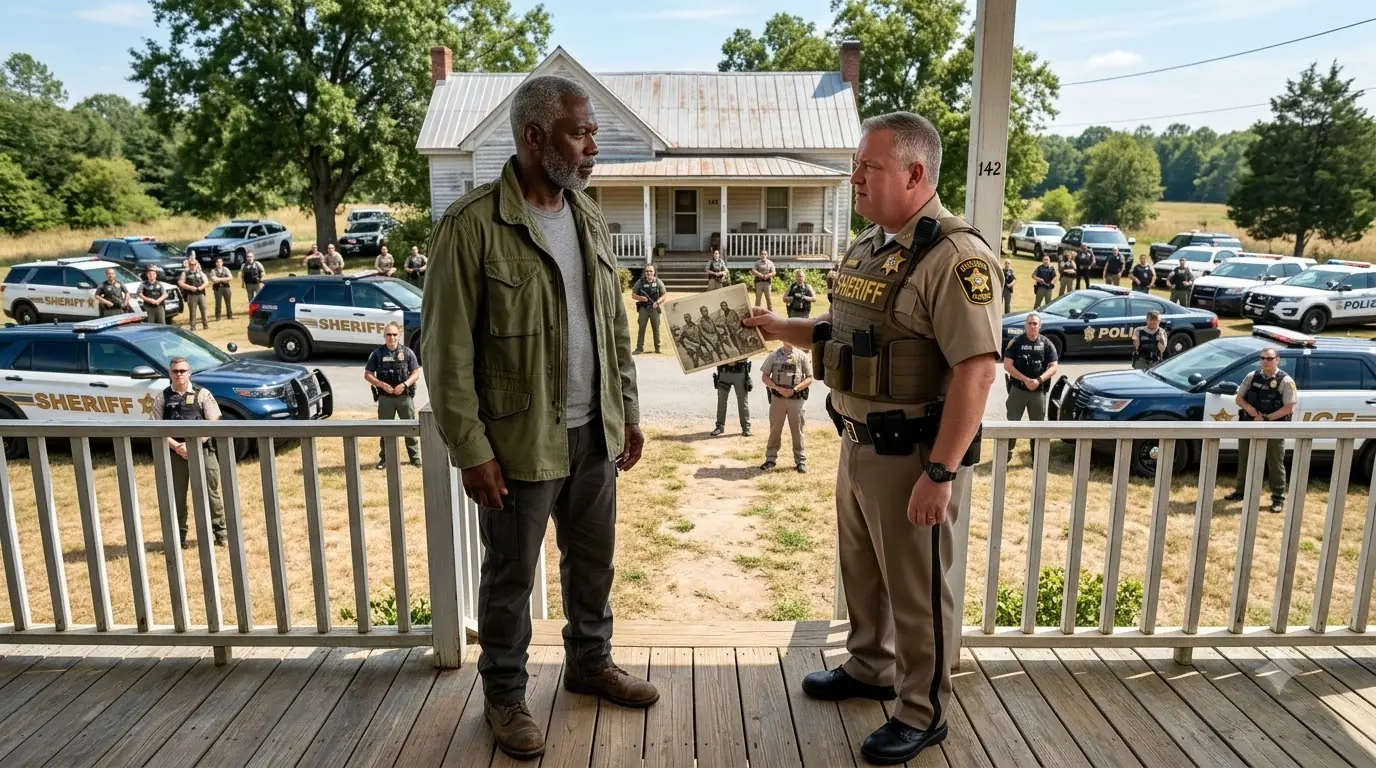
Sheriff Daniel Whitmore stood in Marcus Carter’s front yard and glanced at the weathered little house behind him.
Paint peeling along one corner.
An aging pickup beneath a maple tree.
A porch railing Marcus had been meaning to repaint before winter.
Nothing about the property looked dangerous.
That apparently disappointed Daniel.
He turned toward the line of armored deputies spread across the road.
Then toward Marcus.
“A Black veteran living in a broken-down house actually thinks he deserves respect because he wore a uniform decades ago.”
Marcus did not answer.
Daniel smiled.
He stepped onto the porch.
There, beside the front door, sat an old framed photograph.
Marcus in desert camouflage.
Much younger.
Standing beside six other soldiers beneath a faded American flag.
Daniel picked it up.
Marcus’s expression changed.
“Put that down.”
Daniel looked at the picture.
Then at Marcus.
“That an order, soldier?”
“No.”
Marcus’s voice remained quiet.
“It’s a request you should listen to.”
Daniel laughed.
Then deliberately tore the photograph in half.
The sound was small.
Paper separating.
Nothing compared with the noise around them.
Engines idling.
Radios crackling.
Boots moving across pavement.
Fifty officers from the Oak Haven County Sheriff’s Office and two neighboring departments had sealed both ends of Carter Road.
Patrol cars blocked driveways.
A tactical vehicle sat near the intersection.
Rifles pointed toward Marcus’s home from behind engine blocks and open doors.
Neighbors watched through curtains.
Several recorded from upstairs windows.
Daniel dropped the two pieces into the dirt.
Marcus stared at them.
One half showed him.
The other showed Sergeant Thomas Bell and three men who had never made it home from that deployment.
Marcus slowly lifted his eyes.
“Sheriff.”
Daniel spread his arms.
“What?”
“You wanted my attention.”
Marcus’s jaw tightened.
“You have it now.”
The operation had begun forty-three minutes earlier.
Marcus was standing in his kitchen making coffee when he noticed the first cruiser.
Then another.
Then four.
Within minutes, the road disappeared beneath police lights.
Marcus did not reach for a weapon.
Did not rush to a window.
Did not call the media.
He placed his coffee on the table.
Walked to the front room.
And watched.
Experience taught him something most civilians never had to learn.
Large armed groups became more dangerous when nobody understood what everyone else believed was happening.
So Marcus waited.
At 7:18 a.m., a loudspeaker crackled.
“MARCUS CARTER!”
“This is the Oak Haven County Sheriff’s Office!”
“Exit the residence immediately with your hands visible!”
Marcus looked through the side window.
Tactical officers.
Too many for a simple warrant.
Then the loudspeaker again.
“YOU ARE CONSIDERED ARMED AND DANGEROUS!”
Marcus almost laughed.
Almost.
Instead, he called the sheriff’s office dispatch number.
A dispatcher answered.
“This is Marcus Carter at 214 Carter Road.”
Pause.
The woman on the line became cautious.
“Mr. Carter, follow commands from officers outside.”
“I intend to.”
“I need to know the basis for the operation.”
“I can't discuss that.”
“Is there an arrest warrant?”
“Sir—”
“Search warrant?”
“I don't know.”
“Who is incident commander?”
Another pause.
“Sheriff Whitmore.”
Marcus closed his eyes.
That explained more than it should have.
Daniel Whitmore and Marcus had met twice before.
Neither meeting had gone well.
The first was at a county veterans ceremony where Marcus quietly corrected Daniel after the sheriff falsely described an Army decoration he claimed his father had received.
The second came six months later after Marcus testified at a county budget hearing against using federal surplus-equipment grants to buy an armored vehicle without funding training or maintenance.
Marcus had said:
“Equipment without discipline becomes theater.”
Daniel had heard:
You are incompetent.
Men like Daniel collected insults even when nobody offered them.
Marcus looked outside again.
Then asked dispatch:
“Am I permitted to come out unarmed?”