On Saturday morning, September 19, 1981, Cal Whitmore stepped into the Mercer County farm-equipment auction yard in Celina, Ohio, carrying a notebook and wearing his father’s old work jacket. The jacket was two sizes too large, his face made him look younger than seventeen, and his slight build did little to convince the men around him that he belonged among serious equipment buyers. Within ten seconds, Cal could feel the judgment settling around him without anyone needing to say a word. He had felt that kind of judgment before, and he had learned not to waste energy fighting it.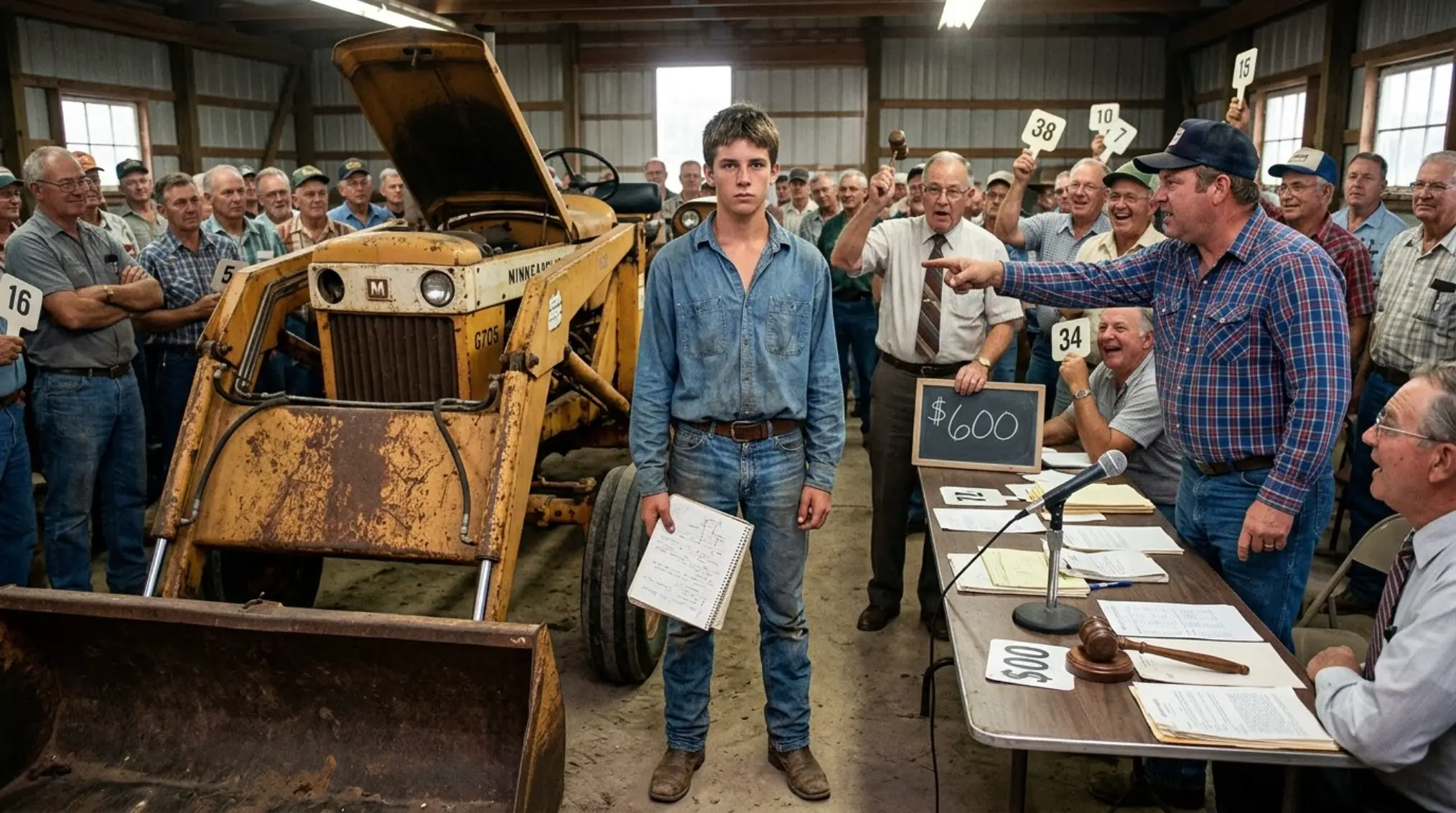
Forty-one registered bidders had come to the sale that morning. Retired farmers, active operators, equipment dealers, and a land speculator from Toledo moved through the rows of machinery with the confidence of men who had bought and sold tractors longer than Cal had been alive. Many had financing arranged, trailers parked outside, and enough cash or credit to make decisions without checking a savings account first. Cal had exactly $215 saved from two summers of detasseling corn and doing repair work for neighbors.
That difference did not bother him as much as people might have assumed. Cal had never expected to outspend anyone in the yard, and he had not come pretending otherwise. He had come with a flashlight, a compression gauge that had belonged to his grandfather, a small mirror borrowed from his mother’s compact, and a notebook full of observations. More importantly, he had come early.
Cal had arrived at seven in the morning, nearly an hour and a half before many of the serious buyers. He moved from machine to machine slowly, checking what interested him and ignoring what did not. Other men glanced at him occasionally, but almost nobody asked what he was doing. To them, he was a teenager wandering through equipment he could not afford.
Lot 11 changed that.
The tractor sat near the middle of the auction inventory, faded prairie-gold paint chalked by age and weather. It was a 1963 Minneapolis-Moline G705 diesel, a large row-crop tractor that had once been the pride of the Henderson estate. One headlight was missing, the loader attachment was badly corroded, and the hood had been propped open to expose an engine that looked tired enough to confirm every bad assumption a buyer might make. The catalog estimated the machine somewhere between $800 and $1,400, but even that range seemed optimistic to several experienced men.
Minneapolis-Moline tractors already made buyers cautious by 1981. The company had been absorbed into White Farm Equipment years earlier, and older parts were becoming harder to locate. A machine that needed serious repairs could consume more money than it was worth before the owner ever put it back to work. That reality made appearance matter more than it should have that morning.
The Toledo speculator inspected the G705 for roughly three minutes before walking away. Ray Sutherland, one of the county’s most established equipment dealers, spent about five minutes on it before turning toward an associate and saying one word. “Parts.”
Several other serious buyers reached the same conclusion. The tractor might be worth four or five hundred dollars if someone dismantled it and sold the major components individually. The engine and transmission might still have value. But as a working tractor, nobody appeared eager to gamble.
Cal spent thirty-seven minutes with it.
He started with the compression test.
The six cylinders produced readings he wrote carefully into his notebook. He did not rush from one to the next, and he did not rely on memory. When the last number was written, he compared the spread across all six and found something that immediately challenged the assumption that the engine was worn beyond useful life.
Then he checked the transmission fluid.
He pulled the dipstick, examined the color, rubbed a small amount between his fingers, held it toward the morning light, and smelled it. Nothing about it suggested the kind of severe internal abuse he expected from a tractor supposedly ready for dismantling. That did not prove the machine was healthy, but it gave him another reason to keep looking.
Cal moved to the hydraulic system.
The G705 had known hydraulic concerns that mattered greatly to him because he had spent months studying the model. A return-line fitting on early machines had been undersized for sustained pressure and had later received a factory revision. Because the tractor in front of him was a 1963 model, it had originally been built before that revision.
Cal found the fitting.
It was not original.
Someone had replaced it.
He wrote that down.
Then he inspected the front axle pivot area, another point of concern on the model. The G705 had a reputation for wearing that bearing faster than expected, and a badly neglected example could reveal the problem through looseness and handling symptoms. The tractor showed evidence of service there as well.
Cal became more interested.
He traced the fuel system from the tank toward the injectors. The last two were difficult to inspect from his angle, so he removed the little mirror he carried and used it to see what most buyers had not bothered reaching for. Two dealers watching from farther away laughed quietly enough that Cal could not make out every word.
He heard the tone.
That was enough.
Cal continued working.
He had not spent the previous eight months studying the Minneapolis-Moline G705 because he expected strangers at an auction to approve of him. He had studied it because his grandfather, Harold Whitmore, had once owned one for eleven years. Harold understood the machine better than most men who still encountered one occasionally in 1981.
The study had begun the previous winter.
Harold had farmed in Van Wert County for forty years before retiring from active work in 1975. Retirement had not stopped his interest in machinery, and one spare bedroom in his house had gradually become an equipment library. Technical digests, factory bulletins, parts catalogs, manuals, and service documents covered shelves and filled drawers in an organization system that made perfect sense to Harold and eventually to Cal.
Cal had been spending weekends in that room since he was twelve.
Other teenagers might have considered it punishment. Cal did not.
He liked understanding why a machine failed.
He liked tracing systems through diagrams.
He liked discovering that a symptom that appeared catastrophic could sometimes come from one bearing, one fitting, or one calibration error. Knowledge turned machinery from mystery into cause and effect.
Harold taught him that attention mattered, but attention without knowledge was only observation. Anyone could notice a leak. Knowing where the leak came from, what it suggested, and whether it represented a fifty-dollar repair or a five-thousand-dollar failure required understanding.
Cal’s father, James Whitmore, had taught him another version of the same lesson.
James farmed 160 acres of corn and soybeans outside Rockford, Ohio. He worked mostly alone because the family could not afford regular hired help, and he believed that farms survived by noticing problems early. A belt replaced today cost less than an engine damaged tomorrow.
“Attention,” James often said.
The word appeared everywhere in Cal’s childhood.
Pay attention to the soil.
Pay attention to the sound of machinery.
Pay attention to what changed.
Pay attention before the problem became expensive.
Harold added the other half.
“Know what you’re paying attention to.”
That was why the G705 interested Cal months before he saw the Henderson tractor.
In January, Harold had pulled out a Minneapolis-Moline technical digest and begun explaining the G705’s strengths and weaknesses. Cal listened closely enough that Harold continued. Two evenings became several, and soon Cal was requesting service information through the Van Wert County library.
Seven documents arrived through interlibrary loan after nearly three weeks.
Cal read every one.
He learned about injector pump timing drift on high-hour machines. He studied the front axle pivot bearing. He memorized information about the hydraulic return-line revision. He looked through old service recommendations until he understood the difference between a neglected G705 and an ugly one.
That distinction mattered.
By September, Cal had built an eight-month file on a tractor he did not own.
Now, in the Mercer County auction yard, that preparation suddenly had a physical machine attached to it.
After inspecting the systems he could reach, Cal climbed carefully around the operator’s station. The seat was worn, dirt had accumulated in places nobody cared to clean, and the tractor looked exactly like something an estate wanted removed quickly. Cal checked behind the seat anyway.
Harold had taught him to do that.
Farmers kept things in machines.
Receipts.
Grease schedules.
Notes.
Parts numbers.
Service records.
Sometimes the most important piece of information about a tractor was not under the hood at all.
Cal found a plastic sleeve.
Inside were folded service records.
He stopped moving.
Then he opened them.
The first entries dated back years.
Walt Henderson had recorded maintenance systematically.
Oil changes.
Filter changes.
Hour readings.
Service work.
Cal read faster.
Then slower.
The tractor had been serviced at eight-hundred-hour intervals with remarkable consistency. The injector pump had been calibrated at roughly 1,400 hours in 1974 by a Minneapolis-Moline certified technician in Fort Wayne. The hydraulic return line had been replaced in 1976 with the revised fitting.
Cal checked the recorded part number.
It matched what he knew.
Then came the front axle.
Pivot bearing replaced in 1979.
Cal looked back at the machine.
The last service entry dated to March 1980.
Oil and filter.
Only 212 hours before the recorded total.
He sat there for several seconds with the papers in his hands.
The tractor was not what everyone thought it was.
Its exterior told one story.
Its records told another.
Cal returned the service papers carefully to the plastic sleeve.
He did not take them.
He did not hide them.
He wrote the important details in his notebook and put the sleeve back exactly where he found it.
Then he waited.
The auction moved steadily through the morning.
Equipment changed hands.
Numbers were shouted.
Bid cards rose.
Gavels fell.
Cal watched, listened, and occasionally wrote something down.
Nobody asked him what he had found.
At 11:20, the auctioneer reached Lot 11.
Al Greer had been calling sales in Mercer County for sixteen years. He was compact, efficient, and skilled at moving a crowd without wasting time. He stepped beside the faded G705 and read the basic information from the auction sheet.
“1963 Minneapolis-Moline G705 diesel. Engine turns over. Loader included. Condition as seen. Sold as is.”
He looked across the buyers.
“Who’ll give me six hundred?”
Nothing.
Greer waited only a moment.
“Five hundred?”
Silence.
“Four hundred?”
A parts dealer from Lima raised his number.
Greer caught it instantly.