The metal trowel clicked against something that did not feel like stone.
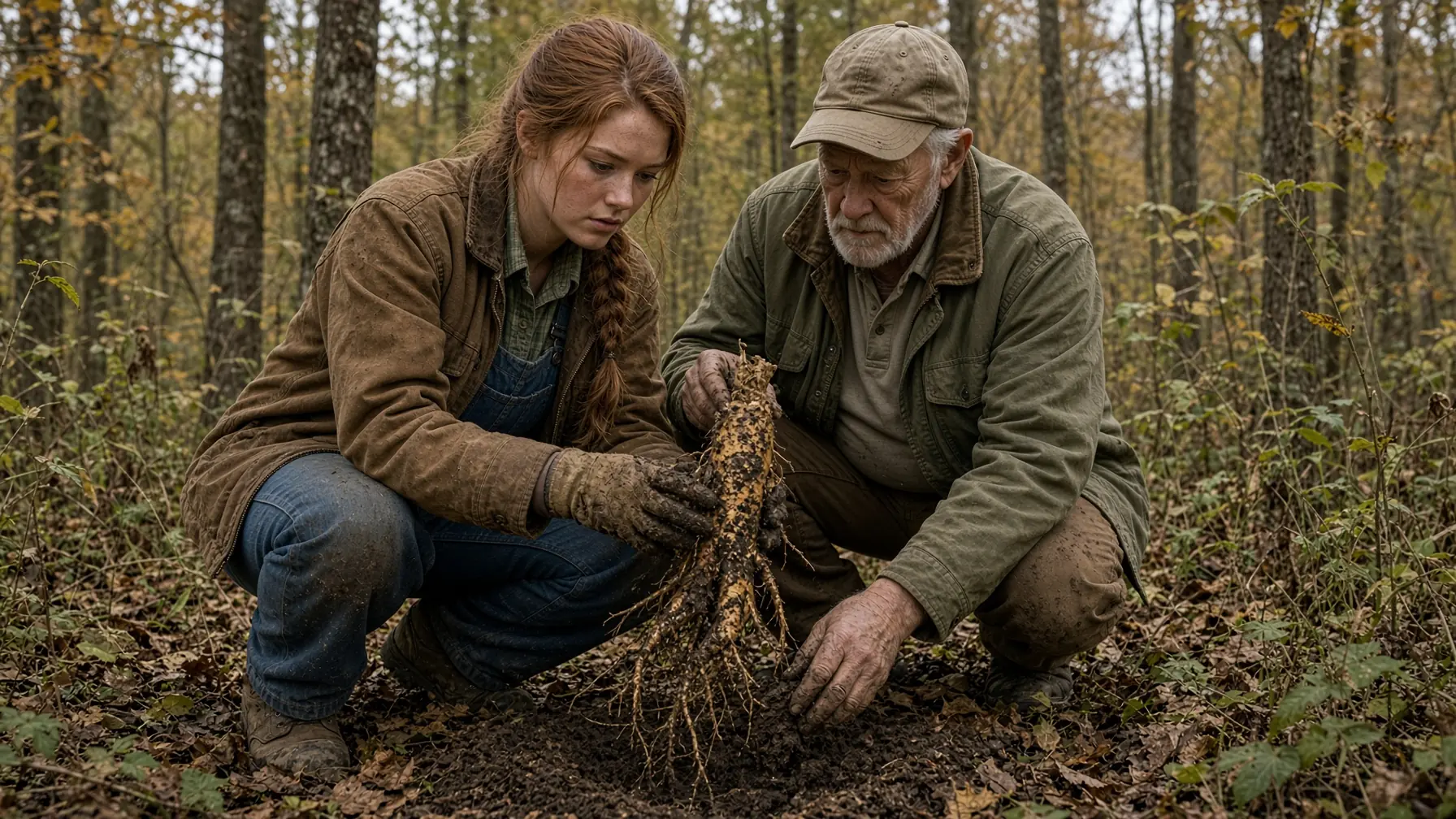
Maggie Carter stopped.
She was half-kneeling beneath a tangle of spicebush and young maple on the north-facing slope behind her grandfather’s farm, one knee sunk into damp leaves, the other braced against the hillside.
At nineteen, Maggie had spent enough time in the woods to know the difference between rock, root, and buried metal by feel.
This was softer than stone.
More solid than loose root.
She pushed a strand of auburn hair away from her cheek with the back of one glove and scraped gently at the soil.
The morning was cool.
Cloud cover muted the Kentucky hills into browns, greens, and gray.
Somewhere lower in the hollow, water moved over rock.
Behind her, Earl Carter was cutting dead blackberry canes away from an old fence line.
Maggie called:
“Grandpa?”
He did not hear.
She set the trowel aside.
Whatever she had touched deserved hands, not steel.
She loosened damp earth with her fingers.
A pale neck appeared.
Then a thick root body.
Maggie frowned.
It forked.
Twisted.
Then forked again.
She widened the hole carefully until the entire thing emerged.
The root was strangely human-looking.
Not actually shaped like a person.
But enough that she understood immediately why somebody might think so.
Two thick lower forks.
A narrow neck.
Fine feeder roots trailing from the sides.
Dark soil clung to every crease.
Maggie turned it in her palm.
“Grandpa, look what I just dug up.”
Earl straightened.
“What?”
“Over here.”
He stepped through the brush toward her.
At first he looked mildly interested.
Probably expecting an old bottle.
A horseshoe.
Maybe another piece of forgotten farm machinery swallowed by the hillside.
Then he saw the root.
He stopped.
Maggie noticed instantly.
The relaxed look left his face.
He stepped closer.
“Hold it still.”
Her smile faded.
“What is it?”
Earl crouched beside her.
He did not take the root.
Instead he rubbed a little soil from the neck with his thumb.
Then looked at the stem scar.
Then the fine rings below it.
His eyes moved toward the hole.
Then uphill.
Downhill.
Across the surrounding understory.
Maggie watched him.
“Grandpa?”
He stared at the root for a long moment.
Then said:
“If that root is what I think it is, cover the hole back up and don’t say a word to anyone.”
Maggie blinked.
“What?”
“Put the loose dirt back.”
“Why?”
“First do it.”
She knew that tone.
Earl did not use it often.
He was not a man who made ordinary things dramatic.
If anything, he usually reduced drama.
Broken fence?
Fix it.
Sick calf?
Call the vet.
Storm coming?
Fuel the generator.
So Maggie obeyed.
She pressed the soil back into the shallow hole.
Covered it with leaves.
Then looked at the root again.
“What is this?”
Earl glanced toward the trail behind them.
“Wild ginseng.”
Maggie looked down.
“This?”
“Yes.”
“I’ve seen ginseng pictures.”
“Most pictures are cultivated.”
He gently took the root now.
Turned it in his palm.
“Wild is different.”
“How old?”
Earl rubbed dirt carefully from the root neck.
“Older than you.”
“That’s not very impressive.”
He gave her a look.
“Probably older than your mother.”
Maggie’s expression changed.
“How can you tell?”
“Stem scars.”
He pointed to the tight stack of marks at the crown.
“Each growing season leaves one.”
Maggie counted roughly.
Lost track.
Counted again.
“There are more than thirty.”
“Yes.”
She stared at it.
“So what?”
Earl looked at her.
“So somebody would pay a lot of money for this.”
That got her attention.
“How much?”
“I don't know.”
“You just told me not to tell anybody, so you must know something.”
“I know enough.”
He handed the root back.
“Wrap it in your bandanna.”
Maggie hesitated.
“Shouldn’t we leave it here?”
Earl looked toward the hole again.
“Too late now.”
She carefully wrapped the root.
Then stood.