Everyone remembered the sticks.
Two hundred gray branches.
No leaves.
No buds.
No sign of life.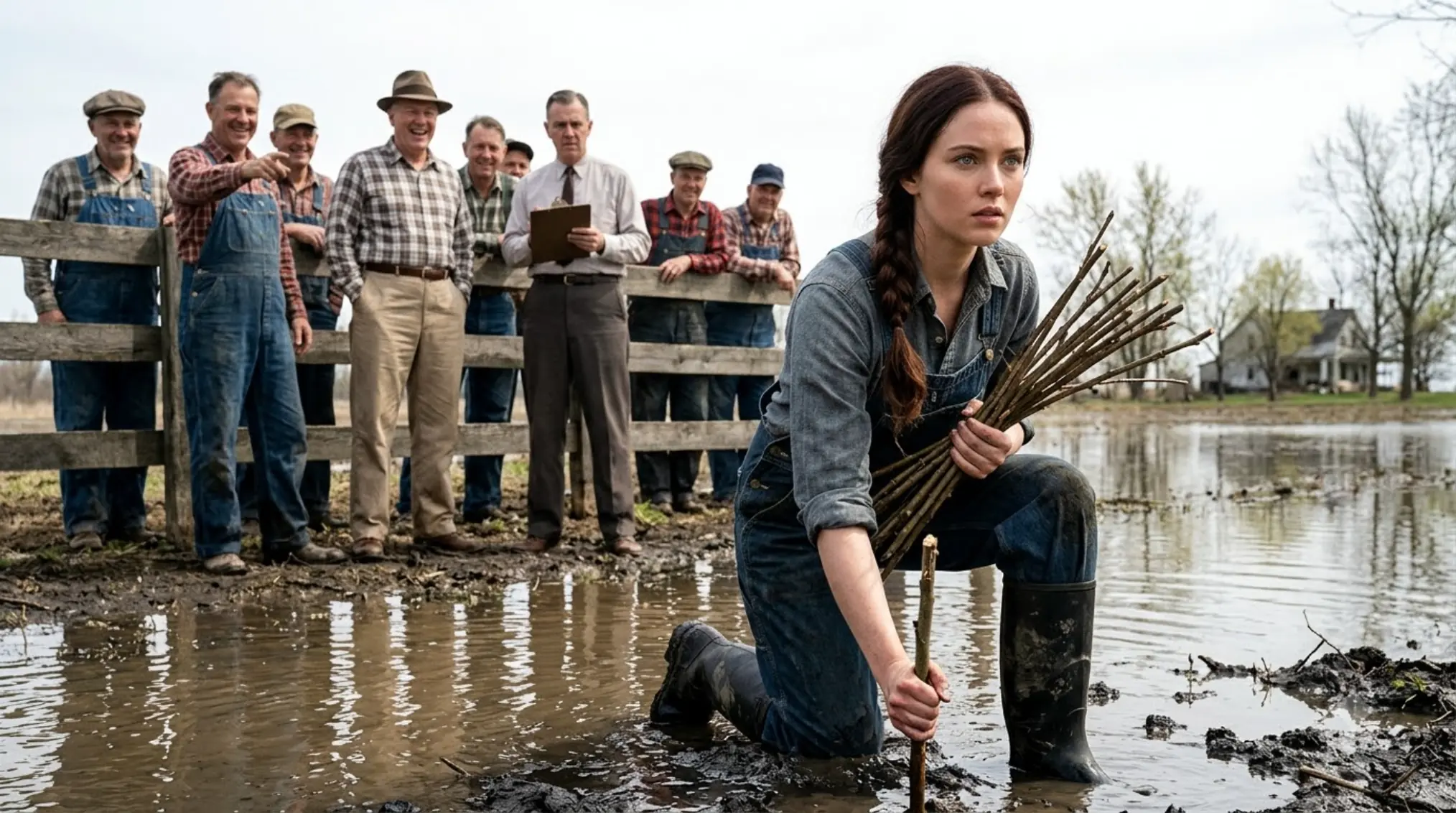
They stood in neat but imperfect rows across six inches of muddy floodwater behind Evelyn Jennings’s old farmhouse in Mercer County, Indiana, looking less like a crop than the remains of a drowned fence.
And in the middle of them stood nineteen-year-old Clara Jennings.
Her overalls were soaked to the knees.
Mud covered her rubber boots.
A loose braid of dark-auburn hair hung over one shoulder.
And she was pushing another dead-looking cutting into the black soil while five grown farmers stood behind the fence laughing at her.
Tom Blackwell laughed loudest.
He owned nearly six hundred acres north of the Wabash River and had spent years trying to buy the Jennings bottomland cheaply.
He pointed toward the flooded field.
“Keep going, Clara.”
“Maybe if you plant enough firewood, one of them will grow into a bank payment.”
The men beside him laughed.
Clara did not look up.
She drove the cutting twelve inches deep.
Pressed mud firmly around it.
Reached for another.
County Extension Agent Harold Vance stood apart from the farmers with a clipboard beneath one arm.
He was thin, serious, and almost offended by anything agriculture could do without permission from a university bulletin.
He had already examined several of the cuttings.
His conclusion had been immediate.
“White willow.”
“Possibly an older cultivar.”
“Desiccated.”
“Low viability.”
“Wrong soil.”
“Wrong water level.”
“Wrong planting conditions.”
“Everything about this is wrong.”
Clara had listened.
Then planted another stick.
Vance stepped closer to the fence.
“Miss Jennings, I’m trying to prevent you from wasting what little time you have.”
Clara finally looked toward him.
“Then stop talking.”
A farmer nearly choked laughing.
Vance’s face tightened.
“I’m giving professional advice.”
“I heard it.”
“And?”
Clara pushed another cutting into the mud.
“My grandmother gave me different advice.”
Tom Blackwell grinned.
“Your grandmother talked to roses.”
Clara straightened.
Water ran from her gloves.
“She also kept this farm through three floods, two droughts, and twenty years of bank payments.”
That quieted them slightly.
Only slightly.
Blackwell leaned against the fence.
“She’s dead, Clara.”
Clara’s expression changed.
He saw it.
For one second, even Tom knew he had stepped too far.
Then his smile returned.
“Dead people leave memories.”
“Not farming plans.”
Clara looked down at the bundle in her arms.
Her grandmother had left much more than memories.
Three months earlier, Evelyn Jennings had died inside the upstairs bedroom of the farmhouse where she had lived for forty-four years.
She left Clara forty acres of bottomland, a leaking roof, unpaid taxes, a mortgage nearing default, an old mule harness for a mule already dead, and almost no cash.
Clara’s father, Ben Jennings, wanted the property sold immediately.
He had escaped farming twenty years earlier and worked at the grain elevator in town.
Regular wages.
Clean ledgers.
Predictable hours.
To Ben, the Jennings farm represented everything uncertainty could destroy.
To Clara, it was the last place her grandmother’s voice still seemed close enough to hear.
The bank gave her sixty days.
Sell.
Pay.
Or lose the farm.
Clara intended to clean the house for auction.
Instead, she found the bundle.
It lay in the attic on top of an old cedar chest.
Two hundred willow cuttings wrapped in brittle twine.
Beside them rested one sheet of yellowed paper.
Evelyn’s handwriting.
Plant these in the mud when the creek rises. Trust the water.
On the reverse side:
Soak three days in rainwater. Plant twelve inches deep. Full sun. Wait.
That was all.
No explanation.
No name for the variety.
No promise of money.
Just instructions.
Clara almost burned them.
Instead she soaked them inside an old galvanized tub.
Three days later, Miller’s Creek overflowed and flooded the lowest field.
Clara carried the first armful into the water.
And now half the county thought she had lost her mind.
Her father thought worse.
Ben arrived near sunset on the first planting day.
His truck stopped beside the fence.
He climbed out wearing work clothes from the grain elevator.
Clara immediately knew from his face that someone had already told him.
He stared at the sticks.
Then his daughter.
“What have you done?”
“Planted them.”
“I can see that.”
Ben walked to the edge of the water.
“What are they?”
“Willow cuttings.”
“Why?”
“Grandma left instructions.”
Ben closed his eyes.
“Clara.”
“She knew this land.”
“She believed these would grow.”
“She believed a lot of things.”
Clara stared.
“That doesn’t mean she was wrong.”
“She planted by moon phases.”
“She put eggshells around tomatoes because she claimed they made the fruit sweeter.”
“She talked to plants.”
“She also harvested tomatoes when everyone else lost theirs.”
Ben rubbed his face.
“The bank man is coming next week.”
“I know.”
“He sees this…”
He gestured toward the field.
“He will think you cannot manage the estate.”
“Then he can think.”
“This is not a game.”
“I know.”
“You have sixty days.”
“I know.”
“You wanted teachers college.”
Clara looked at him.
“I still do.”
“Then sell this place.”
“Use the money.”
“Go.”
She said nothing.
Ben’s voice softened.
“Your grandmother wanted more for you than mud.”
Clara looked down at the cutting in her hand.
“Maybe.”
“Maybe she wanted me to understand the mud first.”
Ben stared.
Then something hardened inside him.
“You’re just like her.”
He turned toward his truck.
The words should have sounded affectionate.
They did not.
Clara watched him leave.
Then planted the final twelve cuttings before darkness.
For three weeks, nothing happened.
Rain continued.
Water rose higher.
By mid-April, only the top few inches of many cuttings remained visible.
They looked ridiculous.
Even Clara had to admit it.
She checked them every morning.
Touched the bark.
Looked for swelling.
Green.
Anything.
Nothing.
The bank representative arrived on a Tuesday.
Walter Henderson wore a black suit inappropriate for farm mud and carried a leather folder beneath one arm.
Tom Blackwell came with him.
That surprised Clara less than it should have.
Blackwell had wanted the land for years.
Henderson smiled.
“Miss Jennings.”
“Mr. Henderson.”
He looked toward the flooded field.
“I understand you’ve made agricultural improvements.”
Tom laughed.
Clara ignored him.
Henderson opened the folder.
“The mortgage balance, taxes, and accumulated interest are substantial relative to current land value.”
“How substantial?”
“More than your savings can cover.”
“I know.”
“The bank is willing to make this easier.”
Tom stepped closer.
“I’ll buy the forty.”
Clara looked at him.
“For how much?”
“Enough to satisfy Henderson.”
“And?”
“And give you a little cash.”
“How much?”
Tom named a figure.
It was low.
Very low.
Enough to close the mortgage.
Not enough to start over comfortably.
Clara glanced toward the bottomland.
“You’ve offered more before.”
Tom smiled.
“Before you planted a swamp full of dead sticks.”
Harold Vance arrived while they spoke.
He had come for what he called a “follow-up viability observation.”
He entered the field with rubber boots and magnifying glass.
Clara followed.
Henderson and Tom remained near the bank.
Vance crouched beside one cutting.
Scraped bark.
Shook his head.
“No visible cambium activity.”
He checked another.
“Water stress.”
A third.
“Early decay.”
Tom called from the fence:
“Told you.”
Clara moved toward a cutting near row three.
Something looked different.
A pale swelling near the mud line.
She crouched.
Touched it.
There.
A white thread finer than hair.
Her heart stopped.
“Mr. Vance.”
He barely looked up.
“Look.”
He moved closer.
Clara pointed.
“A root.”
Vance frowned.