The storm was less than two days away, and Wesley Granger could not afford to lose another hour.
At seventy-one, he had spent enough autumns watching the sky to know when a forecast was worth fearing.
The western horizon had already begun turning gray.
Not black yet.
Not threatening enough to send a younger farmer running.
But Wesley knew Iowa weather rarely announced exactly how hard it intended to hit.
His corn stood dry across most of his acreage.
Moisture was finally low enough to harvest.
The combine had been fueled before sunrise.
The grain cart was ready.
The elevator had room for him.
Everything depended on keeping the machine moving.
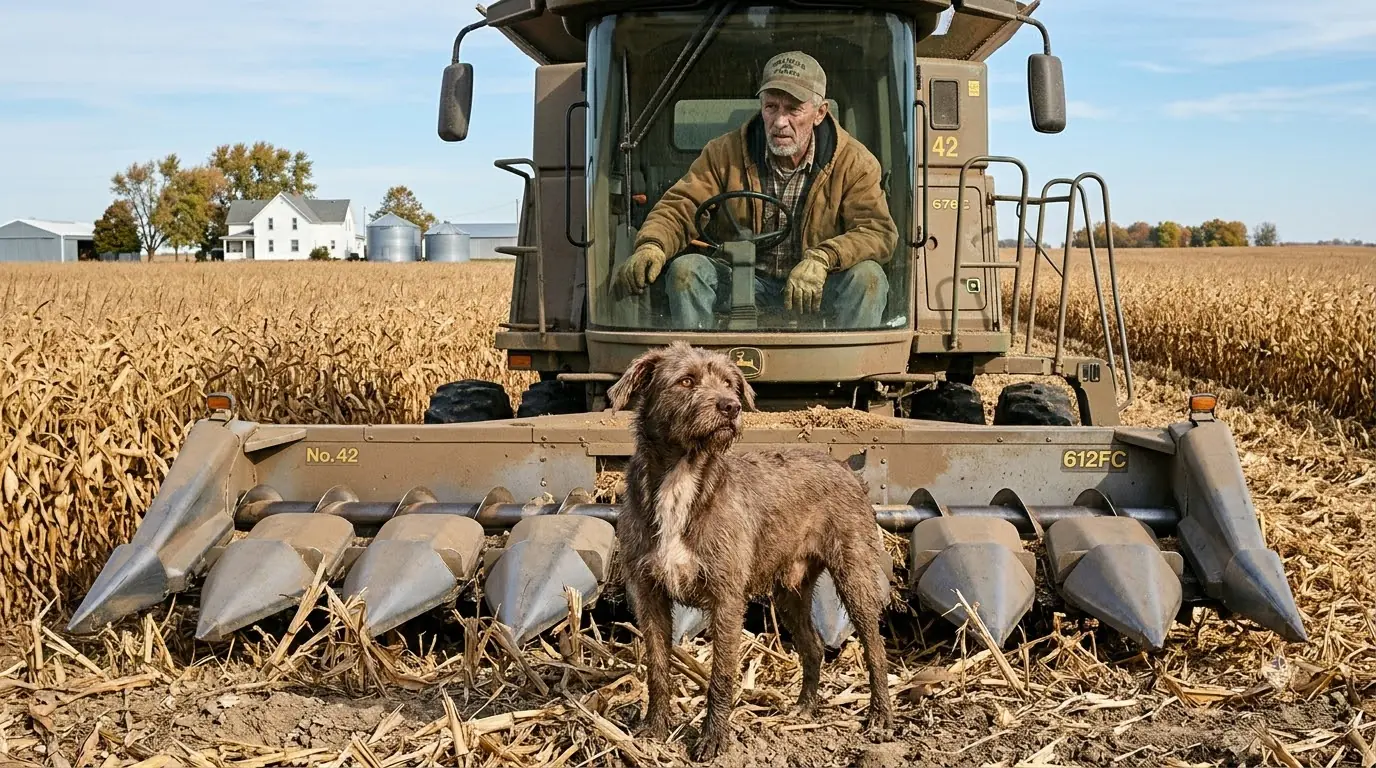
Then a dog stepped in front of the header.
Wesley leaned toward the windshield.
“You have got to be kidding me.”
The animal stood twenty feet ahead.
Medium-sized.
Brown-gray coat nearly hidden beneath dried mud.
Thin enough that Wesley could see the shape of its ribs.
One ear upright.
The other folded slightly at the tip.
Amber eyes fixed directly on him.
The combine idled.
The dog did not move.
Wesley honked once.
Nothing.
“Go on!”
The dog barked.
Wesley frowned.
He shut down the machine and climbed from the cab.
Cold wind pushed corn leaves across the field entrance.
The dog backed away as he approached.
“That’s right.”
Wesley waved one gloved hand.
“Keep going.”
The animal retreated toward the standing corn.
Wesley turned.
Climbed back into the combine.
Started the engine.
The dog ran back.
It stopped in almost the exact same place.
Wesley stared.
“No.”
He climbed down again.
This time he clapped both hands.
“Go!”
The dog trotted thirty yards away.
Stopped.
Watched.
Wesley returned to the cab.
The dog returned too.
By the third time, Wesley had lost whatever patience remained after forty-seven harvest seasons.
He opened the cab door.
“You trying to farm this field yourself?”
The dog barked.
Wesley looked toward the clouds.
Every delay felt expensive.
Fuel.
Mortgage.
Fertilizer.
Spring repairs.
A grain market that could change between breakfast and supper.
One windstorm at the wrong time could flatten standing corn enough to turn a routine harvest into weeks of slow, miserable work.
He could not spend the morning arguing with a stray.
So Wesley moved the combine to another entrance.
Nearly two hundred yards south.
That should settle it.
He eased the machine forward.
Corn rattled in the wind.
Then the dog burst from between the rows.
Crossed directly in front of the header.
And stopped.
Wesley’s hands tightened around the steering wheel.
He did not move.
Neither did the dog.
For several seconds, they simply stared at each other.
Then the animal turned suddenly.
It ran into the standing corn.
Fifty yards.
Maybe sixty.
Stopped.
Looked back.
Then lowered its head and began digging.
Hard.
Fast.
Wesley watched dirt fly.
The dog looked toward him again.
Then dug more.
Something inside Wesley’s irritation changed.
He killed the engine.
Climbed down.
And followed.
Wesley Granger had spent most of his adult life on that farm.
His father, Raymond, had purchased the original eighty acres shortly after the Second World War.
Wesley expanded it gradually.
Rented more.
Bought some.
Lost one parcel during the high-interest years of the 1980s.
Bought another later.
Nothing glamorous.
Just the mathematics of surviving long enough to become old on the same ground.
His wife Helen had understood that life.
For forty-three years they measured time by planting, harvest, calving, taxes and weather.
Then cancer took her.
The farmhouse became too large overnight.
Wesley left her chair at the kitchen table for nearly a year before finally pushing it against the wall.
He stopped setting two coffee cups long before he stopped reaching for the second one.
Work helped.
Machines required attention.
Cattle did not care if a man felt lonely.
Corn certainly did not.
So Wesley kept moving.
That morning, however, something beneath the corn was asking him to stop.
The dog waited until he was close.
Then returned to digging.
Wesley looked around.