Customers turned from the deposit tables, loan offices, and leather waiting chairs as the arrogant Branch Manager leaned over the counter. He was a handsome thirty-eight-year-old white American man with carefully slicked black hair, a polished athletic build, and a tailored navy suit completed by a bright red tie. He pointed at the few worn bills inside the Elderly Man’s wallet as though poverty were a joke prepared for his personal entertainment.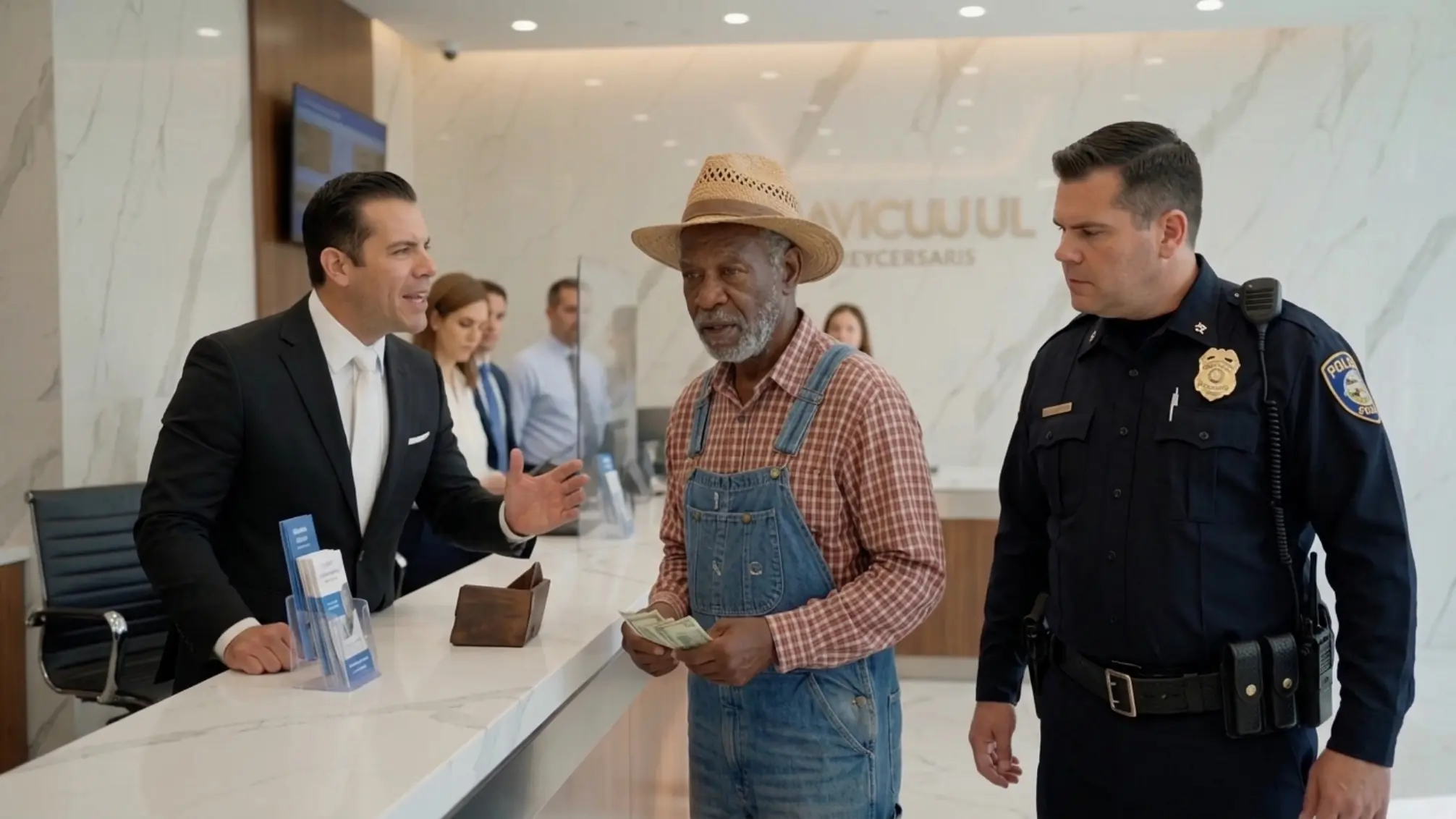
Behind the counter, a beautiful thirty-two-year-old white American Teller covered her mouth while laughing with him. She wore a fitted white blouse, navy skirt, and expensive heels, and she had spent the past year learning that humiliating customers earned the Branch Manager’s approval. Near the entrance, a broad-shouldered Security Guard watched uncertainly but did not intervene.
The seventy-two-year-old Black American Elderly Man lowered his gaze toward the five-dollar bills and coins in his weathered hands. His deep-brown skin carried the lines of age, his short gray beard was neatly trimmed, and his thin frame was covered by a faded plaid shirt over a gray T-shirt. A straw hat shaded his calm dark eyes, while worn trousers and dusty work boots completed the appearance of someone the manager believed could be dismissed safely.
An old brown wallet rested on the counter.
The Branch Manager picked it up without permission and opened it wider. “This thing belongs in a museum.”
The Elderly Man reached for it. “That belongs to me.”
“Then you should have taken better care of it.”
The Teller laughed again.
Several customers looked uncomfortable, but most remained silent. One elderly white American woman seated near the loan offices tightened both hands around her cane. A young Latino American father holding a stack of utility bills looked toward the floor, clearly recognizing treatment he had experienced before.
The Elderly Man had entered the branch twenty minutes earlier and requested help accessing a savings account. He carried no smartphone, displayed no expensive watch, and arrived alone rather than inside a chauffeured vehicle. The Teller had looked at his clothes and immediately directed him toward a prepaid debit-card brochure instead of asking what service he needed.
When he repeated that he already had an account, she demanded two forms of identification.
The bank’s policy required one.
The Elderly Man presented a valid driver’s license. The Teller studied it for nearly a minute, then suggested it might be expired despite the date clearly showing otherwise. She called the Branch Manager only after the Elderly Man calmly asked for her name and employee number.
The Branch Manager approached already irritated.
“You people come in here every week with stories about lost accounts,” he said. “Then when we check, there’s nothing but unpaid fees.”
The Elderly Man asked what he meant by “you people.”
The Manager smiled. “Customers who don’t understand banking.”
The Elderly Man did not argue. He asked the Manager to locate the account using the identification and account card he had provided.
Instead, the Manager began performing for the lobby.
He mocked the worn wallet, the straw hat, and the Elderly Man’s request to withdraw ten dollars. He told the Teller that processing the transaction would cost the bank more than the customer was worth. Then he offered to pay double if the account contained even ten dollars.
The challenge was meant to force the Elderly Man out through humiliation.
It achieved the opposite.
“Enter the account number,” the Elderly Man said.
The Branch Manager pushed the card toward the Teller. “Go ahead. Let’s finish the show.”
The Teller entered the number.
Her smile disappeared.
The computer did not display an ordinary account screen. Instead, a black security window appeared with a gold border and a warning requiring executive authorization. She clicked again, believing she had made a mistake.
The system locked her keyboard.
“What did you do?” the Branch Manager demanded.
“Nothing. The account triggered a restricted-access notice.”
The Elderly Man rested both hands on the counter. “Read the message.”
The Teller looked at the screen. “Executive identity verification required.”
The Branch Manager grabbed the mouse and attempted to close the window. A second warning appeared, stating that unauthorized access had been recorded and transmitted to corporate compliance.
His expression hardened. “This is some kind of fraudulent account.”
The Elderly Man removed a black card from behind an old photograph inside his wallet.
It carried no credit-card number. A silver crest appeared in one corner, and beneath it were the words Chief Executive Officer — National Executive Access.
The Branch Manager stared at it.
Then he laughed again, although the sound was weaker.
“You printed that yourself.”
The Elderly Man turned the card over. “Scan it.”
The Teller hesitated.
“Do it,” the Manager ordered.
She passed it beneath the secure reader.
Every screen behind the counter changed at once. The bank’s blue logo disappeared, replaced by the Elderly Man’s official executive profile, security clearance, and live confirmation from corporate headquarters.
The Teller stepped backward.
The Branch Manager stopped smiling.
The man he had mocked was not merely a wealthy customer. He was the founder, majority voting shareholder, and Chief Executive Officer of the banking group that owned the building, the regional offices, and more than six hundred branches across the United States.
The Elderly Man had built the first branch forty-one years earlier.
The original location had been one rented room above a grocery store in Detroit. He had begun with three employees and a simple promise: no honest customer would be humiliated for having little money.
That promise had been personal.
His mother had cleaned hospital rooms at night and deposited five dollars each week into a savings account. When she once asked a bank employee to explain a fee, the employee mocked her accent and told her that people with small balances wasted everyone’s time. She never entered another bank alone.
The Elderly Man remembered standing beside her as a twelve-year-old boy, watching shame replace confidence in her face.
Decades later, after military service, college, and years managing community loans, he created a bank designed to treat small depositors with the same dignity as wealthy investors. The institution grew because working families trusted it.
Now one of its most profitable branches had forgotten why it existed.
The Elderly Man had not entered by accident.
For six months, corporate headquarters had received complaints from this branch. Retired customers reported being pressured into high-fee accounts. Immigrant families claimed employees refused to explain documents. Customers wearing work clothes waited longer than those arriving in business suits.
The numbers looked clean because many complaints were closed without investigation.
The Branch Manager personally approved those closures.
The Elderly Man could have sent auditors, attorneys, or regional executives. Instead, he chose to visit without an entourage and see what happened when employees believed he possessed no power.
The answer stood before him in a navy suit and red tie.
“This card proves nothing about why you came here dressed like that,” the Branch Manager said, struggling to recover. “You deliberately misled my staff.”
“I wore clothes.”
“You disguised yourself.”
“I never claimed to be anyone else.”
“You let us believe you were poor.”
The Elderly Man’s calm expression did not change. “Would being poor have made your behavior acceptable?”
The Manager looked toward the watching customers.
“No one knows the context.”
A voice came from the waiting area.
“I do.”
The elderly woman with the cane slowly stood. She was a seventy-six-year-old retired American schoolteacher who had banked there for nineteen years. Two weeks earlier, the Branch Manager had pressured her into converting her savings account into an investment product carrying penalties she did not understand.
When she asked to call her son, he said the opportunity would disappear if she left.
She had signed because she was embarrassed to admit confusion.
The Elderly Man invited her forward.
The Manager moved between them. “This is not the time for unrelated complaints.”
“It became the time when you made customer dignity a public performance,” the CEO replied.
The retired teacher produced a folder from her handbag. Inside were the investment papers, fee disclosures, and a handwritten note from the Manager promising returns that the contract did not guarantee.
The CEO read every page.
The Branch Manager’s signature appeared beneath the recommendation.
“How much commission did this generate?” the CEO asked.
The Manager folded his arms. “That information is confidential.”
“Not from me.”
The Teller quietly opened the transaction record. “Four thousand eight hundred dollars.”
The retired teacher’s eyes widened.
“That came from my money?”
The Manager spoke quickly. “It was a legitimate advisory fee.”
“She came here to renew a certificate of deposit,” the CEO said. “You sold her a product she did not understand because it paid you more.”
“She signed voluntarily.”
The retired teacher looked at him. “You told me my savings would be unsafe if I waited.”
The Manager’s confident expression finally cracked.
The young father near the utility desk stepped forward next. He explained that the branch had charged him three overdraft fees on the same ten-dollar transaction. When he asked for one fee to be removed, the Teller laughed and suggested he stop buying things he could not afford.
The purchase had been medicine for his daughter.
Another customer described being denied access to a restroom because employees assumed she was homeless. A construction worker said the Branch Manager refused to meet him about a business loan until he returned wearing “something respectable.”
Each story had been isolated in the complaint system.
Together, they formed a culture.
The CEO looked toward the Security Guard. “Close the doors.”
The Branch Manager immediately shouted, “You heard him. Remove these people.”
The Guard did not move.
The CEO clarified, “No customers leave until compliance arrives and everyone who wishes to give a statement receives the opportunity. No employee may access, alter, or delete a record.”
The Guard locked the entrance and stood beside the internal office hallway.
The Branch Manager reached for his phone.
The CEO held out his hand. “Place it on the counter.”
“You cannot confiscate my personal property.”
“I am preserving evidence after watching you attempt unauthorized access to a protected account.”
The Manager looked toward the exit, but the Guard stepped into his path.
Minutes later, three black vehicles stopped outside. The bank’s beautiful forty-six-year-old Black American Chief Compliance Officer entered with two forensic auditors and corporate security. She wore a charcoal suit, low heels, and a calm expression that made the Branch Manager’s panic more visible.
She greeted the CEO, then connected her tablet to the branch system.
The audit had already begun remotely.
Corporate software showed that the Branch Manager had closed eighty-three complaints during the previous year. Seventy-one involved customers over sixty-five, people with limited English proficiency, or accounts containing less than one thousand dollars.
He had marked nearly all of them “unsubstantiated.”
The Compliance Officer restored archived emails he believed had been deleted.
In one message, the Manager instructed employees to identify “low-value customers” before offering service. Another created weekly targets for moving elderly depositors into commission-based products. A third praised the Teller for “clearing the lobby quickly” after she threatened to call police on a man asking about a frozen disability payment.
The Teller began crying.
“I only followed his instructions.”
The CEO looked at her. “Did he instruct you to laugh?”
She lowered her head.
The Manager pointed toward her. “She handled the customer. I arrived after the dispute began.”
The Teller looked up sharply.
“You were standing here the entire time.”
“You misunderstood what I said.”
“You told me to make him prove he had ten dollars.”
The partnership between them collapsed as soon as consequences arrived. Each attempted to push responsibility toward the other.
The CEO had seen that pattern in failed organizations before. Cruelty often appeared confident only while everyone believed accountability would never enter the room.
The Compliance Officer requested access to the Manager’s office safe.
He refused to provide the code.
Corporate security opened it under executive authorization.
Inside they found cash-filled envelopes, luxury event tickets, and client lists marked with handwritten commission estimates. More troubling was a second ledger containing names of customers whose accounts carried dormant balances.
The Manager had targeted accounts belonging to elderly people who rarely visited branches. By charging unnecessary service fees and placing funds into unsuitable products, he generated revenue while assuming the customers would not understand enough to object.
One name in the ledger belonged to the CEO.
The Branch Manager had found an inactive test account opened decades earlier with a balance of nine dollars and eighty-four cents. He planned to close it at the end of the month and charge the remaining amount as an account-maintenance fee.
That was the account the CEO had asked to access.
The irony was exact.
The balance did not contain ten dollars.
The Manager laughed once, nervously. “Then I was right. It has less than ten.”
The CEO reached into his wallet and removed sixteen cents.
He placed the coins on the counter.
“Deposit this.”
The Teller stared at him.
The Compliance Officer completed the transaction herself.
The account balance changed from nine dollars and eighty-four cents to exactly ten dollars.
The CEO looked toward the Branch Manager. “You offered to pay double.”
No one laughed.
He continued, “But I do not want your twenty dollars. I want an explanation for why you believed a customer with nine dollars deserved less dignity than one with nine million.”
The Manager had none.
Corporate security escorted him into the private conference room while investigators preserved records. The Teller and three other employees were suspended pending individual review. Those who had refused to participate in the mistreatment were separated from those who had benefited from it.
The CEO insisted on fairness.
He did not fire every employee immediately or treat fear as equal to fraud. Each person would be interviewed, records would be reviewed, and customers would receive restitution based on evidence.
The Branch Manager demanded the same consideration he had denied everyone else.
“You cannot ruin my career over one bad interaction.”
The CEO looked at the ledger, the emails, and the retired teacher’s contract.
“This was not one interaction. It was the first one you performed in front of someone you later discovered could stop you.”
The Manager’s voice rose. “I brought millions in deposits to this branch.”
“You drove away the customers my mother built this bank for.”
“Small accounts do not keep branches profitable.”
“Trust does.”
The CEO removed the Manager’s access badge.
“Effective immediately, you are suspended from all duties. The board will determine termination after compliance completes its investigation. Any effort to contact witnesses or alter evidence will be referred to federal authorities.”
The Manager stared at the customers whose complaints he had ignored.
For the first time, he could not control the room.
The investigation lasted five weeks.
It uncovered more than three million dollars in improper fees, unsuitable investments, and manipulated account conversions. The Manager had earned large bonuses by exploiting customers least likely to challenge him.
His employment was terminated.
Regulators permanently barred him from managing investment products, and criminal investigators reviewed several transactions involving forged consent records. The Teller cooperated with the inquiry but lost her position after video evidence showed repeated participation in customer humiliation.
Several lower-level employees kept their jobs after proving they had raised concerns internally. Two had saved emails and complaint records because they suspected the Branch Manager was deleting evidence.
The CEO promoted neither of them immediately.
Instead, he placed them into a training program and required them to help rebuild the branch’s customer-service system. Courage shown quietly would be recognized, but promotions still had to be earned through consistent work.
The retired teacher’s investment contract was canceled without penalty. Every fee was returned, and the bank paid for an independent adviser to review her finances.
The young father received reimbursement for the overdraft charges. The CEO also discovered that the family qualified for an emergency medical assistance account the branch had never mentioned because it generated no commission.
The CEO personally called each affected customer.
He did not delegate the apologies.
Some accepted his words. Others closed their accounts anyway, explaining that trust could not be restored with one telephone call. The CEO respected those decisions and instructed employees to complete every transfer without pressure.
The branch closed for one week.
When it reopened, the marble floors, counters, and expensive furniture remained unchanged. The culture did not.
The CEO replaced sales targets based solely on deposits and commissions. Employee performance would now include complaint resolution, customer retention across income levels, and independent reviews of whether clients understood the products they purchased.
Every branch received a visible customer-rights statement.
The first line read:
Your balance never determines your dignity.
The CEO also created a program inspired by the ten-dollar account.
Any customer could open a fee-free emergency savings account with a minimum deposit of ten dollars. The bank would match the first ten dollars for qualifying families, then provide free financial education without sales pressure.
The board questioned the expense.
The CEO brought the old brown wallet into the meeting and placed it on the table.
Inside was a photograph of his mother holding the first passbook she ever owned. Its opening balance had been ten dollars.
“This institution exists because one woman with little money deserved to be treated as though her future mattered,” he told the directors. “The day we forget that is the day our size becomes evidence of failure.”
The program passed unanimously.
One year later, more than four hundred thousand customers had opened the emergency accounts. The average balance remained modest, but missed-payment rates declined among participants who used the financial-education services.
The program was profitable in a way the former Manager never understood.
Customers who received dignity remained loyal. Small accounts grew. Parents opened accounts for children, workers returned for responsible loans, and local businesses trusted employees who explained risks instead of hiding them.
The branch where the confrontation occurred became one of the strongest in the region.
The CEO returned on the anniversary without announcing his visit.
This time he wore a clean gray suit, but he carried the same wallet and straw hat. Near the entrance, a young Black American Teller knelt beside an elderly customer and patiently explained how to read a bank statement.
No one rushed them.
At another desk, an employee helped a construction worker complete a small-business application without commenting on his dusty clothes. A Spanish-speaking adviser translated fee disclosures for a family instead of pushing documents across the table.
The CEO waited in line like everyone else.
When he reached the counter, the Teller smiled.
“How may I help you today, sir?”
He placed the old account card before her. “I would like to check my balance.”
She verified his identification once, following policy without adding unnecessary obstacles. Then she read the screen.
“Your account contains twenty dollars.”
The CEO raised an eyebrow. “Twenty?”
The Teller turned the monitor slightly.
After he deposited sixteen cents, the Compliance Officer had added ten dollars under the new matching program. The account carried no maintenance fees and had earned a small amount of interest.
The CEO smiled.
“Would you like to withdraw anything?” she asked.
“No. Leave it there.”
“May I ask why?”
He looked around the lobby.
“Because ten dollars once revealed what was broken in this bank. Twenty reminds me what we rebuilt.”
The retired teacher entered moments later without her cane. She recognized him and approached with a warm smile. Her savings were now held in products she understood, and she had begun volunteering at free financial workshops for older residents.
“You look different in a suit,” she said.
“So do you without that worried expression.”
She laughed.
Near the entrance, a framed copy of the customer-rights statement hung where everyone could see it. Beneath it sat a small display containing an old passbook, a photograph of the CEO’s mother, and a simple explanation of the bank’s founding promise.
The CEO had not included the Branch Manager’s name.
The lesson did not require turning one cruel man into a permanent attraction. It required changing the system that allowed his cruelty to become profitable.
As the CEO prepared to leave, the young Teller called after him.
“Sir, you forgot your hat.”
He returned to the counter and placed it on his head.
“Thank you.”
She smiled. “Every customer matters here.”
The CEO looked toward the ten-dollar statement on the wall.
“That is what I came to check.”
He walked through the doors without security, applause, or employees gathering around him. Most customers never learned that the elderly man in the straw hat controlled the entire banking group.
That was exactly how he wanted it.
The former Branch Manager believed power wore an expensive suit, arrived with assistants, and carried balances large enough to command respect. He believed the elderly Black man counting worn bills possessed none of those things.
His mistake was not simply failing to recognize the bank’s CEO.
It was believing anyone needed to be the CEO before they deserved kindness.