“Move that wreck—I need the owner.”
The beautiful CEO stood beneath the wing of her private jet, one hand resting on the slim leather portfolio tucked against her red dress. Her long blonde hair moved gently in the morning wind as she looked past the grease-covered man kneeling beside an aging Bell 47 helicopter. To her, he appeared to be nothing more than an exhausted mechanic blocking the airfield expansion she had flown across Virginia to negotiate.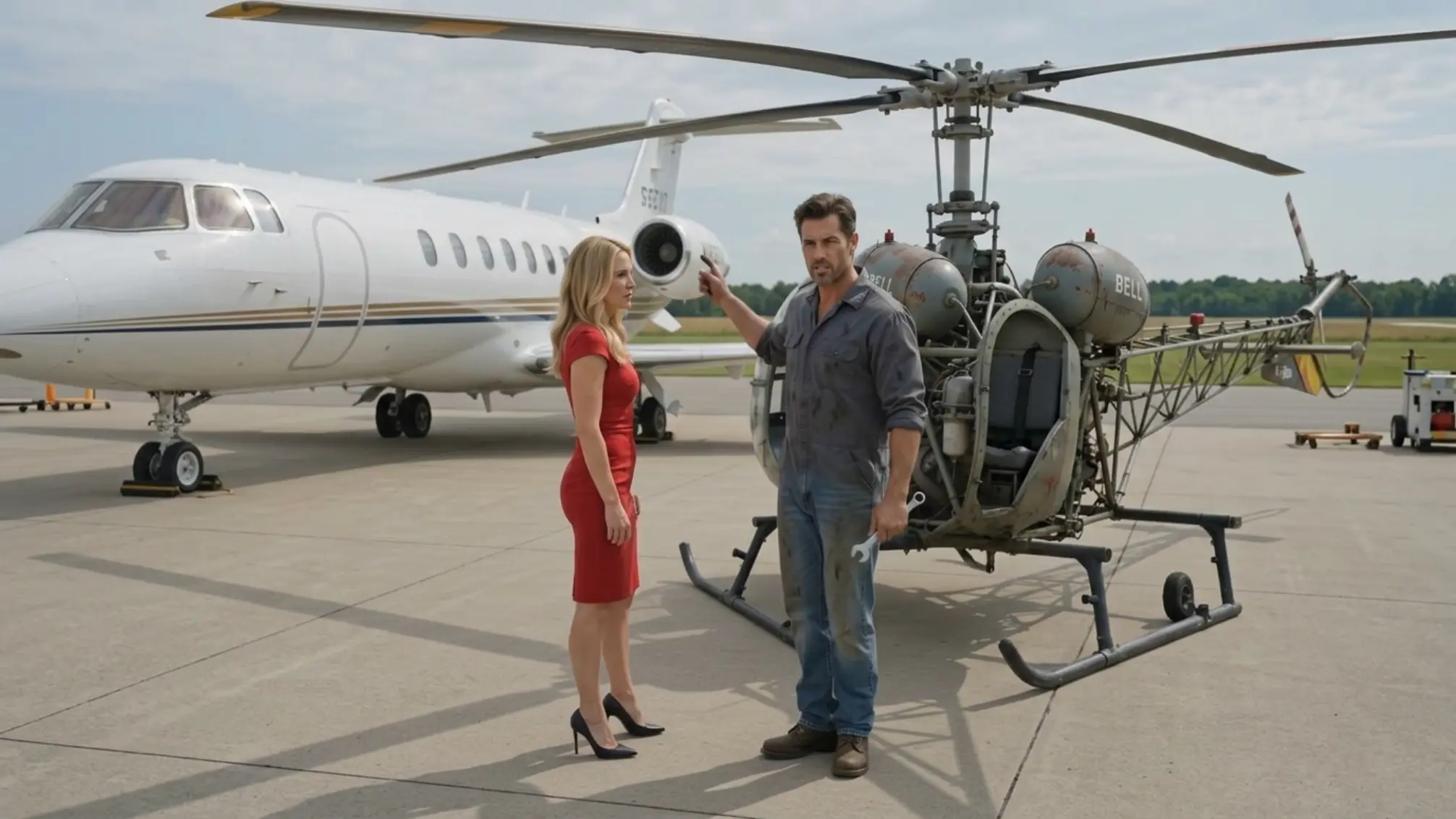
The man slowly set his steel wrench on the concrete.
“You found him.”
For the first time, the CEO looked directly at his face. He was thirty-nine, broad-shouldered and ruggedly handsome, with lightly tanned skin, thick dark-brown hair, gray eyes, and short stubble that suggested he had started working long before sunrise. His charcoal work shirt was marked with grease, his faded jeans were worn at the knees, and his brown boots looked older than some of the equipment parked inside the nearby hangar.
Her expression tightened, but embarrassment never fully reached her voice.
“You own this place?”
“My family has owned it for forty-five years.”
She glanced toward the weathered hangars, the narrow runway, and the old helicopter whose engine remained exposed beside him. The rural airfield did not resemble the polished cargo hubs normally associated with Reynolds Meridian Logistics. Yet her company needed this location more than she intended to admit.
“Then we can stop wasting time,” she said. “Sell—or I shut this runway down.”
The man reached into the open toolbox and removed a folded property deed protected inside a clear plastic sleeve.
“Try it,” he answered. “Your jet is sitting on my land.”
The confidence in his voice changed the air between them.
The CEO’s name was Sophia Reynolds. At thirty-six, she had built Reynolds Meridian from a failing regional delivery service into one of the fastest-growing logistics companies in the United States. Business magazines called her fearless, strategic, and impossible to intimidate.
Her employees used different words when she was not listening.
Demanding.
Relentless.
Cold.
Sophia did not object to any of them. She believed success belonged to the person willing to make decisions before everyone else finished discussing them. Her company had grown because she entered negotiations knowing exactly what she wanted and refused to leave without securing it.
Bennett Airfield was supposed to be another acquisition.
Her expansion team had identified the property as the only privately operated runway in the county capable of supporting the company’s planned regional cargo route. Its location connected three distribution centers, two highways, and a growing medical-manufacturing corridor. Purchasing it would save Reynolds Meridian millions in fuel, travel time, and leasing costs over the next decade.
The paperwork described the owner as Ryan Bennett.
The photographs showed hangars, runway measurements, fuel tanks, and development boundaries. Nothing in the corporate briefing had shown the grease-covered single father working beside the old helicopter.
Sophia looked again at the deed in Ryan’s hand.
“I did not come here to threaten you.”
“You said you would shut down my runway.”
“I said I could.”
“That sounds like a threat where I come from.”
Her jaw tightened. “I expected a serious commercial meeting.”
Ryan glanced at his stained clothing. “And I expected someone who knew the name of the man she planned to negotiate with.”
Behind Sophia, the jet’s cabin door remained open. Her assistant and two company attorneys stood near the stairs, pretending not to hear the exchange. They had never seen anyone challenge her so directly within the first five minutes of a meeting.
Sophia stepped closer.
“Mr. Bennett, Reynolds Meridian is prepared to offer you more than this property will produce in twenty years.”
“It is not for sale.”
“You have not heard the number.”
“I have heard numbers before.”
“Not mine.”
Ryan returned the deed to his toolbox. “A different number does not change the answer.”
He turned back toward the exposed engine.
The dismissal stunned her more than an argument would have. Most owners became eager the moment she mentioned an offer. Ryan behaved as if the conversation had ended before she had even opened her portfolio.
Sophia followed him.
“You cannot maintain this operation forever with one mechanic and two deteriorating hangars.”
“I am the mechanic.”
“That proves my point.”
“I am also a licensed commercial pilot, an aerospace engineer, and the airfield operator.”
Ryan reached into the helicopter and tightened a fuel-line fitting with controlled precision. He did not look up as he spoke.
“The hangars passed structural inspection in March. The runway was resurfaced eighteen months ago. The fuel system exceeds the current state environmental requirements, and every aircraft on this property has complete maintenance documentation.”
Sophia opened the portfolio.
“Our assessment says the eastern hangar needs reinforcement.”
“Your assessment used satellite measurements from three years ago.”
She paused.
Ryan finally looked at her.
“The eastern hangar was reinforced last winter.”
One of the company attorneys lowered his folder.
Sophia had not been prepared to be the least-informed person in the conversation. That almost never happened, and she disliked the unfamiliar sensation.
“Show me,” she said.
Ryan wiped his hands on an old cloth. “You want the hangar or the records?”
“Both.”
He nodded toward the squat office building near the apron. “Then change your shoes.”
Sophia looked down at her black heels.
“They are fine.”
“The southern drainage path is soft from last night’s rain.”
“I can walk.”
“You can also sink three inches into clay and spend the rest of the inspection angry at the ground.”
Ryan walked away before she could respond.
Twenty minutes later, Sophia emerged from her aircraft wearing borrowed work boots provided by the flight crew. The boots were slightly too large, and the red dress looked almost absurd against them. Ryan noticed but said nothing.
He led her through the eastern hangar first.
The building looked old from the outside, but the interior structure had been meticulously maintained. Steel reinforcement beams ran beneath the original framework. Every repair carried an inspection date, certification mark, and contractor record.
The concrete floor was clean enough to reveal even the smallest oil leak.
Tools hung in exact order along one wall.
Aircraft parts were labeled, wrapped, and organized by project.
“This does not look like a struggling operation,” Sophia admitted.
“It is not struggling.”
“Your financial disclosures suggest narrow margins.”
Ryan stopped beside a repaired Cessna wing. “You reviewed my finances?”
“I review everything.”
“Then you know the difference between narrow margins and failing.”
She did.
The airfield was profitable, but only barely. Ryan had rejected several lucrative contracts because they required traffic volumes he could not safely manage while raising his son alone. He had chosen stability over aggressive growth, even when the decision cost him money.
Sophia found that difficult to understand.
“You could hire more staff.”
“I could.”
“Then why have you not?”
“Because hiring quickly is easy. Trusting the wrong person around aircraft is expensive.”
They entered the office.
The room was simple: faded green walls, metal filing cabinets, two mismatched chairs, and a heavy wooden desk scarred by decades of use. The southern wall displayed pilot certificates, engineering credentials, commendations, inspection approvals, and old photographs.
Sophia stopped in front of a framed university degree.
Ryan Bennett had graduated near the top of his aerospace-engineering class.
Another photograph showed him standing beside an experimental aircraft at a national design conference. A third showed a younger Ryan receiving an aviation-safety award.
“You left engineering for this?” she asked.
Ryan opened the filing cabinet. “I came home for my son.”
“Those are not the same thing.”
“They became the same thing.”
He placed a thick maintenance binder on the desk.
Sophia opened it.
Every inspection, repair, certification, fuel delivery, equipment replacement, and aircraft movement had been documented in precise detail. The records stretched back fourteen years without a missing date or unexplained gap.
“You maintain all of this yourself?”
“I maintain the airfield. Clients maintain their own flight records.”
“You wrote these operating procedures?”
“Yes.”
“The emergency-response plan?”
“Yes.”
“The property lease template?”
“Yes.”
Sophia flipped another page.
The language was more sophisticated than agreements produced by many corporate legal teams. Liability exposure, aircraft movement, environmental compliance, and emergency access had all been addressed with unusual clarity.
She looked at Ryan differently.
He noticed.
“You thought I only turned wrenches.”
“I made an assumption.”
“You made several.”
“I admitted one.”
“That is progress.”
A quiet laugh escaped one of the attorneys before he quickly looked away.
Sophia closed the binder. “I owe you an apology.”
Ryan leaned against the filing cabinet.
She took a controlled breath.
“When I arrived, I judged your position from your clothing and the work you were doing. It was careless and disrespectful.”
Ryan studied her face.
“Apology accepted.”
“That was easier than expected.”
“You said it directly.”
“I generally do.”
“Not this morning.”
She almost smiled.
The office door opened before either of them could continue.
A ten-year-old boy stepped inside carrying a school backpack and a small model helicopter. He had dark eyes, wind-tousled brown hair, and the serious expression of a child accustomed to listening before speaking.
“Dad, the bus driver said the county road might close later.”
Ryan checked the clock. “You are home early.”
“Teacher conference.”
“You were supposed to tell me.”
“I put it on the calendar.”
Ryan looked toward the wall.
A handwritten note was pinned beneath the operations schedule.
The boy followed his gaze. “Tuesday.”
“It is Tuesday.”
“I know.”
Ryan rubbed a hand across his forehead.
Sophia watched the exchange with growing curiosity. The confident airfield owner suddenly looked less certain when confronted by his son’s calendar reminder.
“This is Lucas,” Ryan said. “Lucas, this is Sophia Reynolds.”
“The CEO?”
Sophia raised an eyebrow. “You know who I am?”
“My dad read your company reports last week.”
Ryan looked at him. “We do not share people’s research files.”
“I only saw the cover.”
Lucas turned toward Sophia.
“Are you buying the airfield?”
“No,” Ryan answered before she could speak.
Lucas nodded with visible relief.
“Good. Grandpa built it.”
Sophia looked toward an old photograph on the wall. An older American man stood beside the Bell 47 helicopter, one hand resting proudly against its frame.
“Your grandfather flew that helicopter?”
“For twenty-two years,” Lucas said. “Dad is fixing it.”
Ryan corrected him. “Restoring it.”
“It means fixing it properly.”
“That is close enough.”
Lucas placed the model helicopter on the desk. Its tiny skids were unfinished, but the red-and-white body closely matched the aircraft outside.
Sophia picked it up carefully.
“You built this?”
“Most of it. Dad helped with the rotor.”
“It is impressive.”
Lucas accepted the compliment without false modesty.
“I know.”
Ryan exhaled slowly. “Homework.”
Lucas collected his model.
Before leaving, he looked at Sophia’s oversized work boots.
“They look uncomfortable.”
“They are.”
“You should wear regular shoes next time.”
Ryan turned away to hide a smile.
Sophia watched the boy disappear into the adjoining apartment.
“You live here?”
“The apartment was added behind the office when my father got older.”
“And Lucas grew up on the airfield?”
“It is home.”
That single word explained more than the financial documents had.
To Sophia, the property had been coordinates, operating capacity, and projected revenue. To Ryan, it was the runway his father had poured, the hangar where he learned to repair engines, and the only home his son had ever known.
The acquisition she planned would erase all of it.
Sophia placed the model helicopter back on the desk.
“What would you consider?”
“I already told you.”
“Not a sale. A lease.”
Ryan remained silent.
“My company needs operating access,” she continued. “You need stable cargo income without surrendering control of the land.”
“You threatened to bury this place twenty minutes ago.”
“I negotiate aggressively.”
“You insult aggressively.”
“And I apologized.”
Ryan crossed his arms.
Sophia opened the portfolio again and removed the proposed purchase agreement. She tore the first page in half, then placed the pieces on the desk.
The attorneys stared at her.
“Ten-year lease,” she said. “Your airfield remains privately owned. Reynolds Meridian finances necessary cargo infrastructure, pays operational fees, and accepts liability within its designated area.”
“Fifteen years.”
Her eyes narrowed. “You rejected a purchase and responded by extending my commitment.”
“If you want access to this runway, you invest in stability.”
“Twelve.”
“Fifteen, with a review after five.”
“Termination protection?”
“Mutual, but no provision allows you to force a sale.”
“Cargo exclusivity?”
“Only within your operating category.”
“Expansion rights?”
“Subject to written approval.”
Sophia looked at one of her attorneys.
He gave the smallest possible nod.
She turned back to Ryan.
“You negotiate better with grease on your hands than most executives do in boardrooms.”
“I read before meetings.”
The words struck exactly where he intended.
Sophia accepted the correction.
“Draft it,” she said.
“I already did.”
Ryan opened the desk drawer and removed a forty-one-page agreement.
For several seconds, Sophia simply stared at him.
“You prepared a lease before I arrived?”
“I knew what your company needed. I also knew I would not sell.”
“And you let me threaten you anyway?”
“I wanted to hear how you behaved when you thought you had all the power.”
Her face hardened.
“What did you learn?”
“That you are intelligent, impatient, and too accustomed to people giving you what you want.”
“That is hardly a revelation.”
“I also learned you can admit when you are wrong.”
Something softened behind her eyes.
She took the agreement.
“I will review this.”
“I expected you would.”
Sophia remained at Bennett Airfield until late afternoon.
She inspected the runway, fuel station, drainage system, and cargo hangar. Ryan answered every question without exaggeration and corrected her twice when her company’s data conflicted with current conditions.
By the time she returned to her jet, the airfield no longer looked small.
It looked disciplined.
The old structures had survived because someone maintained them correctly every day, not because they had escaped time. The operation’s value did not lie only in the land or location.
It lived in Ryan.
Three days later, Sophia returned the lease with fourteen proposed changes.
Ryan accepted nine, revised three, and rejected two with written explanations that cited state aviation law, federal operating guidance, and a regulatory case her legal team had overlooked.
Sophia called him personally.
“Do you enjoy proving my attorneys wrong?”
“I enjoy correct documents.”
“My general counsel says your interpretation is unusually broad.”
“Your general counsel specializes in commercial property. This provision involves aviation liability.”
A pause followed.
“You researched him.”
“I research everyone sitting across from me.”
Sophia leaned back inside her glass office overlooking Richmond.
She should have found his confidence irritating.
Instead, she smiled.
They negotiated for two weeks.
Their calls became longer, gradually moving beyond legal language and operational terms. Sophia learned that Ryan’s wife had died five years earlier after a sudden illness. He had declined a prestigious federal aerospace position because Lucas needed him at home.
“You never reconsidered?” she asked.
“Every difficult morning.”
“That sounds like regret.”
“It is not. Missing one path does not mean choosing the other was wrong.”
Sophia understood sacrifice in business terms. She had traded relationships, holidays, sleep, and comfort for her company.
Ryan had sacrificed ambition for a child.
The difference unsettled her.
The final lease was signed on a Tuesday morning at his father’s desk.
Sophia arrived alone.
She wore practical boots, dark trousers, and a fitted jacket suitable for the airfield. Ryan noticed the change but did not mention it.
They signed both copies.
When their hands met across the desk, neither released immediately.
“This does not mean you control the airfield,” Ryan said.
“I would be disappointed if you became easy now.”
“I was never difficult.”
Sophia raised an eyebrow.
“You threatened to shut down my runway.”
“You raised the deed.”
“You deserved it.”
She smiled fully for the first time.
The partnership began smoothly until a local developer named Martin Caldwell arrived with a purchase offer. He had spent eighteen months trying to pressure Ryan into selling, convinced the exhausted single father would eventually surrender.
When Ryan refused again, Martin’s smile disappeared.
“Properties like this become difficult to maintain when regulators start asking questions.”
Ryan’s expression went still.
“Is that a threat?”
“I am advising you to consider the future.”
“Get off my property.”
Two days later, the state aviation authority notified Ryan that a formal complaint had been filed alleging maintenance failures and unsafe operating practices.
Sophia learned about it directly from him.
“The inspection may delay your cargo launch,” Ryan said.
“Are the allegations true?”
“No.”
“Then the launch remains scheduled.”
“You have not seen the complaint.”
“I have seen your records.”
Ryan studied her.
“You trust them that much?”
“I trust you.”
The answer carried more weight than either expected.
Sophia attended the inspection beside him.
Three officials spent hours reviewing fourteen years of records, examining the runway, checking the fuel system, testing emergency equipment, and inspecting every active aircraft.
Martin Caldwell parked outside the gate to watch.
At noon, the lead inspector returned to the office.
“We found zero deficiencies.”
Sophia released the breath she had been holding.
The inspector closed the complaint as unsubstantiated and described Bennett Airfield as one of the best-maintained private aviation facilities she had reviewed.
Martin drove away before anyone could confront him.
Ryan watched the silver car disappear.
Sophia stood beside him on the apron.
“He thought pressure would make you sell.”
“He thought tired meant weak.”
“He made the mistake I made.”
Ryan looked at her.
“You corrected yours.”
“I am still correcting it.”
The cargo operation began the following month.
The first aircraft landed cleanly, unloaded within forty-two minutes, and departed before noon. By spring, Bennett Airfield supported four regular cargo routes, new jobs, and enough income to remove the financial uncertainty Ryan had quietly carried for years.
Sophia visited often.
Sometimes for meetings.
Sometimes for no professional reason at all.
She helped Lucas paint the skids on his model helicopter. She learned where Ryan stored the coffee filters and kept a spare jacket behind the office door.
Ryan finished restoring the Bell 47 in December.
On its first flight, he followed the creek north toward the runway as his father had done for twenty-two years. Lucas and Sophia stood together on the apron, watching the helicopter return home.
When Ryan landed, Lucas ran to him and wrapped both arms around his waist.
Sophia waited until the boy stepped away.
“How was it?” she asked.
Ryan looked back at the restored aircraft.
“Not perfect.”
She smiled. “You never call anything perfect.”
“It was right.”
That evening, the three of them ate dinner inside the small apartment behind the office. The CEO who had once stepped from a private jet and mocked the grease-covered mechanic now sat at his kitchen table while Lucas explained the history of early American helicopters.
Later, when Lucas went to bed, Sophia remained beside the window.
“I came here to purchase an airfield,” she said.
“You failed.”
“I am not accustomed to failure.”
“You leased it.”
“That is not what I mean.”
Ryan waited.
Sophia looked toward the eastern hangar, where the Bell 47 rested beneath the lights.
“I thought power meant owning every place I needed. You showed me some things become valuable because someone refuses to sell them.”
Ryan stepped closer.
“And you showed me protecting this place does not mean refusing every person who wants to help it grow.”
Sophia held his gaze.
“Is that all I am helping grow?”
“No.”
The answer was quiet but certain.
Ryan touched her face with one grease-scarred hand.
Their first kiss was slow, cautious, and nothing like the hostile negotiation that had brought them together.
Months later, they signed a second agreement.
Not a purchase.
A partnership.
Reynolds Meridian invested in expanding the cargo operation, but the Bennett family retained the land and final authority over its future. Ryan’s name remained on every major operating decision, and Lucas’s future remained protected.
The airfield grew without losing what made it matter.
Years later, visitors still noticed the old Bell 47 parked inside the eastern hangar. Beside it hung a framed copy of the original property deed and a small photograph taken on the morning Sophia first arrived.
She stood in a red dress and borrowed work boots.
Ryan stood beside her covered in grease.
Beneath the picture, Lucas had written one sentence:
She came looking for the owner—and finally learned how to see him.