“You’re a broke mechanic, not a doctor—don’t experiment on my daughter.”
Victoria Sterling slammed the medical folder onto Ethan Cole’s scarred workbench. Reports, equipment estimates, and photographs slid across the oil-stained metal while her fifteen-year-old daughter waited behind her in rigid leg braces. Ethan remained still, holding a pencil sketch of the lightweight support frame he believed might reduce the strain of every step Lily took.
“Your expensive specialists studied reports,” Ethan said. “I actually listened to her.”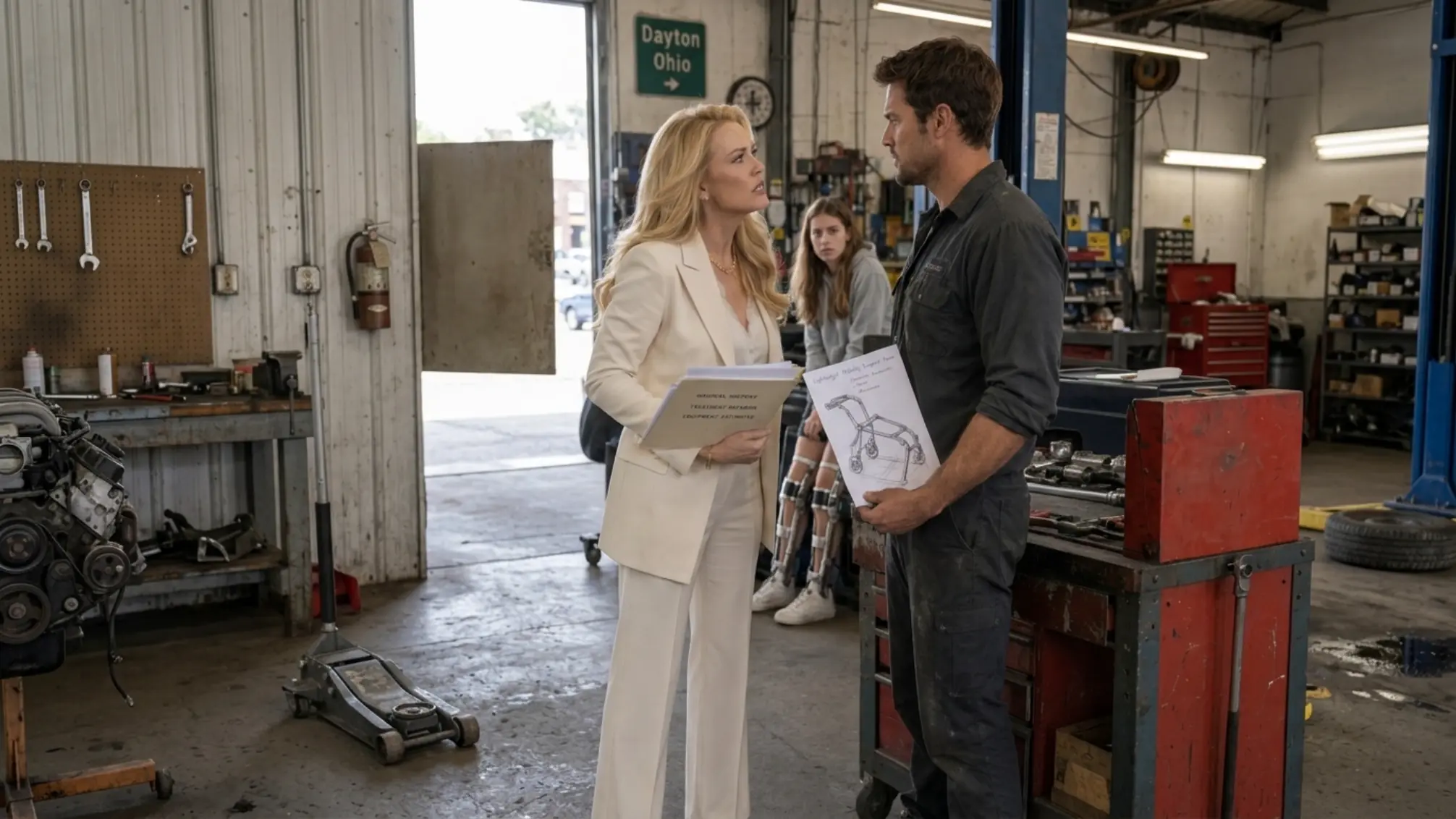
Victoria stepped closer, her cream pantsuit looking impossibly clean inside the worn Ohio garage. “One mistake, and I’ll bury this place beneath lawsuits.”
Ethan turned toward Lily. “Then stay and watch. She’s about to take the step they said was impossible.”
The words sounded more confident than he felt.
Ethan was twenty-eight and owned little beyond the struggling repair shop his father had left behind. The faded sign above the entrance had lost several letters, the roof leaked over Bay Two, and the oldest hydraulic lift shook whenever it carried a heavy truck. His bank account remained one major repair away from empty, but he opened the rusty gate before sunrise every morning because surrender would have made every sacrifice his father made meaningless.
He had learned to repair machines before he was tall enough to reach an engine without standing on a crate. His father taught him that broken parts should be understood before they were discarded. A failed component usually revealed exactly what pressure had destroyed it, if someone possessed enough patience to look. Ethan carried that belief into everything he touched.
Victoria Sterling entered his life in a black luxury SUV that looked worth more than the garage. She was the founder of Sterling Medical Technologies, a company producing hospital equipment, robotic surgical systems, and advanced imaging software. Newspapers called her brilliant, investors called her relentless, and employees learned quickly that explanations rarely satisfied her when results were late.
Yet the woman who stepped from the SUV did not look powerful.
She looked exhausted.
Lily emerged slowly from the passenger side, gripping the door frame while metal braces supported both legs. Her knees trembled before she reached the ground, but she refused the hand her mother offered. She took three difficult steps toward the garage, each one accompanied by the faint mechanical click of rigid joints fighting her natural movement.
Ethan initially assumed something was wrong with their vehicle.
“I’m a mechanic,” he told Victoria when she explained why they had come. “I repair cars.”
“That is why we’re here.”
A rehabilitation specialist had mentioned Ethan after seeing a stabilizing system he designed for an injured racecar driver. The device prevented the driver’s damaged knee from twisting while allowing enough motion to operate the pedals. It was crude compared with medical equipment, but the specialist believed Ethan understood weight distribution and assisted movement differently from traditional brace manufacturers.
Victoria opened the folder containing years of medical history.
Lily had a neuromuscular condition that weakened the muscles supporting her knees and hips. She could walk, but standard braces forced her into an exhausting pattern that created pain through her lower back and shoulders. More advanced systems existed, yet none had fitted correctly, and several prototypes costing six figures had been abandoned after causing additional discomfort.
“I cannot cure her,” Ethan said.
Victoria’s expression sharpened. “I didn’t ask for a cure.”
“What are you asking for?”
Lily answered before her mother could.
“I want to walk without thinking about walking.”
Ethan looked at her.
Most people would have described a distance, a destination, or an activity. Lily wanted something simpler and far more difficult. She wanted movement to stop controlling every moment of her life.
“What hurts first?” Ethan asked.
“My knees.”
“Then what?”
“My hips compensate. After that, my back feels like someone is pulling it apart.”
“When do the braces feel strongest?”
“Standing still.”
“And weakest?”
“When I start moving again after stopping.”
Victoria watched the conversation with visible impatience. She had heard doctors ask about pain levels, muscle strength, and fatigue scores, but Ethan asked Lily how she moved through school hallways, how she climbed into vehicles, and which daily movements made her feel most dependent. He asked what she hated about every device she had worn.
“They’re built around the idea that my legs are the problem,” Lily said. “Nobody asks what my whole body has to do because of them.”
Ethan studied her existing braces.
The metal frames locked too much motion at the knee, forcing her hips to lift each leg rather than allowing a controlled forward swing. The device prevented collapse but demanded enormous energy. Ethan imagined a system that supported the moment weakness appeared instead of restricting movement continuously.
He sketched a hinged frame with adjustable resistance.
Victoria examined the drawing and almost laughed. “You made that in twenty minutes.”
“The concept took twenty minutes. Building it safely will take much longer.”
“With parts from old cars?”
“No.”
“You just said you were adapting mechanical ideas.”
“I’ll use medical-grade materials. The principles may come from suspension systems, counterbalances, and assisted hinges, but nothing goes on Lily without approval from her doctors.”
That answer prevented Victoria from leaving.
Ethan insisted on speaking directly with Lily’s rehabilitation physician and orthotist. He sent his sketches, explained every proposed joint, and requested written limits concerning pressure, alignment, permitted resistance, and range of motion. The physician warned him that no device could restore muscle strength or replace therapy.
“I understand,” Ethan replied. “I’m trying to reduce the energy wasted fighting the brace.”
The first design failed before Lily ever saw it.
Ethan built a lightweight aluminum frame with spring-assisted knee joints, but the mechanism released too much force near full extension. On his testing stand, the leg snapped forward hard enough to shake the workbench. He immediately dismantled it and started again.
The second prototype moved smoothly but weighed nearly as much as Lily’s existing braces.
The third developed lateral instability.
The fourth worked perfectly for twenty minutes before a pivot bushing overheated and seized. Ethan threw nothing across the garage, cursed no one, and blamed neither his tools nor the design. He placed each failed component on the workbench and wrote exactly why it had failed.
Six weeks passed.
Customers sometimes found Ethan asleep inside the office before sunrise, his head resting beside stacks of diagrams. He repaired vehicles during the day and worked on Lily’s support system after closing. His savings disappeared into medical-grade aluminum, carbon-fiber supports, adjustable dampers, straps, padding, sensors, and precision-machined hinges.
His employee warned him that the electricity bill was late.
Ethan paid it with money intended for new tires on his truck.
Victoria knew nothing about those sacrifices. She assumed a mechanic asking for no payment had either hidden motives or unrealistic confidence. Her attorneys prepared liability documents long enough to frighten a hospital, and she demanded access to every design decision.
Ethan signed what was reasonable and rejected what was not.
One clause would have transferred ownership of anything he developed to Sterling Medical Technologies.
He crossed it out.
Victoria noticed immediately. “You’re using my daughter’s condition to create the design.”
“I’m creating it with Lily’s feedback.”
“My company can protect the intellectual property.”
“Your company can discuss that after we know it helps her.”
“You have no ability to manufacture this at scale.”
“I’m not trying to sell it.”
“Everyone is trying to sell something.”
Ethan looked toward Lily, who sat near the garage entrance completing schoolwork. “That belief may be why the most expensive people you hired stopped listening once the invoice was paid.”
Victoria’s face became cold.
“You should be careful.”
“I am careful. That’s why your daughter hasn’t worn an unfinished device.”
Lily lowered her pencil. “Mom, he’s right.”
Victoria turned toward her.
“Every specialist talks to you,” Lily continued. “Then they examine me like I’m equipment you brought in for repair. Ethan talks to me.”
The accusation silenced Victoria more effectively than anything Ethan could have said.
She had spent years fighting for Lily. She challenged insurance companies, flew across the country, hired specialists, funded research, and rejected anyone who treated her daughter like a tragedy. Yet somewhere inside that relentless effort, she had begun making every decision before Lily could speak.
“I’m trying to protect you,” Victoria said.
“I know.”
“Then why does that sound like criticism?”
“Because sometimes protecting me feels like deciding I’m too fragile to have an opinion.”
Victoria looked away.
The fifth prototype was ready three days later.
It consisted of lightweight supports following the outside of Lily’s legs, articulated knee joints with adjustable resistance, and flexible hip connections that reduced unwanted twisting without locking natural movement. Sensors measured pressure and joint angle, but the device did not move Lily’s legs for her.
It supported.
It did not command.
The first fitting occurred under the supervision of Lily’s physician and orthotist. Ethan tightened nothing without asking how it felt, and every adjustment followed the alignment measurements provided by the medical team. Victoria stood several feet away with her arms folded so tightly that her knuckles became pale.
“This is still a prototype,” Ethan said. “Pain means we stop. Instability means we stop. Anything that feels wrong means we stop.”
Lily nodded.
He secured the final strap and stepped back.
“Ready?”
“No.”
“That’s an honest answer.”
She smiled nervously. “Do it anyway.”
Lily placed both hands on the parallel bars and shifted her weight forward. The support frame moved with her rather than resisting. Her right foot advanced, touched the floor, and accepted weight without the familiar violent lock at the knee.
She stopped.
Victoria took one step forward. “Does it hurt?”
“Wait.”
Lily moved her left leg.
Then her right again.
Her expression changed after the fifth step. The concentration remained, but the fear disappeared. She reached the end of the bars and looked down at the device as though it had spoken in a language only she understood.
“It feels easier.”
Victoria covered her mouth.
“Not perfect,” Lily added quickly. “The left side pushes too much, and something rubs near my hip.”
Ethan was already writing.
They adjusted the left resistance, moved the upper support, and added temporary padding. Lily tried again, walking twelve steps before fatigue required her to sit. It was not a miracle, a cure, or the transformation Victoria desperately wanted.
It was twelve steps that cost Lily less pain.
To Ethan, that was enough to continue.
The following week, Lily walked twenty-two steps.
Two weeks later, she reached the sidewalk outside the garage. Ethan followed beside her carrying tools while Victoria remained close enough to catch her but far enough to let her choose the pace. Lily stopped halfway to the corner.
“Something wrong?” Ethan asked.
She pointed toward a coffee shop across the street.
“I’ve never walked there from here.”
“That’s almost three hundred yards.”
“I know.”
Victoria immediately objected. “That’s too far.”
Lily looked at Ethan. “Can the device do it?”
“The device isn’t the only question.”
“Can I do it?”
“I don’t know.”
Victoria stepped closer. “Then we’re not testing that today.”
Lily’s jaw tightened.
Ethan crouched beside her. “We reach the first bench. You decide there. No proving anything to anyone.”
They reached the bench slowly.
Lily sat for eight minutes, drank water, and continued. Her steps became shorter near the coffee shop, but she crossed the final stretch without being carried or pushed in a chair. When she entered, the employee behind the counter applauded after recognizing her from the garage.
Lily laughed.
Victoria turned toward the window and wiped her face before anyone could acknowledge the tears.
Progress continued, but not in a straight line.
One morning, Lily experienced severe pain after a minor alignment shift. Ethan shut down testing for a week and refused Victoria’s demand to “correct it immediately.” The medical team reassessed her gait, and Ethan discovered that improved movement had changed how her existing footwear supported her ankles.
The device needed adaptation because Lily was changing.
That realization became the foundation of his design. Traditional braces had been manufactured as fixed answers, yet the human being wearing them changed through growth, fatigue, therapy, confidence, and daily variation. Ethan redesigned the system so resistance and alignment could be modified without replacing the entire frame.
Victoria began arriving without attorneys.
Sometimes she brought coffee. Sometimes she sat silently at the workbench while Ethan machined components. The first time she noticed the overdue utility notice beneath a stack of drawings, she understood how much the project had cost him.
“You used your own money.”
“I had some saved.”
“You were supposed to invoice me.”
“I wasn’t sure I could build anything useful.”
“You spent thousands of dollars without knowing whether this would work?”
“Yes.”
“That’s irresponsible.”
“Probably.”
“Why?”
Ethan looked toward Lily, who was practicing controlled turns with the therapist.
“My father died when I was seventeen. The last thing he taught me was that ability creates responsibility. If you can fix something important, pretending not to see it doesn’t make you innocent.”
Victoria looked at the faded photograph of Ethan and his father hanging above the tool cabinet.
“You could lose this garage.”
“I could.”
“For someone you didn’t know.”
“I know her now.”
Victoria’s company had spent millions developing technologies intended to improve lives, yet she could not remember the last time anyone made a decision without first projecting market size. Ethan’s garage had no research department, investors, or advanced laboratory.
It had patience.
Months after the first fitting, Lily began wearing the refined system for several hours each day. She still required her wheelchair for longer distances and still used therapy to maintain strength. No one described the device as a cure.
What changed was the amount of life available between necessary rests.
She walked through a bookstore without calculating every aisle. She joined friends at a shopping center. She stood beside the stove while teaching Ethan how to prepare a dessert he repeatedly ruined.
One afternoon, Ethan watched her walk beside Victoria while discussing a school argument. Neither seemed focused on her feet. Lily was angry about something ordinary, speaking quickly and gesturing with both hands while her mother tried to keep up.
For the first time, walking was not the subject.
Living was.
Victoria invited Ethan to Sterling Medical Technologies’ annual foundation gala. The event raised money for children who needed mobility equipment, rehabilitation services, and home modifications. Ethan initially refused because he owned one formal shirt and disliked rooms where every glass of water appeared expensive.
“You need to attend,” Victoria said.
“Why?”
“Trust me.”
“That phrase usually means someone has hidden the important details.”
Lily smiled. “Just come.”
Luxury vehicles lined the entrance to the downtown Columbus venue. Ethan parked his aging pickup near the back, checked twice that it was not leaking oil, and entered through doors tall enough to belong to a government building. Hundreds of executives, investors, physicians, and donors filled the ballroom.
Ethan remained near the rear wall.
Victoria stepped onto the stage wearing a deep-blue evening dress. Her usual confidence appeared intact until photographs of Lily filled the enormous screen behind her. The first images showed rigid braces, exhausted eyes, and hands gripping rails.
Then newer photographs appeared.
Lily walking through the park.
Lily browsing inside a bookstore.
Lily laughing with friends.
“For years,” Victoria said, “I believed the most expensive solution must be the best one. I believed expertise was measured by titles, facilities, and invoices. Then my daughter met a mechanic inside a garage with leaking ceilings and tools older than some of our engineers.”
The audience laughed gently.
Victoria’s voice broke.
“He did not promise to cure her. He promised to listen.”
A spotlight found Ethan near the back.
He froze.
Victoria looked directly toward him. “He spent his savings, his nights, and months of his life building something around Lily instead of forcing Lily to adapt to something already built.”
Then Lily entered from the side of the stage.
She wore the support system beneath a dark formal outfit. No one carried her, and no one held her arm. She walked slowly across the stage while the entire ballroom rose.
The applause became thunderous.
Victoria tried to continue speaking but could not. She embraced her daughter, and the billionaire known for never losing control cried openly before hundreds of people.
Lily whispered something into her ear.
Victoria nodded and faced Ethan again.
“Come up here.”
Ethan shook his head.
The audience turned toward him.
Lily reached the microphone. “He’s stubborn. Keep clapping.”
The applause grew louder until Ethan had no dignified way to remain in place. He walked toward the stage, uncomfortable beneath the attention, and stopped several feet from Victoria.
She extended her hand.
“I threatened to bury your garage beneath lawsuits.”
“You were scared.”
“I was cruel.”
“You were scared and cruel.”
Laughter moved through the ballroom.
Victoria nodded through her tears. “That is fair.”
She announced the creation of the Lily Sterling Mobility Workshop, funded with $25 million from her family foundation. The center would bring mechanics, engineers, physicians, therapists, orthotists, and disabled users together to create affordable adaptive equipment.
Ethan would lead practical design.
He immediately refused the title.
“I own a garage.”
Victoria smiled. “The garage will remain yours.”
“I’m not leaving my customers.”
“You won’t.”
“And no device gets built without the person using it participating in every stage.”
“Agreed.”
“Affordable means affordable, not a smaller six-figure invoice.”
“Agreed.”
Lily leaned toward the microphone. “Make her put it in writing.”
The room laughed again.
Victoria did.
One year later, Ethan’s garage still carried the faded sign, although the roof no longer leaked. A new workshop stood beside it, filled with adaptive bicycles, adjustable supports, modified controls, and prototypes designed for individual needs.
Lily served as the workshop’s first user consultant.
She corrected engineers who spoke about disabled people without including them and rejected designs that looked impressive but failed ordinary daily tasks. Ethan frequently reminded visitors that the device had not given Lily a new life.
It had returned energy to the life she already possessed.
Above his workbench hung the original pencil sketch. Beside it was a photograph from the gala showing Lily halfway across the stage and Victoria crying before the standing crowd.
The billionaire’s money expanded the work.
The mechanic’s persistence began it.
But Lily’s voice shaped every part that mattered.
Victoria once entered the garage prepared to destroy Ethan if he endangered her daughter. She believed wealth had taught her how to recognize value, yet the most valuable thing anyone offered Lily came from a man with nearly nothing left to spend.
He gave time.
He gave attention.
He gave failure enough patience to become progress.
And when Lily walked onto that stage alone, Victoria finally understood why every expensive solution before Ethan had fallen short.
They had tried to build a better machine.
The poor mechanic had started by understanding the girl who needed it.