The coffee did not spill because the aircraft moved.
There was no turbulence, no sudden drop, and no careless hand brushing against the cup. Graham Voss, a forty-seven-year-old white American billionaire in a perfectly tailored navy suit, deliberately tilted the white porcelain cup until steaming black coffee poured across the cream trousers of the Black woman seated beside the window. Dark liquid spread across the expensive fabric almost instantly while the First Class cabin fell silent. Graham looked down at her and smiled.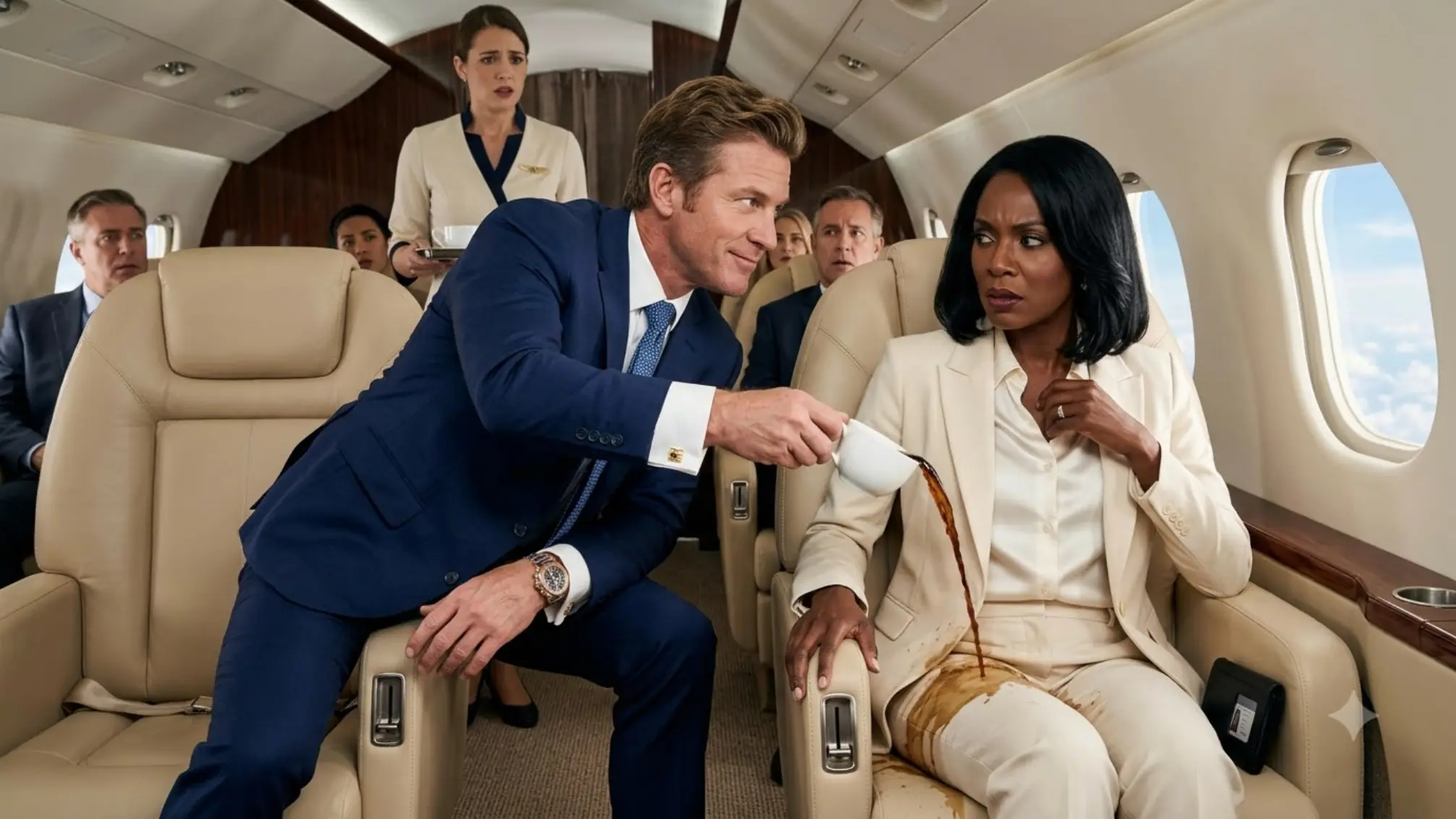
“Maybe next time you’ll remember First Class isn’t for people like you.”
The woman’s fingers tightened around the beige leather armrests, but she did not scream. Camille Reed, forty-four, had deep-brown skin, shoulder-length glossy black hair, elegant features, and the calm posture of someone who had spent twenty years learning never to give cruel people the reaction they wanted. She closed her eyes for one second as the heat soaked through her trousers, then looked directly at Graham. “Tell me your full name.”
Graham leaned toward her, his gold watch catching the overhead light. “Shut up before I have you dragged off this plane.” Behind him, flight attendant Maya Chen stood frozen with a silver tray trembling between her hands, while one woman across the aisle covered her mouth in shock. Camille slowly reached inside her cream blazer. “Say that once more—after you see what I’m about to show them.”
Three rows ahead, a quiet man stood.
Until that moment, he had looked like any other passenger, wearing a plain charcoal jacket and reading a paperback beside the aisle. When he moved forward, his coat opened just enough to reveal a federal credential clipped beneath it. The nearest passengers immediately understood. Federal Air Marshal Daniel Mercer stepped between Graham and Camille without raising his voice.
“Sir, step away from the passenger.”
Graham turned sharply. “This is a private disagreement.” Daniel looked at the empty cup, Camille’s soaked clothing, and the stunned faces surrounding them. “Step away.”
“Do you know who I am?”
Daniel’s expression remained flat. “Right now, you’re the man I watched pour hot coffee on another passenger.”
Graham's smile weakened.
Camille removed a slim black leather credential case from inside her blazer, but she did not open it yet. She pressed her lips together as the pain continued burning through the fabric and glanced toward Maya. “Cold towels, please.”
Maya nodded quickly. “Yes, ma’am.”
Graham laughed.
“Ma’am?”
He looked at Camille as though the word itself offended him.
Daniel directed Graham to step into the aisle and keep his hands visible. Graham complained immediately, insisting the coffee had merely slipped and that Camille was exaggerating because she wanted attention. Several passengers shifted uncomfortably. A man across the aisle slowly raised his phone.
“I recorded it,” he said.
Graham looked at him.
The passenger, Thomas Reed, held the phone firmly. “Your hand was steady.”
Graham’s jaw tightened.
Daniel pointed toward an empty First Class seat across the aisle. “Sit there.”
“You cannot order me around.”
“I can maintain safety aboard this aircraft.”
Graham looked around as though waiting for someone to defend him.
Nobody did.
Maya returned with cold towels and handed them to Camille. Her eyes kept moving toward the stained cream suit, and guilt was already visible in her face because she had witnessed the entire incident without intervening fast enough. Camille accepted the towels and carefully pressed them over the burned area.
“Thank you.”
Maya lowered her voice.
“I’m sorry.”
Camille looked at her.
“For what?”
“I should have stopped him.”
“You should have.”
Maya’s face fell.
Camille softened slightly.
“But we’ll talk about why you believed you couldn’t.”
Maya looked confused.
Graham heard it.
“You think you're conducting an employee meeting now?”
Camille ignored him.
Daniel crouched beside her seat. “Do you need the captain to divert?”
“No.”
“You’re sure?”
“I need medical documentation after landing, but I’m stable.”
Daniel nodded.
Then Camille finally opened the black credential case.
It did not contain a government badge.
Inside was a high-security corporate identification card bearing her photograph, biometric certification, and an executive designation rarely issued outside the highest level of Meridian Crown Aviation Group.
Daniel looked at it.
Then at her.
His expression changed.
He knew the name.
Almost everyone working in aviation knew the company, though few ordinary travelers knew who controlled it.
CAMILLE REED.
CHIEF EXECUTIVE OFFICER.
MERIDIAN CROWN AVIATION GROUP.
EXECUTIVE SECURITY ACCESS — LEVEL ONE.
Daniel straightened.
“Ms. Reed.”
Maya froze.
Thomas glanced between them.
Graham frowned.
Camille closed the case again.
“Keep handling this exactly as you would for any passenger.”
Daniel understood immediately.
“Yes, ma’am.”
Graham laughed again, but the sound was weaker now.
“Meridian Crown?”
Nobody answered him.
He looked toward Maya.
“You work for Meridian Crown?”
Maya swallowed.
“Our airline is part of the group.”
Graham's face changed.
Meridian Crown Aviation Group owned controlling interests in several airlines, aircraft-services companies, airport lounges, ground operations, and aviation technology providers across North America. Graham Voss had flown on their aircraft dozens of times. His corporation also maintained a multimillion-dollar executive travel contract with one of their premium carriers.
He slowly looked back at Camille.
“You're telling me you run the company?”
Camille pressed the towel against her lap.
“No.”
Graham seemed relieved for half a second.
Then Camille continued.
“I run the group that owns it.”
The cabin became completely silent.
Graham stared at her.
For perhaps the first time in years, he had no immediate answer.
Then arrogance returned.
“You expect me to believe the CEO of an aviation group travels without an entourage?”
Camille looked at him.
“I expected to learn how my employees treat passengers when they don’t know I’m watching.”
Maya's eyes widened.
That sentence changed the entire atmosphere.
Camille had not been flying anonymously for entertainment. She had deliberately booked the seat through an ordinary reservation channel, used no executive flag on her passenger profile, and declined the private aviation options available to her. Over the previous four months, her office had received an increasing number of complaints about inconsistent treatment aboard premium cabins.
None seemed serious enough alone.
Together, they bothered her.
One passenger claimed crew members ignored verbal abuse from a wealthy customer because he carried a platinum corporate travel account. Another said a flight attendant apologized privately but refused to report misconduct involving a celebrity. Several employees anonymously described an internal culture where “high-value travelers” were protected from consequences because losing their business could hurt route profitability.
The complaints were difficult to prove.
So Camille began traveling.
Not disguised.
Not using a fake name.
She simply removed the privileges her position normally triggered.
No executive escort.
No special crew briefing.
No internal notification.
Just a valid ticket and a quiet seat.
She had already taken seven flights before meeting Graham Voss.
Most had been uneventful.
That was what she hoped for.
Then Graham poured coffee on her.
Daniel instructed Maya to preserve the cup, napkins, and any other relevant material. Thomas voluntarily provided his contact details as a witness, while two passengers behind Camille said they had seen Graham lift the cup and aim it deliberately. Another woman confirmed hearing his remark about First Class not being for “people like” Camille.
Graham leaned back.
“This is becoming ridiculous.”
Camille looked across the aisle.
“You made it simple.”
“How?”
“You did it in front of witnesses.”
Graham crossed his arms.
“You're angry.”
“Yes.”
“So now you're going to destroy my business because you own an airline?”
Camille's expression hardened.
“No.”
That answer surprised him.
She continued.
“If your business suffers, it will be because of what can be proven, not because you embarrassed me.”
Daniel glanced toward her.
The distinction mattered.
Camille had spent too many years building Meridian Crown to turn corporate authority into personal revenge. If she used her position to punish Graham merely because she hated him, she would become another version of the very culture she had been investigating.
So she gave Daniel one instruction.
“Document everything.”
He nodded.
That was enough.
The confrontation might have ended there had Maya not remembered something.
She approached Daniel several minutes later while another flight attendant helped Camille move into an empty seat. Maya lowered her voice.
“There’s something else.”
Daniel looked at her.
“What?”
“Mr. Voss has a VIP notation.”
Camille heard her.
“What kind?”
Maya hesitated.
“A service profile.”
“Explain.”
Maya glanced toward Graham.
He was watching.
Camille noticed.
“Speak freely.”
Maya took a breath.
“Certain passengers have notes attached to their profiles. Corporate clients, celebrities, major investors, people with high annual spend.”
Camille already knew the system existed.
What she did not know was how it had evolved.
“What does his say?”
Maya looked embarrassed.
“Executive priority. Escalation discouraged.”
Camille stopped moving.
“Escalation discouraged?”
“Yes.”
“Meaning?”
“If there’s a complaint involving him, we’re encouraged to resolve it quietly before contacting the captain or security.”
Daniel’s expression tightened.
Camille looked toward Graham.
He suddenly seemed interested in the window.
“Who created the notation?”
“I don’t know.”
“Does the crew see it?”
“Yes.”
“Before boarding?”
“Usually.”
“And that is why you froze.”
Maya's eyes filled.
“Yes.”
Camille leaned back slowly.
The burned fabric on her trousers hurt less than that answer.
She had suspected wealthy travelers were receiving preferential treatment.
She had not expected to discover an internal instruction actively discouraging escalation.
Graham spoke from across the aisle.
“It's called customer service.”
Camille turned toward him.
“No.”
Her voice was quiet.
“It’s called buying immunity.”
Graham rolled his eyes.
“You people always make business sound dirty when you don't understand how important clients work.”
Camille almost laughed.
“You still think I don’t understand business?”
Graham realized too late what he had said.
Daniel instructed him to remain silent unless addressed.
That should have been enough.
It was not.
Graham leaned closer.
“My company spends millions with your airlines.”
Camille stared at him.
“Then somebody should probably check whether we earned those millions honestly.”
Graham’s face tightened.
He looked toward Maya.
“You’ll regret repeating internal information.”
Daniel stepped immediately between them.
“Do not threaten crew members.”
“I didn't threaten anyone.”
Maya whispered, “It sounded like one.”
Daniel wrote it down.
Camille watched Graham carefully.
There was something about his reaction that went beyond embarrassment.
He seemed worried about the VIP note being examined.
That interested her.
Not because she wanted revenge.
Because people often revealed what mattered by protecting it too quickly.
Camille turned toward Maya.
“Do these notes come from the airline or from corporate sales?”
“I think both.”
“You think?”
“We’re never told.”
Camille nodded.
“Good answer.”
Maya looked confused.
“I'd rather hear what you know than what you think I want.”
For the remainder of the flight, Camille asked no more questions.
She knew better.
An aircraft cabin was not the place to conduct a corporate investigation, and Maya was already frightened. Camille instead asked Daniel to document the immediate incident while she waited for the plane to land.
Graham tried three separate times to negotiate.
The first attempt was an apology.
“I may have overreacted.”
Camille said nothing.
The second was money.
“I'll cover the suit.”
Camille still said nothing.
Then he increased the offer.
“Ten thousand.”
Thomas looked up from across the aisle.
Graham continued.
“Twenty-five.”
Daniel stopped writing.
Graham shrugged.
“Fifty thousand and we all forget this nonsense.”
Camille finally looked at him.
“You just tried to purchase silence in front of an air marshal and six witnesses.”
Graham's face hardened.
“I was offering compensation.”
“For what?”
“An accident.”
Thomas spoke.
“It wasn't an accident.”
Graham glared at him.
Daniel intervened immediately.
“No contact with witnesses.”
Camille leaned back.
“You keep confusing wealth with control.”
Graham sneered.
“And you don't?”
The question was sharper than he intended.
Camille considered it.
Then answered.
“I try very hard not to.”
For the first time, Graham said nothing.
When the aircraft landed, passengers were instructed to remain seated while airport police boarded. Camille specifically requested that Graham not be publicly humiliated, restrained unnecessarily, or handled differently because of her position. Daniel agreed.
“He’s a passenger accused of an assault,” Camille said. “Treat him that way.”
Graham heard her.
Something about being denied the opportunity to claim persecution irritated him more than anger would have.
Airport officers interviewed Daniel first.
Then witnesses.
Paramedics documented Camille’s injuries and advised medical follow-up. She accepted transportation to a nearby clinic after completing the immediate statement.
Graham was escorted separately.
Before leaving, he looked back at Camille.
“This won’t end the way you think.”
Camille met his eyes.
“I haven't decided how it ends.”
He smiled coldly.
“My lawyers will.”
Camille shook her head.
“No.”
She glanced toward Thomas's phone.
“The evidence will.”
The following morning, Camille arrived at Meridian Crown headquarters wearing a charcoal suit and carrying the stained cream trousers in a sealed garment bag.
Her executive team was waiting.
Chief Operating Officer James Holloway, General Counsel Rebecca Sloan, Chief Ethics Officer David Park, and Head of Customer Experience Nina Patel sat around the conference table. None had been told exactly what happened until Camille entered.
She placed the garment bag on the table.
Nobody spoke.
James stared.
“What happened?”
Camille sat.
“I found the VIP escalation problem.”
Nina's face changed immediately.
Camille explained everything.
Not dramatically.
Chronologically.
The boarding process.
Graham's behavior.
The coffee.
Maya's hesitation.
The air marshal.
The VIP notation.
The attempted payment.
The threat toward Maya.
When she finished, Rebecca opened her legal pad.
“What do you want done?”
“Preserve every record tied to Graham Voss.”
Rebecca nodded.
“Passenger history?”
“Yes.”
“Customer-service complaints?”
“Yes.”
“Corporate travel agreements?”
“Yes.”
“Internal notes?”
“Everything.”
David leaned forward.
“Do we suspend his corporate travel account?”
Camille shook her head.
“Not yet.”
James looked surprised.
“He assaulted you.”
“That does not give us permission to destroy evidence by changing systems before preservation.”
Rebecca nodded approvingly.
Camille continued.
“We freeze document deletion, preserve logs, retain the original profile, and appoint an investigation team that does not report through Customer Experience.”
Nina stiffened slightly.
Camille noticed.
“This is not about blaming you.”
“It happened in my division.”
“Which is exactly why you should not investigate yourself.”
Nina nodded.
Fair.
The independent review began that afternoon.
Investigators first examined Graham's passenger profile.
The note existed.
EXECUTIVE PRIORITY. ESCALATION DISCOURAGED. CORPORATE RELATIONSHIP VALUE: CRITICAL.
Below it were thirty-one service records over four years.
Graham had received upgrades.
Fee waivers.
Special ground transportation.
Complimentary lounge guests.
Late boarding exceptions.
None of that was inherently improper.
Then the complaints appeared.
A flight attendant reported that Graham had screamed at her after she refused to serve additional alcohol.
Closed as “service recovery.”
A passenger reported Graham threatened him after an argument over overhead-bin space.
Closed.
A crew member documented insulting comments toward a Black gate agent.
Reclassified as “communication issue.”
Another complaint involved Graham throwing food onto the floor after disliking a meal.
No formal escalation.
The pattern went back years.
Nina stared at the reconstructed history.
“How did none of this reach me?”
David answered quietly.
“Because somebody designed the system so it wouldn't.”
The investigation expanded.
Access logs showed a small Corporate Relationship Management team had authority to add VIP notes.
One name appeared repeatedly.
Trevor Lang, Vice President of Strategic Accounts.
Trevor managed several of Meridian Crown's largest corporate travel customers.
Graham Voss was one of them.
Rebecca requested Trevor's emails.
The results were ugly.
In one message, a route manager complained about Graham verbally abusing a flight attendant. Trevor responded:
VossTech spends $11.8M annually across the group. Manage locally. Do not turn this into a security issue unless physically unavoidable.
Another manager asked what “manage locally” meant.
Trevor wrote:
Keep him happy.
Camille read the email twice.
James swore under his breath.
The deeper problem appeared in another exchange.
A cabin-service supervisor had recommended suspending Graham's premium privileges after repeated incidents.
Trevor forwarded the recommendation to Martin Kessler, Chief Commercial Officer.
Martin responded:
Not happening. Losing Voss would cost more than a dozen complaints.
Silence filled the room.
Camille looked toward James.
“How long has Martin had authority over VIP policy?”
“Six years.”
“And our complaints?”
“Nina's team handles ordinary complaints.”
Nina answered.
“VIP escalations were often rerouted through Commercial Relations before reaching us.”
Camille looked at her.
“You never questioned that?”
Nina did not defend herself.
“I should have.”
Camille nodded once.
“Yes.”
The investigation eventually reviewed more than four hundred VIP accounts.
Most contained ordinary notes.
Diet preferences.
Seat choices.
Accessibility requirements.
Security sensitivities.
Only forty-three contained language discouraging escalation.
Those accounts represented enormous corporate revenue.
The problem was not one billionaire.
It was a shadow policy.
Nobody had formally approved it.
That almost made it worse.
Executives had gradually built an unwritten understanding that certain customers mattered too much to discipline.
Every individual decision seemed small.
Together, they created a separate set of rules.
Camille called an emergency board meeting.
Martin Kessler arrived angry.
Trevor Lang arrived with an attorney.
Camille opened the meeting by placing a printed copy of the VIP policy notes on the table.
Martin glanced at them.
“These are service-management tools.”
“No,” Camille said. “Diet notes are service-management tools.”
She pointed at the phrase escalation discouraged.
“This is liability disguised as customer retention.”
Martin leaned back.
“You're reacting emotionally because you were involved.”
Camille had expected that argument.
She slid another folder forward.
“Which is why I removed myself from the investigation.”
Martin looked down.
The independent law firm's name appeared on the cover.
Camille continued.
“They reached the same conclusion.”
Trevor shifted.
Martin opened the report.
Camille watched him read.
The investigation had found that VIP customers were statistically less likely to receive formal misconduct escalation even when behavior reports were comparable to ordinary passengers. Employees were more likely to describe themselves as afraid of retaliation when the passenger carried a high-value corporate designation.
Worst of all, several internal communications explicitly tied enforcement decisions to revenue.
Martin closed the report.
“You're going to sacrifice hundreds of millions in business because of service complaints?”
Camille looked at him.
“No.”
She pointed toward the report.
“You sacrificed our standards because you were afraid of losing business.”
Martin laughed.
“Standards don't pay salaries.”
Camille's expression changed.
Neither James nor Rebecca spoke.
Martin realized too late he had said the sentence in front of the board.
Camille leaned forward.
“Neither does a company nobody trusts.”
Martin was placed on administrative leave pending further review.
Trevor followed.
The board appointed an external compliance monitor to examine VIP policies across the group. Complaints previously closed through Commercial Relations were reopened and reviewed independently.
Employees were invited to provide confidential testimony.
Hundreds responded.
Some described harmless favoritism.
Others described something more disturbing.
Celebrities permitted to board late after gates should have closed.
Executives receiving alcohol beyond recommended limits.
Corporate clients insulting crew members without consequences.
Passengers removed from upgrade lists after complaining about wealthy customers.
No single story resembled Camille's exactly.
Together, they described a culture.
Camille did not publish Graham's name internally.
She did not make him a symbol.
The problem had existed before he poured the coffee.
His action had merely exposed it.
Two weeks later, prosecutors charged Graham over the onboard assault based on witness statements and video evidence. His lawyers described the case as exaggerated.
Then Thomas's recording became public through court filings.
The video showed the cup clearly.
Graham's arm.
The tilt.
Camille recoiling.
His words.
That ended most arguments about whether the incident had been accidental.
Graham's company issued a statement saying the matter was personal and unrelated to VossTech operations.
Camille agreed.
At least initially.
Then Meridian Crown investigators discovered something else.
Trevor Lang had not protected Graham merely because VossTech bought millions in airline travel.
Trevor owned stock options in a private aviation-software company backed by one of Graham's investment funds.
The relationship had never been disclosed.
Rebecca immediately expanded the conflict-of-interest investigation.
Payments and investment records were subpoenaed through appropriate legal channels.
The result did not prove Graham had paid Trevor to protect him personally.
But it established an undisclosed financial relationship between a senior Meridian Crown executive and a billionaire customer whose misconduct complaints he repeatedly suppressed.
That was enough to create serious governance problems.
Trevor was terminated.
Martin resigned before the disciplinary process finished.
The board commissioned an external review of executive conflicts.
Camille did not celebrate either departure.
She had worked with Martin for eleven years.
He had helped build Meridian Crown from a regional aviation holding company into an international group.
That history made the failure worse, not easier.
One evening James found Camille alone in the executive dining room.
She was staring at the stained cream blazer lying inside a clear preservation bag.
“You still have that?”
“Legal released it.”
“You going to throw it away?”
Camille looked at the dark mark.
“Eventually.”
James poured coffee into his own cup.
Then stopped.
Camille noticed.
“You can drink coffee around me.”
He laughed awkwardly.
“Feels wrong.”
Camille smiled.
Then became serious.
“I keep thinking about Maya.”
“The flight attendant?”
“She knew what Graham did was wrong.”
James nodded.
“She froze anyway.”
“Because we taught her the wrong risk.”
He understood.
Camille continued.
“She believed stopping a powerful customer might cost her job.”
James sat opposite her.
“And now?”
“Now we make sure the company is more afraid of employees staying silent.”
That principle became the center of Meridian Crown's reforms.
VIP accounts remained.
Preferential service remained in areas where it made sense.
Premium customers still received dedicated check-in desks, concierge assistance, and specialized travel management.
But misconduct rules became universal.
No profile could discourage safety escalation.
No commercial executive could delete or downgrade a crew complaint.
Any complaint involving threats, physical aggression, discriminatory language, or repeated harassment bypassed sales teams entirely.
Crew members received written protection against retaliation for reporting high-value customers.
Camille insisted on one sentence being placed at the top of the new policy.
Revenue does not alter conduct standards.
Some executives called it obvious.
Camille responded that if it had truly been obvious, they would not need the investigation.
Maya Chen was asked to testify before the board's ethics committee.
She arrived nervous.
Camille was present but did not lead the questioning.
Maya described the flight honestly, including her own hesitation.
“I knew he had done it deliberately,” she said. “I knew I should tell him to step away. But I saw the VIP note before boarding.”
A director asked, “What did that note mean to you?”
Maya answered without hesitation.
“Don't create trouble for the company.”
Camille closed her eyes briefly.
There it was.
Not what policy officially said.
What employees understood.
That distinction mattered.
After the testimony, Camille found Maya in the hallway.
The flight attendant immediately straightened.
“Ms. Reed.”
“Camille is fine when we're not working.”
Maya smiled nervously.
“I don't think I'll ever manage that.”
Camille laughed softly.
Then Maya grew serious.
“Are you going to fire me?”
“No.”
Maya looked shocked.
“I froze.”
“Yes.”
“I failed you.”
“No.”
Camille shook her head.
“You failed a passenger.”
Maya understood the correction.
Camille continued.
“And then you told the truth when it became difficult.”
Maya's eyes filled.
“Does that erase it?”
“No.”
Camille's answer was immediate.
“But accountability isn't the same as destruction.”
Maya nodded slowly.
She completed additional safety training and later joined a working group redesigning cabin escalation procedures. Within two years, she became a senior trainer.
The story of the coffee incident eventually reached the press.
Predictably, the headline became simple.
Billionaire attacks airline CEO in First Class.
Camille disliked it.
It made the event sound like the only reason Graham's behavior mattered was because his victim happened to own the company.
During an interview months later, a reporter asked whether Graham would have poured the coffee if he knew who she was.
“Probably not.”
“Does that make the reveal satisfying?”
Camille paused.
“No.”
The reporter looked surprised.
“Why?”
“Because it means he understood respect only after learning I had power.”
She leaned back.
“That is not respect.”
The reporter asked what lesson she wanted people to take from the incident.
Camille thought about Maya.
Thomas.
Daniel.
The passengers who had remained silent at first.
The internal emails.
Trevor.
Martin.
Then she answered.
“If the story becomes ‘be careful who you mistreat because she might secretly be a CEO,’ we learned nothing.”
The reporter waited.
Camille continued.
“She should not need to be a CEO.”
That sentence spread quickly.
More quickly than she expected.
Graham's criminal case moved forward separately from Meridian Crown's internal investigation.
Camille testified as a witness.
She did not mention his net worth.
She did not mention owning the airline.
She described only what happened.
He raised the cup.
He poured.
He made the statement.
He threatened her.
He later offered money.
Thomas's video supported her.
Daniel's report supported her.
Maya's testimony supported her.
The truth did not require Camille's title.
That pleased her.
After the case concluded, Graham's corporate travel relationship with Meridian Crown came under independent review. The company did not cancel it simply because Camille disliked him.
Instead, they applied the new standards.
Repeated documented misconduct.
Threats toward crew.
Physical aggression.
An unresolved pattern.
The travel privileges associated with his executive account were suspended under exactly the same policy that would apply to anyone else.
Graham appealed.
The appeal went to a committee with no reporting relationship to Camille.
They upheld the suspension.
When the decision reached her desk, she did not sign it.
She did not need to.
That was the system working properly.
One year after the flight, Camille booked the same route again.
No executive alert.
No special treatment.
She sat in First Class beside the window.
When Maya appeared carrying the beverage cart, both women stopped.
Maya smiled.
“Coffee?”
Camille stared at the pot.
Maya immediately covered her mouth.
“Oh no.”
Camille began laughing.
Several passengers looked over.
Maya laughed too.
“Tea?”
“Tea.”
“Very safe choice.”
“Extremely.”
Maya poured it carefully.
Before moving away, she hesitated.
“Things are different now.”
Camille looked up.
“Better?”
“Yes.”
“How?”
Maya considered the question.
“We don't look at the passenger profile before deciding whether to report something.”
Camille smiled.
“That sounds boring.”
Maya laughed.
“It is.”
“Good.”
Ordinary fairness was supposed to be boring.
There should be no dramatic reveal.
No shocked cabin.
No CEO reaching into her blazer.
No air marshal discovering the victim owned the company.
A crew member should see unacceptable behavior and respond because it is unacceptable.
Nothing else should matter.
Before departure, Camille noticed a maintenance worker boarding briefly to inspect an overhead panel. His uniform was dusty, and several premium passengers barely looked at him.
Camille watched him finish.
A flight attendant thanked him.
He smiled.
Then he left.
Nobody knew whether he owned property.
Nobody knew what his bank account looked like.
Nobody knew whether his children attended expensive schools.
Nobody needed to know.
He was treated professionally because he was there doing his job.
Camille thought about Graham.
He had looked at her cream suit, her skin, her silence, and whatever else existed inside his own assumptions, then decided he could pour coffee over her without consequence.
His greatest mistake was not failing to recognize a CEO.
It was believing recognition should have mattered.
Months later, Camille addressed several hundred Meridian Crown managers at the annual leadership conference.
Behind her was no photograph of Graham.
No video of the coffee.
No stained suit.
Instead, the screen displayed one sentence.
WHO GETS THE RULES?
Camille walked to the center of the stage.
“Three years ago,” she began, “I would have answered that question by saying everyone.”
She paused.
“But saying something is true does not make it operationally true.”
The room remained silent.
She explained the investigation.
Not the sensational details.
The mechanics.
A commercial team was rewarded for revenue retention.
Complaints threatened revenue.
Therefore complaints involving profitable customers became inconvenient.
Managers created informal workarounds.
Employees learned what behavior leadership rewarded.
No executive sat in a conference room and announced, wealthy passengers may mistreat people.
Nobody needed to.
The incentives delivered the message.
Camille looked across the audience.
“Culture is often the thing employees believe will happen when policy and profit disagree.”
Nobody moved.
“If policy says report misconduct, but the employee believes reporting it will cost her career, the real policy is fear.”
She paused.
“That is leadership's responsibility.”
At the end of the speech, someone asked whether she regretted traveling anonymously that day.
Camille smiled slightly.
“No.”
“Even after what happened?”
“Especially after.”
The questioner looked surprised.
Camille explained.
“If I had boarded as CEO, there would have been flowers at my seat.”
Soft laughter moved through the room.
“Senior crew would have known my favorite drink. Managers would have checked every detail. I would have experienced the company we perform for executives.”
She looked toward the audience.
“I needed to experience the company we provide when nobody important appears to be watching.”
That line eventually became part of Meridian Crown's leadership handbook.
Camille disliked that too.
James teased her about it.
“You hate having your own words quoted.”
“I hate when people quote them instead of practicing them.”
He laughed.
Fair enough.
Three years after the incident, Meridian Crown's customer complaint numbers initially increased.
Some investors worried.
Camille did not.
She knew why.
Employees were finally reporting behavior previously buried.
Then the numbers stabilized.
Serious unresolved complaints fell.
Crew retention improved.
Customer trust scores rose.
The company lost several high-spending customers who disliked stricter conduct rules.
It gained others.
The financial impact was nowhere near the catastrophe Martin Kessler had predicted.
More importantly, nobody inside Meridian Crown could again claim certain passengers were too valuable for rules.
Camille kept the black credential case.
She stopped carrying the stained suit.
That eventually went into storage.
One afternoon, Maya visited headquarters for a training conference and asked whether Camille still had it.
“The suit?”
“Yes.”
“Unfortunately.”
“You should frame it.”
Camille stared at her.
“Absolutely not.”
Maya laughed.
“It changed the company.”
“No.”
Camille shook her head.
“A cup of coffee didn't change the company.”
“What did?”
“People finally telling the truth about what was already happening.”
Maya considered that.
Then nodded.
Years later, employees still occasionally repeated exaggerated versions of the flight story.
Some claimed Camille fired half the First Class staff before landing.
False.
Others said she canceled Graham’s company contract from her seat.
False.
One version insisted Daniel announced over the cabin speaker that she owned the aircraft.
Also false.
Reality had been less theatrical.
And more important.
A woman was assaulted.
An air marshal preserved the scene.
Passengers provided evidence.
An employee admitted why she had been afraid.
Executives preserved records.
An independent investigation followed the data.
Conflicts were uncovered.
Policies changed.
People were held accountable through process.
That was how real institutional change worked.
Slowly.
Document by document.
Decision by decision.
Camille preferred that truth to the legend.
Because legends made people wait for powerful heroes.
Systems allowed ordinary people to act.
On the fourth anniversary of the incident, Camille boarded another Meridian Crown flight.
This time she wore jeans, a black sweater, and simple shoes.
No executive alert.
Again.
The young flight attendant at the entrance smiled.
“Welcome aboard.”
“Thank you.”
No recognition.
Perfect.
Camille found her seat.
A few minutes later, an elderly man in worn work clothes entered First Class. Another passenger looked at him suspiciously.
The flight attendant did not.
“Good afternoon, sir.”
The man handed over his boarding pass.
She checked it.
“Right this way.”
Nothing dramatic happened.
The man sat down.
The aircraft departed.
No one discovered he was secretly rich.
No one learned he owned a company.
No badge appeared.
No reveal came.
He was simply a passenger with a valid ticket.
And he was treated like one.
Camille watched from two rows behind.
Then she smiled.
That ordinary moment told her more about Meridian Crown than any executive presentation ever could.
Graham Voss had once believed First Class belonged to people who looked like him.
Camille could have answered by proving it belonged to someone even richer.
Instead, she rebuilt the rules around a different idea.
The cabin did not belong to billionaires.
It did not belong to CEOs.
It did not belong to passengers whose corporate accounts generated millions of dollars.
It belonged equally to everyone who had a right to be there.
Years earlier, when coffee spread across Camille Reed's cream suit, Graham had expected silence.
For a few seconds, he got it.
Then someone stood.
Someone recorded.
Someone spoke.
Someone preserved the evidence.
Someone admitted the system had frightened her into hesitation.
And eventually, hundreds of employees helped repair what that moment exposed.
People later remembered the instant Camille opened the black credential case.
She remembered the moment before it.
Because before anyone knew her title, Graham had already shown everyone who he was.
And nothing printed beneath Camille Reed's photograph could make his decision more wrong than it had been from the beginning.