“You damaged my tire, didn’t you? Poor men always invent emergencies when they smell money.”
The accusation struck harder than the freezing rain. Adrian Cole remained on one knee beside the disabled black sedan, his soaked work jacket clinging to his shoulders and the tire iron still locked between both hands. Behind him, headlights blurred across the wet highway while the beautiful blonde woman towered over him in black heels wholly unsuited for the muddy roadside.
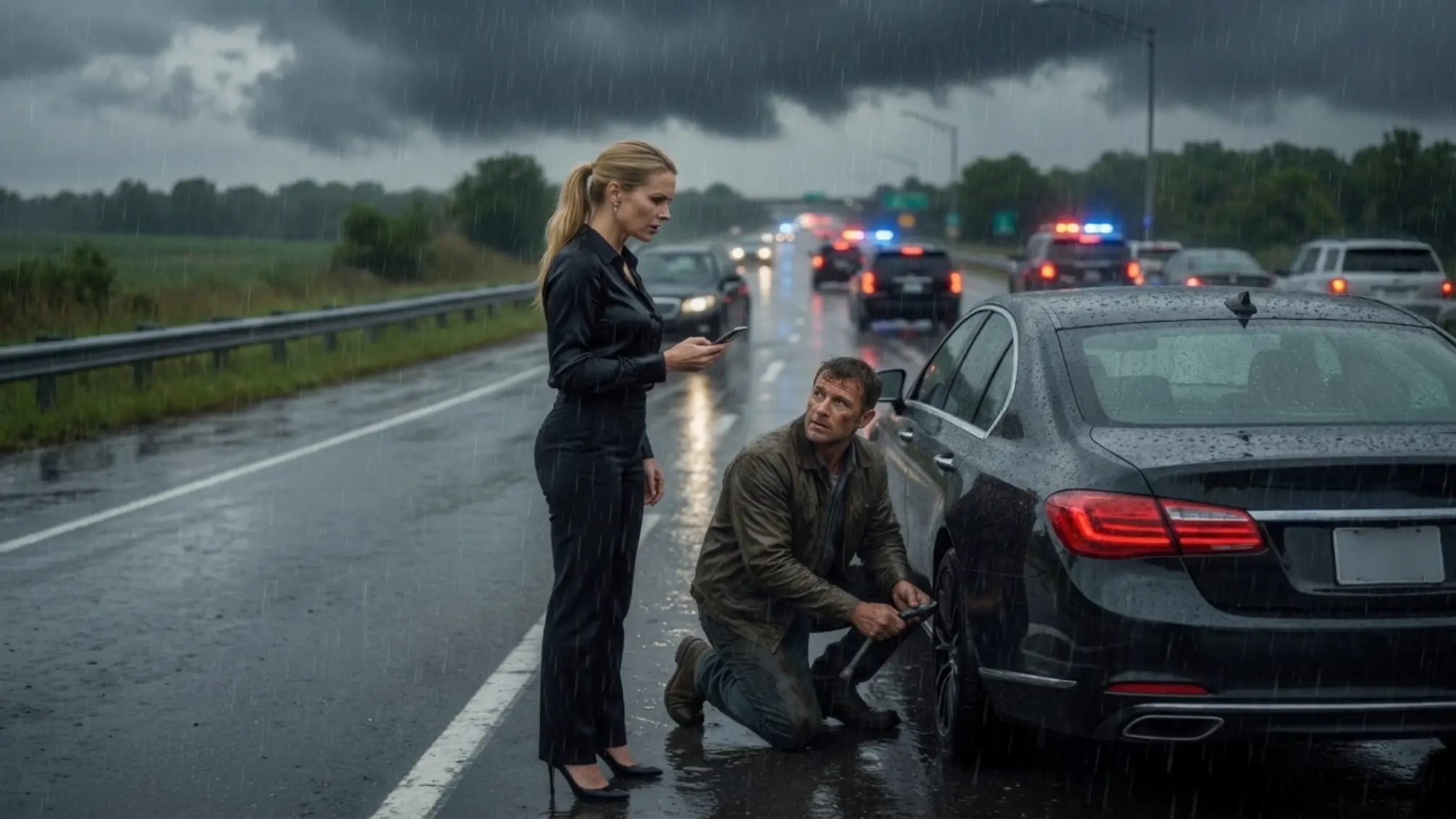
Adrian slowly looked up.
At thirty-eight, he had spent enough years being judged by worn clothes, calloused hands, and an aging pickup to recognize contempt before it finished speaking. His short dark-brown hair dripped across his forehead, rugged stubble darkened his jaw, and rainwater ran from the sleeves of the jacket he had owned since before his wife died.
“I was driving home when I saw you stranded,” he said. “I didn’t touch your car before tonight.”
The woman’s sharp blue-gray eyes narrowed. “Then why did my tire suddenly fail on an empty road five minutes before you appeared?”
“Because someone punctured it.”
She laughed without humor. “Convenient.”
Adrian turned back toward the exposed wheel assembly. What should have been a simple tire change had become something else the moment he found the brake line partially loosened. The puncture itself was too clean, positioned where ordinary road debris would rarely strike, and the tire-pressure sensor had been deliberately disconnected.
Then he saw the black plastic device tucked behind the brake shield.
It was no larger than a matchbox, secured with industrial adhesive and connected to a thin wire disappearing beneath the chassis. A tiny green indicator pulsed beneath the casing.
Adrian pulled it free.
“Then explain why this was wired behind your wheel before I ever stopped.”
The woman’s expression changed.
Only slightly.
But Adrian saw it.
She stepped closer, forgetting the mud splashing against her pointed heels. “What is that?”
“A tracker, possibly more.”
“You’re lying.”
“I wish I were.”
He rotated the device beneath the police cruiser’s flashing roadside lights. An officer had stopped several minutes earlier to provide traffic protection, then returned to his vehicle after the woman insisted she needed no assistance. Adrian had assumed the distant amber and blue reflections belonged to that cruiser.
Now the lights approaching from behind were different.
Three black SUVs accelerated along the shoulder.
The woman looked past Adrian and released a breath of relief. “Those are my security vehicles.”
Adrian watched the formation.
The lead SUV traveled too close to the center line, leaving no defensive spacing. The second vehicle’s headlights were off despite the rain, while the third had no visible company markings. None slowed when they passed the police cruiser farther up the road.
Adrian rose.
“Step away before they put you on the ground,” she warned.
“They’re not here to protect you.”
Her face hardened. “You know nothing about my security.”
“I know the lead driver just killed his lights before turning toward us.”
The first SUV stopped at an angle behind the sedan, blocking the shoulder and part of the right traffic lane. The other two positioned themselves ahead and behind, forming a cage around the disabled car.
Doors opened.
Six men emerged wearing dark tactical jackets.
None displayed identification.
Adrian moved between the woman and the vehicles.
She grabbed his arm. “What are you doing?”
“Stay behind me and watch who reaches for a gun first.”
The tallest man approached with one hand inside his jacket.
“Ms. Vale,” he called. “Are you injured?”
The woman’s grip loosened. “Marcus?”
Adrian heard recognition in her voice but not relief.
The man smiled. “Your office received an emergency alert from the vehicle. We came immediately.”
His eyes moved toward Adrian.
The smile disappeared.
“Step away from her.”
Adrian did not move. “Show identification.”
Marcus laughed. “You don’t give orders here.”
“He found a tracking device behind my wheel,” the woman said.
Marcus glanced toward the plastic unit in Adrian’s hand.
That one movement exposed him.
He did not look surprised.
He looked angry.
Adrian raised the device slightly. “You know what this is.”
Marcus reached inside his coat.
Adrian moved first.
He drove his shoulder into Marcus’s chest before the weapon cleared the fabric. Both men struck the side of the SUV, and the object fell onto the wet pavement.
It was not a security radio.
It was a suppressed handgun.
The woman gasped.
The other men surged forward.
Adrian seized Marcus’s wrist, twisted hard, and forced him between himself and the nearest attacker. The second man stopped rather than fire through his own leader. Adrian kicked the pistol beneath the disabled sedan and shouted toward the police cruiser.
“Officer! Gun!”
The roadside officer had already seen enough.
His siren erupted as he accelerated backward along the shoulder. Two additional patrol units appeared beyond the curve, summoned moments earlier when Adrian quietly pressed the emergency button on his phone while inspecting the tracker.
Marcus shoved away from him.
“Take her now!”
One attacker grabbed the woman’s wrist.
She drove the pointed heel of her shoe into his shin, tore free, and ran behind Adrian. He threw the tire iron across the wet pavement, striking another man’s forearm before the weapon in his hand could rise.
Police flooded the roadway.
“Drop your weapons!”
The men near the SUVs froze.
One attempted to climb back into the lead vehicle, but an officer dragged him out and forced him onto the asphalt. Another fled toward the tree line until a K-9 unit cut off his escape.
Marcus remained beside Adrian, breathing heavily.
“You have no idea what you interrupted,” he whispered.
Adrian looked toward the woman shaking behind him. “I interrupted a murder.”
Marcus smiled through the rain. “You delayed one.”
The officer slammed him against the SUV and secured his wrists.
Only after every man had been disarmed did Adrian notice blood running down his own hand. Marcus’s watch had cut his knuckles during the struggle, but the injury was shallow.
The woman noticed too.
“You’re bleeding.”
“I’m fine.”
She looked at the pistol beneath the sedan, the tracker in his hand, and the six men now lying face down beneath police supervision. Her earlier contempt had vanished, replaced by shock and something more painful.
Shame.
“My name is Evelyn Vale,” she said quietly.
Adrian almost laughed. “I know.”
Her company’s name appeared on hospitals, technology campuses, scholarship programs, and the tallest office tower in Columbus. Evelyn Vale had built Vale Dynamics into a multinational logistics and cybersecurity corporation worth nearly $12 billion.
Business magazines described her as brilliant, disciplined, and impossible to intimidate.
None mentioned how small she looked standing in the rain after realizing her own security director had arrived to kill her.
“Who are you?” she asked.
“Adrian Cole.”
“That isn’t what I meant.”
“I repair industrial cooling systems. I have a daughter waiting for me at home, and I stopped because your hazard lights were on.”
Evelyn looked toward his dented pickup parked behind the police cruiser. A child’s purple backpack rested on the passenger floor, and a photograph of a smiling little girl was clipped above the dashboard.
“You risked your life for a stranger.”
“I didn’t know they had guns when I stopped.”
“You stayed after you knew.”
Adrian glanced toward Marcus.
“By then, leaving would have made me part of what happened next.”
The police separated Adrian and Evelyn for statements. Detectives photographed the damaged tire, loosened brake line, electronic tracker, pistol, and SUV interiors.
Inside the third vehicle, officers found plastic restraints, sedatives, a change of license plates, and a gasoline container.
The plan became horrifyingly clear.
The tire would fail on a remote highway. Marcus’s team would arrive under the appearance of rescue, abduct Evelyn, stage a fatal crash, and burn the vehicle to destroy physical evidence.
Adrian’s arrival had not merely inconvenienced them.
It had ruined every controlled part of the operation.
At midnight, Evelyn sat inside a state police interview room wrapped in a gray blanket while investigators reviewed the names of the arrested men. Four worked for the private security contractor assigned to protect Vale Dynamics executives.
Marcus Hale had served as her security director for six years.
He knew her schedule, habits, preferred routes, emergency codes, and the exact nights she dismissed her regular driver to travel alone.
A detective placed a photograph of the tracker on the table.
“This was not commercially available equipment,” he explained. “It appears custom-built.”
“By whom?”
“We’re tracing the components.”
Evelyn looked through the glass wall toward Adrian. He sat in the neighboring room with a bandage around one hand, refusing coffee while using the other to type a message on his phone.
“His daughter,” Evelyn said.
The detective followed her gaze. “Excuse me?”
“He said his daughter was waiting.”
“We offered him transportation after the interview.”
“What time is it?”
“12:14.”
Evelyn stood. “He needs to call her.”
Adrian had already called.
His nine-year-old daughter, Sophie, was spending the evening with his elderly neighbor because Adrian had accepted an emergency repair job at a warehouse outside the city. When he failed to return, Sophie began imagining accidents.
Adrian spoke softly into the phone.
“I’m safe, sweetheart.”
“You always say that when you don’t want me worried.”
“This time it’s true.”
“Are you at the police station?”
“Yes.”
“Did you get arrested?”
“No.”
A pause followed.
“Did you arrest someone?”
Adrian smiled despite the pain in his hand. “Not exactly.”
When the call ended, Evelyn entered the room.
“She sounds intelligent.”
“She’s nine. That means she thinks she knows every secret in the world.”
“Does she?”
“Most of mine.”
Evelyn sat opposite him.
For several seconds, neither spoke.
Finally, she lowered her eyes. “What I said beside the car was cruel.”
“Yes.”
Her gaze lifted, surprised by the direct answer.
Adrian continued. “You saw my clothes, truck, and hands and decided I wanted something from you.”
“I was frightened.”
“You were insulting me before you knew someone was hunting you.”
The truth landed cleanly.
Evelyn did not defend herself. “You’re right.”
“That does not happen often, does it?”
“Being wrong?”
“Admitting it.”
The faintest smile touched her face, but it disappeared almost immediately.
“I am sorry, Mr. Cole.”
“Adrian.”
“I’m sorry, Adrian.”
He nodded once.
“I accept.”
Evelyn studied him. “That’s all?”
“What else do you expect?”
“Most people would demand compensation.”
“I changed a tire.”
“You also stopped six armed men from abducting me.”
“The police stopped them.”
“After you exposed the trap.”
Adrian looked toward the bandage around his hand. “I have enough trouble without becoming the headline in someone else’s story.”
He left before sunrise.
Evelyn’s attorneys offered him a hotel room, transportation, replacement clothes, and private security. He refused everything except a ride back to his pickup.
When he reached home, Sophie ran from the neighbor’s porch wearing pajamas beneath her winter coat.
She stopped when she saw the bandage.
“You said you were safe.”
“I am.”
“Safe people do not come home wrapped like sandwiches.”
Adrian knelt and hugged her.
His wife, Rachel, had died four years earlier after a short illness. Since then, Sophie had developed an instinctive fear whenever Adrian arrived late or failed to answer a call. He tried to protect her from financial strain, exhaustion, and loneliness, but children often recognized the shape of danger even when adults hid its name.
“What happened?” she asked.
“I helped someone with a tire.”
“That’s not what happened to your hand.”
“No.”
“Was she pretty?”
Adrian leaned back. “Why does that matter?”
Sophie narrowed her eyes. “Because you’re avoiding the question.”
“Yes, she was pretty.”
“Did she say thank you?”
“Eventually.”
The investigation expanded over the following week.
Federal agents discovered Marcus had been communicating with Vale Dynamics’ chief operating officer, Douglas Trent. Trent had recently opposed Evelyn’s plan to report suspicious contracts connected to an overseas logistics subsidiary.
The subsidiary had processed hundreds of millions of dollars through false shipping companies.
Evelyn intended to present the evidence to federal regulators on Monday.
The highway attack occurred Sunday night.
Marcus’s team was supposed to recover the encrypted phone containing her preliminary files, kill her, and make the death appear accidental. Douglas would then assume temporary control of the company and destroy the remaining records.
But the phone was not inside the sedan.
Evelyn had been holding it when Adrian stopped.
The tracker he removed sent a final location signal before police secured it. Investigators used that transmission to identify the server receiving the data.
The server belonged to a private intelligence company secretly funded by Douglas Trent.
Within ten days, Douglas and three other executives were arrested.
Marcus offered cooperation after learning that Douglas had planned to blame the entire operation on him. His testimony connected the attempted murder to the fraudulent contracts, bribery payments, and illegal surveillance of board members.
Adrian followed the story through television reports while repairing refrigeration systems and trying to return life to normal.
Normal did not cooperate.
Reporters learned his name.
Videos from police body cameras showed him standing between Evelyn and the armed men. Headlines called him the “Highway Hero,” though Adrian rejected every interview.
Several strangers appeared outside his house.
One offered money for photographs.
Another asked Sophie what her father had told her after “saving the beautiful billionaire.”
Adrian became angry enough to contact Evelyn.
She answered personally.
“Your people gave reporters my address.”
“No one from my company released it.”
“They found Sophie’s school.”
Silence followed.
“I’ll handle it,” Evelyn said.
“I don’t want SUVs outside my house.”
“You need protection.”
“My daughter needs privacy.”
“She needs both.”
Within hours, the reporters vanished. Evelyn used legal notices, private security stationed discreetly several blocks away, and direct calls to media executives. No visible guards appeared outside Adrian’s house.
She had listened.
Three days later, she visited alone.
Sophie opened the door.
Evelyn wore a camel coat, simple black trousers, and flat shoes rather than the heels from the highway. She carried a bakery box and appeared more nervous facing one nine-year-old girl than she had facing federal investigators.
“Are you the tire lady?” Sophie asked.
Evelyn blinked. “I suppose I am.”
“Daddy said you were mean first.”
“Sophie.”
“What? You said honesty is respectful.”
Evelyn looked toward Adrian. “She really does know every secret.”
“Most of them.”
Evelyn knelt slightly. “I was mean first. Your father helped me anyway.”
Sophie considered this. “Mom said helping people does not mean they deserve it. It means you decided who you are.”
Adrian’s expression softened.
Rachel had said those words often.
Evelyn handed Sophie the bakery box. “I brought apple pastries.”
“You can come in.”
They drank coffee around the small kitchen table. Evelyn noticed the repaired cabinet handles, overdue utility notice partly hidden beneath a school newsletter, and photograph of Rachel beside the stove.
She did not comment on any of it.
Instead, she asked Sophie about school.
Sophie spoke for twenty minutes.
Before leaving, Evelyn placed a business card beside Adrian’s mug.
“I need someone to inspect physical vulnerabilities at our distribution facilities.”
“I fix cooling equipment.”
“You identified a sabotaged brake line and covert tracker in the rain.”
“Because the work was careless.”
“Then imagine what you might notice when people are trying to be careful.”
Adrian shook his head. “You don’t owe me a job.”
“This is not repayment.”
“It feels like it.”
“It’s an interview.”
“For what?”
“Senior field-integrity consultant.”
He laughed. “That sounds invented.”
“It was created this morning.”
“Exactly.”
Evelyn leaned forward. “The attack succeeded because my company divided responsibility. Mechanics handled vehicles, security handled personnel, information teams watched networks, and executives assumed every department was doing its job. You looked at the whole situation.”
“Because I didn’t trust it.”
“Neither do I anymore.”
Adrian picked up the card.
“I have a daughter.”
“The role includes limited travel, predictable hours, full medical coverage, and tuition assistance.”
“You researched me.”
“I needed to know whether the man I was inviting into my company had lied about anything.”
“Did I?”
“No.”
“What did you learn?”
“That you worked two jobs after your wife died, turned down a promotion because it required leaving Sophie overnight, and quietly repaired heating units for three elderly neighbors who could not afford service.”
Adrian’s expression hardened. “That was private.”
“You’re right.”
Evelyn immediately stood.
“I crossed a line.”
She reached for the card, but Adrian placed one hand over it.
“Sit down.”
She did.
“You really don’t know how to ask normal questions, do you?”
“No.”
Sophie entered carrying three plates. “She can learn.”
Adrian accepted the position two weeks later.
His first months at Vale Dynamics were uncomfortable. Executives underestimated him because he lacked a university degree and arrived wearing work boots. Security directors resented his authority to inspect their systems, while engineers disliked how often he noticed expensive failures through simple observation.
Adrian did not care.
He found loading-dock cameras blocked by decorative signs, emergency generators installed beneath leaking roofs, vehicle-maintenance records copied without inspection, and executive panic buttons routed through outdated software.
Every correction made the company safer.
Evelyn trusted his judgment because he never told her what she wanted to hear.
When she demanded an overseas trip despite an unresolved security warning, Adrian refused to clear the aircraft.
“You work for me,” she said.
“I work to prevent people from burying you.”
She stared at him, then canceled the flight.
A week later, investigators discovered someone had attempted to compromise the aircraft’s maintenance system.
Evelyn stopped questioning his caution.
Sophie became part of their lives slowly.
Evelyn attended one school science exhibition and arrived carrying flowers large enough for a wedding. Sophie told her they were embarrassing.
At the next event, Evelyn brought a single sunflower.
“Better?” she asked.
“Much.”
Adrian watched them and felt something he had not permitted himself in years.
Hope.
He also felt guilt.
One evening, he stood before Rachel’s photograph after Sophie had fallen asleep.
“I don’t know whether this is allowed,” he whispered.
Sophie answered from the doorway.
“Talking to Mom or liking Evelyn?”
Adrian turned.
“How long have you been standing there?”
“Long enough.”
He sat beside her. “I loved your mother.”
“You still do.”
“That doesn’t disappear.”
Sophie leaned against him. “Mom never liked empty rooms.”
“What does that mean?”
“It means she would not want us keeping one empty just because it belonged to her.”
Months later, Evelyn invited Adrian and Sophie to the company’s restored community center. It had been funded with assets recovered from the fraudulent logistics contracts and provided technical training for single parents seeking stable employment.
During the opening ceremony, reporters asked Evelyn who deserved credit for exposing the conspiracy.
She looked toward Adrian standing beside Sophie.
“The investigation was possible because one man stopped on a dangerous road to help someone who had just insulted him.”
Adrian shook his head.
Evelyn continued.
“He found the device, recognized the trap, and stood between me and armed men without asking my name. But the most important thing he exposed was not hidden behind my wheel.”
The crowd waited.
“He exposed how easily wealth can make a person confuse suspicion with wisdom.”
After the ceremony, they walked outside together.
A black sedan waited beside the curb.
Sophie inspected every tire.
Evelyn smiled. “What are you doing?”
“Making sure Dad doesn’t have to save you again.”
Adrian crouched beside her. “Everything looks fine.”
Sophie looked between them. “Good. Then you can stop pretending this is still about the car.”
She climbed inside.
Evelyn laughed softly.
Adrian offered his hand.
This time, she took it without suspicion.
On the highway months earlier, Evelyn had looked at his muddy clothes and believed poverty made him dangerous. Adrian looked at her expensive car and believed only that someone needed help.
She possessed billions, private security, and an empire filled with powerful people.
Yet the person who saved her was a widowed single father kneeling in the rain with a tire iron, because he noticed the trap everyone paid to protect her had helped create.
The black SUVs arrived expecting him to step aside.
He did not.
And when the doors opened, Adrian exposed more than a tracker, a punctured tire, and a planned murder.
He revealed exactly who Evelyn could trust when every polished person around her had already been bought.