A boy had one meal, his only meal for the entire week.
An elderly white couple was stranded on a cold highway, shivering and helpless. In this part of Georgia, people like Miles Edwards were invisible, stepped over, and forgotten.
Three cars had already passed the old couple, three cars that slowed down and then sped away when they saw the child approaching.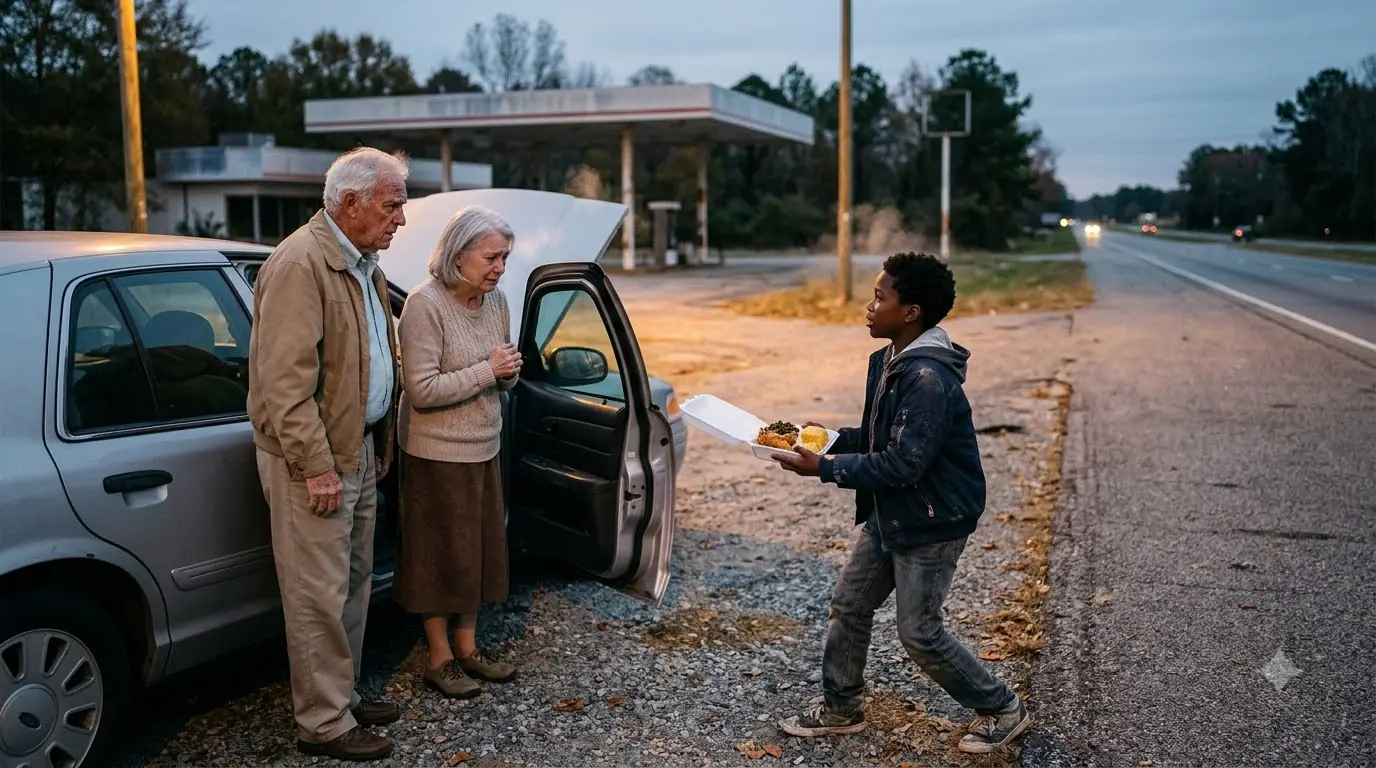
Too poor, too dark, too risky.
But this eleven-year-old boy did not calculate. He did not hesitate. He walked toward them. He had nothing, just a box of fried chicken that was supposed to be his dinner, his breakfast the next morning, and his only food. He gave it all away to strangers.
What Miles did not know, what he could not possibly know, was who those two old people really were and what they would do for him the very next day. This is that story. But first, you need to see where Miles came from.
Macon, Georgia, was a town the world had forgotten. Miles Edwards lived in a small house near the railroad tracks. Blue paint peeled from the walls, the porch steps creaked under every footstep, and the vegetable garden in the yard had seen better days. Inside, the house was clean, spotless, actually, but nearly empty. The furniture was decades old, and faded photographs covered the walls.
One photograph stood out. It showed a beautiful, smiling young woman holding a newborn baby. That was Miles's mother, and the baby was him. She had died two years earlier from cancer. There had been no insurance and no money for treatment. She fought as long as she could, and then she was gone.
Now Miles lived with his grandmother, Ethel Edwards. She was sixty-eight years old, a retired nurse with arthritis in both knees, high blood pressure, and not enough money to buy her medication every month. There were no photographs of Miles's father anywhere in the house. Not one.
Miles had asked about him many times. The answer was always the same. "Your daddy left when you were three. Don't waste your thoughts on someone who didn't want to stay."
So Miles stopped asking. But late at night, when the house was quiet and trains rumbled past, he would wonder, "What did I do wrong? Why didn't he want me?" They were questions with no answers.
Every morning, Miles woke at 5:30, before his grandmother and before the sun. He checked the kitchen cabinet first. That morning, like most mornings, it was nearly empty. There was half a box of oatmeal, a few cans of beans, and bread that was beginning to mold.
Miles made oatmeal for his grandmother and used the last of the brown sugar, all of it, for her bowl. His own bowl held only oatmeal and water, with no sugar and no milk. He told himself it did not matter. Grandma's knees hurt worse when it was cold, and she needed something sweet to start her day.
Before leaving, Miles touched the silver cross necklace hidden under his shirt. It had belonged to his mother and was the only thing he had left of her. "Mama, watch over us today," he whispered. Then he wrote a note and left it on the kitchen counter: "Gone to school. Love you, Grandma. Don't forget your medicine."
The walk to school was two and a half kilometers. No school bus came to his street anymore because of budget cuts. Miles walked past boarded-up houses, a church with a sign that read, "Free Lunch Every Wednesday," and Mr. Deacon's corner grocery store, where the old man waved to him every morning.
At the railroad tracks, Miles counted his steps. One hundred twenty-eight, the same number every day. He had been counting since he was seven years old.
On the way, he stopped to help Mrs. Patterson, an elderly neighbor, drag her trash can to the curb. She did not ask. He simply did it.
"Miles, you're such a good boy. Here, take a cookie."
"No, thank you, ma'am. Save it for your grandchildren."
He kept walking. He passed a group of older teenagers who sometimes gave him trouble. That day, they ignored him, and Miles breathed a little easier.
Near the tracks, he found a crushed soda can. He picked it up and put it in his backpack. Twenty more cans would bring him sixty cents. Every penny counted.
At Jefferson Middle School, Miles sat in the front row, always prepared and always paying attention. His teacher, Ms. Taylor, handed back a history test that day. Miles had scored ninety-eight percent. She stopped at his desk and looked at him with kind eyes.
"You have a gift, Miles. Don't ever let anyone tell you differently."
"Thank you, ma'am. I want to make you proud."
At lunch, Miles went through the free-lunch line. He received a small sandwich, an apple, and a carton of milk. That was all. He ate slowly and made every bite last. His friend Deshawn sat across from him, watching.
"Yo, did you just eat the apple core too?"
Miles smiled. "More fiber."
Deshawn laughed, but Miles was not joking.
After school, Miles did not go home. He went to the library. The only working computer was in the back corner, and he used it to search for scholarship programs: Gates Millennium, Posse Foundation, and QuestBridge. He wrote the names in a small notebook. They were his ticket out.
His plan was simple and clear, even if it seemed impossible for most people from his neighborhood. He would graduate from high school, earn a scholarship, become a doctor, and take care of his grandmother. Miles believed he could do it.
At 4:30 that afternoon, Miles left school and headed toward Oak Street Church. Every Friday, the church gave away leftover food from the week. That was how he and his grandmother ate on weekends. But Miles did not know that this Friday would be different.
He did not know that one mile away, a silver sedan was about to break down. He did not know that an elderly couple was about to be stranded in the cold. He did not know that everything was about to change.
On Highway 41, just past an abandoned gas station, the sun was setting quickly. The temperature had fallen to eleven degrees Celsius and was still dropping. Harold Whitmore was behind the wheel. He was seventy-four years old, with white hair, a calm face, and worried eyes.
His wife, Margaret, sat beside him. She was seventy-one and had spent forty years working as a pediatric nurse and caring for children. Now she was the one who needed help. They were taking an old-fashioned road trip with no GPS, only paper maps and the open road.
Then the engine coughed. Warning lights illuminated the dashboard. Harold pulled onto the shoulder just as the car died completely. He tried to restart it, but nothing happened, not even a click.
Margaret checked her phone. There was no signal. Harold checked his phone and found the same thing.
Margaret had circulation problems. In weather like this, her fingers turned white, then blue, then numb. Harold stepped out, opened the hood, and stared at the engine as if it were written in a foreign language. He knew nothing about cars.
A truck drove past. Harold waved, but it did not stop. Another car passed with the same result. A third driver slowed down, looked at them, and then sped away. Harold's shoulders dropped.
This is what the world looks like when no one knows your name, he thought.
In his pocket, he felt a keychain. He pulled it out without thinking, an old habit whenever he became anxious. Two letters were engraved on it: DW, for Daniel Whitmore, his son, who had died fifteen years earlier. Margaret saw him holding it, and her eyes softened with old grief. Neither of them spoke.
Behind them, the abandoned Sunoco station stood like a ghost. A faded sign read, "Closed. Thank You for 43 Years of Service." It was another reminder that this community had been left behind.
Half a mile away, Miles Edwards was taking his usual shortcut. He carried a Styrofoam container that was still warm. Mr. Deacon had stopped him outside the grocery store.
"Take this, son. I made too much. Don't argue with me."
Miles had tried to refuse, but Mr. Deacon would not hear it. Inside the box were fried chicken, collard greens, and cornbread, the most delicious meal Miles would have all week. He planned to split it with his grandmother, half that night and half the next day.
The smell drifted through the container, and his stomach growled. But as Miles approached the old Sunoco lot, he stopped. Something was different. A silver sedan stood with its hood open. An old man paced back and forth, while an old woman sat inside the car with her arms wrapped around herself.
Miles's first instinct was to keep walking. It was getting dark, and he did not know these people. In this part of town, a boy approaching a white couple's car could mean trouble. But then he looked closer. The old woman was shivering, her breath visible in the cold air, and the old man looked lost and defeated.
A voice echoed in Miles's head, his mother's voice. "Miles, you can't fix everything, but you can fix something."
He thought about his grandmother and how she shared her tea with neighbors even when they had almost nothing. He thought about Ms. Taylor telling him he had a gift. Then he looked at the food in his hands, the only valuable thing he owned. His stomach growled again.
Another car drove past the stranded couple without even slowing down. Miles watched the old man's shoulders sag. That was the moment. Miles took a deep breath. His stomach twisted with hunger, and he started walking toward them.
He did not know that within thirty minutes he would give away everything he had. He did not know that this old man had spent fifteen years searching for someone exactly like him. He did not know that the next day his whole life would change. All he knew was that two people needed help and that he could do something.
His worn sneakers crunched on the gravel as he crossed the parking lot. The old man turned around. For a moment, his posture stiffened, defensive and wary. Then he saw what was approaching.
It was a small boy wearing a thin jacket and an old backpack held together with safety pins. He carried a Styrofoam container. He was not a threat, just a child.
Miles stopped a few feet away and looked the old man in the eyes. "Excuse me, sir. Are you and your wife okay?"
Harold Whitmore looked at the boy standing before him. His jacket was torn and had no working zipper, and his backpack was held together with safety pins. Yet this child was asking whether they were okay.
"Car trouble," Harold said, his voice guarded. "We're fine. We're waiting for help."
Miles looked around. There were no other cars, houses, or lights except the dying sunset. "Have you been able to call anyone, sir?"
Harold hesitated. "No signal."
Miles nodded slowly as he thought. The car door opened, and Margaret stepped out, visibly shivering. Her lips had a slight blue tint. She looked at Miles, and something in her expression changed immediately. After forty years of working with children, she knew a good child when she saw one.
"Hello there," she said warmly despite the cold. "What's your name?"
"Miles, ma'am. Miles Edwards."
She smiled. "That's a beautiful name."
Miles noticed her trembling hands. Her thin sweater was not enough for the weather. "Ma'am, you should get back in the car. I'll figure something out."
Margaret and Harold exchanged a glance. This child, who was obviously poor and hungry, was trying to take care of them. Miles walked to the edge of the road and looked in both directions. It was empty.
Then he remembered that Mr. Earl's farm was about a mile and a half to the east. Mr. Earl had a truck and a telephone. Miles turned back to the couple.
"Sir, there's a farm about a mile and a half that way. Mr. Earl has a truck and a telephone. I can run there and be back in twenty minutes."
Harold shook his head. "Son, it's getting dark. You shouldn't."
"With all due respect, sir, your wife is cold, and I run fast."
Harold stared at the boy. Who was this child? But Miles was not finished. He looked down at the Styrofoam container in his hands. The smell of fried chicken filled the cold air, and his stomach screamed.
He opened the box. Inside were golden fried chicken, steaming collard greens, and warm cornbread. Margaret's eyes widened. Harold stood frozen. Miles held the box out to Margaret.
"Ma'am, this is still hot. Please eat. It'll help you stay warm."
"Oh, sweetheart, I can't take your food."
"I already ate, ma'am."
It was a lie. His stomach tightened. Margaret looked at the boy's hollow cheeks and at the hunger in his eyes that he was trying so hard to hide. She knew he was lying, but she also saw something rare. This child was giving his only meal to strangers without hesitation.
Harold watched the exchange, and something shifted in his face. His defensive posture melted away.
"Thank you, Miles," Margaret said softly as she accepted the container.
Miles nodded. Then he turned and started running. His worn sneakers pounded against the cold asphalt, and his backpack bounced with every stride. Darkness swallowed the road ahead, but he kept running.
Back at the car, Margaret opened the container. The chicken was still warm and perfectly seasoned. She took a small bite and closed her eyes.
"Harold, this is delicious. That boy gave us his dinner."
Harold did not respond. He was staring in the direction where Miles had disappeared.
"Did you see his jacket?" Harold asked quietly. "It doesn't even have a zipper."
"I saw. He lied about eating. His stomach was growling."
Margaret reached out and took Harold's hand. He pulled out the keychain again. The letters DW glinted in the fading light.
"Daniel would have done the same thing," Harold whispered.
"I know," Margaret said.
They sat in silence, remembering their son and thinking about the boy who had just run into the darkness to save two strangers.
Twenty-two minutes later, headlights appeared. An old pickup truck rumbled into the parking lot. Mr. Earl, a white farmer in his sixties, stepped out. Miles was in the passenger seat, breathing hard but smiling.
"You folks the ones with the dead car?" Mr. Earl asked.
"That's us," Harold replied.
"This boy ran almost two miles in the dark to get me. Nearly gave me a heart attack, banging on my door."
Miles climbed out of the truck, embarrassed. "I knocked normally, Mr. Earl."
"Son, you knocked like the police were coming to arrest somebody."
Mr. Earl connected jumper cables, and the sedan roared back to life. Harold reached for his wallet and pulled out several bills, with at least five hundred dollars visible.
"Please let me pay you for your trouble."
Mr. Earl waved him off. "Don't thank me. Thank the boy. He's the one who came running."
Harold turned to Miles. "Son, let me give you something for what you did."
Miles stepped back and shook his head. "No, thank you, sir. I didn't do it for money."
"Then at least let me..."
"Sir, my mama taught me that kindness isn't something you sell. It's something you give away. I'm just glad you and your wife are okay."
Harold stood speechless. In his seventy-four years, he had met thousands of people, including executives, politicians, and billionaires who would do almost anything for money. Yet here was an eleven-year-old boy, poor and hungry, who had given away his only meal and refused payment.
Harold looked at Miles, truly looked at him, and felt something he had not felt in fifteen years. Hope.
Fifteen years, he thought. Fifteen years I've been searching for someone like Daniel, and tonight, on this cold, dark road...
Margaret approached Miles and knelt to his eye level. "Miles, can you tell me where you live? I'd like to thank your family properly."
Miles hesitated, then nodded and gave them his address. Margaret smiled and gently touched his cheek.
"You're a special young man, Miles Edwards. Don't ever forget that."
Miles did not know what to say. No one had called him special in a long time. "Thank you, ma'am. Get home safely."
He watched the silver sedan drive away into the darkness. Then he turned and started walking home, hungry and cold, but somehow full.
The walk home felt longer than usual. The temperature had dropped below six degrees Celsius, and Miles's thin jacket did nothing against the wind. He shoved his hands into his pockets and kept moving. His stomach growled so loudly that he laughed.
"Shut up," he told it. "Tomorrow."
Even as he walked, Miles felt something strange. Peace. He thought about the old couple, the woman's kind eyes, and the man's face changing from suspicion to something softer. He wondered where they were from, why they had been on that road, and whether they would make it home safely.
When Miles reached his house, his grandmother was sitting on the porch, wrapped in a blanket and rocking slowly in her chair. The moment she saw him, relief flooded her face.
"Lord, child, I was worried sick. It's dark outside. Where's the food from the church?"
Miles stood at the bottom of the porch steps. He did not want to lie, but he did not want her to worry either.
"I gave it to someone who needed it more, Grandma."
Ethel studied her grandson's face, his hollow cheeks, tired eyes, and empty hands. Her expression shifted, pride mixing with sorrow.
"Come here, baby."
She pulled him into a tight hug and held him for a long moment. "Your mama would be so proud, Miles. Proud as the sunrise."
Miles felt his eyes sting and blinked the tears away. Inside, they ate what remained in the cabinet: canned beans, stale bread, and tap water. Grandma Ethel made it feel like a feast. She said grace, thanking God for another day and another chance to do good.
Miles watched her eat and noticed how she took smaller bites than usual, leaving more for him. He did not say anything, but he saw.
"You gave your food to strangers?" Ethel asked between bites.
"Yes, ma'am. An old couple. Their car broke down. The lady was shivering."
Ethel nodded slowly. "Your mama raised you right, Miles. Even from heaven, she's raising you right."
Miles's throat tightened, and he looked down at his plate. "I hope I did the right thing, Grandma."
Ethel reached across the small table and took his hand. "Baby, you always do."
That night, Miles lay on his mattress on the floor, staring at the ceiling. He was hungry but calm. He touched the silver cross necklace beneath his shirt.
"Mama," he whispered, "I hope you saw. I hope I made you proud."
Then he closed his eyes and drifted to sleep.
Miles did not know that at that very moment, fifty miles away, Harold Whitmore was wide awake in a hotel room with his laptop open and his phone pressed to his ear.
"Patricia, I need you to look into someone for me. A boy named Miles Edwards in Macon, Georgia. Tonight."
His wife, Margaret, sat nearby, still holding the empty Styrofoam container. She had not put it down since they arrived.
"What did you find?" Harold asked after a long silence.
He listened as the report came through. His face grew more serious with every word. Mother deceased from cancer two years earlier. Father had abandoned the family. Miles lived with his elderly grandmother, who had chronic health problems and no insurance. He was at the top of his class and enrolled in the free-lunch program.
Harold closed his eyes. "Patricia, I want a full report by morning."
He ended the call and looked at his wife. "That boy is exactly who I thought he was," Harold said quietly.
Margaret nodded. "He's like Daniel."
Harold stared out the window at the dark Georgia night. "Fifteen years, Margaret. Fifteen years I've been looking for someone like our son, someone who gives without expecting anything back."
He paused. "Tonight, on a cold highway, a hungry boy gave us his only meal and refused our money."
Margaret walked over and placed her hand on his shoulder. "What are you going to do?"
Harold's eyes were wet, but his voice was steady. "Tomorrow, we change that boy's life."
The next morning, Miles noticed something strange. A SUV was parked at the end of the street. Its windows were tinted, and it had not been there the day before. He watched it for a moment, but no one got out.
Probably lost, he thought.
At breakfast, Grandma Ethel mentioned something odd. "Someone called this morning asking about you."
Miles looked up from his oatmeal. "Who?"
"They didn't say. They asked where you went to school and what our situation was. I didn't tell them anything."
Miles thought about the old couple from the night before. Could the call be connected to them? He pushed the thought aside. It was probably a coincidence.
He went to school and came home early. The SUV was still there. At four o'clock that afternoon, Miles sat at the kitchen table doing homework while Grandma Ethel dozed in her chair by the window.
Then it came. Knock, knock, knock.
Miles jumped. The knock was firm and polite, but deliberate. Grandma Ethel woke.
"Who's that, baby?"
"I don't know, Grandma."
Miles walked to the door, his heart beating quickly. He peered through the peephole. A middle-aged white woman in a professional suit stood on the porch, and the SUV was parked behind her. Miles took a deep breath and opened the door.
The woman looked at him with warm eyes. "Miles Edwards?"
"Yes, ma'am."
"My name is Patricia Owens. I'm the executive director of the Second Chance Initiative."
Miles had never heard that name before. Patricia continued, "I'm here because a very special couple wants to thank you, the couple whose car broke down last night on Highway 41."
Miles's eyes widened. "The old man and woman?"
"That's right."
Grandma Ethel appeared behind Miles. Her eyes were cautious and protective. "Who are you? What do you want with my grandson?"
Patricia turned to her with a gentle smile. "Ma'am, I'm here to change your grandson's life for the better. May I come in?"
Ethel looked at Patricia, then at the SUV, and then back at the well-dressed stranger standing on her broken porch. Something in Patricia's eyes seemed genuine. Ethel nodded slowly.
"All right. Come in."
The door opened wider, and Patricia stepped inside. Miles watched her look around the small living room at the old furniture, faded photographs, and empty spaces. Patricia's eyes stopped on the photograph of Miles's mother.
Then she turned to him. "Miles, do you know who the couple you helped last night really are?"
Miles shook his head.
Patricia smiled. "Then let me tell you, because what I'm about to say is going to change everything."
Patricia sat at the kitchen table and motioned for Miles and Ethel to join her.
"Miles, the couple you helped last night are Harold and Margaret Whitmore."
She paused and let the name hang in the air. Grandma Ethel's hand flew to her chest.
"Lord Jesus," she whispered. "Lord Jesus."
Miles looked at his grandmother in confusion. "Grandma, do you know them?"
Ethel could not speak. Her eyes filled with tears. Patricia continued.
"Harold Whitmore founded Whitmore Capital Partners in 1979. At its peak, the company managed more than thirty billion dollars. Mr. Whitmore is one of the wealthiest men in Georgia, perhaps in the entire South."
Miles felt the room spin. Thirty billion dollars.
"That's right," Patricia said.
Miles thought about the night before, the old man in khaki pants, the old woman shivering in the car, and the fried chicken. "He's a billionaire, and I gave him my food."
"Yes," Patricia said. "And that's exactly why I'm here."
She pulled a folder from her bag. It contained official documents with a logo at the top that read, "Second Chance Initiative."
"Fifteen years ago, Mr. Whitmore lost his only son, Daniel. He died from a congenital heart condition at twenty-eight years old."
Patricia's voice softened. "Daniel was a remarkable young man. He volunteered at orphanages and gave money to homeless people. He used to skip lunch so he could give his food to classmates who had less."
Miles listened. Something about the story felt familiar.
"After Daniel died, Mr. Whitmore created the Second Chance Initiative. Its purpose was simple: to find young people who embodied Daniel's spirit, people who gave without expecting anything in return."
Patricia looked directly at Miles. "In fifteen years, Mr. Whitmore has met hundreds of candidates, but he has never personally selected anyone for the initiative."
She paused. "Until last night. Until you."
Miles could barely breathe. "Me?"
"Yes, Miles. You."
Patricia reached into the folder and pulled out a handwritten note. "Mr. Whitmore asked me to read this to you."
She began. "Miles, last night you gave away your only meal to two strangers. You ran almost two miles in the dark to find help. Then you refused payment because you believed kindness wasn't something you sold."
Patricia's voice wavered slightly as she continued. "My son Daniel was the same way. For fifteen years, I've searched for someone like him, someone who gives without counting the cost. Last night, on a cold highway, I found that person. You, Miles. I found you."
Grandma Ethel was sobbing quietly. Miles felt tears running down his own face.
"But," Patricia said, "before I tell you what Mr. Whitmore wants to do for you, he has one question."
Miles wiped his eyes. "What question?"
Patricia smiled. "If you had one million dollars, with no strings attached, what would you do with it?"
The room went silent. Grandma Ethel looked at Miles, and Patricia waited. Miles could have said anything: a new house, a car, or a trip around the world. Instead, he thought about his street, the church with the leaking roof, Mr. Deacon's store that was about to close, and the school library with too few books.
He thought about his grandmother and her medicine. He thought about Deshawn, Mrs. Patterson, and all the people who had nothing.
"I would fix this community," Miles said slowly. "The church needs a new roof. Mr. Deacon's store needs new equipment. The school library needs books."
He paused. "And I would make sure my grandmother has her medicine every month, no matter what. I would help the people who helped me."
Patricia's smile widened, and her eyes glistened. "That is exactly what Daniel would have said."
She stood. "And that, Miles, is exactly what Mr. Whitmore hoped you would say."
Just then, the front door opened. Harold Whitmore stepped inside. He was the same man from the night before, but now Miles saw him differently. This was not merely an old man in khaki pants. This was a man who could buy the entire town without thinking twice, and he had come to this tiny house to see Miles.
Harold walked straight to the boy. There was no handshake and no small talk. He knelt, a seventy-four-year-old billionaire on his knees before an eleven-year-old boy.
"Miles," Harold said, his voice trembling, "last night you gave me your only meal. You ran through the darkness to save strangers. You refused money because you believed kindness wasn't for sale."
Harold's eyes were wet. "My son was like you, and I have spent fifteen years looking for someone like him."
He placed a hand on Miles's shoulder. "Thank you, Miles. Thank you for reminding me that Daniel's spirit is still alive in people like you."
Miles could not hold back anymore. For the first time in the two years since his mother had died, he cried, not from sadness, but from being seen, valued, and loved.
Grandma Ethel wrapped her arms around him. Harold placed his other hand on her shoulder. Three generations, three strangers, stood in a tiny living room connected by kindness.
Patricia wiped her eyes and spoke. "Miles, Mr. Whitmore would like to tell you what he has prepared to offer you, your grandmother, and this entire community."
Miles looked up, still crying and trembling, but for the first time in a long time, he felt hope. Patricia pulled more documents from her folder, official letterhead, legal signatures, and the weight of real promises.
"Miles, the Whitmore Foundation would like to offer you the following."
Miles held his breath.
"First, for you personally," Patricia read from the document, "a full scholarship to any university you choose, undergraduate and graduate. Tuition, room, board, books, and living expenses will be fully covered. No repayment will ever be required."
Miles's mouth fell open.
"Additionally, we will establish a trust fund in your name. Fifty thousand dollars will be managed until you turn eighteen. Then it will be yours."
Grandma Ethel grabbed the edge of the table as her knees weakened. Patricia continued.
"Second, for your grandmother." She turned to Ethel with gentle eyes. "Mrs. Edwards, we understand that you've been managing chronic health conditions without adequate support. That ends today."
Ethel covered her mouth with one hand.
"You will receive full medical coverage, including specialists, medications, and home care if needed. Everything will be covered for life."
Tears streamed down Ethel's wrinkled cheeks.
"Third, for this house." Patricia gestured around the small living room. "The foundation will purchase this property and fund complete renovations, including a new roof, new plumbing, new electrical systems, insulation, air conditioning, and everything else this house needs."
She looked at Miles and his grandmother. "You will never have to worry about this home falling apart again."
The room was silent except for the sound of crying, but Patricia was not finished.
"Finally, and this is the part Mr. Whitmore is most excited about, we have something for the community."
She pulled out another document. "The Second Chance Initiative will establish a permanent program here in Macon. We are committing five million dollars over five years."
Miles stared at her. "Five million?"
"Yes. Five million dollars for education, small-business support, healthcare, and infrastructure."
Patricia pointed toward the window. "The church on Oak Street that needs a new roof, we'll fix it. Mr. Deacon's grocery store, we'll help him upgrade everything. Jefferson Middle School, we'll fund a new STEM lab and stock the library with three hundred new books."
She smiled at Miles. "All of this, Miles, because of you. You showed Mr. Whitmore that this community deserves a second chance."
Miles could not process it. His mind was overloaded. "But I just gave them some chicken."
Harold, who had been standing quietly by the door, stepped forward. "No, Miles. You gave us something no amount of money can buy."
He knelt again to meet Miles's eyes. "Fifteen years ago, I lost my son. After Daniel died, I thought that kind of pure goodness had disappeared from the world. I thought people cared only about themselves."
Harold's voice cracked. "Then last night, a hungry boy on a cold highway gave his only meal to two strangers and refused payment because his mother had taught him that kindness wasn't for sale."
Harold placed both hands on Miles's shoulders. "You didn't just help us, Miles. You restored my faith in humanity. That is worth more than all the money I have."
Miles looked at the billionaire kneeling before him and crying. "I don't know what to say, sir."
Harold smiled through his tears. "You don't have to say anything. Just promise me one thing."
"What's that?"
"Never change. Never stop being exactly who you are."
Miles nodded. "I promise."
Harold stood and extended his hand. Miles shook it. For a moment, the distance between them, billionaire and poor child, white and , old and young, disappeared completely. They were simply two people who believed in kindness.
Patricia cleared her throat gently. "There's one more thing. Mr. Whitmore would like to make a public announcement next month at City Hall. He wants the world to know about you, Miles, about what you did, and about what this foundation will do for Macon."
Miles shifted uncomfortably. "I don't need people to know."
Harold nodded approvingly. "I know you don't, and that's exactly why you should let them."
He put an arm around Miles. "The world needs to see that goodness still exists, that a boy with nothing can teach a man with everything. Your story will inspire others, Miles, more than you can imagine."
Miles looked at his grandmother. She was still crying, but she was smiling now too.
"What do you think, Grandma?"
Ethel wiped her eyes and took a deep breath. "I think your mama is looking down from heaven right now, and she is smiling bigger than she ever smiled before."
Miles felt the silver cross beneath his shirt. "Okay," he said quietly. "I'll do it."
Harold smiled, and Patricia made a note in her folder.
"Then it's settled," Harold said. "One month from now, we announce everything. And Miles, from this day forward, your life will never be the same."
Miles nodded. He still could not believe it. One meal, one cold night, one choice, and everything had changed.
Three days later, everything seemed perfect. Miles and his grandmother were working with Patricia on the paperwork. The foundation had already sent contractors to assess the house, and a doctor's appointment had been scheduled for Grandma Ethel. It felt like a dream, but not everyone was happy.
That afternoon, while Miles was at school, Grandma Ethel was home alone. A Mercedes, different from the SUV, pulled up in front of the house. A man in his late thirties stepped out. He wore an expensive suit, had slicked-back hair, and cold eyes.
He walked up the creaking porch steps and knocked. Ethel opened the door.
"Mrs. Edwards, I'm Victor Whitmore, Harold Whitmore's nephew."
Ethel felt a chill that had nothing to do with the weather. "What can I do for you?"
Victor did not wait for an invitation. He stepped inside and looked around the small living room with visible disgust.
"I'll be direct, Mrs. Edwards. My uncle is a good man, too good, but he's seventy-four years old. Sometimes he makes decisions that aren't sound."
Ethel straightened her spine. "I don't understand."
Victor turned to face her. His smile did not reach his eyes. "The Whitmore family has lawyers, many lawyers. If there is any evidence that someone is taking advantage of an elderly man's generosity, we will act."
Ethel's blood went cold. "We're not taking advantage of anyone."
"Perhaps not, but appearances matter, don't they?"
Victor reached into his jacket and pulled out an envelope. He placed it on the table.
"Fifty thousand dollars in cash. Sign this paper agreeing to refuse any further contact with my uncle, and it's yours. No complications. No lawyers."
Ethel looked at the envelope and then at Victor. Her hands were shaking, but not from fear. They were shaking with anger.
"Get out of my house."
Victor's smile faded. "You have forty-eight hours to think about it. After that, things will become much more complicated."
He straightened his tie and walked out. The Mercedes drove away. When Miles came home, he found his grandmother sitting in her chair and trembling, with the envelope of cash still on the table.
"Grandma, what happened?"
She told him everything, including Victor's threats and the money. Miles looked at the fifty thousand dollars, more money than his family had ever seen, but he did not touch it.
"Grandma, he's trying to scare us."
"I know, baby, but I'm afraid. I don't want trouble."
"Mr. Harold isn't like that. I saw how he looked at me. He's not being fooled. He knows what he's doing."
Ethel's eyes filled with tears. "But what if they sue us? We can't afford lawyers."
Miles was quiet for a moment, and then he stood. "I'm calling Patricia."
He found the business card Patricia had left and dialed the number.
"Ms. Patricia, it's Miles Edwards. Something happened. Someone came to our house."
He explained everything: Victor, the threats, and the money. Patricia listened, and her voice grew harder with every detail.
"Miles, Victor has no authority whatsoever. Mr. Harold is completely mentally sound and has full control over his money. Victor has done this before. He has tried to intimidate people Mr. Harold wanted to help."
"What can we do?"
"Don't worry. Mr. Harold already knows, and he's on his way."
Miles ended the call and looked at his grandmother. "She said Mr. Harold knows. He's coming."
Ethel nodded slowly, but worry still clouded her eyes. "I hope she's right, baby. I hope she's right."
That night, neither of them slept well. Victor had planted a seed of fear, but Miles refused to let it grow. He remembered what his mother had taught him: being afraid did not mean you should not act. It meant that what you were doing was important.
The next day, he would face Victor, and he would not back down.
Harold arrived at the Edwards house the following day, but he was not alone. Patricia was with him, along with a man in a suit carrying a briefcase. He was a lawyer. Victor was there too, confident that his threats had worked. He was wrong.
"Victor." Harold's voice was still. "You came to this house. You threatened an elderly woman. You tried to bribe a child."
Victor's smug expression flickered. "Uncle Harold, I was only protecting..."
"Silence."
Victor's mouth snapped shut. Harold stepped closer to his nephew.
"You weren't protecting anyone. You were protecting your inheritance, the money you think you're entitled to."
Victor's face went pale. Harold continued.
"Did you think I wouldn't find out? Did you think I didn't know about the other families you've intimidated over the years?"
The room was completely quiet.
"I stayed silent because you're family, but today you went too far."
Harold straightened his shoulders. "Effective immediately, you are removed from the initiative's board. You will have no voice in any foundation decisions."
Victor's eyes widened. "You can't."
"I just did. And if you continue to harass this family or anyone else, I will revisit my entire will. Do you understand?"
Victor looked around the room at Harold, Patricia, the lawyer, Ethel, and Miles. No one was on his side. He turned to Miles, his voice bitter.
"You think you won, boy?"
Miles stood his ground and looked Victor directly in the eyes. "I wasn't trying to win anything. I was just trying to make sure nobody bullied my grandmother."
Something in Victor's expression cracked. He grabbed the envelope of cash from the table and walked out without another word. The door slammed behind him. The Mercedes drove away, and just like that, it was over.
Ethel collapsed into her chair, crying with relief. "I'm so sorry, Mr. Whitmore. I almost believed him."
Harold walked over and knelt beside her. "You have nothing to apologize for. Victor is skilled at manipulation, but he won't bother you again."
He looked at Miles. "You stood up to him. You weren't afraid."
Miles shrugged. "I was scared. But my mama taught me that being scared doesn't mean you don't act. It means you're doing something that matters."
Harold smiled, a real smile that was warm and full. "Daniel used to say the same thing."
He placed a hand on Miles's shoulder. "You're even more remarkable than I thought, Miles Edwards. Now, with Victor out of the way, we can focus on what matters."
He looked at Patricia. "Let's move forward. The announcement, the scholarships, the community investment, all of it."
Patricia nodded. "It's already in motion, sir."
Harold turned back to Miles and Ethel. "From today on, there will be no more interruptions and no more threats, only change. Real change."
He extended a hand to Miles. "Partners?"
Miles shook it firmly. "Partners."
One month later, the announcement came. City Hall was packed with local news cameras, national reporters, and people eager to hear the story. Harold Whitmore stood at the podium for his first public appearance in fifteen years.
"Today, I am announcing the creation of the Macon Community Investment Program, a five-million-dollar commitment over five years."
The crowd murmured.
"But this program was not my idea. It was inspired by someone else."
Harold turned and gestured toward the side of the stage. "A boy named Miles Edwards, eleven years old. He taught me something I had forgotten."
Miles walked out, shy in his new button-down shirt. The crowd applauded.
"One month ago, my wife and I broke down on Highway 41. We were stranded, cold, and helpless. Three cars passed us without stopping."
Harold's voice thickened with emotion. "Then Miles appeared, a poor boy with nothing but a box of fried chicken. He gave us his only meal. He ran two miles through the darkness to find help. When I tried to pay him, he refused."
Harold looked at Miles. "He told me his mother had taught him that kindness wasn't something you sold. It was something you gave away."
The room was silent.
"That night, Miles Edwards reminded me why I started the Second Chance Initiative: to find people like my son, Daniel, people who give without counting the cost."
Harold wiped his eyes. "Today, in partnership with Miles and this community, we begin something new."
A reporter raised his hand. "Miles, how does it feel?"
Miles leaned toward the microphone. "I just gave away some chicken. I never thought it would turn into all this."
The room laughed and then erupted in applause. The headlines wrote themselves: "Eleven-Year-Old Gives Away Only Meal, Triggers Five-Million-Dollar Community Investment."
The story went viral, but the real impact was local. Jefferson Middle School received a new STEM lab and three hundred new books for its library. A bronze plaque at the entrance named it the Daniel Whitmore Memorial Library.
Ms. Taylor cried when she saw it. "I always knew you'd change things, Miles."
Mr. Deacon's grocery store received new equipment, new refrigerators, and a fresh-produce section. He stood in the middle of his renovated store and shook his head.
"I gave that boy a box of chicken. He gave me back my whole business."
Oak Street Church received a new roof and new pews. Its first community dinner served more than two hundred people. Grandma Ethel went to a doctor for the first time in years and received a full checkup. Her blood-pressure medication was finally consistent, and she walked a little straighter afterward.
The Edwards house was transformed with new paint, a new roof, and new windows. Ethel stood on her repaired porch and cried happy tears.
"I never thought I'd see this house looking so good."
The ripple reached farther. Deshawn, Miles's friend, applied for mentorship through the initiative and was accepted.
"Miles told me to apply," he said. "He said if he could be helped, so could I."
Mrs. Patterson's medical bills were paid. She brought Miles cookies every week, and now he finally accepted them. Mr. Earl's farm was saved from foreclosure. Whenever he drove past the Edwards house, he honked twice.
"I just opened my door that night," Mr. Earl said. "That boy did all the rest."
National news outlets ran the story, and other communities contacted the initiative. But for Miles, the biggest change was quieter. Every Friday afternoon, volunteers gathered at the new Macon Community Center, built on the lot where the abandoned Sunoco station had once stood. They handed out free meals to travelers on Highway 41.
Leading them was an eleven-year-old boy with a silver cross beneath his shirt. Some things had changed beyond recognition, but Miles Edwards remained exactly who he had always been.
One year later, Miles stood on Highway 41, on the same stretch of road where it had all begun. Everything was different now. The abandoned Sunoco station was gone. In its place stood the Macon Community Center. A bronze sign at the entrance read, "Built Through Kindness."
Every Friday, Miles and a team of volunteers handed out free meals to anyone who needed them. That afternoon, they served twenty-eight people: a truck driver who had not eaten since morning, a single mother traveling with three children, and an elderly man who reminded Miles of Harold.
Each person received food, water, and directions to wherever they needed to go. Each one heard the same words: "No payment necessary. Kindness isn't something you sell."
As the sun began to set, Miles helped pack the last of the supplies. Deshawn nudged him.
"Yo, do you ever think about how wild this is? One year ago, you were walking this road with an empty stomach."
Miles smiled. "I try not to think about it too much."
"Man, you changed the whole town."
Miles shook his head. "I just gave away some chicken. Everyone else did the rest."
That evening, Miles sat on his grandmother's porch. The house looked beautiful, with fresh blue paint, sturdy steps, and a garden that was finally thriving. Grandma Ethel rocked in her chair beside him as stars appeared in the sky.
"Do you know what your mama would say if she could see you?" Ethel asked.
"What, Grandma?"
"She would say, 'That's my boy. That's my Miles.'"
Miles looked up at the sky. His hand moved to the silver cross beneath his shirt.
"I hope she can see, Grandma."
Ethel smiled, her eyes glistening. "Oh, baby, she sees. She always sees."
They sat in comfortable silence. The neighborhood was quiet and peaceful. A car drove past, and the driver honked and waved. Miles waved back. He did not know the driver, probably someone who had heard the story and wanted to say thank you. That happened often these days.
Miles pulled the silver cross out from beneath his shirt and looked at it for a long moment before tucking it back in. Some things you kept close to your heart. Some things you did not need to show the world. You only needed to know they were there.
The porch light flickered on. Grandma Ethel hummed an old hymn, and Miles Edwards, the boy who had given away his only meal, sat in the soft glow of everything that kindness had built.
This is where the story ends. But for Miles, it was only the beginning.