You see the leather.
You see the death’s-head patch.
You cross the street.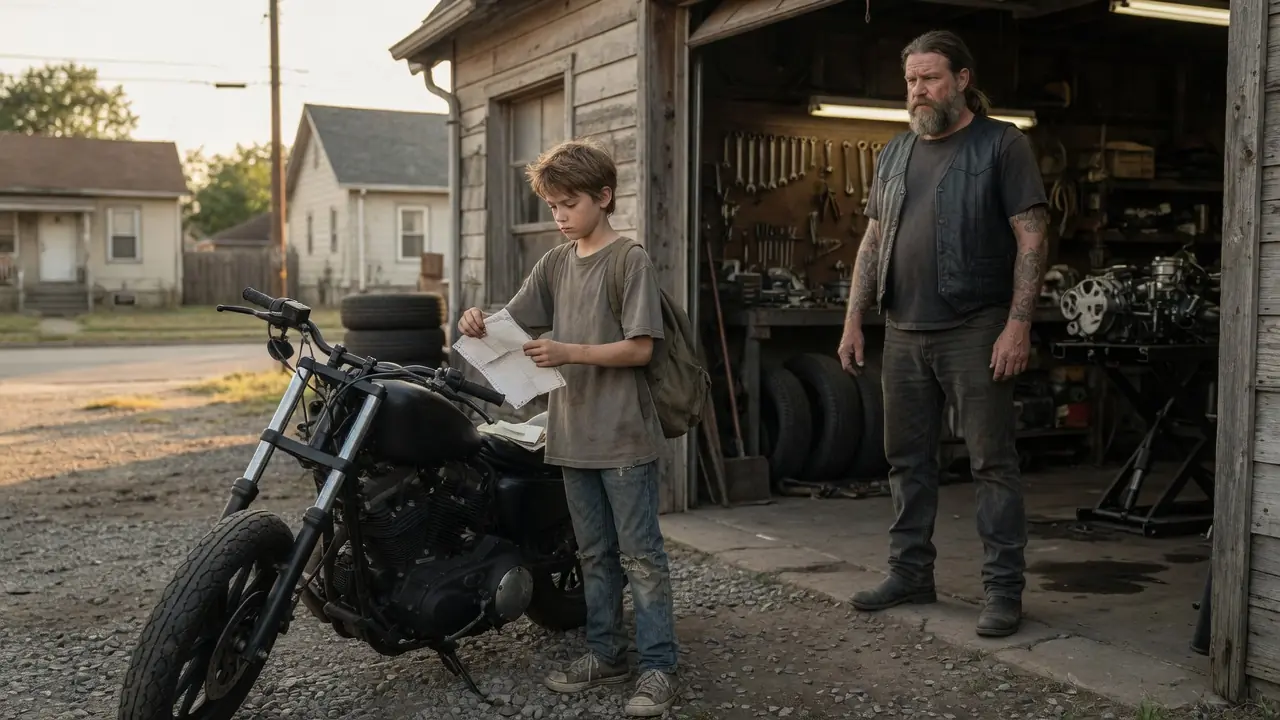
That is the rule.
But a terrified ten-year-old did not have the luxury of fear. He had a dull pencil, torn paper, and ten seconds to make a choice that would either save his life or end it.
The August heat radiating off the asphalt was thick enough to chew. Dutch pushed through the glass doors of the diner, the bell above him chiming a tinny, cheerful sound that felt entirely out of place against the heavy thud of his boots.
He dug a crushed pack of cigarettes from his denim vest. His knuckles were thick, scarred from decades of bad choices and hard concrete. He paused under the buzzing neon sign, struck a match, took a drag, let the smoke fill his lungs, and exhaled into the stifling afternoon air.
Out in the lot, his Harley sat baking in the sun.
It was a beautiful machine, stripped down and mean, matte black with chrome pipes that could wake the dead. Dutch loved the bike more than he loved most people.
People complicated things.
People talked.
The bike just demanded oil, gas, and a firm hand.
He walked over, gravel crunching under his soles, and reached for the handlebars.
That was when he saw it.
Jammed right between the throttle cable and the leather grip was a piece of paper.
It was not a flyer. It was torn from a cheap spiral notebook, the frayed edges fluttering weakly in the dry breeze.
Dutch froze.
A muscle in his jaw ticked.
You did not touch an Angel’s bike.
It was not just a rule.
It was a religion.
His eyes darted around the parking lot. A rusted-out sedan, a delivery truck, and a couple of stray gulls picking at a discarded fry. Nothing moved. Nobody was stupid enough to mess with his ride and stick around to see the fallout.
He pinched the paper between two thick fingers and pulled it free.
He expected a parking warning.
A noise complaint from some suburban hero.
Instead, he found a message written in the frantic, unsteady block letters of a child.
They are going to kill my dog today.
He said he will hurt my mom next.
I don’t have money.
Please, you look scary.
Make them stop.
Leo.
Dutch stared at the graphite smudges on the lined paper. The words were pressed so hard into the page that the pencil had nearly torn through the cheap pulp.
“You look scary.”
Dutch snorted, a harsh, humorless sound.
He was scary.
He was a patched member of the Angels. He had done time. He had broken bones. He did not do charity, and he certainly did not do neighborhood pest control for ten-year-olds.
He moved to crumple the note and toss it into the grease-stained gutter.
It was not his problem.
His hand tightened into a fist around the paper.
He stepped toward the bike.
Then he heard it.
A sharp, ragged intake of breath.
Dutch stopped.
He did not turn his head. He just shifted his eyes toward the sound.
It came from the alley gap between the diner and the adjacent laundromat. A shadow shifted against the brick.
A worn-out canvas sneaker, held together by a prayer and a strip of silver duct tape, poked out from behind the rusted husk of an industrial dumpster.
Dutch sighed.
A long, heavy sigh that carried forty-eight years of exhaustion.
He dropped his cigarette and ground it out thoroughly with the heel of his boot.
He did not walk toward the alley. He leaned against the leather saddle of his bike, crossed his arms over the heavy club patches on his chest, and waited.
“I can see your shoe, kid,” Dutch said.
His voice was like a cement mixer grinding gravel.
Low.
Rough.
The sneaker twitched.
Silence stretched out, punctuated only by the distant whine of a police siren on the highway.
“You got two seconds to come out,” Dutch said, not raising his voice. He did not need to. “Before I get on this bike and leave.”
A small figure stepped out from the shadows.
Dutch’s expression did not change, but something behind his ribs gave a dull throb.
The kid, Leo, was tiny. Skinny arms poked out of an oversized faded gray T-shirt. His jeans were stained with motor oil and grass.
But it was his face that told the story.
There was a fading yellowish bruise along his left cheekbone, right under an eye that looked too old for a face that young.
He was shaking.
Visibly trembling.
But he did not run.
“You Leo?” Dutch asked.
The boy swallowed hard and nodded once.
“You know whose bike this is?”
Another nod.
“You know what my patch means?”
Dutch tapped the winged skull on his leather.
“It means people don’t mess with you,” Leo said.
His voice was a thin reed, terrified but steady.
Dutch uncrossed his arms. He looked at the crumpled note in his hand, then back at the boy.
The cynical side of him, the side that had kept him alive in prison, the side that navigated the violent politics of the club, screamed at him to get on the Harley, rev the engine, and disappear.
It was a domestic mess.
Dangerous.
Pointless.
“Who’s he?” Dutch asked.
“Frank,” Leo whispered. “My mom’s boyfriend. He drinks. He gets mad. My dog, Buster… Buster bit him yesterday when Frank was yelling at my mom. Frank locked Buster in the shed. He said when he gets home from work today, he’s getting his gun.”
Dutch looked at the kid’s duct-taped shoe.
He looked at the fading bruise on his cheek.
He remembered a time, decades ago, before the leather, before the brotherhood, when he was just a skinny kid with a broken nose, hiding in a closet while the house tore itself apart.
Dutch shoved the note into his pocket.
“Where do you live, Leo?”
The boy pointed down the avenue.
“Four blocks down. The green house with the dead grass.”
Dutch did not smile.
He did not offer a comforting platitude.
He just nodded.
“Go home. Sit on your front porch. Wait.”
Leo hesitated. His eyes darted to the massive black motorcycle, then up to the towering bearded man standing beside it.
“Are you going to help?”
“I said wait on the porch,” Dutch repeated, turning his back to the kid.
It was a dismissal, clear and final.
He heard the rapid scuffling footsteps of the boy running off toward the avenue.
Dutch waited until the sound faded completely before he reached into his denim cut and pulled out his cell phone. The screen was cracked. He dialed a number from memory.
It rang twice.
“Yeah,” a voice rumbled on the other end.
“Bear, where are you?” Dutch asked.
“Shop. Me and Reno are replacing a clutch on the Softail. Why?”
“Put the wrenches down. Get on your bikes. Meet me at the diner.”
“We got club business?” Bear asked.
The casual tone dropped instantly, replaced by a cold, professional edge.
“No,” Dutch said.
He looked down at his heavy boots.
“Got a pest control problem. Might need to look scary.”
There was a brief pause.
“Ten minutes,” Bear said.
Then the line went dead.
Dutch stood in the parking lot while the sun beat down, baking the asphalt.
He did not want to do this. The club had enough attention from local law enforcement without sticking their noses into domestic trouble.
But the image of that kid’s shoe, the desperation of jamming a torn piece of paper onto an outlaw’s bike, lodged in Dutch’s throat like a fishbone.
You did not ask the devil for help unless heaven had completely turned its back on you.
Twelve minutes later, the air split with the concussive roar of twin V-twin engines.
Bear and Reno pulled into the lot.
Bear was a mountain of a man, wide as a refrigerator, his beard a tangled gray mess over his chest. Reno was younger, wiry, with a map of prison ink crawling up his neck and a volatile energy that crackled around him like static.
They kicked their stands down in unison.
“Talk,” Bear said, pulling off his leather gloves.
Dutch gave it to them straight.
No embellishments.
The kid.
The note.
The dog in the shed.
The boyfriend named Frank.
Reno spat on the ground.
“We’re running an animal rescue now, Dutch? I got half a transmission sitting on the floor.”
“I didn’t ask if you wanted to adopt a puppy, Reno,” Dutch said, his voice dropping into a register that made the younger biker shut his mouth. “I told you to ride out. You want to go back to the shop, go back to the shop.”
Bear looked at Dutch.
They had ridden together for twenty years. They had bled in the same dirt.
Bear did not ask questions.
He just strapped his gloves back on.
“Four blocks down,” Dutch said. “Green house. Dead grass.”
They mounted up.
The three Harleys roared to life, a deafening, unified thunder that shook the windows of the diner.
They pulled out onto the avenue, riding side by side.
Traffic parted for them.
It always did.
The neighborhood shifted quickly from commercial strips to residential decay. Houses with peeling paint, sagging porches, and chain-link fences holding in dirt yards.
They spotted the green house easily.
It looked exactly as Leo had described.
The siding was rotting. The front yard was a patch of baked mud and weeds.
And sitting on the top step of the concrete porch, knees pulled to his chest, was Leo.
When the three massive bikes pulled up to the curb, the noise was absolute.
Curtains in the neighboring houses twitched.
Doors locked.
The Angels had arrived on Elm Street.
Dutch cut his engine.
Bear and Reno followed.
The sudden silence was heavy, broken only by the ticking of the cooling exhaust pipes.
Dutch swung his leg over the saddle and walked up the cracked concrete path. Bear and Reno flanked him, a wall of leather, denim, and bad intentions.
Leo stood up, his eyes wide, terrified all over again.
He had not expected three of them.
“Where’s the shed?” Dutch asked.
Leo pointed a trembling finger toward the back of the house.
Dutch did not wait.
He walked around the side, his heavy boots crunching on broken glass and dried leaves. The backyard was a graveyard of rusted car parts and empty beer cans.
At the far end stood a dilapidated wooden shed, secured with a heavy rusted padlock.
As they got closer, they could hear it.
A low, miserable whimpering.
Scratching at the wood.
Reno stepped up, examining the padlock.
“Cheap master lock. I can pick it.”
“Move,” Bear grunted.
He did not wait for Reno to get his tools.
Bear lifted his size-fourteen boot and kicked the shed door right next to the hasp. The rotting wood splintered instantly. The screws tore out, and the door swung open violently.
Inside, tied to a lawn mower with a frayed piece of nylon rope, was a mutt.
Part terrier.
Part something else.
Ribs showing.
Shaking just like the boy out front.
The dog cowered, whining at the sight of the giant men filling the doorway.
Dutch walked in, pulled a heavy buck knife from his belt, and sliced the rope in one fluid motion.
He did not try to pet the dog.
He just stepped back.
The dog bolted out the door, making a beeline for the front yard.
“Now what?” Reno asked, looking at the broken door.
“Now,” Dutch said, slowly folding his knife and sliding it back into its leather sheath, “we wait for Frank.”
Buster did not run far.
The scruffy terrier sprinted around the side of the house, claws scrabbling frantically on the cracked concrete path, and launched himself directly into Leo’s arms.
The boy collapsed onto the dead grass of the front yard, burying his face in the dog’s matted fur.
He did not cheer.
He did not yell.
He just let out a hollow, shuddering sob that felt too heavy for his narrow chest.
Dutch watched from the corner of the house.
He felt the familiar dull ache in his knuckles, a phantom pain that always crept up when trouble was brewing.
He stepped up onto the porch. The wooden planks groaned under his heavy boots.
The front door squeaked open on rusted hinges.
A woman stood in the threshold behind the torn mesh of the screen door.
She looked to be in her early thirties, but exhaustion had carved deep lines around her mouth and eyes. She wore a faded blue uniform shirt from a local grocery store. Faded yellow bruises bloomed along her collarbone, disappearing beneath the cheap fabric.
She saw Buster.
She saw Leo on the lawn.
Then she looked up and saw three massive men wearing death’s-head patches standing on her property.
All the blood drained from her face.
Her hand shot up to her mouth, stifling a gasp.
“Ma’am,” Dutch said.
His voice was gravel, flat and devoid of warmth.
“I suggest you go inside and grab a garbage bag.”
She blinked, paralyzed by panic. Her eyes darted from Dutch to Bear, who was standing solidly by the porch railing, looking like a brick wall in a denim cut.
“Who are you?” she whispered. “Did Frank send you?”
Reno barked a short, ugly laugh.
“Frank doesn’t have the cash to send us to the corner store, lady.”
“We’re here for the kid,” Dutch said, cutting Reno off with a sharp glare.
He looked back at the mother.
“Leo left a note on my motorcycle. Said a guy named Frank was going to shoot his dog and put hands on you. Dog is out of the shed. Now we’re waiting for Frank.”
The woman’s name tag read Diane.
She trembled.
“You can’t be here. When he gets off work, he drinks at the tavern by the highway. But when he gets home, if he sees you—”
“If he sees us, he’s going to pack his things,” Dutch interrupted calmly. “Go get a garbage bag, Diane. Frank is moving out today.”
She hesitated, her survival instincts warring with her sheer terror of the men on her porch.
But something in Dutch’s deadpan certainty broke through her panic.
She nodded slowly and retreated back into the dark hallway of the house.
Dutch sat down on a dilapidated wicker chair. It shrieked under his weight, but held.
Bear leaned against a wooden support pillar, pulling a small folding knife from his pocket and idly cleaning dirt from under his fingernails.
Reno paced the short length of the porch, restless energy radiating off him.
He hated sitting still.
They waited.
The afternoon heat baked the neighborhood into submission.
Across the street, the curtains of a yellow house twitched.
Someone was watching.
Dutch did not care.
Let them watch.
A community that turned a blind eye to a bruised woman and a terrified kid did not have the right to complain about the company she kept.
Forty-five minutes bled away.
The shadow of the porch stretched out over the dead lawn.
Leo remained sitting in the dirt, clutching Buster, his eyes fixed down the avenue.
Then the low, unhealthy rumble of a failing exhaust pipe broke the silence.
A dented blue pickup truck turned the corner. It swerved slightly, the driver taking the turn too wide and correcting with a jerk of the steering wheel.
The truck bounced over the dip in the driveway and came to a halt on the dirt lawn, inches from Leo.
The driver’s side door groaned open.
Frank stepped out.
He was remarkably average.
A thick waist, thinning hair plastered to his forehead with sweat, and a stained gray work shirt stretched tight over his gut.
He held a half-empty bottle of cheap beer in his left hand.
He looked at Leo, his face instantly twisting into a sneer.
“What the hell did I tell you about that mutt, you little—”
Frank’s voice died in his throat.
He noticed the three massive black motorcycles parked on the curb.
The chrome gleamed menacingly in the late afternoon sun.
Then his eyes traveled up the cracked concrete path to the porch.
Three men in black leather stared back at him.
Nobody moved.
Nobody said a word.
Frank lowered the beer bottle.
His alcohol-flushed face went pale, a sickly gray replacing the angry red. He swallowed hard, his Adam’s apple bobbing in his thick neck.
He tried to puff out his chest, a pathetic display of territorial dominance that evaporated instantly under the heavy, unblinking gaze of the three Angels.
“Who the hell are you guys?” Frank asked.
His voice lacked the booming authority he used on women and children.
It sounded thin.
Weak.
Dutch stood up slowly.
He did not rush.
He took his time walking down the three wooden steps, his heavy boots crunching on the gravel path.
He stopped four feet from Frank.
Up close, the size difference was jarring.
Dutch towered over him, shoulders twice as wide, arms thick with muscle and faded prison ink.
Dutch looked at the beer bottle in Frank’s hand.
He looked at the heavy steel-toe boots Frank wore.
Then he looked dead into Frank’s bloodshot eyes.
“You Frank?” Dutch asked softly.
“Yeah. This is my house,” Frank stammered, trying to hold his ground but instinctively leaning backward. “What are you doing on my property?”
“You got a gun in that truck, Frank?” Dutch asked, completely ignoring the question.
Frank blinked, sweat beading on his upper lip.
“That’s none of your damn business. I’m calling the cops.”
He reached a shaky hand toward the pocket of his greasy jeans.
Bear shifted on the porch.
Just a slight movement, but the timber creaked loudly.
Reno stopped pacing and smiled.
It was not a friendly smile.
“You reach for that phone,” Dutch said, his voice dropping an octave, “and you’re going to have a much worse afternoon than the one you’re already having. Then we’re going to check that truck for the gun.”
Frank’s hand froze, hovering over his pocket.
He looked at Bear.
He looked at Reno.
The reality of the situation crashed down on him, crushing the last remnants of his drunken bravado.
He was not dealing with a scared kid anymore.
He was standing in front of men who understood fear as a language.
“What do you want?” Frank whispered, the beer bottle shaking in his grip.
“You’re going to walk inside,” Dutch told him, stepping one inch closer, invading Frank’s space until Frank could smell the stale tobacco and engine oil radiating off the biker’s leather. “You’re going to grab whatever fits in a single garbage bag. Then you’re going to leave. You are never coming back to this zip code.”
Frank’s jaw tightened.
A flash of stubborn pride flared in his eyes.
“You can’t make me leave my own house. I pay the rent here.”
Dutch did not blink.
He just stared.
Cold.
Hollow.
“I’m not asking for your lease agreement, Frank. I’m telling you how you get through today.”
Frank broke.
The fleeting spark of defiance extinguished as quickly as it had ignited.
He dropped the beer bottle. It shattered on the concrete, splashing cheap amber liquid over his steel-toed boots.
He did not look down.
He kept his eyes locked on Dutch’s chest, unable to meet the biker’s cold stare.
“All right,” Frank muttered, his voice barely audible over the distant drone of highway traffic. “All right, man. Just take it easy.”
Dutch stepped aside, gesturing toward the front door.
“Ten minutes, Frank. Make them count.”
Frank shuffled past him, head down, his posture crumpled.
As he climbed the porch stairs, Bear detached himself from the wooden pillar and followed the man inside.
Bear did not say a word.
The screen door slammed shut behind them, leaving an oppressive silence in its wake.
On the lawn, Leo tightened his arms around Buster. The boy stared at Dutch with a mixture of raw awe and lingering terror.
Diane stepped out onto the porch. She clutched her arms across her chest, shivering despite the stifling August heat. She looked at Dutch, her eyes wide, searching his scarred face for a catch.
People in her world did not do favors for free.
There was always a bill.
Always a consequence.
“Why are you doing this?” she asked, her voice trembling. “What do you want?”
Dutch pulled his crushed pack of cigarettes from his vest. He tapped one out, placed it between his lips, and struck a match.
The flare illuminated the deep lines around his eyes.
“I don’t want anything from you, Diane. Your kid left a note on my bike. That’s a good way to get himself in trouble where I come from, but he had the guts to do it anyway.”
He took a drag, blowing the smoke away from the woman and the kid.
“Listen to me,” Dutch continued, his tone grounding her, forcing her to focus. “We’re not the cops. We’re not neighborhood watch. We leave today. We’re not coming back. If he shows up tomorrow, that’s on you. Change the locks tonight. File the paperwork in the morning. Get help from whoever you can trust. You protect that kid, because no one else is going to do it for you.”
Diane swallowed hard, tears finally spilling over her lashes.
She nodded, wiping her cheek with the back of her hand.
“I will. I promise.”
“Good,” Dutch grunted.
He was not looking for gratitude.
He was looking for a guarantee that he had not wasted his afternoon.
Eight minutes later, the screen door banged open.
Frank stumbled out.
He was clutching a black plastic lawn bag bulging with clothes, a tangle of charging cables, and a pair of boots.
Bear walked slowly behind him, his heavy boots thudding rhythmically on the floorboards.
Frank scurried down the steps and threw the garbage bag into the bed of his rusted truck.
He did not look at Diane.
He did not look at Leo.
He opened the driver’s side door and scrambled inside, his hands shaking so violently he fumbled with the ignition keys.
Reno walked over to the driver’s side window.
He leaned his forearms against the door, putting his tattooed face inches from the glass.
“Hey, Frank,” Reno said cheerfully.
Frank cranked the window down two inches, his eyes darting frantically.
“What?”
Reno smiled.
“I’ve got a good memory. I know your license plate. I know what your face looks like. If I ever see this truck parked within five miles of this house, you are going to regret coming back. You understand me?”
Frank nodded vigorously, his face slick with sweat.
“I’m gone. I’m gone.”
Reno slapped the roof of the truck hard enough to leave a dent.
“Drive.”
The truck engine roared to life, coughing a cloud of blue smoke from the tailpipe. Frank slammed it into reverse, tires spinning over the dirt lawn, tearing up the remaining dead grass.
He threw it into drive and sped down the avenue, not bothering to check for oncoming traffic.
In less than thirty seconds, he was a speck at the end of the block.
And then he was gone completely.
The silence returned.
Heavier this time, but the suffocating tension had evaporated.
The air felt breathable again.
Dutch dropped his cigarette onto the concrete and crushed it beneath his heel.
He did not offer a dramatic farewell.
He did not pat Leo on the head.
He just looked at the boy sitting in the dirt with his dog.
“Keep the dog inside,” Dutch said simply.
Leo nodded.
He opened his mouth, struggling to find the words.
“Thank you,” he finally whispered.
Dutch did not reply.
He turned his back on the green house and walked down the cracked path toward his Harley.
Bear and Reno followed suit.
They mounted their bikes in synchronized, practiced movements.
The heavy leather creaked.
Keys turned.
Ignitions caught.
The three massive engines erupted simultaneously, a violent metallic roar that echoed off the sagging roofs of the neighborhood.
Dutch kicked his bike into gear.
He did not look back in the rearview mirror as he pulled away from the curb.
Bear and Reno fell into formation behind him, staggering their positions, dominating the lane.
They rode back the way they came, past the laundromat, past the diner with the buzzing neon sign.
The wind whipped against Dutch’s face, hot and dry.
He reached his left hand down to his denim pocket.
He could feel the crumpled cheap paper of the notebook page resting against the heavy cotton fabric.
He thought about tossing it to the wind, letting it scatter over the blacktop like trash.
But his fingers closed around it instead.
When they got back to the shop, Reno immediately returned to the dismantled Softail transmission on the greasy floor.
Bear walked to the industrial fridge, grabbed a beer, and cracked it open without a word.
The routine swallowed them whole, returning them to the gritty, insulated world of the club.
Dutch stood by his bike for a moment.
He pulled the torn paper from his pocket.
The graphite block letters were smudged from the sweat of his palm.
You look scary.
Make them stop.
Dutch walked over to the metal burn barrel in the corner of the yard, where they incinerated shop rags and sensitive paperwork.
The embers at the bottom were still glowing a dull, angry orange.
He dropped the note inside.
He watched the paper curl, turn brown, and erupt into a brief, bright flame before reducing to gray ash.
It was not a fairy tale.
The world was still ugly.
Frank would probably find another woman to frighten. Diane would have to sleep with one eye open until she built a safer life. Leo would remember that afternoon longer than any child should remember anything.
But for one afternoon, in a dying neighborhood, the monsters had run into something bigger, darker, and meaner than themselves.
And the kid with the duct-taped shoe got to keep his dog.
Dutch turned his back on the burn barrel, wiped the grease from his hands onto his jeans, and went to work.
Some heroes do not wear capes.
Some wear heavy leather, ride Harleys, and carry scars no one can see.
And sometimes, when a child has no one left to ask, the scariest man in the parking lot is exactly the one who answers.