A homeless man was about to receive what might have been his first real meal in days from a broke college student.
The security camera at Rossy’s Diner captured everything. A nineteen-year-old Black student spent what he believed was his final twelve dollars helping a stranger eat.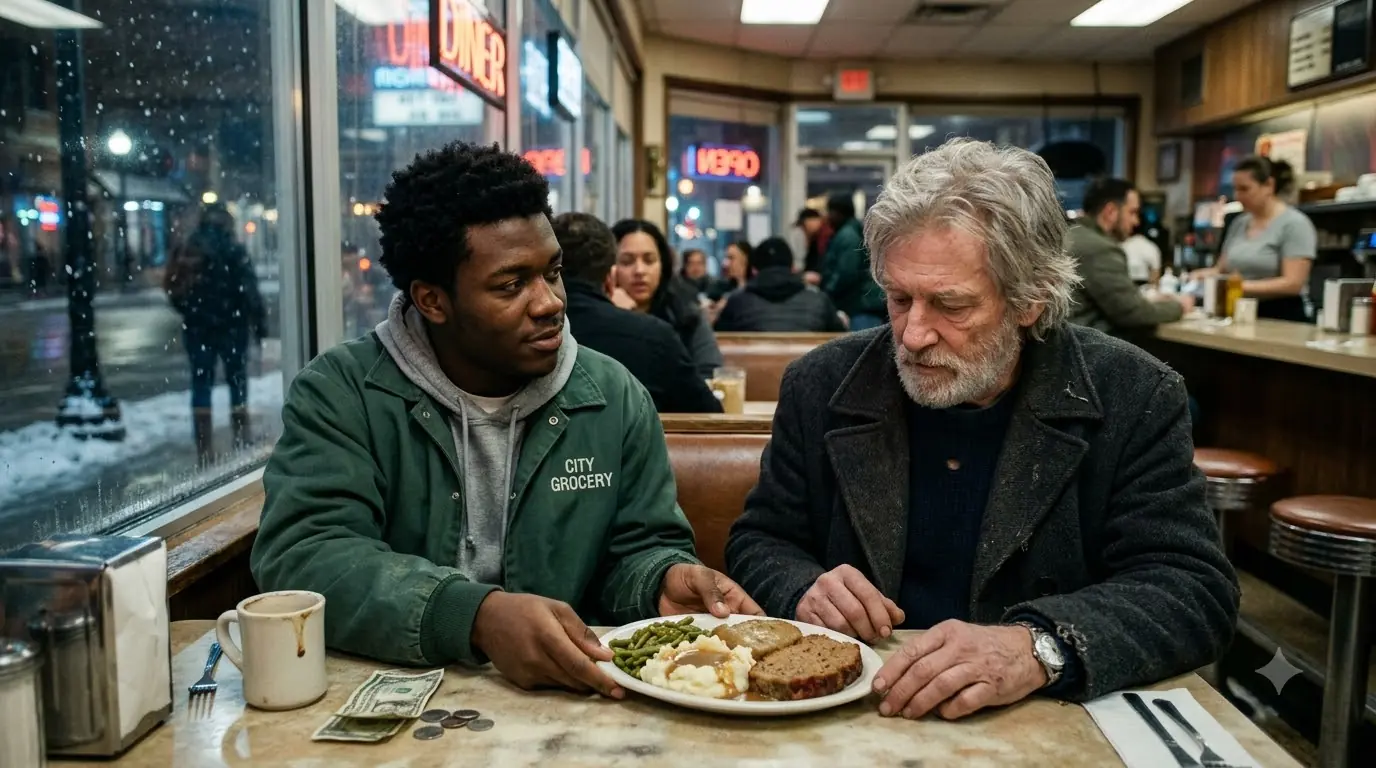
The camera caught the hungry man finishing his dinner, the grateful handshake, and the exchange of a simple business card. Three days later, when the truth began spreading across news channels and social media, almost nobody could believe who the homeless man really was.
William Morrison, CEO of Morrison Industries, one of Chicago’s largest companies, had been living on the streets.
And Jamal Williams, the struggling college student who helped him, was about to see his own life change in ways he could never have imagined.
But to understand why what happened next mattered so much, you first have to understand how badly Jamal was struggling. He was not a wealthy kid trying to play hero for an evening. He knew exactly what it felt like to count every dollar, skip meals, and go to bed wondering whether there would be enough money for tomorrow.
Every morning at five o’clock, Jamal’s alarm pierced the thin walls of his studio apartment. He did not wake that early because he enjoyed it. He woke because there was no other way to fit everything into one day. The cramped apartment he shared with his sixteen-year-old sister, Kesha, was all they could afford.
Four hundred square feet.
One bed, which belonged to Kesha.
Jamal slept on the couch.
There was a tiny kitchenette with a mini refrigerator that barely worked and a rent payment that consumed most of Jamal’s paycheck every month. Six months earlier, their grandmother had died. She was the woman who raised both children after their parents were killed in a car accident when Jamal was twelve.
Their grandmother left them the apartment.
She also left them completely on their own.
At nineteen, Jamal became Kesha’s legal guardian. That meant the version of college he had once imagined was impossible. Full-time university would have to wait because his younger sister’s present mattered more than his future.
So Jamal created a different path.
Community college at night.
Work during the day.
Sleep whenever he could find it.
His schedule was brutal. From 5:30 until 6:30 each morning, he studied while Kesha slept. Then he showered in cold water because the apartment’s water heater was broken and the repair cost was beyond what they could manage.
After that, Jamal took two buses to Meyer’s Grocery Store. He spent eight hours stocking shelves, answering questions, dealing with impatient customers, moving boxes, and cleaning whatever somebody had spilled in aisle seven. The job itself was tiring, but some days the hardest part was watching people his own age live lives that seemed impossibly distant from his.
College students came through the store buying energy drinks and snacks on their parents’ credit cards. They complained about midterms, weekend parties, roommates, spring break, and classes scheduled too early in the morning. Jamal listened while scanning groceries and stacking shelves. Most of them had no idea what it felt like to count every dollar before buying a loaf of bread.
At three o’clock, Jamal clocked out and took the same two buses back toward Kesha’s school. He picked her up from Jefferson High and walked home with her. They did homework together at a kitchen table that rocked slightly because one leg was shorter than the others.
Dinner depended on what was cheapest that week.
Ramen noodles.
Peanut-butter sandwiches.
Generic cereal that tasted like cardboard.
Sometimes canned soup.
At seven, Jamal kissed Kesha on the forehead and went back into the Chicago cold. Two more buses took him to Harold Washington Community College, where he studied business administration. Business was not some lifelong passion he had discovered as a child.
It was practical.
Maybe, he thought, he could someday build something that would lift them out of the cycle they had inherited. Maybe he could create a business, organization, or community center that gave other families tools his own family never had. That dream was still vague, but it kept him moving.
His professors did not know the full story.
His classmates did not know he sometimes fell asleep during lectures because he had stayed awake until two in the morning studying after getting home from work. They did not know he avoided study groups partly because he could not afford to sit in coffee shops buying drinks for hours. They did not know that even an extra bus ride could become a financial decision.
Somehow, Jamal kept going.
His GPA remained at 3.7.
He did not miss work.
He made sure Kesha’s grades stayed high.
He made sure she had clean clothes for school, even when it meant Jamal wore the same three shirts over and over.
The unusual thing about Jamal was that he rarely complained. When Mrs. Rodriguez at the grocery store spoke sharply to him, Jamal smiled and said, “Have a blessed day.” When classmates described vacations he could not imagine affording, he listened politely and asked about their plans.
Inside his wallet, Jamal carried an old business card from a motivational speaker who had visited his high school two years earlier. The speaker had talked about paying kindness forward and how small choices could affect people far beyond the moment in which they were made. Jamal had carried that card through his grandmother’s funeral, through becoming Kesha’s guardian, and through nights spent calculating whether they could survive another month.
Deep down, even when life gave him little evidence to support the belief, Jamal still thought good things mattered.
His grandmother had taught him that.
“Feed people when you can, baby,” she used to say. “The universe keeps track of everything.”
Lately, the universe seemed to be keeping a different kind of scorecard.
That December evening, as Jamal walked toward Rossy’s Diner after work, he had exactly twelve dollars left. Not twelve dollars of spending money. Twelve dollars total.
Payday was three days away.
That meant no lunch the next day.
No extra transportation money if Kesha suddenly needed something.
No emergency cushion.
Nothing.
Jamal’s plan was simple. He would buy the cheapest cup of coffee at Rossy’s and sit inside where it was warm until he needed to leave for class. The diner was known around the neighborhood for allowing customers to sit for a while even when they ordered very little.
Maria, one of the waitresses, knew Jamal and had always treated him kindly.
When he pushed through the heavy glass door, warmth hit his face like a blessing. The smell of coffee, potatoes, gravy, and fried food made his stomach tighten immediately. Jamal had eaten nothing since breakfast except two pieces of toast with generic peanut butter.
Then he noticed the man sitting alone in the corner booth.
Something about him made Jamal forget his own hunger for a moment.
Outside, the wind chill had dropped to fifteen degrees. Chicago winters were always unforgiving, but this was the kind of cold that could become dangerous quickly. The morning weather report had warned people to stay inside if possible, and shelters around the city were already full.
Jamal found a small table near the window and ordered the least expensive thing available.
“A coffee, please.”
Two dollars.
Maria poured it for him.
Jamal wrapped both frozen hands around the mug and let the heat return slowly to his fingers. From his seat, his eyes returned to the elderly white man in the corner booth.
He looked approximately sixty-five.
Silver hair.
Tired face.
His clothes had clearly seen better days, but there was something unusual about them. They were worn, yet clean and deliberately layered.
His wool coat was frayed at the edges, but Jamal could tell it had once been expensive. Beneath it was a sweater with a small hole near the collar, the sort of quality garment designed to last decades rather than seasons. The man appeared homeless, yet details around him did not fit neatly into the picture.
Especially the watch.
It appeared briefly whenever the man moved his left hand.
Even across the diner, Jamal knew it was expensive. The metal caught the overhead light differently from anything else the man wore. It looked like the kind of watch worth more than Jamal could earn in half a year.
The man had been sitting there for at least twenty minutes.
He kept studying the menu.
But he was not simply reading.
He was studying the prices.
His lips moved slightly as if he were calculating numbers in his head.
Maria had approached twice.
Both times the man politely said, “Just a few more minutes, if you don’t mind.”
The second time, he added, “I appreciate your patience, miss.”
His voice was soft and educated.
A voice Jamal could imagine in a boardroom rather than a shelter.
That was when Jamal understood.
The man was hungry.
Not mildly hungry.
Really hungry.
And he appeared to have no money.
The diner became busier as people escaped the worsening weather. Customers shook snow from their coats and stamped feeling back into their feet. Most had houses, apartments, cars, or somewhere warm waiting for them when they eventually left.
The man in the corner did not seem to have anywhere.
Mr. Rossi, the manager, kept glancing toward the booth. He was not deliberately cruel, but Rossy’s was still a business. Tables were intended for customers ordering food.
The older man seemed to understand.
He reached into one coat pocket.
Nothing.
The other.
Nothing.
Then his pants pockets.
Then back through the coat again.
Each search became slightly more desperate.
His shoulders sank lower.
Then he started coughing.
It was not a small cough.
The sound came from deep in his chest and made several nearby customers glance toward him. The man tried to hide it behind his sleeve, trying to make himself smaller, as though illness itself were something he needed to apologize for.
Maria noticed.
She brought him a glass of water and placed it on the table.
“On the house,” she whispered.
“Thank you, miss. You’re very kind.”
Even his gratitude sounded formal.
Jamal began doing the math.
Twelve dollars.
The meatloaf special cost about eight.
Coffee and tax would push the total higher.
If he bought the man dinner, Jamal would have nothing.
Three days until payday.
No lunch tomorrow.
No backup money.
Nothing for an emergency involving Kesha.
His grandmother’s voice returned.
Feed people when you can, baby.
Could he?
The older man started getting up.
He placed one hand on the table and slowly pushed himself to his feet.
Then he swayed.
For one frightening second, he looked as though he might collapse. He caught the edge of the table and steadied himself.
Something tightened in Jamal’s chest.
Every practical part of his mind told him to remain seated.
Think about Kesha.
Think about the rent.
Think about tomorrow.
Think about your own survival.
But the man was sick, hungry, apparently broke, and about to step into a Chicago night cold enough to kill someone.
Jamal’s feet were moving before his mind finished arguing with itself.
He crossed the diner.
The security camera above the counter captured him walking toward the booth.
The older man was still holding the table.
“Excuse me, sir.”
The man turned.
Up close, Jamal saw striking blue eyes.
Intelligent.
Alert.
But exhausted in a way that seemed deeper than missing sleep.
“Yes, son?”
That one response confirmed something Jamal had sensed from across the room.
The man carried himself differently.
Spoke differently.
Like somebody accustomed to being heard.
Jamal swallowed.
“I wondered if you’d like to join me for dinner.”
The man blinked.
For a moment, he looked genuinely stunned.
“Oh, son. I couldn’t impose.”
“You’re not imposing.”
Jamal nodded toward his table.
“I’m inviting you. Please.”
The word seemed to affect the man.
He studied Jamal for several seconds, as though attempting to understand him.
“That’s extraordinarily kind, but I’m afraid I can’t.”
“Sir,” Jamal replied gently, “it’s December in Chicago. It’s fifteen degrees outside, and you’re coughing like you might be getting sick.”
The man’s hand moved unconsciously toward his chest.
“I insist,” Jamal said. “Please let me buy you dinner.”
Another long pause.
The man searched Jamal’s face.
Whatever he found there changed his expression.
“All right.”
His voice became softer.
“Thank you. That’s extraordinarily kind.”
They returned to Jamal’s small table by the window.
Maria approached immediately and smiled when she saw them together.
“What can I get you gentlemen tonight?”
Jamal did not look at the menu.
If he started studying prices now, he feared common sense might win.
“Two meatloaf specials, please. With coffee.”
Then, before fear could stop him, he added:
“And could you bring us some of the apple pie afterward?”
Maria smiled.
“Of course, honey.”
After she left, the older man stared across the table.
“Son, that is going to cost you.”
“Don’t worry about it.”
“I should tell you something.”
“What?”
“I can’t pay you back right now.”
“I’m not asking you to.”
The man became silent.
He folded his hands and studied Jamal, not rudely, but with the expression of someone looking at something he had not expected to encounter.
“What’s your name?” Jamal asked.
“William.”
There was the slightest hesitation.
“William Morrison.”
“I’m Jamal. Jamal Williams.”
“Pleased to meet you, Jamal.”
William extended his hand across the table.
His handshake was firm.
Confident.
It felt like the handshake of someone who had made agreements worth more money than Jamal could imagine.
William leaned back.
“May I ask what you do?”
“I work at a grocery store during the day. Community college at night.”
“What are you studying?”
“Business administration.”
William’s interest sharpened.
“What kind of business interests you?”
Jamal found himself relaxing.
There was something about William that made conversation easy, almost like talking to a teacher who genuinely wanted to hear the answer.
“I’d like to open a community center someday.”
William raised his eyebrows.
“What kind?”
“Somewhere people could get job training. Financial-literacy classes. Help getting back on their feet.”
Jamal smiled awkwardly.
“Right now it’s just a dream.”
“Dreams have an interesting habit of becoming real for people like you.”
“People like me?”
“People who see a stranger in trouble and do not immediately look away.”
The food arrived.
William began eating slowly.
He did not attack the plate, although Jamal could tell he was desperately hungry. Instead, he ate with almost perfect manners.
Napkin properly placed.
Meatloaf cut into precise portions.
Fork and knife used carefully.
Nothing about the way he ate seemed consistent with someone who had spent his life on the street.
“This is delicious,” William said.
He paused after another bite.
“I honestly cannot remember the last time I had a home-cooked meal like this.”
Jamal hesitated.
“How long have you been…”
He could not figure out how to finish politely.
William saved him.
“Between situations?”
Jamal nodded.
“A few weeks.”
“Do you have family? Somebody who could help?”
William’s face changed.
“I lost my wife three months ago.”
Jamal’s expression fell.
“I’m sorry.”
“Thank you.”
William looked toward the window.
“She was the best person I ever knew.”
His voice became quieter.
“Always helping other people. She would have liked meeting you.”
They ate in silence for a while.
William’s phone buzzed twice during the meal.
The first time, he ignored it.
The second time, he glanced at the screen before answering.
“William speaking.”
His voice changed instantly.
The softness disappeared.
His tone became focused and authoritative.
“Not now. I’ll call you back.”
He ended the call.
Then his gentle demeanor returned.
“Sorry about that.”
“Work?”
“Something like that.”
Jamal noticed but did not push.
William began asking him questions.
About school.
About Kesha.
About the grandmother who raised them.
About Jamal’s dream.
He listened closely to every response and occasionally wrote something in a small leather notebook.
“You said your grandmother raised both of you?”
“Yeah.”
Jamal nodded.
“Our parents died when I was twelve. Grandma took us in. She passed six months ago.”
“So you’re taking care of your sister now.”
“She’s sixteen. I’m her legal guardian.”
William stopped eating.
“You are nineteen years old.”
Jamal smiled faintly.
“Last time I checked.”
“You work full-time, attend college, and raise a sixteen-year-old girl.”
“It’s what needs to be done.”
William stared at him.
“That is remarkable, Jamal. Most nineteen-year-olds are still learning how to take care of themselves.”
“I had a good teacher.”
“Your grandmother?”
Jamal nodded.
“She always said, ‘Take care of your family first, but don’t forget strangers either.’”
William smiled for the first time that evening.
“She sounds like a wise woman.”
“She was.”
Jamal stirred his coffee.
“She used to say the universe keeps track of everything. Good things. Bad things. Eventually it all comes back.”
William looked at him for several seconds.
“I believe that too.”
By the time Maria brought out the apple pie, Jamal had noticed something else.
A black SUV with tinted windows had been parked outside for nearly twenty minutes.
Its engine remained running.
William glanced toward it several times.
Always briefly.
When Maria finally placed the bill on the table, William instinctively reached toward his wallet.
Then stopped.
“Son, I need to be completely honest with you.”
Jamal looked up.
“I cannot repay you right now.”
“I told you. I don’t want repayment.”
The total came to approximately twenty-four dollars and fifty cents before tip.
Jamal paid thirty.
It was money he did not really have.
Eighteen dollars beyond the twelve he had mentally counted as his remaining safety net, money he would somehow have to figure out over the next three days.
As Maria walked away, William stared at the receipt.
“Son.”
Jamal looked up.
“Do you understand what you just did?”
“I bought us dinner.”
“You spent thirty dollars when you told me you were nearly out of money.”
Jamal’s stomach tightened.
Of course William had noticed.
“It’s fine.”
“No.”
William’s voice was still gentle, but firm now.
“It is not fine.”
Jamal said nothing.
“You just spent money you cannot afford on a complete stranger.”
William reached into his coat and removed his wallet.
The leather was worn, but clearly expensive.
He opened it.
Looked inside.
Then closed it.
“I still can’t repay you in cash.”
He looked toward his wrist.
“But I have this.”
William began removing his watch.
Up close, Jamal finally recognized it.
A Rolex.
The real thing.
Even someone with little knowledge of luxury watches could tell it was worth an extraordinary amount of money.
William extended it.
“Please take this as collateral.”
Jamal stared.
“When I’m back on my feet, I’ll buy it back.”
“No.”
Jamal gently pushed William’s hand away.
“Son, this watch is worth…”
“I don’t care what it’s worth.”
William froze.
“You don’t?”
“Sir, your life is worth more than a watch.”
Jamal nodded toward his wrist.
“Keep it. You might need to sell it yourself someday.”
William stared.
For a few seconds, he seemed unable to speak.
Then something changed in his eyes.
They became brighter.
More focused.
As though William had been looking at Jamal throughout dinner but was only now really seeing him.
“In forty years,” William said slowly, “I don’t think I’ve ever met anyone quite like you.”
Jamal laughed nervously.
“You don’t even know me.”
“I know enough.”
William opened his leather notebook.
From inside it, he removed a business card.
The card stock was thick.
Minimal design.
Expensive without being flashy.
WILLIAM R. MORRISON
Beneath the name was only a phone number.
No company.
No title.
No address.
Jamal studied it.
“What kind of business are you in, Mr. Morrison?”
William hesitated for a fraction of a second.
“I connect people with opportunities.”
“What kind?”
“The kind that can change lives.”
Jamal slipped the card into his wallet.
“If you ever need anything,” William continued, “call that number. Ask for me specifically.”
“Why?”
“Why what?”
“Why would you do that for someone you met an hour ago?”
William looked toward the nearly empty plate.
“Because you did something for me tonight that I will never forget.”
Jamal listened.
“You did not see a homeless man.”
William’s voice softened.
“You did not see somebody to pity or somebody to avoid. You saw another human being who needed help.”
Outside, the SUV’s engine changed pitch.
William glanced toward the window.
“I should go.”
He stood.
“My ride is here.”
Jamal walked with him toward the diner entrance.
Through the glass, a professionally dressed man stepped from the black SUV.
He moved quickly.
Purposefully.
When William approached, the man opened the rear door.
“Sir.”
Jamal noticed the way he said it.
Not casually.
Not “Mr. Morrison.”
Sir.
The word carried practiced respect.
William paused before entering the vehicle.
He turned back toward Jamal.
“Remember what I said about dreams?”
Jamal nodded.
“They have a way of becoming real for people like you.”
“People like me.”
“People who choose kindness when it costs them something.”
Then William climbed inside.
The black SUV disappeared into the snowy Chicago night.
Jamal remained beneath Rossy’s neon sign.
In one hand was William’s business card.
His wallet was effectively empty.
Yet for reasons he could not explain, he felt richer than he had in months.
The following morning brought consequences.
Jamal woke with his stomach cramping from hunger.
No breakfast.
No lunch money.
When his supervisor at Meyer’s asked why he seemed distracted, Jamal said only that he had not slept well.
All morning, the business card in his wallet seemed to demand attention.
During his fifteen-minute break, Jamal pulled out his phone.
He typed:
William R. Morrison Chicago.
Thousands of results appeared.
Too many.
The name was common.
He tried again.
William R. Morrison business Chicago.
The loading symbol spun.
Just as the results started appearing, Jamal’s phone battery died.
The second day brought another problem.
Kesha noticed the food.
Ramen again.
Third meal in a row.
She pushed noodles around her bowl.
“Jamal?”
“Yeah?”
“Are we okay?”
He knew what she meant.
“Of course.”
“Financially?”
Jamal smiled.
“We’re fine, baby girl. Just saving money this week.”
Kesha looked at him.
She was sixteen, not six.
She understood numbers.
She could see that Jamal was eating less.
Sleeping less.
Worrying more.
That evening, Jamal went to business class.
Professor Martinez was presenting case studies involving major Chicago corporations.
He clicked through a series of slides.
“One of our city’s most influential corporations is Morrison Industries.”
Jamal’s pen stopped.
Professor Martinez continued.
“Founded in 1987 by William Morrison, the organization has grown into a multibillion-dollar conglomerate focused heavily on real-estate development and community investment.”
Jamal slowly lifted his head.
“The company employs more than three thousand people locally and has invested tens of millions of dollars in community projects across Chicago’s South Side.”
The next slide appeared.
A professional photograph filled the screen.
Jamal’s stomach dropped.
William.
Same face.
Same blue eyes.
Same posture.
Except this William wore an expensive suit instead of a frayed wool coat.
His silver hair was perfectly groomed.
He stood behind a podium at a corporate event.
“Morrison Industries CEO William Morrison,” Professor Martinez continued, “is known for philanthropic work and a very hands-on approach to community engagement.”
Jamal barely heard the rest.
His own heartbeat drowned out the lecture.
After class, he walked directly to Professor Martinez.
“Professor?”
“Yes, Jamal?”
“That CEO you showed us. William Morrison.”
“What about him?”
“Is he still actively running the company?”
“Absolutely. Why?”
“What does he look like in person?”
The professor looked confused.
Then he opened the Morrison Industries website on his laptop.
Recent photographs appeared.
Board meetings.
Charity events.
Ribbon cuttings.
Investor conferences.
Every photograph showed the man who had eaten meatloaf with Jamal two nights earlier while claiming he could not afford dinner.
Jamal left campus carrying more questions than answers.
He stared at William’s business card for twenty minutes before finally making the call.
His hands shook.
Not from cold.
From confusion.
Had the diner been staged?
Was he part of some strange experiment?
Had William been testing him?
The phone rang twice.
A professional woman answered.
“Morrison Industries, Mr. Morrison’s office. Janet speaking.”
Jamal’s mouth went dry.
It was real.
“Hi. I’d like to speak with William Morrison, please.”
“May I ask who’s calling?”
“Jamal Williams.”
He swallowed.
“He gave me this number and told me to ask for him specifically.”
Silence.
A long silence.
“Please hold, Mr. Williams.”
Classical music filled the line.
Jamal sat on the edge of his couch.
He was actually calling the CEO of a multibillion-dollar company.
The man who had sat in a corner booth looking homeless.
“Jamal.”
William’s voice came through the phone.
Warm.
Familiar.
But stronger now.
More certain.
“Mr. Morrison.”
Jamal hesitated.
“I found out who you are.”
“I suspected you might.”
“Why didn’t you tell me?”
William became quiet.
Then he asked:
“Can I ask you something first?”
“What?”
“If I had introduced myself that night as William Morrison, CEO of Morrison Industries, would you still have helped me?”
“Of course.”
“But would you have helped me in exactly the same way?”
Jamal opened his mouth.
Then stopped.
He actually considered it.
“I don’t know.”
“Exactly.”
William’s tone was gentle.
“You might have treated me like a wealthy man having a difficult evening. You might have helped because the situation felt unusual. You might have seen money or status instead of simply seeing a person.”
“But you lied to me.”
“I did not lie, Jamal.”
William paused.
“I simply did not tell you everything.”
“What is everything?”
A long breath came through the phone.
“The truth is that I really was homeless that night.”
Jamal frowned.
“What?”
“Not because I had no alternatives. Because I chose to live that way temporarily.”
“I don’t understand.”
“Three months ago, my wife Sarah died.”
Jamal became still.
“We were married thirty-five years.”
William’s voice weakened slightly.
“She was my best friend. My business partner. My entire life.”
Jamal sat down more heavily.
“I’m sorry.”
“When Sarah died, I stopped functioning normally.”
William continued slowly.
“I couldn’t face my office. Board meetings. Charity galas. Everyone wanting decisions from me. Everything reminded me of her.”
“So you left?”
“I took a leave of absence.”
“But why live on the streets?”
William was silent for several seconds.
“Because I needed to remember what being human felt like.”
Jamal leaned forward.
“Sarah used to tell me I had become too comfortable in my ivory tower. Too disconnected from the people our company claimed to serve.”
William’s voice cracked.
“She ran our charitable foundation. Every day, she worked with families who were one paycheck from disaster.”
He laughed softly without humor.
“She would come home and tell me stories about courage and sacrifice. I would listen, write larger checks, approve bigger budgets, and congratulate myself for understanding.”
“But you didn’t.”
“No.”
William’s answer came immediately.
“I understood numbers.”
Another pause.
“I understood tax deductions, program budgets, public-relations reports, annual impact statements.”
His voice became quieter.
“I did not understand hunger.”
Jamal listened.
“I did not understand cold.”
William continued.
“I did not understand what it felt like to have people look straight through you as though you were not there.”
“So you decided to experience it.”
“Yes.”
William explained that he had told his assistant he needed time alone. He left most of his identification and cards at home, took a small amount of cash, and stepped away from the security of his normal life. He slept in shelters, ate at soup kitchens, waited in lines, and depended on strangers.
“That night at Rossy’s was my fourth night.”
“You were actually hungry?”
“Starving.”
William’s answer carried no pride.
“I had spent the last of the cash I was carrying the night before. I had not eaten in approximately eighteen hours.”
“So that wasn’t acting?”
“No.”
Jamal remembered the coughing.
The shaking.
The way William had stared at menu prices.
“What about the watch?”
William became quiet.
“The Rolex was the final gift Sarah gave me.”
Jamal closed his eyes.
“I could have sold it.”
“But you didn’t.”
“I couldn’t.”
William exhaled.
“Even when I became genuinely desperate, I could not bring myself to let go of the last thing she had chosen for me.”
Jamal thought about his grandmother’s business card still sitting in his own wallet.
“When you offered me dinner,” William said, “you helped me in a way you probably still don’t understand.”
“I just bought you food.”
“No.”
William’s voice became firmer.
“You reminded me who I had been before I became surrounded by money, assistants, reports, and people who always knew my title.”
A long silence followed.
“You did not lecture me.”
William continued.
“You did not tell me to improve my decisions. You didn’t ask what I had done wrong to end up there.”
His voice softened again.
“You saw a human being who needed something.”
“Anybody would have done it.”
“No, son.”
William said it immediately.
“They wouldn’t.”
Jamal said nothing.
“I spent hours in that diner over several nights.”
William paused.
“Dozens of people saw me.”
Another pause.
“You were the one who got up.”
Jamal felt tears in his eyes.
Then he said the first thing that came to him.
“Your wife would have been proud of you for trying to understand.”
William went silent.
“She would have loved you,” he finally said. “Because what you did is exactly what Sarah would have done.”
Then his voice shifted.
More focused.
“And that is why I want to ask you something.”
“What?”
“I want to offer you a job.”
Jamal almost dropped the phone.
“A job?”
“With Morrison Industries.”
“Mr. Morrison, I’m just…”
“You are exactly what I need.”
William did not let him finish.
“I need somebody who knows what real kindness looks like.”
Jamal tried again.
“I have no experience with a company like yours.”
“Experience can be taught.”
William spoke with the certainty of someone accustomed to making important decisions.
“Character cannot.”
Jamal sat completely still.
“And you have more character at nineteen than some executives develop in an entire career.”
“What job?”
“I want you to help rebuild the Morrison Foundation.”
Jamal stared at the wall.
“I want you to help me remember what Sarah spent years trying to teach me.”
William continued.
“I want Morrison Industries to become the kind of company that changes lives because it understands people, not because it writes impressive checks.”
Jamal barely managed to ask:
“Are you serious?”
“Completely.”
“What would I do?”
“Community Program Director.”
Jamal laughed nervously.
“I’m nineteen.”
“I know.”
“I stock grocery shelves.”
“I know.”
“I’m still in community college.”
“I know that too.”
William continued.
“Your job would be helping design programs for underserved communities. Real programs based on actual needs.”
Jamal gripped the phone harder.
“Starting salary, seventy-five thousand dollars per year.”
Jamal stopped breathing.
“Plus full benefits. Medical. Dental. Vision.”
William continued speaking.
“Company transportation support. Housing allowance.”
“Seventy-five thousand?”
Jamal had earned around twelve thousand the previous year.
This was not simply a raise.
It was another world.
“The foundation would also pay for you to complete your bachelor’s degree.”
Jamal closed his eyes.
“Where?”
“Northwestern.”
His eyes opened.
“All tuition and educational expenses covered.”
Northwestern University.
Jamal had dreamed about it since he was fifteen.
William was not finished.
“And Kesha.”
Jamal sat straighter.
“What about Kesha?”
“A full scholarship to Francis Parker School.”
Jamal said nothing.
“Strong college-preparation program. She finishes high school with access to opportunities she deserves.”
Jamal became dizzy.
“Why me?”
His voice broke slightly.
“You could hire somebody with ten years of experience.”
“Experience can be learned.”
William repeated the point.
“What you have cannot.”
“What do I have?”
“You understand what it means to face an impossible decision and still choose another person.”
William paused.
“Most nonprofit managers have never spent their last twelve dollars trying to feed a stranger.”
“What would I actually do day to day?”
“Go into communities.”
William answered immediately.
“Talk to people.”
“Assess what they really need rather than what we imagine they need from a conference room.”
Another pause.
“Design programs with residents, not merely for them.”
“You’d trust me with that?”
“You would have a team.”
William continued.
“Training. Mentorship. I would work with you personally.”
Then his voice became firm.
“But yes, Jamal. Eventually, I would trust you to lead.”
Jamal imagined a life without double shifts.
Without deciding between groceries and textbooks.
Without watching Kesha eat cheap noodles because every unexpected expense threatened to break them.
Then fear arrived.
“What if I mess it up?”
“You’re smart enough to raise your sister.”
William replied.
“You were smart enough to recognize when a stranger needed help.”
His tone softened.
“Intelligence isn’t only test scores.”
Then he added:
“There is one condition.”
Jamal’s stomach tightened.
Of course.
The catch.
“What?”
“Non-negotiable.”
Jamal waited.
“You must never forget what made you walk across that diner.”
“I don’t understand.”
“Power changes people.”
William spoke slowly.
“Money changes people.”
He paused.
“I have watched good people become comfortable. Then comfort becomes distance. Eventually, they begin making decisions from spreadsheets instead of humanity.”
Jamal listened carefully.
“I need you to remember what it felt like to have almost nothing.”
William continued.
“To know you might need that money tomorrow and still choose kindness tonight.”
“I’ll remember.”
“Promise me.”
“I promise.”
William’s voice softened.
“Because the moment the people we serve become numbers instead of human beings, the foundation fails.”
“When do I start?”
“Finish this semester.”
William answered.
“January.”
He began listing the transition.
A different apartment for Jamal and Kesha, closer to school.
Moving expenses.
Several months of living costs paid in advance so Jamal could focus on training and education rather than survival.
Jamal felt as though someone had taken the pressure that had sat on his chest for years and suddenly lifted it.
Then he remembered something.
“William?”
“Yes?”
“I have to ask.”
“Anything.”
“That night at the diner.”
Jamal hesitated.
“Was any of it real?”
William was quiet.
“The hunger was real.”
“The desperation?”
“Real.”
“The situation?”
“Real.”
Another pause.
“What was not real was the idea that I had absolutely no way out.”
Jamal leaned back.
“So it was a test.”
“No.”
William answered firmly.
“It was a grieving man who had lost his way and was trying to understand a world he had stopped seeing.”
He continued.
“You did not pass a test. This offer is not a prize.”
“Then what is it?”
“Recognition.”
William’s voice was calm.
“Recognition of who you already are.”
“And if I hadn’t helped?”
“Then I would have walked into the Chicago cold and continued learning.”
William paused.
“And some other company would eventually have had the privilege of hiring Jamal Williams.”
Jamal smiled despite himself.
“You really think I can do this?”
“Son, you are not the risk.”
William laughed softly.
“The risk would be letting somebody else hire you first.”
Jamal closed his eyes.
Kesha.
Northwestern.
A real salary.
A chance to build the community center he had imagined.
A future where kindness did not have to compete with survival every single day.
“If you’re willing to take a chance on me…”
“Jamal.”
William interrupted.
“I am not taking a chance.”
His voice carried the authority Jamal had first noticed during that brief phone call at the diner.
“I am making one of the smartest business decisions of my career.”
Six months later, the effects of that one dinner could be seen across Chicago.
Jamal Williams, who had once counted his remaining dollars before walking into Rossy’s Diner, now worked at Morrison Industries. He wore tailored clothes when necessary and walked through offices where people twice his age listened when he spoke. But he still rode the CTA Blue Line most mornings.
When a Chicago Tribune reporter asked why, Jamal gave a simple answer.
“I want to remember where I came from.”
He continued.
“The moment I stop understanding how normal people move through this city is the moment I stop understanding the people we’re supposed to help.”
Kesha thrived at Francis Parker School.
She made honor roll consistently.
Joined debate.
Began talking seriously about universities she previously considered unreachable.
Every Sunday, however, she volunteered at a South Side food bank.
She would later explain the lesson during her graduation speech:
“My brother taught me that success means very little if you never use it to lift another person.”
The Morrison Foundation changed dramatically under Jamal’s influence.
Programs that had once been designed almost entirely by committees were rebuilt around direct community input. Staff spent more time listening before deciding. Jamal insisted that no neighborhood problem be defined only by people who did not live with it.
Their signature initiative became the Last Dollar Fund.
The idea was simple.
The foundation searched for people who had sacrificed their own limited resources to help others and then found themselves in trouble because of that choice.
Within six months, the team documented hundreds of cases across Chicago.
One was Maria Santos.
A single mother from Pilsen.
Maria had spent her last forty dollars buying groceries for an elderly neighbor.
When Jamal’s team learned about her situation, the Last Dollar Fund paid several months of rent and connected her with healthcare job training.
Maria later told a reporter:
“I never thought anybody noticed the small things.”
Then she smiled.
“Jamal’s team notices.”
Another program required foundation staff to spend significant time directly inside the neighborhoods their projects served.
Jamal explained the philosophy simply.
“You cannot design solutions for problems you have never tried to understand.”
The results quickly drew attention.
Program participation increased.
Resident satisfaction rose sharply.
Other cities began studying Morrison Foundation initiatives.
Some adapted the programs for their own communities.
William changed too.
The grieving CEO who had walked Chicago streets after Sarah’s death began looking energized again. He created “Community Fridays,” during which company leaders left corporate offices and participated directly in foundation programs.
During one interview, William said:
“Jamal helped save my company from becoming disconnected.”
Then he paused.
“But more importantly, he helped save me.”
Media attention became overwhelming.
National morning shows requested interviews.
Late-night programs discussed Jamal’s story.
Documentary producers called.
A streaming documentary titled The Last Dollar eventually followed the foundation and its programs.
Morrison Industries benefited financially as well.
Public trust improved.
The company’s stock climbed.
But Jamal always insisted that those things were side effects.
The more important changes happened quietly.
One of them happened at Rossy’s Diner.
The corner booth where Jamal and William shared their first dinner received a small plaque.
It honored Sarah Morrison and ordinary acts of kindness.
Every December, the Morrison Foundation sponsored a community dinner there.
One hundred people ate free.
There were no requirements involving income or status.
The only tradition was that guests were encouraged to share stories of unexpected kindness.
One of those guests was Isabella Rodriguez.
She was seventeen.
A student working two jobs while maintaining a 4.0 GPA and helping support her disabled mother.
Isabella had heard Jamal’s story.
Then her elderly neighbor, Mrs. Lane, ran into trouble paying for heart medication.
Isabella had $237 saved for college expenses.
She spent it on Mrs. Lane’s prescription.
What Isabella did not know was that Mrs. Lane had spent much of her own life teaching chemistry.
She was retired.
And when she discovered what Isabella had sacrificed, she began tutoring the girl for free.
For six months, they studied together.
Isabella eventually earned a full scholarship to Northwestern.
She went on to study biochemistry while working part-time with the Morrison Foundation.
“The circle keeps growing,” Jamal said during one board meeting.
“Every act of kindness seems to create another one.”
The numbers appeared to support him.
The Last Dollar idea spread online.
Tens of thousands of small acts of kindness were documented under related campaigns.
Food banks in several Chicago neighborhoods reported increases in volunteers.
Other companies launched similar community programs.
But the most meaningful change did not fit neatly inside statistics.
One year after the cold December evening at Rossy’s, Jamal returned to the same diner.
December fifteenth.
7:30 p.m.
Same booth.
Same time.
William sat across from him.
Neither wore business clothes.
Maria brought coffee.
By then, she had become assistant manager.
She was also engaged to Jamal.
“Can you believe it’s been a year?” William asked as he stirred sugar into his cup.
Jamal looked around the diner.
“Feels like a lifetime.”
He smiled.
“And somehow like yesterday.”
Their annual dinner had become a tradition.
The foundation once again sponsored meals for one hundred neighborhood residents.
No media event.
No speeches.
No staged presentation.
Just people eating together.
Then a young woman approached the booth.
“Excuse me.”
Jamal looked up.
“Are you Jamal Williams?”
The girl was perhaps seventeen.
Nervous energy.
Hands marked by work.
A Francis Parker sweatshirt.
“Yes.”
Jamal smiled.
“What’s your name?”
“Isabella Rodriguez.”
Jamal recognized the name immediately.
“I saw your story online,” Isabella said. “About what happened here.”
Jamal glanced toward William.
“It made me help my neighbor, Mrs. Lane.”
William smiled slightly.
“What happened?”
“She couldn’t afford her heart medicine.”
Isabella adjusted the straps of her backpack.
“I used my college savings.”
“How much?” William asked.
“Two hundred thirty-seven dollars.”
Jamal’s expression softened.
“It was everything I had.”
“What happened after that?”
“She turned out to be a retired chemistry professor.”
Isabella smiled.
“She’s been tutoring me ever since.”
Her smile widened.
“I just got into Northwestern with a full scholarship.”
Jamal leaned back.
“That’s incredible.”
Isabella reached inside her backpack.
She removed a twenty-dollar bill.
Then she placed it on the table.
“I want to buy your dinner tonight.”
Jamal stared at it.
“Both of you.”
She pushed the money closer.
“I know it’s not much, but I want to pass it forward.”
Jamal’s eyes filled.
He looked at the bill.
He imagined it might be Isabella’s food money for several days.
Then he remembered another December night.
Another table.
Another amount of money that seemed too small to matter until it changed everything.
He accepted it.
“We would be honored.”
Isabella walked away smiling.
William shook his head in disbelief.
“The circle continues.”
Jamal watched her cross the diner.
“It always does.”
Then he smiled.
“Kindness is like compound interest.”
William laughed.
“There’s the business student.”
“It keeps growing.”
Near the end of the evening, William reached into his coat.
He removed a small wrapped box.
“For you.”
Jamal frowned.
“What’s this?”
“One-year anniversary.”
Jamal opened it.
Inside was a silver watch.
Simple.
Elegant.
Nothing like William’s Rolex.
Jamal turned it over.
An inscription had been engraved on the back.
TIME SPENT ON OTHERS IS NEVER WASTED.
Jamal stared at the words.
William looked toward the diner window.
“Sarah would have loved you.”
Jamal swallowed.
“I wish I could have met her.”
William looked back at him.
“You did, in a way.”
Jamal said nothing.
“Every time you choose kindness over comfort, you’re continuing something she believed in.”
Later, as Jamal walked outside into the December night, the weather was milder than it had been a year earlier, though the air still carried Chicago’s familiar bite.
He reached into his wallet.
He still carried a business card.
But it was no longer William’s.
It belonged to Isabella.
She had recently joined the Morrison Foundation’s youth advisory board and was already helping design student-to-student mentorship initiatives.
The twelve-dollar choice Jamal once made had become something far larger than him.
The Last Dollar Fund expanded beyond Chicago.
Related diner and community networks appeared in dozens of cities.
People who heard the story began looking differently at small decisions that previously seemed insignificant.
But Jamal never believed kindness mattered because it guaranteed a reward.
He had not known William was wealthy when he crossed that diner floor.
Isabella had not known Mrs. Lane could tutor her when she paid for the medication.
Maria Santos had not known anyone was watching when she helped her neighbor.
That was the point.
Somewhere, somebody was always sitting alone.
Somebody was counting the last few dollars in a wallet.
Somebody else was deciding whether to notice.
Jamal had once had twelve dollars.
Isabella had two hundred thirty-seven.
For another person, the meaningful thing might not be money at all.
It might be food.
A ride.
A phone call.
An hour of time.
A seat at a table.
A willingness to see the human being everyone else had learned to overlook.
And every time Jamal returned to Rossy’s Diner and looked toward that corner booth, he remembered the most important part of the story.
He had thought he was spending his last few dollars helping a stranger.
He had no idea that, in choosing not to walk away, he was taking the first step toward the life he had been fighting for all along.