The auctioneer pointed toward the rusted tractor and laughed before anyone had even placed a bid. “That corpse is worthless—and your dying farm can’t survive another stupid mistake.” A few farmers standing near the machinery trailers joined him, their laughter rolling across the dusty estate yard. Henry Cole placed one hand against the tractor’s blackened steel and answered without looking at them.
“Then explain the fresh metal welded inside a hundred-year-old machine.”
The auctioneer’s smile weakened for only a second. He glanced at the ancient tractor, then back at Henry’s faded overalls and cracked work boots. “You paid one dollar for scrap, you desperate old fool.”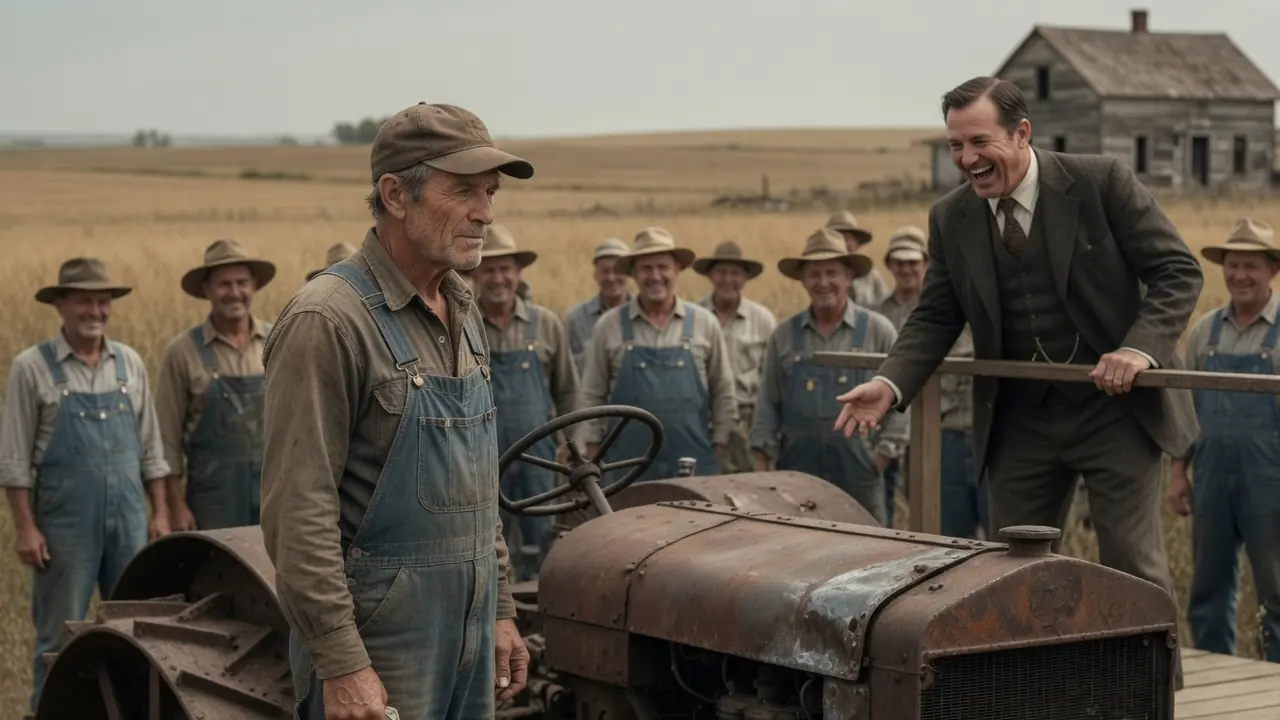
Henry struck the engine panel with his knuckles. The sound came back low and heavy instead of hollow.
“No,” he said. “I paid one dollar for the secret someone was terrified to leave exposed.”
The laughter continued, but Henry no longer heard it.
At fifty-eight, he had become accustomed to being judged by men who knew only what they could see. They saw a widowed farmer with a failing corn crop, an unpaid equipment loan, and a tractor at home that had not moved in two years. They did not see the nights Henry spent repairing machinery beneath a single hanging bulb or the mornings he walked fields that had once supported his family and now broke beneath his boots like dry pottery.
The drought had lasted longer than anyone predicted. The soil on his Iowa farm had lost its dark richness, and the few cattle remaining near the eastern fence wandered through grass too dry to feed them properly. Bills arrived faster than rain, each envelope carrying another warning from the bank or another supplier asking when Henry intended to pay.
His wife, Margaret, had been dead for four years.
Before illness took her, she had been the person who believed Henry could repair anything. Engines, fences, leaking roofs, frightened animals, even bad days. After her death, he discovered that some things did not want to be repaired and that silence could occupy more space than another human being.
He attended Harold Goodwin’s estate auction only because of a small advertisement in the newspaper. Goodwin had once owned an ironworks outside Des Moines and had been known for collecting old machinery rather than throwing it away. Henry hoped to find a used plow blade, a pump, or perhaps enough parts to rebuild the tractor sitting beside his barn.
Instead, he found the Titan.
It stood at the far end of the auction yard, half buried in weeds and leaning slightly toward one enormous iron wheel. Its steel body carried layers of rust, soot, and old black paint. The tall exhaust stack had split along one side, and the seat looked as if no man had occupied it since Herbert Hoover was president.
A corroded plate beneath the hood read:
TITAN INDUSTRIAL TRACTOR — 1918
An auction worker told Henry the machine had once belonged to Goodwin’s factory. It had not run in decades and was too heavy to move without a crane. Several museums had refused it because restoration would cost more than the tractor was worth.
Henry did not care whether it ran.
He cared about the panel beneath the engine housing.
The surrounding steel was pitted and uneven with age, but one rectangular section carried smooth welds hidden beneath artificial rust. Someone had sealed it carefully, then worked to make the repair appear as old as the machine itself.
When the bidding began, the auctioneer asked for fifty dollars.
No one answered.
He dropped the price to twenty, then ten.
The crowd remained silent.
Henry raised one finger. “One dollar.”
They laughed, but the auctioneer accepted. The crane required nearly two hours to lift the Titan from the weeds and lower it onto Henry’s borrowed trailer. The chains groaned under its weight, and rust fell from the body in red flakes.
Henry drove home slowly beneath a setting sun. Each time he looked into the rearview mirror, the Titan appeared less like machinery and more like an enormous animal being carried out of a grave.
He parked it inside the barn where his broken tractor had once stood. There was barely enough room between the workbench and the grain bins, but Henry managed to position the machine beneath the strongest roof beam. He chained the rear wheel before removing the trailer supports.
For the first three days, he treated the Titan as a restoration project.
He brushed away loose rust, cleaned the identification plate, drained thick oil from the engine casing, and removed a nest built behind the dashboard. He found broken wires, seized controls, and a boiler chamber blackened by decades of soot.
The false panel remained in the back of his mind.
On the fourth morning, Henry crawled beneath the housing with a flashlight and hammer. He struck the original steel first and listened to the clear metallic echo. Then he struck the suspicious panel.
The sound was dull.
Something rested behind it.
Henry examined the welds and found no bolts or inspection openings. Whoever created the compartment had never intended it to be opened normally. He used a grinder to cut a narrow line along the upper seam, sending orange sparks through the dim barn.
When the blade broke through, a thin strip of yellow appeared behind the steel.
Henry switched off the grinder.
The barn became silent except for the ticking of cooling metal.
He widened the opening and inserted a screwdriver. The tip touched cloth instead of machinery. He worked slowly until the rectangular panel came free and dropped onto the floor with a crash that frightened the birds from the rafters.
Inside the cavity were three bundles wrapped in oil-soaked canvas.
The first weighed more than a sack of seed. Henry carried it to the workbench, cut the cord, and peeled back the fabric.
A gold bar lay beneath it.
Not brass.
Not painted iron.
Gold.
Its surface was dull from age, but the metal glowed when morning light crossed the barn. Stamped into one end were numbers, a small crown, and a five-pointed star.
Henry unwrapped the remaining bundles.
There were twelve bars in total.
Between them lay yellowed documents, shipping manifests, military correspondence, and a folded parchment map marked with red lines stretching from Rotterdam to New York, then west through Chicago. Several pages carried seals from the United States War Department and the Department of Commerce.
One document read:
Industrial Reconstruction Shipment No. 14
Restricted Transfer Authority — 1919
The cargo list included precious metals intended for postwar reconstruction in Europe. A handwritten note at the bottom stated:
Shipment rerouted by special order. Hold until recalled.
The signature belonged to Captain Edward Hughes.
Another document named Harold Goodwin as a civilian transport contractor.
Henry lowered himself onto a stool. He had spent his final dollar on a tractor meant to decorate the yard, and now more wealth than he had ever imagined rested on his workbench. One gold bar could settle his bank debt, repair the irrigation system, and replace every broken machine on the farm.
But government markings changed everything.
Selling the bars quietly would invite questions. Reporting them could bring officials who might take the tractor, search the farm, and leave Henry with nothing except a story people refused to believe.
He wrapped the gold again and hid it beneath loose floorboards inside an empty grain bin. He placed the documents inside Margaret’s old cedar chest, then locked the barn before sunset.
That night, headlights stopped near his gate.
Henry watched from the farmhouse window as a dark vehicle idled on the county road. It remained there for nearly a minute before reversing into the darkness.
The following morning, he found fresh tire tracks near the mailbox.
He told himself someone had taken a wrong turn.
Then he found a boot print beside the barn.
It was larger than his and pressed sharply into soil that had been dry the previous evening. A faint scrape marked the Titan’s false panel where someone had tried to pry it open.
Henry carried his shotgun into the house that night.
He slept in a chair facing the window.
The next day, he drove to the local library and requested newspapers from 1918 through 1922. For hours, he searched industrial journals, county reports, and old government announcements. Harold Goodwin’s name finally appeared in a 1920 article.
Goodwin Iron Works had produced heavy machinery for military transport during the First World War. After the armistice, the company helped move materials connected to European reconstruction. In 1919, federal investigators examined the disappearance of government assets from several shipments.
No charges were filed.
Six months later, a fire destroyed Goodwin’s primary warehouse, including most company records.
Henry copied the article.
As he left the library, he noticed a man in a dark coat watching from across the street. Their eyes met through the reflection of a shop window. The man stepped into an alley and disappeared.
A vehicle followed Henry for eleven miles on the road home.
It never approached close enough for him to identify the driver. When Henry turned toward the farm, the headlights continued past the intersection.
The barn door was open when he arrived.
Henry entered with the shotgun raised. Muddy footprints led directly to the loose floorboards beneath the grain bin. The gold remained, but the folded map had vanished.
In its place was a plain envelope.
Henry tore it open.
The typed note contained only three sentences.
You do not understand what you uncovered.
Do not contact anyone.
Some things were meant to remain buried.
Henry stood alone in the barn, listening to the wind move through the damaged roof.
Fear urged him to return the gold to the Titan, weld the panel shut, and pretend the discovery had never happened. Pride told him the treasure belonged to the man who found it. Margaret’s voice, preserved only in memory, offered something harder.
Do what lets you sleep afterward.
Henry photographed every remaining document with an old digital camera. He copied the images onto three memory cards, then placed one in the farmhouse, one inside his truck, and one beneath a loose stone near Margaret’s grave.
Two days later, his neighbor Joe Harris arrived without calling.
Joe had farmed the adjacent land for fifteen years and often helped Henry repair fences or move cattle. He walked around the Titan slowly, touching the boiler and studying the cut panel with too much attention.
“Strange machine,” Joe said. “Old metal sometimes hides surprises.”
Henry watched him. “What kind of surprises?”
Joe smiled. “Rust. Cracks. Nothing worth getting hurt over.”
After Joe left, Henry found the latch on the grain bin partially open.
That night, one gold bundle disappeared.
A note remained beneath the floorboard.
STOP DIGGING.
Henry no longer believed the threats came only from strangers. Someone nearby had been watching the farm, reporting his movements, or entering the barn when he left.
He called the sheriff’s office.
The young deputy who answered treated the matter as a routine theft. Henry did not mention the gold, only historical documents taken from an antique tractor. The deputy promised to file a report and contact him if anything developed.
Nothing did.
Henry searched through old newspapers at home and found an article written by investigative journalist Sarah Keller about military artifacts hidden inside industrial equipment. He called the newspaper and left a message. Sarah returned the call that evening.
She sounded skeptical until Henry mentioned Captain Hughes, Shipment Fourteen, and the crown-and-star stamp.
Her silence lasted several seconds.
“Do not discuss this with anyone else,” she said. “I’ll be there tomorrow morning.”
Sarah arrived driving a dusty compact car, carrying a camera bag and a laptop. She was in her late thirties, spoke quickly, and inspected the papers with careful hands. After three hours, she looked toward Henry with an expression that frightened him more than disbelief would have.
“The gold was part of a reconstruction fund,” she said. “Several private American companies helped transport it after the war. Some shipments disappeared before reaching Europe.”
“Goodwin stole it?”
“Perhaps. Or perhaps he hid evidence from the people who did.”
She pointed toward letters signed by military officers and financiers. “Some fortunes and companies may have been built using these assets. The gold matters, but the documents could expose families and institutions that still hold influence.”
Henry looked toward the barn doors. “After a hundred years?”
“Money survives longer than people.”
Sarah copied every image and created encrypted files. She planned to contact a federal archivist and an attorney familiar with recovered government property.
The following morning, she disappeared.
Her motel room was empty, her car gone, and the front-desk clerk claimed she had checked out before sunrise. Henry called repeatedly, but her phone went directly to voicemail.
That afternoon, a black sedan entered his driveway.
Two men in dark suits stepped out. The taller man handed Henry a plain business card without a company name.
“We represent a private historical estate,” he said. “We understand you recently acquired the Goodwin tractor.”
“I bought it legally.”
“No one disputes that.”
The shorter man glanced toward the barn. “We are prepared to offer you five hundred thousand dollars for the machine exactly as it stands.”
Henry nearly laughed. “You haven’t even inspected it.”
“We know what it is.”
“You mean you know what was inside.”
Neither man answered.
The taller one placed the card into Henry’s hand. “The offer remains open for forty-eight hours. After that, the situation may become more complicated.”
Henry tore the card in half.
The men returned to their sedan without threatening him again.
That night, the phone rang.
A distorted voice said, “Destroy the documents and surrender the tractor. The gold belongs to history, not to you.”
The line disconnected.
Henry entered the barn moments later and discovered every original document missing. The intruders had left the remaining gold untouched.
That revealed what they truly feared.
Not the fortune.
The proof.
At dawn, Henry placed the gold bars, memory cards, and his written account inside the truck. He drove to Des Moines and visited Samuel Beck, an elderly estate lawyer who had represented Henry’s parents years earlier.
Samuel examined the markings and documents. “You cannot keep this secret. The government may claim the gold, but reporting it provides you legal protection.”
“Will it protect Sarah?”
“I don’t know.”
They prepared affidavits and copied everything onto the law firm’s secure server. Before they finished, Samuel received a telephone call that drained the color from his face.
“Two men are parked outside,” he whispered after returning. “Leave through the rear door. I will contact federal authorities.”
Henry slipped into the alley carrying one memory card. Before reaching his truck, his phone vibrated.
THE LAWYER CANNOT PROTECT YOU.
Henry drove without direction until sunset.
Behind him, a black sedan appeared and disappeared along the highway. He considered running west, abandoning the farm, and hiding with the gold. But hiding would allow the people threatening him to control the story forever.
He parked behind the Des Moines public library and used a public computer. The photographs went to the Treasury Department, National Archives, state attorney general, and three newspapers. He included Sarah’s name, the letters, the threats, and the registration number he had recorded from the black sedan.
Once the emails were sent, Henry drove to the nearest state police station.
He entered carrying one gold bar wrapped in an old feed sack.
“I found twelve of these hidden inside a tractor,” he told the desk officer. “People have already broken into my home twice. Call someone who understands what this means.”
Federal agents arrived before midnight.
Henry surrendered the remaining gold and gave a statement lasting nearly eight hours. Investigators searched the Titan, documented the false compartment, recovered fingerprints, and compared the serial markings with century-old Treasury records.
Joe Harris was questioned the following week.
He admitted accepting money from a private research organization to report Henry’s movements. He claimed he believed they were collectors searching for lost Goodwin documents and denied knowing about threats or stolen gold. Surveillance footage later placed one of the black sedans near Sarah Keller’s motel, but investigators discovered she had not been abducted.
Sarah had gone into protective custody after sending her files to a federal contact.
She called Henry three weeks later.
“You did it,” she said.
“We did it.”
The investigation remained sealed for almost a year. Officials traced the gold to missing reconstruction assets and confirmed that Goodwin had concealed it inside the Titan after discovering several officers intended to divert the shipment. His letters suggested he feared exposing the operation would endanger his family, so he hid the evidence and waited for instructions that never arrived.
The warehouse fire had likely been set to destroy remaining records.
Goodwin had kept the tractor for the rest of his life but never opened the compartment again.
The government retained the gold as recovered federal property. However, Henry’s cooperation, lawful purchase, preservation of evidence, and role in exposing the hidden assets qualified him for a recovery settlement.
The amount was six and a half million dollars.
Henry stared at the official letter for nearly ten minutes.
He paid the bank first.
Then he repaired the farmhouse, restored the irrigation system, purchased reliable used machinery, and hired two neighboring families who had nearly lost their own farms. He did not build a mansion or buy a new truck.
He rebuilt the barn.
The federal government returned the empty Titan after completing its investigation. Henry mounted it on a stone platform beside the barn, leaving the false compartment open behind reinforced glass.
A plaque beneath it read:
TITAN 1918
Bought for One Dollar.
Found in Silence. Returned in Truth.
Schoolchildren visited each spring. Henry showed them the false wall, the government photographs, and copies of the manifests. He never displayed the threats because he did not want fear to become the most important part of the story.
One evening, several years later, Henry sat on the porch watching fireflies rise above healthy corn. The farm no longer felt like a place slowly dying. Workers had gone home, cattle moved calmly near the fence, and the rebuilt barn reflected the last light of sunset.
A letter rested beside his coffee.
It had arrived from Europe without a return address. The writer claimed his grandfather had served under Captain Hughes and had spent his final years regretting that he could not expose the stolen shipment.
The last line read:
You returned not only what was lost, but what powerful men tried to erase from memory.
Beneath the signature was a small crown beside a star.
Henry folded the letter and placed it inside the wooden box where he kept Margaret’s photograph and the Treasury certificate. Then he walked to the Titan and rested one hand against its cold steel.
At the auction, men had seen only rust.
Henry had seen a panel that did not belong.
He had not been brave every moment. He had hidden the gold, distrusted everyone, and nearly surrendered when fear entered his home. But courage had never meant feeling no fear.
It meant refusing to let fear decide where the truth would remain buried.
Henry looked across the restored fields.
The tractor had not saved his farm because there was gold inside it. The truth saved the farm because Henry finally chose to place it somewhere no locked barn, threatening stranger, or powerful family could hide it again.
He turned toward the farmhouse as darkness settled over Iowa.
Behind him, wind moved through the hollow body of the old Titan, producing a faint metallic hum.
For the first time, it sounded less like a warning.
It sounded like a machine finally relieved of its burden.