The red wine struck Colonel Adrian Cole across the left side of his face before anyone in the first-class cabin understood that Gavin Mercer had actually thrown it. The glass remained in Gavin’s outstretched hand while dark liquid ran from Adrian’s cheek, soaked the collar of his decorated uniform, and dripped across the ribbons and medals pinned over his chest. Around them, passengers froze behind the curved gray seat partitions, their expressions suspended between disbelief and fear.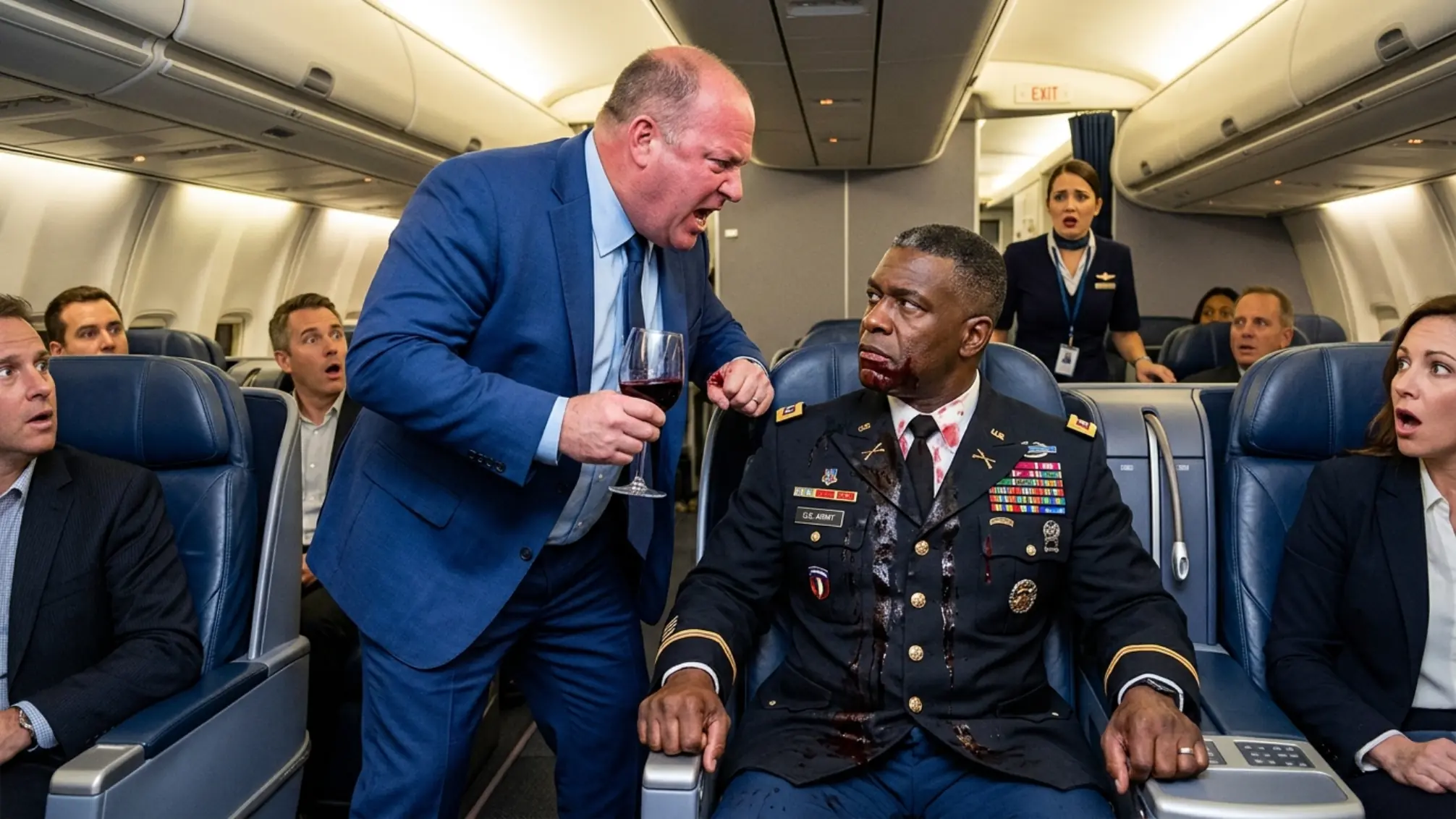
Gavin stood in the aisle wearing an expensive royal-blue suit, his face red with fury and entitlement. He had another glass clutched in his left hand, while an open bottle rested on the polished console between the seats. Adrian remained seated in 1A, both hands gripping the armrests, his eyes closed for one controlled second as wine slid from his jaw.
“I said get him off this plane!” Gavin shouted. “That seat is mine.”
The lead flight attendant, Rachel Kim, hurried down the aisle. “Sir, step away from the passenger immediately.”
Gavin turned on her without lowering the empty glass. “Passenger? Look at him. He’s wearing a costume to steal upgrades from people who actually paid for them.”
A woman seated across the aisle lifted her phone and began recording. Behind her, a middle-aged man stared at the wine covering Adrian’s uniform and quietly pressed the call button above his seat. Several passengers had already witnessed Gavin’s behavior in the terminal, but the attack transformed their discomfort into something sharper.
Adrian opened his eyes.
He did not shout. He did not lunge. He removed a white handkerchief from his pocket and slowly wiped the wine from his face.
“Take one more step,” he said quietly, “and say that again without hiding behind that glass.”
Gavin laughed, but the sound lacked confidence now. He had expected embarrassment, perhaps anger, but not the cold stillness of a man who appeared to be measuring every movement in the cabin.
“I’ll drag you out myself,” Gavin said. “You have no idea who you’re dealing with.”
Adrian looked down at the stained ribbons on his chest. He had worn the uniform because he was scheduled to attend a memorial ceremony in London the following morning. One of the medals now carried a dark red streak across its center.
“No,” Adrian replied. “You have no idea who you just assaulted.”
Rachel placed herself between the two men. “Mr. Mercer, return to your assigned seat now.”
“I am not sitting in 3D.” Gavin pointed at Adrian. “He took 1A from me.”
Rachel’s voice hardened. “Seat 1A was assigned to Colonel Cole before you reached the airport.”
“He’s not a colonel.”
The words came out louder than Gavin intended.
Adrian slipped one hand inside his uniform jacket.
Several passengers inhaled sharply, but he withdrew only a black credential wallet. He did not open it toward Gavin. Instead, he held it against his knee and looked at Rachel.
“Please ask the captain to come out,” he said.
Gavin sneered. “Good. Bring him here. He can explain why this airline lets frauds board in military costumes.”
Rachel stared at the credential wallet. Something in Adrian’s tone made her stop treating the incident as an argument between passengers.
She turned to another flight attendant. “Call the cockpit. Tell Captain Reynolds we have a serious security incident in first class.”
Gavin raised his wine glass again. “You’re delaying two hundred passengers because this man refuses to move.”
The woman filming from across the aisle spoke for the first time. “No. We’re delayed because you threw a drink in his face.”
“Stay out of this,” Gavin snapped.
A second passenger leaned into the aisle. “We watched you follow him from the lounge.”
Gavin’s eyes moved through the cabin. He had spent his entire morning intimidating employees who were paid to remain polite. Now he was surrounded by people who owed him nothing.
At the premium lounge, Gavin had announced that he always traveled in 1A. Elaine Porter, the lounge supervisor, had explained three times that the seat was unavailable. She had offered him 3D, another first-class seat with full service and direct aisle access, but Gavin treated the change as a deliberate insult.
Then he noticed Adrian seated near the windows with a boarding pass beside his tablet.
“You’re in my seat,” Gavin had said.
Adrian looked up. “No. I’m in mine.”
“I always sit 1A.”
“That sounds like a personal tradition,” Adrian replied. “Not my problem.”
The surrounding lounge had gone quiet. Gavin leaned over Adrian’s table and asked who he thought he was.
“My name is Colonel Adrian Cole.”
Gavin looked at Adrian’s dark blazer, light shirt, and neatly folded garment bag. The military uniform was still inside the bag at the time.
“Colonel?” Gavin said. “Sure.”
Security escorted Gavin from the lounge after he threatened Elaine and attempted to grab Adrian’s boarding pass. Instead of removing him from the airport, the contracted guards accepted his claim that the dispute was over. He was allowed to proceed to the gate after promising to behave.
The promise lasted less than twenty minutes.
At the gate, Gavin saw Adrian board ahead of him. After entering the aircraft and finding Adrian seated in 1A wearing his formal uniform, he resumed the argument. Rachel instructed Gavin to take 3D, but he refused to move until another attendant offered him wine in an attempt to calm him.
The wine became his weapon.
Captain Thomas Reynolds emerged from the cockpit wearing his uniform jacket, his expression controlled but urgent. He had flown commercial aircraft for twenty-seven years and had removed disruptive passengers before, but the sight in front of him made him stop.
A Black man in formal military dress sat covered in wine. An enraged passenger towered over him with a glass in his hand. Half the cabin had phones raised.
“Set the glass down,” Captain Reynolds ordered.
Gavin turned toward him. “Finally. I want this man removed.”
The captain’s eyes remained on the glass. “Place it on the console and step into the aisle.”
“I’m Gavin Mercer. My firm manages more money than this airline is worth.”
“Set down the glass.”
Gavin obeyed, but only after making sure everyone saw how insulted he felt by the command. He placed it beside the bottle and straightened his jacket.
Captain Reynolds looked at Adrian. “Sir, are you injured?”
“I don’t believe so.”
“Did he strike you?”
“He threw the wine and pressed the glass against my face before you arrived.”
Captain Reynolds glanced at Rachel, who nodded.
Gavin raised both hands. “That is a ridiculous exaggeration. I spilled a drink because he provoked me.”
Adrian opened the credential wallet.
Captain Reynolds looked down.
His face changed instantly.
He took the wallet carefully and examined the photograph, seal, identification number, and printed authority beneath Adrian’s name. Then he looked at the colonel again.
“Colonel Cole,” he said, “I was informed the federal cabin-security evaluation had been postponed.”
“It was not postponed,” Adrian replied. “The distribution list was intentionally limited.”
The cabin fell silent.
Gavin blinked. “What evaluation?”
Captain Reynolds returned the credential with both hands. “Colonel Cole is a senior aviation-security inspector assigned to a joint federal transportation oversight unit.”
Adrian closed the wallet. “I am also a passenger who was assaulted before departure.”
The distinction mattered to him. He did not want Gavin removed merely because he held authority. He wanted the crew to follow the same process they should have followed for any traveler.
Captain Reynolds turned to Rachel. “Has the main cabin door closed?”
“Yes, Captain.”
“Reopen it. Contact airport police and the station manager. This aircraft is not moving until the incident is documented.”
Gavin stared at him. “You cannot delay an international flight over a glass of wine.”
“I can delay it over an assault, a direct threat, refusal to follow crew instructions, and potential interference with flight operations.”
“I didn’t interfere with anything.”
Rachel pointed toward the bottle. “You ignored six instructions to sit down.”
“Because you refused to correct the seat.”
“There was nothing to correct.”
Gavin stepped toward the captain. Adrian rose before he could close the distance.
For the first time, the cabin saw Adrian’s full height. He was broad-shouldered and steady, his stained uniform making Gavin’s polished blue suit appear almost theatrical beside him.
Adrian did not touch Gavin. He simply positioned himself between the businessman and the captain.
“Back up,” Adrian said.
Gavin stopped.
“You think that badge makes you important?” he asked.
“No,” Adrian replied. “It makes me responsible for what happens next.”
The aircraft door reopened. Two airport police officers boarded with the station manager and Elaine Porter from the lounge. Elaine’s expression tightened when she saw the wine covering Adrian’s uniform.
“That is the same passenger,” she told the officers. “We requested that security document his threats in the lounge.”
One officer approached Gavin. “Sir, place your hands where I can see them.”
Gavin laughed as though the instruction were absurd. “I am not being arrested.”
“We are investigating an assault.”
“It was wine.”
“It was an object and liquid thrown intentionally at another person.”
Gavin reached into his jacket. Both officers immediately ordered him to stop.
“I’m getting my attorney’s card.”
“Keep your hands visible.”
The entire cabin watched as Gavin slowly raised them.
The man who had spent the morning declaring that rules belonged to other people suddenly discovered that commands sounded different when ignoring them carried consequences.
The officers escorted him off the aircraft. Gavin continued shouting until he reached the jet bridge.
“My firm will own this airline when I’m finished!”
Captain Reynolds waited until Gavin was gone before addressing the cabin.
“Ladies and gentlemen, we apologize for the delay. Airport authorities are handling the incident. We will provide an updated departure time shortly.”
The passengers did not complain.
Several applauded.
Adrian sat down again, uncomfortable with the attention. Rachel brought clean towels and offered to arrange replacement clothing, but he shook his head.
“The uniform goes with me,” he said.
She looked at the damaged ribbons. “I am so sorry.”
“You did not throw the wine.”
“I should have had him removed before the door closed.”
Adrian studied her face. She was not defending herself. She was reviewing the mistake.
“Then make sure the report says that,” he replied.
Rachel nodded. “It will.”
The security evaluation Adrian was scheduled to conduct had focused on escalation procedures, disruptive passenger handling, and the influence of status on employee decisions. It was not designed to create incidents. Adrian traveled anonymously because rehearsed compliance revealed little about how systems worked under pressure.
Gavin had unknowingly exposed the exact weakness Adrian had been sent to examine.
Employees at the lounge recognized his aggression. Contracted guards intervened, but they failed to create a formal incident record. Gate personnel heard Gavin threaten lawsuits, yet no one reviewed whether he remained fit to board. Cabin staff knew he was disputing a seat before takeoff, but the desire to avoid delaying a premium passenger led them to offer alcohol instead of removing him.
The failure did not belong to one person.
It belonged to a chain of people who each hoped someone else would make the difficult decision.
Airport police interviewed passengers in the gate area. The woman across the aisle provided her video, which clearly captured Gavin raising the glass, shouting, and throwing the wine. Another passenger had recorded the preceding minute, including Rachel ordering Gavin to sit down.
Elaine provided a written statement about the lounge confrontation. Security footage showed Gavin grabbing toward Adrian’s boarding pass and following him when he left the seating area.
The contracted guards’ body cameras revealed another detail.
After escorting Gavin from the lounge, one guard suggested denying him boarding. The second guard recognized Gavin from a financial magazine and warned that removing someone “that connected” could create trouble for the airport.
Their supervisor allowed Gavin to continue.
By the time the flight departed ninety-three minutes late, Gavin was sitting in an airport police interview room. His attorney arrived with two associates and immediately attempted to describe the incident as a misunderstanding involving spilled wine.
The video ended that strategy.
Gavin was charged with assault and interfering with a flight crew. The airline banned him pending investigation. His passport was held temporarily under the conditions of his release, preventing him from taking the London trip he had insisted was too important to delay.
The first person from Mercer Vale Capital to hear about the incident was not Gavin’s chief of staff. It was the firm’s general counsel, who received a link to the passenger video from a board member.
By the time the aircraft reached cruising altitude, the video had spread across social media. Viewers saw Gavin’s face clearly. They heard him call Adrian a fake hero and demand that he be removed from the seat legally assigned to him.
The firm released a statement saying it was reviewing the matter.
That statement survived for forty minutes.
A second video from the lounge appeared, showing Gavin leaning over Adrian’s table and threatening to have Elaine fired. A former employee of Mercer Vale then posted that Gavin had a history of humiliating assistants, drivers, restaurant workers, and junior analysts.
The board scheduled an emergency meeting before Adrian’s flight landed.
Gavin called from the airport police station and demanded that the firm’s lawyers protect him. The general counsel explained that the attorneys represented the company, not him personally.
“You work for me,” Gavin shouted.
“No,” she replied. “I work for the corporation.”
It was the same lesson Gavin had refused to learn at the airport. Authority had limits. Money had limits. Titles did not transform personal desires into law.
In London, Adrian completed the memorial ceremony in a replacement uniform arranged by the airline’s local station. The stained jacket was preserved as evidence, though Adrian insisted that photographs be taken before it was sealed.
Three days later, he returned to New York to complete the aviation-security review.
His report did not focus solely on Gavin.
Adrian documented how deference to wealth had weakened every layer of the response. The lounge staff had correctly identified dangerous behavior, but contract security reduced the incident to a customer-service dispute. Gate agents saw repeated aggression but lacked access to the lounge report because no formal record existed. Cabin employees attempted to calm Gavin with alcohol despite his visible agitation.
The airline’s senior executives expected Adrian to praise Captain Reynolds for recognizing his federal credential.
Instead, Adrian asked them a question.
“What should have happened if I had no credential?”
No one answered immediately.
Adrian looked around the conference table. “I was assaulted before the captain knew my position. The correct response should not depend on what was inside my jacket.”
Captain Reynolds, invited to the meeting, nodded. “He is right.”
The airline adopted new procedures requiring formal transfer of disruptive-passenger reports from lounges to gates and aircraft crews. Employees received authority to pause boarding without waiting for a senior manager when threats or targeted harassment occurred. Alcohol could no longer be offered as a calming strategy to visibly agitated passengers.
The security contractor lost its airport agreement after the investigation found repeated cases in which wealthy or publicly connected travelers received exceptions.
Elaine Porter was promoted into a new passenger-safety training role. She had been the first employee to challenge Gavin directly, and her records helped investigators reconstruct the escalation.
Rachel was not fired. Adrian opposed punishing her as though she alone had caused the failure. She participated in the review, admitted that avoiding confrontation had influenced her decisions, and helped design better cabin procedures.
Captain Reynolds later asked Adrian whether revealing the credential had compromised the evaluation.
“No,” Adrian said. “The evaluation ended when the wine left the glass.”
Gavin’s consequences continued.
Mercer Vale Capital placed him on leave after major investors demanded an independent review of his conduct. Investigators uncovered expense reports showing that he had repeatedly used company resources to threaten service workers and settle personal disputes. Several employees described a culture in which Gavin’s anger was treated as a management style rather than misconduct.
Two weeks after the incident, the board removed him as senior managing director.
He claimed he had been destroyed by one bad moment.
The board disagreed.
The airport had not created Gavin’s behavior. The wine had only made it impossible for people around him to continue pretending they did not see it.
Months later, Adrian appeared in court during Gavin’s criminal case. He wore a dark civilian suit rather than his uniform.
Gavin looked smaller without the cabin, the expensive bottle, or frightened employees around him. His attorney argued that he had been exhausted, under pressure, and provoked by the seat dispute.
Adrian listened without expression.
When asked whether he had threatened Gavin before the wine was thrown, Adrian answered honestly.
“I told him to step back.”
“Did you identify yourself as a colonel?”
“Yes.”
“Did you expect special treatment because of your service?”
“No.”
“Then why show the credential?”
“Because the captain needed to know there was a federal inspector aboard after a security incident.”
The attorney glanced toward the jury. “And once he saw it, the entire situation changed.”
Adrian looked directly at Gavin.
“The situation changed when your client chose violence,” he said. “The credential only stopped him from controlling the story afterward.”
Gavin eventually accepted a plea agreement that included probation, community service, mandatory behavioral treatment, restitution, and a long-term ban from the airline. The agreement required him to submit a written apology.
Adrian read it once.
He did not frame it or keep it.
He placed it in the same evidence file as the photographs of the stained uniform and returned to his work.
A year after the incident, Adrian boarded another international flight from JFK. This time he wore a charcoal suit and carried the restored uniform inside a garment bag.
Rachel Kim was the lead flight attendant.
She recognized him at the door and smiled. “Welcome aboard, Colonel Cole.”
Adrian handed her his boarding pass.
“1A again?” she asked.
“Apparently it has become a personal tradition.”
Rachel laughed softly.
As Adrian settled into his seat, he noticed a nervous young employee struggling with an angry passenger near the galley. Before the disagreement could escalate, a supervisor stepped in, paused boarding, and calmly explained the rules.
No one asked whether the passenger was wealthy.
No one offered him alcohol.
No one waited for a credential to decide whether another person deserved protection.
Adrian watched the procedure work exactly as it had been redesigned to work. Then he looked out the window as the morning light spread across the runway.
The greatest change had not occurred when Captain Reynolds opened the credential wallet.
It occurred afterward, when an airline finally understood that dignity should never depend on the title a victim can prove.