He handed over a black card, and they laughed. The next morning, he canceled a $3.8 billion deal without blinking.
There are places where the air feels off, not because something has happened, but because something is about to.
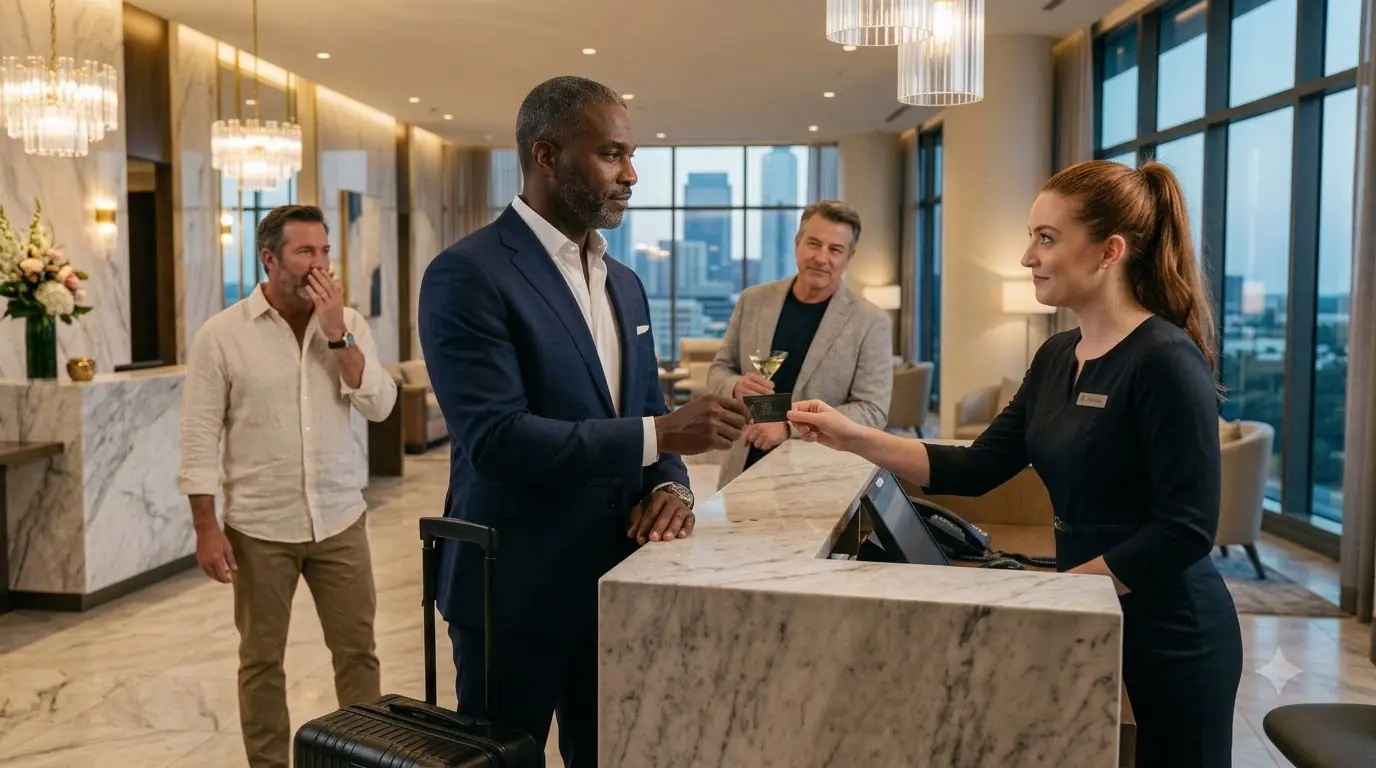
It was a Thursday evening in Dallas, late spring, the sun still out, but the heat was not smothering like usual. It was just warm enough to make you grateful for air conditioning. Darius Coltrane had just stepped out of a sleek black Escalade, his luggage wheeled behind him by the driver. He wore a tailored navy suit, matte brown shoes, and no tie, the perfect balance of money and comfort.
He was not flashy, just sharp, the kind of man who knew his worth and did not need to say a word about it. The hotel was the Lexington Tower in Uptown Dallas, one of those high-end places where the valet knows your name before you say it and the front desk offers you water while you check in.
Glass chandeliers hung above gold trim everywhere, and the lobby smelled like lemon polish and imported flowers. He was in town to finalize a $3.8 billion merger with Benley Group, a deal that had taken nearly two years to negotiate. This meeting was supposed to be the finish line. But from the moment he walked into the lobby, eyes tracked him. Not in a respectful way, more like confusion mixed with judgment. A white couple by the espresso bar looked up, glanced at each other, then turned away whispering. A man in a plaid golf shirt nudged his friend and gestured subtly toward Darius's luggage. The kind of whispers that never hit your ears can still cut through your skin. Darius felt it. He always did, but he kept moving, steady and composed, like always. He reached the front desk. The clerk looked up from her monitor, young, maybe in her mid-twenties, with an auburn ponytail, a hotel name tag, and gum she probably thought nobody noticed her chewing. "Hi, checking in." "Yes," he replied, offering a smile. "Reservation under Darius Coltrane." She clicked for a moment while he glanced around, taking in the place. He had stayed in hotels all over the world, Seoul, Zurich, Johannesburg, and on paper this one belonged in that league. But the room felt different now, cold in a way that had nothing to do with the air conditioning. "All right, Mr. Coltrane," she said finally. "That'll be a credit card and ID." Darius reached into his wallet and handed her his Centurion Card, the Black Card, solid metal, invitation-only, and known for having no preset spending limit. Darius had one. But when she saw it, she paused, then gave a short laugh, a real laugh, like she could not stop it in time. "Oh, wow. Okay," she said, her mouth twisting into a smirk. "You're carrying one of these around?" The way she said it made it sound like a toy, like it had come from a cereal box. Darius blinked, slow and patient, not angry and not surprised either. He had been here before, not in this exact hotel, but in this exact kind of moment. He waited a beat. No reaction. She either did not catch the disrespect or, worse, she did and did not care. "Is there a problem?" he asked calmly. She shrugged. "No, just, uh, haven't seen many of these come through here. Usually, it's, uh, you know, executives." And there it was. Right behind him, someone chuckled, a low nasal laugh from the man in the plaid shirt again. Darius turned his head just slightly, caught the man looking away, then looked back at the clerk, who now seemed to be waiting for something, approval, validation, he did not know. Instead, he reached slowly into his pocket, pulled out his phone, and dialed. "Yeah," he said. "It's me. No, don't go in yet. Cancel the room block, and call Raymond. Tell him the merger's off." Her expression did not change at first. It was as if her brain had not registered the words. "The whole thing?" came the muffled but serious voice through the phone. "Every inch of it," Darius replied. He hung up, then leaned forward and met the clerk's eyes. "I'll find somewhere else to stay." He turned, rolled his bag out behind him, and disappeared through the revolving doors, quiet, graceful, in control. But behind him, the room felt different now. The real storm had not even started yet. The hotel's assistant manager, Kelsey Durham, had been watching from the far end of the lobby, just behind a tall marble column near the business center. She had seen the exchange, or at least the tone of it, but had not moved fast enough. Now the man in the navy suit, carrying himself like someone important, had just walked out, leaving silence in his wake. She rushed over to the front desk. "What just happened?" The clerk, Megan, looked up, still twirling her pen between her fingers. "Just, uh, some guy tried to check in with a fake Centurion Card or something. He got all weird when I asked him about it." Kelsey narrowed her eyes. "A fake Centurion Card?" "That's what it looked like," Megan said with a half shrug. "Those things aren't just handed out, right? He didn't even seem like..." She paused, catching herself. Kelsey's voice dropped. "Did you ask for another form of payment?" "No. He just made some call and left, like he was important or something." She snorted lightly. "Probably bluffing." Kelsey stared at her for a moment longer before pulling out her tablet. She tapped a few times, and her jaw tensed. "His name was Darius Coltrane." "Yeah, that's what he said." Kelsey turned the screen toward Megan. There, in plain view, was a VIP guest profile: platinum rating, founder and CEO of Lucent Applied Technologies, one of the most influential tech firms in the United States. His net worth had been speculated to be over a billion dollars. "Megan," she said, keeping her voice as steady as possible, "that card was real, and he's not just someone. He was the reason the entire Benley Group was staying here this weekend." Megan blinked. "Wait, seriously?" "He's the one leading the Benley merger, the one that was set to bring in nearly $30 million in long-term contracts to this hotel chain over the next three years." Her mouth opened, but no sound came out. "He just canceled everything, Megan." Kelsey did not wait for a response. She turned and walked briskly toward the elevators. Upstairs in the penthouse suite, three top executives from Benley Group were lounging around reviewing the presentation decks for the next morning. Howard Lynn, the COO, was sipping club soda while Trina Mendes, general counsel, scrolled through her emails. Dev Shaw, the CFO, had his jacket off and his sleeves rolled up, trying to unwind. A knock hit the door, sharp and sudden. Trina got up and opened it. Kelsey stepped inside, visibly tense. "I think we may have a serious problem," she said. Howard looked up. "What kind of problem?" "Mr. Coltrane. He's gone." "Gone where?" Dev asked. "He left the hotel, canceled his reservation, and said the merger is off." Silence. Trina blinked slowly. "Off? What the hell happened?" "There was an incident at the front desk," Kelsey said. "One of our employees mishandled his check-in." Dev set his glass down carefully. "What kind of mishandling?" "She questioned his card and mocked him in front of other guests." Howard sat up straighter. "You mean she racially profiled him?" Kelsey did not answer. She did not have to. Trina stared at her tablet. "This isn't just bad. This is catastrophic." Howard stood and ran a hand through his thinning hair. "Do you understand what kind of signal this sends? That we couldn't even host the lead on the deal without insulting him in the lobby." "PR is going to have a field day with this," Trina muttered. Dev paced the room. "He's not going to be quiet about this. He's powerful, but not the kind that wants headlines. He doesn't need attention. He's got influence." And they all knew influence moves faster than noise. Back downstairs, Megan was still at her post, her earlier confidence long gone. A nearby bellhop named Andre, who had seen the incident but kept his head down, finally stepped over. "You know," he said, keeping his voice low, "that man, he's the kind people remember. The way he walked out, that wasn't a tantrum. That was someone sending a message." Megan did not respond, but for the first time she looked uneasy. Andre added, "I've seen people blow up over the wrong room or not enough towels. He didn't blow up. He just decided you weren't worth his voice." Outside the hotel, Darius's silence was already making more noise than words ever could. Darius did not go far. He checked into a modest boutique hotel across the street, the Bishop House, known for its quiet style and no-nonsense service. No grand chandelier, no bellhop pretending to care, just a clean room and respect at the door. That was all he needed. He sat on the edge of the bed for a moment, the city humming faintly through the double-paned glass. The call he had made earlier had already started setting off alarms. His chief of operations, Raymond, had probably cleared the meeting room already. By tomorrow, every stakeholder at Benley Group would be wondering what had gone wrong, and that was the point. Darius was not impulsive. He had built Lucent Applied Technologies from scratch, from a laptop in a shared office space in Tulsa to a billion-dollar company with operations on four continents. His moves were always deliberate, measured. Even his silence had weight. Still, he was not made of stone. He looked down at the Black Card still in his hand, resting against his palm. Solid, heavy, a symbol, and in the wrong hands, apparently a punchline. His phone buzzed. Raymond: Need me to come to you? Darius: No. Just handle the numbers. I'm done talking. Raymond understood. Another buzz came, this time from Camille, his sister back in Tulsa. Camille: Heard you pulled the plug. You good? He stared at the message. He thought about replying with the truth, that no matter how many awards they gave you, no matter how many zeros were in your account, someone would always think the card in your hand was not yours. Instead, he wrote: Yeah. Just tired. Camille replied with a single line: Get some rest. And don't let this turn you cold. He put the phone down and sat back. No anger, no tears, just a deep ache. Not the kind you feel in your chest, but the kind that lives in your bones, familiar and old, like something you carry and forget until someone pokes it. And that girl at the desk, Megan, had not invented that moment. She had just repeated it, recycled it. He had seen it in classrooms, at airports, at country clubs, even in his own boardroom, people assuming he was someone else's assistant, not the man running the table. Back in college, one of his professors had pulled him aside after class and asked, "Hey, Darius, I've been meaning to ask, who's paying your tuition?" Not, "How's the coursework going?" Not, "Do you need help with the labs?" Just curiosity about money because the math did not add up for him: smart, Black, and present. Years later, even with a Black Card and a private jet, he was still getting the same test, just in fancier buildings. His thoughts were interrupted by a knock at the door. Room service. He opened it to find a young man holding a tray, two bottles of water, and a fruit plate. "Compliments of the manager, sir," the young man said. "He saw your name on the check-in log. Just wanted to say he appreciates you staying with us." Darius nodded. "Thank you." "Also," the young man added, "my dad works in tech. He talks about your company all the time. Said you built something no one else even thought of." That made Darius pause. "What's your name?" "Jaden." "Well, Jaden, tell your dad I said thank you." Jaden smiled, nodded, and left quietly. Darius closed the door and looked out the window at the Lexington across the street. Tall, polished, expensive, full of people who still did not understand what they had just lost. Not just a deal. Not just a guest. They had lost a lesson. That lesson was about to be taught publicly, loudly, and without mercy. By 8:17 the next morning, the boardroom at the Lexington's executive conference level was supposed to be buzzing with final preparation. Instead, it was silent. The long walnut table, usually full of printed decks and lattes, sat untouched. Nameplates were already positioned, water bottles chilling, pens lined up perfectly, but no one from Lucent had entered, not even Darius's assistant. On the other side of the floor, Howard Lynn was pacing. "I'm telling you, if he doesn't walk through that door in the next ten minutes, we've lost him." Across the room, Trina Mendes was not even looking up. She was glued to her phone, reading a message from Lucent's legal team. "Effective immediately, we are withdrawing our interest in the Benley merger. We will not be rescheduling negotiations. We consider the matter closed." She read it out loud. Dev sat back in his chair. "That's it, then." Howard finally stopped pacing. "No explanation? No reconsideration?" "He doesn't owe us anything," Trina replied flatly. "Not after yesterday." Dev leaned forward, eyes sharp. "Let's be clear. The merger is dead, and the fallout's going to be brutal. Shareholders are going to panic. Media will pick it up by lunch, and we'll get dragged into the mess." Howard sat down, rubbing his temples. "Thirty months of negotiations, gone." "I told you," Trina said, scrolling. "He's not loud. He's precise. When Darius Coltrane walks out, he doesn't slam the door. He locks it behind him and throws away the key." Ten blocks away at the Bishop House, Darius sat across from Raymond in a private lounge. "Did they respond?" Darius asked. "They're still scrambling. You pulled the plug so fast they didn't even have time to make excuses," Raymond replied. "Good." Raymond hesitated. "You sure you want this on record? No press statement means they'll try to shape the story themselves." Darius took a sip of his tea. "They're already doing that. Let them. We'll say what we need to when we need to." Raymond nodded, then leaned in. "We just lost out on a huge infrastructure extension. That merger would have tripled our manufacturing capacity in the South." "I know," Darius said. "You sure this isn't personal?" Darius looked him dead in the eyes. "It is personal, and it's business." Raymond did not argue. Instead, he pulled up an article on his iPad. "They're running the first wave already. A blog out of Austin just posted something titled, 'The Black Card Backlash: Did Racism Kill a Historic Tech Deal?'" Darius did not react. Raymond tapped another tab. "And the hotel's PR director just posted, 'We are aware of an incident involving a guest. We are investigating and take this very seriously.'" Darius smirked. "They're not sorry. They're just loud now that they're losing money." Raymond laughed quietly, then sobered. "It's wild, though. All these years you kept your head down, played the long game, and all it took was one desk clerk." "It wasn't just her," Darius replied. "It was the look on her face when she thought she had power over me. That smug little smile. That's what lit the fuse." Back at the Lexington, panic had fully settled in. A meeting had been called in the HR conference room. Megan sat across from Susan Tramble, the regional director of guest experience, while legal counsel sat at the end of the table. "I didn't mean anything by it," Megan said. "He handed me this weird metal card. I didn't know they made real ones like that." Susan stared at her. "You thought a man who walked in wearing a suit, carrying a confirmed reservation under his name, was pretending." "I just didn't think." "That's right," Susan cut in. "You didn't think. You didn't verify. You didn't even ask for a second card. You mocked a guest in public in front of witnesses." Legal counsel chimed in. "We'll need to do an internal review, but I'll be honest. This is going to spread, and quickly." Susan looked tired. "Do you understand who you disrespected?" Megan lowered her voice. "Now I do." "Too late," Susan replied. "He's not coming back, and neither is that deal." She stood up. "Meeting over." Across town, Darius checked his phone again. Camille had sent another message. Camille: You just made the news. She attached a screenshot from a morning segment on a Dallas network: Billionaire Tech CEO Cancels Mega Merger After Hotel Incident. Details Emerging. He watched the clip. The anchor struggled to explain what had happened, relying on words like allegedly, reportedly, and sources close to the matter. But it did not matter. The truth was already out there. The real story was not about the card. It was about being dismissed, laughed at, reduced, and then turning that disrespect into a lesson too expensive to ignore. But what no one saw coming was that this was only the first domino. The world knew Darius Coltrane as a billionaire CEO. Press releases called him a visionary. Analysts called him the quiet architect of modern logistics AI. But none of that told you where he came from. He grew up in Midwest City, Oklahoma, just outside Oklahoma City. It was not exactly a tech hotspot, and not exactly the place anyone expected greatness to grow. His mother, Charlene, worked at the post office. His father, Leonard, was a mechanic who owned a little shop two blocks from their house. They never had much, but they had a worn kitchen table where every night meant dinner, no matter what. Around that table, Darius first learned the rules, not the ones people wrote down, but the real ones. Do not speak unless you know your facts. Let them underestimate you, but do not believe them when they do. And the hardest one: You will have to be twice as good for half the respect. He heard it from his parents, his uncles, and teachers at his high school who pulled him aside, not to push him forward, but to remind him what he was up against. He never forgot. At seventeen, he got his first real taste of rejection. He had applied for a state scholarship, a full ride. He was at the top of his class, with AP credits stacked, volunteer hours, and recommendations from teachers and the local pastor. They gave it to a boy named Kevin. Kevin had lower grades and fewer extracurriculars, but his father owned a dealership and was connected with the school board. Darius sat on his porch the day he found out, gripping the rejection letter like it owed him an apology. His mother came outside, sat beside him, and said, "We already knew this road wouldn't be straight, but it's still yours. Keep walking." So he did. He got into Oklahoma State, took out loans, worked nights at a printing shop, and graduated early. When he applied for his first tech job, they told him he was overqualified for the entry role but not quite the right fit for the next level. He started coding on the side and built a tiny warehouse management system that helped his father track parts inventory at the shop. That tool got noticed by a local auto supply chain, then another, then another. By thirty-two, Darius had built Lucent. By forty-seven, it was running international logistics for more than eighty major companies. But no matter how high he climbed, there were always reminders. Boardroom introductions where people skipped over him to shake hands with his white CFO. Investors asking whether he was in sales or engineering. Reporters calling him humble when he was simply measured, knowing every word he spoke would be dissected for attitude. It was not new. It was just polished. So when the girl at the desk looked at him like his card was a joke, she did not see a billionaire. She saw a Black man checking in alone. In her mind, that made the card suspicious. It did not matter that his name was engraved in silver, that he had built an empire from a 2007 ThinkPad and a rented garage, or that he had more power in his phone than most people would ever touch. She still saw him as a question mark. That night, back at the Bishop House, Darius pulled an old manila folder from his briefcase. Inside were a few personal photographs, things he kept close, not because he needed reminders, but because he believed in honoring the climb. One photo showed him and his father standing outside the garage. Leonard had grease on his shirt and a smile that did not come easily. Darius was barely out of college then. Another was a newspaper clipping from when Lucent got its first million-dollar contract. At the bottom of the folder was a yellowed envelope. Inside it was the scholarship rejection letter. He kept it not out of bitterness, but clarity. Every time someone looked at him sideways, every time someone questioned how he had gotten here, he remembered that they were not starting the fight. They were just showing up late to it. He picked up his phone and opened a message draft to Camille. You were right. That moment didn't turn me cold. It just reminded me I never stopped fighting. Some people throw punches. I write checks. He did not send it. He just smiled to himself, because tomorrow he was not going to tell his story quietly. He was going to say it loud enough that the whole industry had to listen. By Friday afternoon, the story was spreading like wildfire. Not from Darius. He still had not said a word publicly, but it did not matter. The silence itself had become news. Someone from Benley Group, maybe out of guilt or maybe just trying to save face, leaked the cancellation. An anonymous user on Twitter, claiming to be close to the deal, posted a thread titled, "A Black CEO Was Laughed At While Using His Own Card. The Next Morning, He Killed a $3.8 Billion Deal." The thread laid it all out. No dramatic wording, just bullet points, receipts, names, and screenshots. It ended with a single sentence: Power doesn't always raise its voice. Sometimes it just walks away. Within three hours, it had 2.4 million views. By evening, it was the number-one trending topic nationwide. At the Bishop House, Darius was in the lounge again, this time sipping ginger ale and reading quietly when Raymond stormed in holding his phone. "You seen this?" He handed Darius the screen. It showed a clip from a morning talk show in Los Angeles. A host was nearly yelling. "This is not about a credit card. It's about assumptions. This man could have bought the hotel and still got treated like he needed to show ID twice. You think this doesn't happen every day to people without the bank account? Come on now." Darius let out a slow breath. "They're going to try and spin it," Raymond warned. "You know that, right? The hotel already started damage control. They're releasing statements talking about retraining, internal investigations, standard playbook." Darius looked out the window. "Let them spin." "You sure you want to stay quiet?" Raymond asked. "Because if you don't take control of the narrative..." "I already did," Darius interrupted. Raymond paused. "When?" "The second I walked away." At the Lexington, chaos was still unfolding behind the scenes. Megan had been removed from her shift pending investigation. Several front desk employees were being questioned. The general manager had already been in three meetings, all of them with lawyers. One email thread included the phrase, "This is becoming a brand-level problem." They were scrambling. Andre, the bellhop who had witnessed the incident, posted something on Facebook that afternoon. "I've worked in that hotel for six years. I've seen celebrities, CEOs, athletes, but I never saw a man more composed than Darius Coltrane after he got humiliated. He didn't raise his voice. He didn't argue. He just made a call and left like a man who already knew his worth. That's the kind of power you don't learn in school." That post went viral. People began sharing their own experiences in the comments, stories of being followed in stores, laughed at in luxury settings, denied respect because of skin, hair, tone, or the wrong last name. It was not just Darius's story anymore. It was everyone's. That evening, Darius sat alone in his room watching the coverage. The local NBC affiliate showed a segment with his name splashed across the screen alongside a photo of him from a tech conference two years earlier. He looked strong in that image, focused, the kind of photo that made people stop scrolling. The anchor read from a script. "While Mr. Coltrane has yet to issue a public statement, the financial impact of his decision is already being felt across corporate circles. Analysts say the canceled merger will ripple through logistics and retail sectors within weeks." He muted the television, then turned to his laptop, opened a document, and started typing. He was not ready to talk to the media, but he was ready to talk to people. Tomorrow, he would do it on his terms, with no reporters twisting his words and no headlines watering them down. Because if people were going to hear his voice, it was going to sound like truth, not damage control. Saturday morning, there was no suit, no cameras, and no stage. Darius stood behind a plain podium in a quiet community center in South Dallas, in front of a room full of local business students, interns, and young professionals. No fanfare, no press invitations, just a few rows of folding chairs, some notepads, and phones set to record. It was an event planned months earlier, a mentoring session. He had almost canceled it after the hotel incident, not because he did not want to show up, but because he did not want to bring the storm with him. But when the story broke, the organizer called and said, "They need to hear from you, not from the headlines." So Darius showed up. He looked out at the small crowd. A few people nodded. A few just watched, still unsure whether the man in front of them was really him, the same man trending on their phones all week. He cleared his throat and began. "I was asked to talk about what leadership looks like, what success looks like." But that's not what I'm going to do today. I want to talk about what power looks like. Because some people think power is about shouting, threatening, making people afraid. But that's not real power. Real power is knowing who you are and knowing when to leave the room without saying a word. He let the silence sit. "In my line of work, I've signed nine-figure contracts in ten minutes, but I've also been mistaken for security at my own headquarters. That's just the world we live in. And it doesn't stop even when you reach the top." He paused, scanning the room. "Some of you might be thinking, 'If that can happen to him, what chance do I have?' And I get that. But let me tell you, they don't get to define you. The smirks, the doubt, the assumptions, that's them. What you build, what you walk away from, that's you." Someone in the second row whispered, "Facts," under their breath. Darius smiled. He continued. "The truth is, I didn't cancel that deal out of emotion. I did it because values matter more than contracts. If someone laughs at your presence, they'll never respect your partnership. And if you tolerate disrespect in silence, it only gets louder." Another pause. "You don't fight everything with rage. Sometimes you fight it by succeeding anyway, by choosing where to put your energy, by walking out with your dignity and letting the silence say everything." Then he leaned forward slightly. "So when they question your place at the table, remember, you are the table. And if they can't recognize that, you don't owe them a seat." After the talk, people approached slowly. Some just wanted to shake his hand. Others asked questions or thanked him. One young woman in a mustard-colored hoodie looked nervous but stepped up anyway. "My dad followed your story this week. He said it gave him hope. He's a janitor, and he said you walked away like a king." Darius took that in. He did not have a clever reply. He just nodded and said, "Tell your dad he raised someone brave." Later that evening, he sat in his office at Lucent headquarters, feet up on the desk, looking at the sunset through the tinted glass. His phone buzzed again. Camille: Saw the clip. You said it better than any of the news did. Darius: They never listen right the first time anyway. Camille: True. But this time, I think they heard you. He leaned back, finally breathing in deep. It was not about the hotel anymore, or the card, or even the deal. It was about a mirror he had held up to the system and the fact that the reflection made people uncomfortable. He did not need revenge. He did not need to scream. He just needed to move in a way that made people think. And now they were. Because sometimes the most powerful thing you can do is simply walk away with your head high and let the world feel the silence you left behind.He handed over a black card, and they laughed. The next morning, he canceled a $3.8 billion deal without blinking. There are places where the air feels off, not because something has happened, but because something is about to. It was a Thursday evening in Dallas, late spring, the sun still out, but the heat was not smothering like usual. It was just warm enough to make you grateful for air conditioning.
Darius Coltrane had just stepped out of a sleek black Escalade, his luggage wheeled behind him by the driver. He wore a tailored navy suit, matte brown shoes, and no tie, the perfect balance of money and comfort. He was not flashy, just sharp, the kind of man who knew his worth and did not need to say a word about it.
The hotel was the Lexington Tower in Uptown Dallas, one of those high-end places where the valet knows your name before you say it and the front desk offers you water while you check in. Glass chandeliers hung above gold trim everywhere, and the lobby smelled like lemon polish and imported flowers. He was in town to finalize a $3.8 billion merger with Benley Group, a deal that had taken nearly two years to negotiate. This meeting was supposed to be the finish line.
But from the moment he walked into the lobby, eyes tracked him. Not in a respectful way, more like confusion mixed with judgment. A white couple by the espresso bar looked up, glanced at each other, then turned away whispering. A man in a plaid golf shirt nudged his friend and gestured subtly toward Darius's luggage. The kind of whispers that never hit your ears can still cut through your skin.
Darius felt it. He always did, but he kept moving, steady and composed, like always. He reached the front desk. The clerk looked up from her monitor, young, maybe in her mid-twenties, with an auburn ponytail, a hotel name tag, and gum she probably thought nobody noticed her chewing. "Hi, checking in."
"Yes," he replied, offering a smile. "Reservation under Darius Coltrane." She clicked for a moment while he glanced around, taking in the place. He had stayed in hotels all over the world, Seoul, Zurich, Johannesburg, and on paper this one belonged in that league.
But the room felt different now, cold in a way that had nothing to do with the air conditioning. "All right, Mr. Coltrane," she said finally. "That'll be a credit card and ID."
Darius reached into his wallet and handed her his Centurion Card, the Black Card, solid metal, invitation-only, and known for having no preset spending limit. Darius had one. But when she saw it, she paused, then gave a short laugh, a real laugh, like she could not stop it in time. "Oh, wow. Okay," she said, her mouth twisting into a smirk.
"You're carrying one of these around?" The way she said it made it sound like a toy, like it had come from a cereal box. Darius blinked, slow and patient, not angry and not surprised either. He had been here before, not in this exact hotel, but in this exact kind of moment.
He waited a beat. No reaction. She either did not catch the disrespect or, worse, she did and did not care. "Is there a problem?" he asked calmly. She shrugged.
"No, just, uh, haven't seen many of these come through here. Usually, it's, uh, you know, executives." And there it was. Right behind him, someone chuckled, a low nasal laugh from the man in the plaid shirt again. Darius turned his head just slightly, caught the man looking away, then looked back at the clerk, who now seemed to be waiting for something, approval, validation, he did not know. Instead, he reached slowly into his pocket, pulled out his phone, and dialed.
"Yeah," he said. "It's me. No, don't go in yet. Cancel the room block, and call Raymond. Tell him the merger's off."
Her expression did not change at first. It was as if her brain had not registered the words. "The whole thing?" came the muffled but serious voice through the phone. "Every inch of it," Darius replied. He hung up, then leaned forward and met the clerk's eyes.
"I'll find somewhere else to stay." He turned, rolled his bag out behind him, and disappeared through the revolving doors, quiet, graceful, in control. But behind him, the room felt different now. The real storm had not even started yet.
The hotel's assistant manager, Kelsey Durham, had been watching from the far end of the lobby, just behind a tall marble column near the business center. She had seen the exchange, or at least the tone of it, but had not moved fast enough. Now the man in the navy suit, carrying himself like someone important, had just walked out, leaving silence in his wake. She rushed over to the front desk. "What just happened?"
The clerk, Megan, looked up, still twirling her pen between her fingers. "Just, uh, some guy tried to check in with a fake Centurion Card or something. He got all weird when I asked him about it." Kelsey narrowed her eyes. "A fake Centurion Card?"
"That's what it looked like," Megan said with a half shrug. "Those things aren't just handed out, right? He didn't even seem like..." She paused, catching herself. Kelsey's voice dropped.
"Did you ask for another form of payment?" "No. He just made some call and left, like he was important or something." She snorted lightly.
"Probably bluffing." Kelsey stared at her for a moment longer before pulling out her tablet. She tapped a few times, and her jaw tensed. "His name was Darius Coltrane."
"Yeah, that's what he said." Kelsey turned the screen toward Megan. There, in plain view, was a VIP guest profile: platinum rating, founder and CEO of Lucent Applied Technologies, one of the most influential tech firms in the United States. His net worth had been speculated to be over a billion dollars.