The black metal card struck the marble counter with a sharp crack that silenced the entire lobby of the Lexington Tower. Beneath the enormous crystal chandeliers, Darius Coltrain stared across the desk at the hotel employee who had just accused him of fraud and threatened him in front of dozens of guests. Darius did not raise his voice, loosen his navy jacket, or step away. He simply took out his phone while the man behind the counter continued smirking.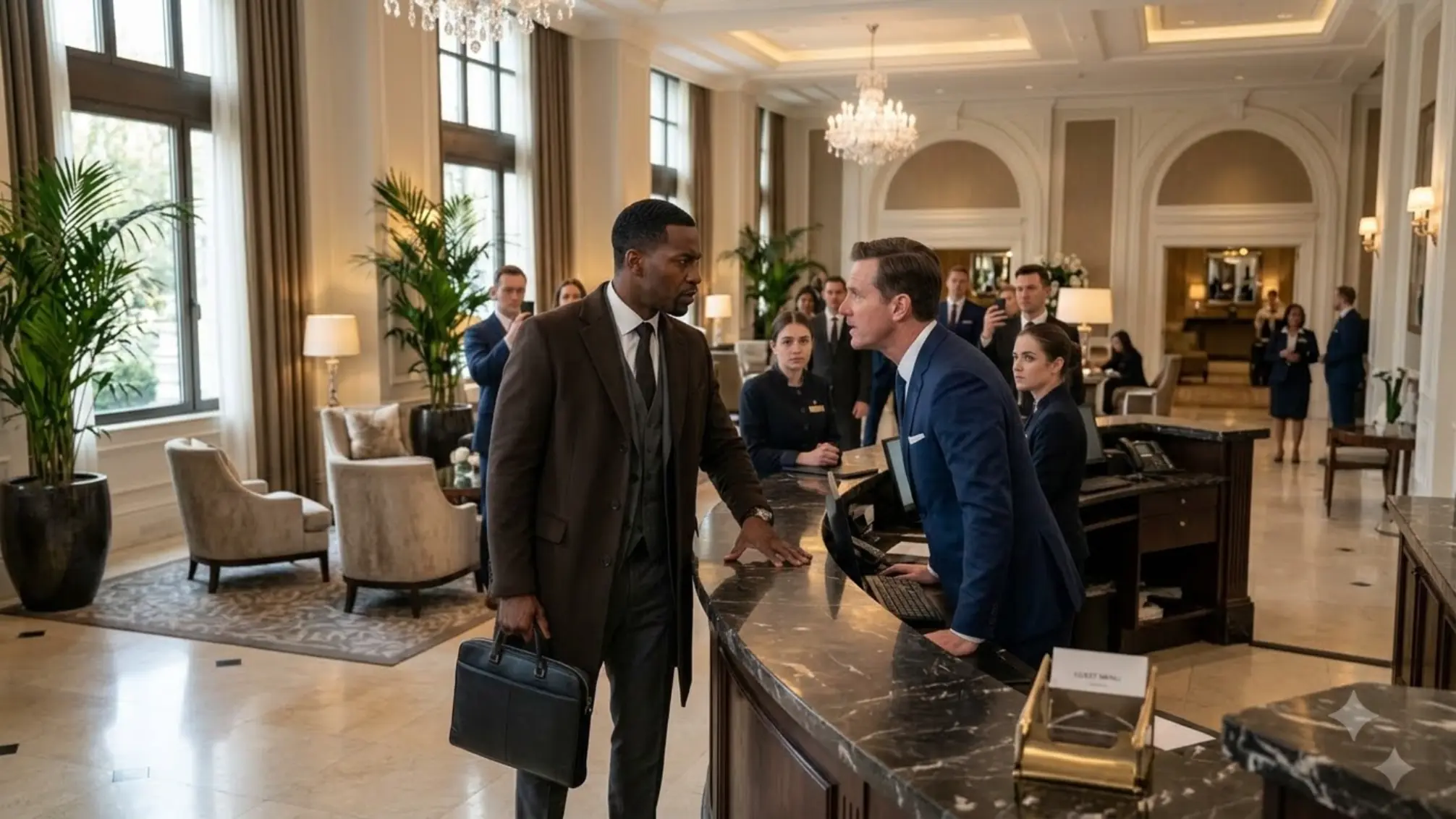
Graham Mercer, the forty-six-year-old senior front-desk supervisor, had worked at the luxury Dallas hotel for eleven years. He knew how to bow slightly when greeting celebrities, how to remember the preferred drinks of wealthy regulars, and how to make powerful guests feel as though the building existed solely for them. Yet when Darius had walked in alone carrying his own briefcase, Graham had seen none of the details that normally commanded his respect.
He had not noticed the precision of Darius’s tailored suit, the understated watch beneath his cuff, or the confidence of a man accustomed to entering rooms where billion-dollar decisions were made. He had seen a Black man presenting an expensive card, and suspicion had arrived before verification. That assumption had hardened the moment Graham felt the card’s unexpected weight in his hand.
Darius had given him a valid government-issued identification card and stated the name on his reservation clearly. Graham had found the booking, paused at the executive-suite designation, and then looked back at Darius as though the computer had made a mistake. Instead of processing the payment, he held the black card beneath the desk light and scraped one fingernail across its surface.
“Where did you get this?” he had asked.
“From the issuer,” Darius replied.
Graham laughed. “That is not what I asked.”
Darius’s eyes narrowed. “Then ask a legitimate question.”
The answer embarrassed Graham because two nearby guests had heard it. He could have corrected himself, verified the card through the hotel system, and completed the reservation. Instead, he chose to turn his embarrassment into authority.
He announced loudly that fraudulent luxury cards were becoming common and said he would not allow the hotel to be scammed. Darius asked whether the payment had been declined. Graham admitted he had not run it, then claimed he did not need to because the card was obviously suspicious.
When Darius requested a manager, Graham stepped out from behind the counter. He moved close enough that the front of his navy hotel jacket nearly touched Darius’s chest. The young receptionist seated beside him stopped typing and watched with wide eyes.
“You people always demand a manager when the trick fails,” Graham said quietly.
Darius’s expression changed.
It was not rage, at least not the kind Graham understood. Darius did not shout, curse, or make a scene. The warmth simply disappeared from his face, leaving behind the stillness of someone making a final calculation.
He picked up the card Graham had thrown onto the counter and examined the scratch across its edge. Then he called Raymond Pierce, chief operating officer of Lucent Applied Technologies. Raymond answered before the second ring.
“Stop our delegation outside the hotel,” Darius said. “Nobody enters the conference floor.”
Raymond hesitated. “What happened?”
“Cancel the room block, the executive dinner, and every scheduled meeting.”
Graham folded his arms and gave the receptionist an amused glance. He clearly believed Darius was staging an important-sounding conversation to protect himself from humiliation. Darius watched the smirk grow before delivering the final instruction.
“Tell legal the Benley merger is terminated.”
Raymond became silent.
“The entire agreement?” he asked.
“Every dollar.”
Darius ended the call and slipped the card into his wallet. Graham’s expression had not disappeared completely, but uncertainty had begun spreading beneath it. The hotel supervisor glanced toward the revolving doors, where several black vehicles had stopped outside.
Men and women in formal business attire stood on the sidewalk speaking into their phones. They had been moments away from entering the Lexington when Darius’s order reached them. One by one, they turned back toward the waiting vehicles.
Graham followed Darius’s gaze. “You expect me to believe those people work for you?”
Darius lifted the handle of his suitcase. “What you believe stopped mattering when you refused to check the facts.”
“You cannot threaten this hotel because I followed procedure.”
“You never followed procedure.”
Graham moved to block his path. “You are not walking out until security checks that card.”
Darius stopped inches from him. “Stand aside.”
“And if I don’t?”
“Then security will have footage of you unlawfully detaining the man whose signature your owners have been waiting thirty months to receive.”
The certainty in Darius’s voice finally broke Graham’s confidence. He stepped aside, but only after looking around to see whether the watching guests had noticed. They had.
Darius walked through the revolving doors without looking back.
Assistant manager Kelsey Durham emerged from the corridor behind the reception desk moments later. She had seen the gathering crowd through the security monitor and hurried downstairs, expecting a medical emergency or an unruly guest. Instead, she found Graham standing rigidly beside the counter while the young receptionist stared toward the entrance.
“What happened?” Kelsey asked.
Graham adjusted his jacket. “A man attempted to use a counterfeit Centurion card.”
“Did the payment decline?”
“I did not run it.”
“Did the identification fail?”
“He became hostile before we reached that stage.”
The young receptionist looked at Graham. “He gave you his ID first.”
Graham turned sharply. “Stay out of this, Ethan.”
Kelsey reached for the card terminal records but found no attempted transaction. She then opened the reservation under the name Darius Coltrain. The color drained from her face before the profile finished loading.
A red executive banner appeared across the screen.
Founder and Chief Executive Officer, Lucent Applied Technologies. Lead principal, Benley merger. Highest-priority corporate guest.
Kelsey scrolled through the notes. Darius controlled the seventy-eight-room executive block reserved for the week. Lucent and Benley had also planned to sign a three-year accommodation contract that would bring nearly $30 million in business to the hotel group.
More importantly, Darius was the only person authorized to execute the $3.8 billion merger scheduled for nine o’clock the next morning.
Kelsey turned the monitor toward Graham. “Tell me exactly what you said to him.”
Graham stared at the profile photograph. “That cannot be the same man.”
“He gave you this name.”
“He could have researched it.”
“He gave you matching identification.”
“Documents can be forged.”
Ethan finally spoke. “You told him he did not look like someone who would carry that card.”
Kelsey closed her eyes briefly. “You said that in the lobby?”
Graham pointed at the young receptionist. “He is twisting what happened.”
“There are cameras over the desk,” Kelsey said. “And at least fifteen witnesses.”
Graham’s jaw tightened. “Then the cameras will show that he threatened me.”
“They will also show whether you processed the payment, verified the ID, or called a manager before threatening to throw him out.”
Kelsey grabbed the hotel phone and called the penthouse suite. Three senior Benley executives had gathered there to review the final presentation: chief operating officer Howard Lynn, general counsel Trina Mendes, and chief financial officer Dev Shaw.
Howard answered impatiently. “We are waiting for Mr. Coltrain. Has he arrived?”
“He arrived,” Kelsey said. “Then he left.”
The room on the other end became quiet.
“What do you mean, left?”
“There was a confrontation during check-in.”
“What kind of confrontation?”
Kelsey looked at Graham. “His black card was called fraudulent. He was denied service and threatened with removal.”
Howard’s voice dropped. “Who did that?”
“Our senior front-desk supervisor.”
“And where is Darius now?”
“He canceled his reservation.”
“That is not what I asked.”
Kelsey swallowed. “He also said the merger was over.”
Upstairs, Howard lowered the phone slowly. Trina recognized the expression on his face and stood before he spoke. Dev closed the financial model on his laptop as if protecting himself from what was coming.
“What happened?” Trina asked.
Howard repeated Kelsey’s words.
Dev stared at him. “The front desk denied the lead executive the night before signing?”
“They accused his card of being fake.”
Trina walked toward the window. “Did anyone verify it?”
“No.”
“Then this is not a payment dispute. This is profiling.”
Howard called Darius immediately. The call went unanswered. He tried Raymond, then Lucent’s general counsel, then Darius again.
Every call went to voicemail.
Across the street, Darius entered the Bishop House, a smaller independent hotel with a narrow lobby and no crystal chandeliers. A young male receptionist welcomed him, checked the reservation created minutes earlier by Raymond’s assistant, and requested identification and payment.
Darius placed the same black card on the counter.
The receptionist inserted it into the terminal. The transaction was approved immediately.
“Your suite is ready, Mr. Coltrain,” he said. “Would you like assistance with your luggage?”
Darius looked at him for a moment. “No, thank you.”
The difference between the two encounters should have felt comforting. Instead, it made the insult at the Lexington clearer. Nothing about the card had been difficult to verify. No complicated process, special approval, or executive intervention had been required.
Only professionalism.
Inside his suite, Darius placed the card on the desk and stared at the scratch Graham had left on its surface. He had owned the card for nearly a decade, but it was merely a payment instrument. The insult had never been about metal, credit limits, or luxury.
It was about the speed with which Graham had decided Darius was dishonest.
His phone filled with calls and messages. Howard asked for a private conversation. Trina requested thirty minutes to explain the hotel’s relationship with Benley. The Lexington’s general manager offered a personal apology, an upgraded penthouse, and the dismissal of the employee involved.
Darius answered Raymond instead.
“Where is the team?” he asked.
“Returning to the airport and alternate hotels. Legal is reviewing the withdrawal clause.”
“Use Section Fourteen.”
Raymond paused. “Material concerns regarding corporate culture and undisclosed reputational exposure?”
“Yes.”
“They will argue that one hotel employee does not represent Benley.”
“The hotel is partly owned by a Benley-controlled investment group. Their executives selected it, promoted it to our board, and tied the accommodation contract to the merger.”
Raymond remained quiet for several seconds. “You were ready for this.”
“I was ready for any evidence that their stated values were false.”
“Do you believe this incident proves that?”
“No,” Darius said. “I believe their response will.”
Before midnight, Lucent’s legal department delivered a formal withdrawal notice. The letter contained no insults and did not mention Graham by name. It stated that Lucent had identified a material conflict between Benley’s public commitments and the conduct tolerated within an affiliated property.
Lucent was ending negotiations effective immediately.
At the Lexington, Graham sat inside an HR conference room with the hotel’s general manager, regional counsel, and Kelsey. He had abandoned his claim that the card was visibly counterfeit. Now he insisted Darius had behaved aggressively from the beginning.
Regional counsel placed a tablet on the table and played the lobby footage.
The video had no difficulty showing the truth.
Darius entered calmly, presented his reservation details, and handed over both his ID and card. Graham examined the card but never inserted it into the terminal. He laughed, said something that made Ethan look up sharply, and then threw the card onto the counter.
The audio captured every word.
“You people always demand a manager when the trick fails.”
Graham’s face changed as the sentence played.
“I was frustrated,” he said.
The counsel continued the recording. Graham threatened to put Darius down, raised his fists, and stepped into his personal space. Darius’s verbal warning sounded harsh, but he never touched Graham, blocked another guest, or attempted to cross behind the desk.
The general manager paused the footage. “You told us he initiated the threat.”
“He stepped toward me.”
“After you threw his property and ordered him out.”
“I believed he was committing fraud.”
“Based on what evidence?”
Graham looked around the room. “The card did not fit the situation.”
Kelsey stared at him. “What does that mean?”
He did not answer.
The internal review expanded before dawn. Kelsey searched archived complaints and found Graham’s name attached to nine previous incidents. In one, a Black surgeon had been asked to produce the credit card used to book a suite even though his company had prepaid the room.
In another, a Latino construction executive had been escorted away from the priority desk after Graham accused him of entering the wrong line. A Middle Eastern family had been required to pay an additional deposit that did not exist in hotel policy.
Every complaint had been closed as a misunderstanding.
Several had been approved for closure by the general manager himself.
At 8:17 the following morning, the executive conference room remained empty. Nameplates for both companies sat beside untouched water bottles. Leather folders bearing the Lucent and Benley logos had been arranged carefully around the long walnut table.
Not a single Lucent executive arrived.
Trina opened the withdrawal notice on her tablet and read the final paragraph aloud. Lucent would not reschedule discussions, enter a revised exclusivity period, or consider a temporary delay. The merger was finished.
Dev leaned back in his chair. “Thirty months of work.”
Howard stared at the empty chair reserved for Darius. “He cannot destroy a $3.8 billion agreement over one employee.”
Trina looked at him. “He did not destroy it. He exercised a withdrawal right we negotiated.”
“Because someone insulted him.”
“Because an affiliated business demonstrated a governance risk the night before we asked him to trust us with his company’s data, government contracts, and employees.”
Dev opened the financial model. Benley had delayed two manufacturing projects because the merger would have given it access to Lucent’s advanced logistics systems. It had also assured investors that the agreement was essentially complete.
The cancellation would trigger questions about debt, expansion costs, and executive judgment.
Howard pressed both hands against the table. “We need him back in this building.”
Trina shook her head. “That building is the reason he left.”
Darius agreed to one call, but only with Trina. She did not defend Graham, and she did not describe the incident as a misunderstanding. Instead, she acknowledged what had happened and asked whether an independent investigation could preserve the merger.
“No,” Darius said.
“May I ask why?”
“Because you are asking whether the problem can be repaired quickly enough to save the deal. I need partners who would repair it even if no deal existed.”
Trina absorbed the words. “Benley does not manage daily hotel operations.”
“Your investment division appoints two board members to the hotel group. Your team chose the property. Your executives negotiated the room contract. You used the relationship when it created value.”
“That is fair.”
“You cannot deny the relationship only after it creates responsibility.”
Trina looked down at her notes. “What would accountability look like to you?”
“Find out whether Graham was protected before yesterday.”
“And if he was?”
“Then stop pretending one man caused this.”
By noon, news of the canceled merger reached financial reporters. Benley’s stock price fell sharply as analysts tried to understand why a nearly completed agreement had vanished overnight. Anonymous sources initially described the problem as a disagreement during hotel check-in.
Then one guest uploaded a video.
The recording showed Graham slamming the card onto the counter and moving aggressively toward Darius. It captured the threats, the watching crowd, and Darius making the call that stopped his delegation outside.
Within hours, the video had millions of views.
The Lexington issued a statement promising a full investigation. It said the conduct shown in the recording did not reflect the hotel’s values. Darius read the statement once before giving the phone back to Raymond.
“They discovered their values after losing the contract,” Raymond said.
“Then the contract taught them where to look.”
Graham was suspended immediately, but the investigation did not end with him. Interviews with employees revealed that managers had repeatedly discouraged formal complaints against high-ranking front-desk staff. Workers who challenged discriminatory treatment were assigned worse shifts, denied promotions, or written up for insubordination.
Ethan admitted that he had wanted to intervene sooner but feared losing his job. Six months earlier, he had questioned why Graham demanded additional identification from a Black family while accepting a white guest’s explanation for a booking error.
The next week, Ethan’s hours had been cut.
Kelsey uncovered seventeen complaints involving unequal treatment across three hotels connected to the same regional leadership team. Eleven had been closed without interviewing the guest. Security footage had been allowed to expire, witness statements had disappeared, and refund records were used to make the complaints look like ordinary service disputes.
The hotel group’s regional guest-experience director had approved most of the closures.
The problem was no longer Graham’s behavior.
It was the system that had taught him he could behave that way without consequence.
Graham was terminated for discrimination, threatening a guest, violating payment-verification procedures, and lying during the investigation. The general manager resigned after emails showed that he had been warned about Graham more than once. The regional guest-experience director was dismissed for suppressing complaints and retaliating against employees.
Benley’s board opened a separate review into its investment division. Investigators found that executives had received summaries of guest complaints but classified them as minor operational matters. They had prioritized occupancy figures, corporate contracts, and brand scores over evidence of repeated discrimination.
Howard lost his position after the board concluded that he had dismissed earlier concerns to protect the planned merger.
Trina remained because she had preserved internal warnings and cooperated fully. She later helped establish an independent ethics office with authority to investigate complaints across every Benley-controlled business.
Darius refused a private settlement from the hotel group. He also rejected a confidentiality agreement that would have prevented public discussion of the incident.
He did not ask for free rooms, money, or Graham’s personal apology.
Instead, Lucent required every future hospitality partner to disclose unresolved discrimination complaints, employee retaliation claims, and audit findings before receiving corporate business. Hotels that concealed records would lose their contracts automatically.
The Bishop House became Lucent’s preferred Dallas hotel.
Jaden, the young employee who delivered breakfast to Darius on his first morning there, learned why the CEO was staying across the street. His father managed a warehouse using Lucent software, and Jaden nervously mentioned this while placing the tray on the table.
“My dad says your system saved their branch,” he said.
Darius smiled for the first time since entering Dallas. “What is his name?”
“Calvin Brooks.”
“Tell Mr. Brooks I appreciate his trust.”
Jaden nodded, then hesitated. “Sir, I saw the video. I am sorry that happened.”
Darius looked toward the Lexington through the window. “Do not apologize for what someone else chose to do. Just remember what respectful service looked like before you knew who I was.”
Jaden understood.
The story continued spreading, but Darius remained silent for two days. He had no interest in becoming a symbol created by television panels or headlines. He also knew that millions of people had experienced similar humiliation without having the power to cancel a billion-dollar agreement.
On Saturday morning, he attended a mentoring event scheduled months earlier at a community center in South Dallas. Students, interns, small-business owners, and young professionals filled the folding chairs.
Darius had planned to speak about technology and entrepreneurship.
Instead, he spoke about power.
“Some people believe power means making others afraid,” he began. “They believe it is the right to raise their voice, close a door, or decide who belongs.”
The room became silent.
“Real power is knowing who you are before someone checks your title. It is refusing to let another person’s assumption become your identity.”
A student near the front raised his hand. “Did you cancel the merger because you were angry?”
“Yes,” Darius said. “I was angry. Pretending otherwise would be dishonest.”
The audience waited.
“But anger did not write the withdrawal notice. Evidence did.”
He explained that Graham’s conduct had revealed an institutional risk, while the buried complaints proved that the risk extended far beyond one encounter. A business partnership required trust, and Lucent could not hand over sensitive systems and employee futures to leaders who treated dignity as a marketing phrase.
Another student asked whether walking away had been financially difficult.
“The agreement would have expanded our manufacturing network,” Darius said. “Losing it cost us time and money.”
“Then how do you know you made the right choice?”
“Because money tells you what something pays. Character tells you what it costs.”
The clip of that answer spread farther than the confrontation video.
Within six months, Lucent signed separate agreements with three smaller manufacturing partners. Together, the partnerships created nearly the same capacity Benley had offered, but they distributed risk and included enforceable protections for workers, suppliers, and customers.
Lucent continued growing.
Benley’s recovery took longer. The company replaced several board members, sold part of its hotel investment, and compensated former guests and employees whose complaints had been suppressed.
Its new CEO publicly admitted that the lost merger had not been caused by one front-desk employee. It had been caused by years of leadership decisions that allowed misconduct to become normal.
Ethan was promoted after investigators credited his truthful testimony. Kelsey became the Lexington’s director of operations and reopened every complaint closed under the previous management.
Payment cards were no longer treated as suspicious because of their material, color, or the appearance of the person presenting them. Every challenge required an actual transaction failure, an identification mismatch, or a documented security concern.
A year later, Darius returned to Dallas for another business meeting. His driver passed the Lexington Tower, its chandeliers visible through the enormous lobby windows.
Raymond glanced toward the hotel. “Do you ever wonder what would have happened if Graham had simply processed the card?”
“The merger probably would have been signed.”
“Do you regret that it was not?”
Darius considered the question.
“No,” he said. “He did not create their weakness. He exposed it.”
Darius reached into his wallet and removed the same black card. The scratch Graham had left was still visible along one edge. The issuer had offered to replace it, but Darius had declined.
The mark reminded him that recognition often arrived too late.
Graham had believed Darius deserved respect only after learning he was a billionaire capable of destroying a $3.8 billion agreement. But wealth was never supposed to be the reason the humiliation was wrong.
It had been wrong before the title appeared on the screen.
It had been wrong before Benley’s executives panicked upstairs.
It had been wrong when Graham believed he was threatening a man without power.
The black card did not prove Darius belonged in the hotel.
It merely revealed how expensive prejudice became when the hotel decided he did not.