“You really think that card belongs to you? Don’t embarrass yourself.”
The words cracked across the hotel lobby like a whip.
Three employees behind the polished mahogany desk burst into laughter. Sharp, rehearsed, cruel. 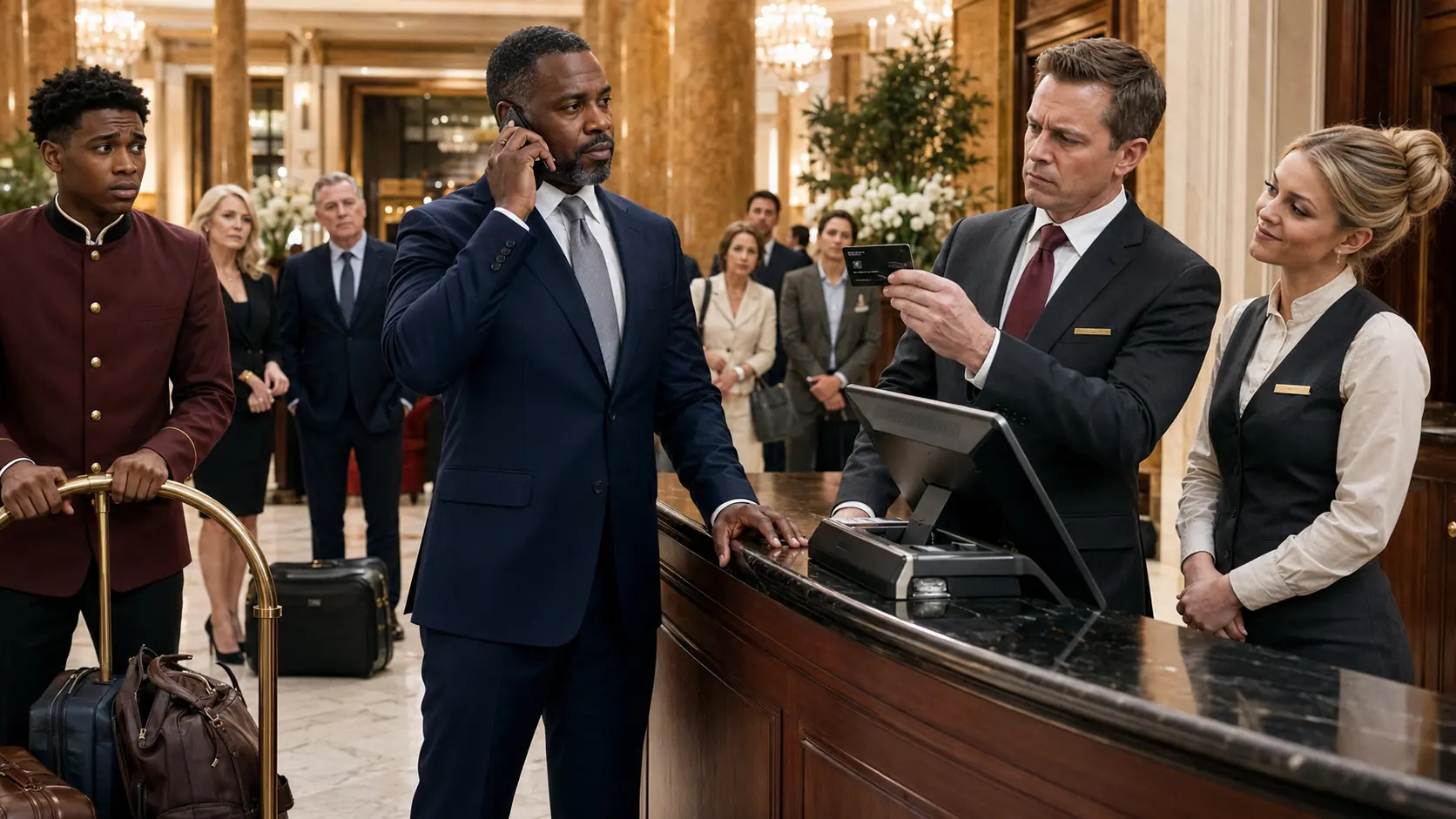
One of them jabbed a finger toward the small black rectangle resting in the CEO’s steady hand, as if pointing out a counterfeit bill.
The sound of their mockery echoed in the vaulted space, mixing with the hum of chandeliers and the shuffle of guests pausing mid-check-in.
He did not flinch.
He did not join their laughter.
He simply held the card between two fingers, the matte surface catching no light at all, as if it refused to perform for them. His other hand lifted a phone to his ear. Calm. Controlled. Almost detached.
The staff thought they were watching a stranger bluff.
They had no idea they were watching the collapse of their own careers.
The CEO stood rooted, a figure in a tailored navy suit, posture quiet but unyielding. He had walked into this lobby alone with no entourage, no bodyguards, no display of wealth, only the calm certainty of someone who had carried that card across continents.
To the laughing employees, it was nothing more than a piece of plastic.
To him, it was a ledger of decades.
Every deal signed. Every company built. Every barrier shattered.
Yet at this moment, none of that mattered. What mattered was the sneer, the disbelief, the dismissal packaged as humor.
A nearby guest lowered her coffee, eyes narrowing. Another froze mid-stride, watching the air shift. What began as background chatter now pulsed with unease.
The joke was not landing.
The cruelty was visible.
Still, the CEO remained silent. The phone in his ear was not for show. On the other end, an assistant was already logging every second: location, language, tone, evidence.
But the staff did not know that.
They only saw a man they thought did not belong.
And that mistake, those seven careless words, would soon erase a $3.8 billion deal before they even realized it was theirs to lose.
The lobby gleamed with marble and brass, a space designed to impress. But for him, it was just another room, a stop on the way to something larger.
He had checked into dozens like it. Cities blurred across decades of travel. Each lobby was another test of patience.
Tonight was no different.
He had flown in quietly. No assistants trailing with luggage carts. No press release announcing his arrival. Just one man in a tailored navy suit worn with the kind of ease that comes from habit, not display.
No Rolex flashing under the lights.
No designer scarf to mark his worth.
He chose this on purpose because what people reveal when they do not recognize you often matters more than what they say when they do.
The card in his hand was not decoration. It was a key, a silent passport to every boardroom he had ever conquered.
The matte black surface had been swiped in Tokyo, Paris, Lagos, Dubai, and every city that had once looked at him with the same skepticism he saw now in these clerks’ eyes.
They did not see billions.
They saw only what they wanted to see.
A Black man holding a card they thought could not possibly be his.
“Reservation under Carter. Presidential suite.”
His voice was even. Professional.
The receptionist glanced at the screen, then at him, then back again.
A small pause.
That pause said more than words. It was disbelief masked as procedure.
Then came the smirk, quick and cutting, followed by the manager’s chuckle, as if the entire transaction were a joke arranged for their amusement.
But he stayed still.
Calm was not new to him.
At twenty-four, his first commercial lease had been rejected for “insufficient credibility,” even though he had overfunded the deal.
At thirty-one, he walked into a lender’s office with more collateral than the project required and still heard, “Not our type of client.”
He learned then that silence was not weakness.
It was a blade sharper than outrage.
So he did not raise his voice. He simply set the card down on the counter with quiet precision.
Around them, guests shifted, sensing the tension but not yet knowing why. The employees still laughed softly, thinking they had the upper hand.
The hotel was hours away from becoming part of his portfolio.
Unless this moment changed everything.
The laughter did not fade.
It spread.
The front desk clerk nudged his colleague with an elbow, whispering loud enough for the lobby to catch.
“Presidential suite in that suit? He’s probably lost.”
The words carried more venom than volume.
A second clerk leaned over the counter, her grin wide and mocking.
“Sir, you don’t look like someone who books that room. Maybe you meant the standard floor.”
Guests nearby shifted uneasily.
A woman with rolling luggage slowed her step. A father tugged his son closer, sensing the sharp edge in the air.
What should have been a quiet check-in was curdling into spectacle.
The manager emerged from the back office. Crisp tie, stiff posture, and a look that said judgment had already been passed.
He did not even ask for confirmation. He did not glance at the reservation system. He just locked his eyes on the card.
“We see fakes like this every week,” he announced, voice pitched for the entire lobby. “Better to deal with it now. Security will escort you out.”
The room shifted again, whispers buzzing like static.
Someone lifted a phone halfway, thumb hovering above record. Another guest folded their newspaper but did not look away.
Attention was tilting toward the scene, gravity pulling eyes toward the counter.
The CEO did not move.
He let the moment expand, the insult hanging in the air like smoke.
Calm was not compliance.
It was calculation.
He remembered another desk years ago in Atlanta. The clerk then had squinted at his ID and said, “We’ll need to verify. Come back later.”
He had slept in his car that night.
That memory lived in his bones, carved into every deal he made afterward.
Now, decades later, the same tone echoed here.
Same disbelief.
Same dismissal.
Wrapped in different uniforms.
The card was still on the counter, untouched. The manager did not pick it up, did not run it, did not even check the system.
He simply waved his hand as though brushing away a nuisance.
“Call security,” he instructed flatly.
One clerk pressed a button beneath the counter.
A chime rang somewhere deep in the building.
The sound cut through the marble silence like an alarm.
The CEO’s phone was still at his ear. He did not raise his voice, did not argue.
He simply said four words into the receiver.
“Log this as escalation.”
On the other end, his assistant’s voice came through steady.
“Timestamped. Protocol standing by.”
The clerk smirked, thinking they had forced submission.
What they had really done was trigger a sequence far bigger than this lobby could contain.
And the watching guests, sensing the shift, began to realize this was not just about a room.
It was about who was allowed to exist inside it.
The chime that summoned security echoed once, then faded.
The clerks exchanged smug glances as though the outcome was sealed. In their eyes, he was already gone, escorted out, erased, forgotten before the night could settle.
But he did not move.
He did not even blink.
Instead, he rested his phone against his shoulder, folding one hand calmly over the other, posture steady as stone.
Not a trace of panic.
Not even irritation.
Just stillness, the kind that made observers lean forward, wondering what they were not seeing.
Guests noticed.
The father with the son whispered, “Why isn’t he leaving?”
A woman near the velvet couches shook her head, lips pressed tight. She had seen enough lobbies to know this was not ordinary.
The manager mistook that calm for weakness. He leaned closer, lowering his voice but sharpening its edge.
“Sir, silence won’t help you. Fraud doesn’t vanish just because you stand still.”
The words slid across the polished counter like oil on glass.
The CEO did not respond.
He had learned long ago that silence unsettles more than shouting. At twenty-five, a banker once called him “high risk” in a crowded office. He had not argued. He had simply waited, watching the man stumble over his own reasoning until the room turned against him.
Tonight carried the same rhythm.
So he stood there, the black card still untouched on the counter, his phone still open on the line.
On the other end, his assistant’s voice was quiet but firm.
“We’re recording. Language flagged. Escalation noted.”
The clerks chuckled again, mistaking documentation for desperation.
One of them muttered, “Pathetic. He’s calling friends for backup.”
But the guests heard.
More phones began to lift, hesitant at first, then steady. Screens glowed like quiet witnesses.
He raised one hand slightly, palm outward, signaling no.
His voice finally broke the silence, low but deliberate.
“We don’t need footage. We need facts.”
The gesture startled the nearest clerk.
To him, it was a refusal of spectacle.
To the guests, it was something else entirely.
Dignity.
The lobby felt different now. The laughter did not land the same. The smirks looked smaller.
The stillness carried weight, pressing against every corner of the marble hall.
For the first time, it was not just employees against one man. It was a gathering storm.
Guests watching.
Recording in memory, if not in pixels.
Waiting for what would come next.
Through it all, he remained quiet, anchored, unshaken.
Because silence was not surrender.
It was strategy.
The murmur started small, just one voice near the corner couches.
“Are you seeing this?”
Another replied, “I’m filming already.”
A young traveler in a denim jacket angled his phone upward, the red recording light blinking like a beacon. He whispered into the mic.
“We’re at the Royal Meridian Hotel, and they’re throwing out a man for using a black card. Watch what happens.”
His live stream counter ticked upward.
Ten.
Twenty.
Forty viewers in seconds.
Across the lobby, a middle-aged couple froze mid-check-in. The husband’s brow furrowed.
“They didn’t even swipe the card,” he muttered.
His wife clutched her handbag tighter, eyes narrowed at the front desk, as if the marble counter itself had betrayed something ugly.
By the elevators, two college students whispered furiously.
“This is racial profiling.”
“Don’t say it too loud,” the other cautioned.
But neither of them looked away.
Even the bellhop, no older than twenty-two, lingered with a luggage cart at his side, hands tightening on the handle. He had worked here six months, long enough to know the pattern, but never brave enough to speak.
Tonight, the tension was too heavy to ignore.
The clerks, oblivious or arrogant, continued their mock performance.
One leaned over the desk, voice pitched for the growing crowd.
“Sir, your reservation doesn’t exist. People like you try this trick all the time.”
The phrase landed with a thud.
People like you.
Guests stiffened.
Phones rose higher.
Someone gasped loud enough to echo.
The CEO did not move. He let the words hang, poisonous and undeniable, knowing the witnesses had already absorbed them.
Then came a shift.
The bellhop stepped forward. His voice trembled but carried.
“I saw the booking earlier. The name’s real. His suite is in the system.”
The manager whipped around, eyes flashing.
“Quiet. You’re mistaken.”
But the damage was done.
The first crack in their control had opened.
The young traveler with the live stream raised his voice now, addressing his audience.
“You heard that, right? A staff member confirmed the reservation. This is on record.”
The chat counter leapt again.
Hundreds now.
Comments streaming like sparks.
Guests shuffled closer, forming a loose semicircle. They were not shouting. They were not chanting.
But their silence was charged, heavy with judgment.
Every raised phone was a mirror reflecting the imbalance of the moment.
The CEO remained anchored, posture still, eyes forward.
Not once had he raised his tone.
He did not need to.
The room was doing it for him.
And in that gathering of witnesses, in every lifted screen, every whispered protest, the power dynamic shifted.
What began as mockery was now a tribunal.
The hotel was no longer judging him.
It was on trial itself.
The semicircle of guests pressed closer, their silence louder than any chant. Screens hovered like lanterns, casting cold blue light across the marble lobby.
The clerks began to squirm under that glow, but the manager straightened his tie and forced a smirk, as if the presence of witnesses only sharpened his authority.
He raised his voice so it could climb the chandeliered ceiling.
“Enough. This man is not a guest. His so-called reservation is a fabrication. Security will be here any moment to escort him out.”
Gasps rippled through the crowd.
A woman whispered, “He hasn’t even checked the system.”
The live stream camera caught the disbelief on her face.
But the manager was not finished.
He leaned across the counter, lowering his tone to a snarl meant only for the man in front of him.
“You can stand here all night, but the truth is simple. You don’t belong here. Not in this hotel. Not in that suite.”
The insult was sharper than the words themselves.
Guests shifted uneasily. The bellhop froze, guilt etched across his face. He had spoken truth, and now he was staring down the cost of it.
The clerk to the manager’s right chimed in, her voice dripping with contempt.
“He’s wasting everyone’s time. Real clients are waiting.”
She gestured toward the couple at the check-in desk as if inviting them to agree.
But the wife shook her head, pulling her husband’s arm.
“We’re not part of this,” she whispered firmly.
The manager slammed a hand against the counter, the crack echoing across the lobby.
“You are a fraud.”
His declaration was loud enough to drown the hum of phones, to stamp authority where reason had already failed.
Then the choice of words shifted the air.
Fraud.
The live stream caught it.
Comments poured in.
They just called him a fraud without evidence.
Unreal.
The CEO did not flinch. His stillness only magnified the chaos building around him.
One more clerk, emboldened, added fuel.
“We’ve seen this trick before. Flash a black card. Demand a suite. Walk out with the system compromised. He’s dangerous.”
The word dangerous hung like smoke.
A mother in the corner pulled her daughter close.
A young man muttered, “They’re trying to paint him as a threat.”
The manager, sensing he was losing ground, snapped at the bellhop.
“Say another word and you’re out of a job.”
The boy’s lips tightened, but he stayed silent, hands trembling on the luggage cart.
The CEO’s phone remained at his ear, his voice calm and deliberate.
“Note the language. Fraud. Dangerous. Timestamp it.”
The assistant’s reply came clear.
“Logged. Escalation recorded.”
The lobby had shifted again.
It was no longer the quiet theater of luxury.
It was a courtroom without walls, and every witness had already heard the verdict.
One side escalating with insults.
The other standing still with dignity.
The fracture was widening, and the next move would decide whether it collapsed entirely.
The marble floor caught the sound first: the sharp clack of the manager’s polished shoes as he stormed around the counter.
The crowd parted slightly, unsure of what he intended but bracing.
His hand shot forward, snatching the black card from where it rested.
He held it aloft like a trophy, his smirk stretching wider.
“This doesn’t prove who you are. This proves nothing.”
Gasps cut through the lobby.
The bellhop flinched.
Phones tilted higher.
The manager dangled the card between two fingers, shaking it as though it were counterfeit paper.
“We’ve seen dozens like this. Printed. Stolen. Borrowed. And you walk in here thinking a piece of plastic earns you a suite.”
The word plastic hissed like an insult, though everyone knew the weight of that card could crush entire balance sheets.
Then slowly, deliberately, he turned to the clerk beside him.
“Cancel the reservation right now, Heba.”
Her fingers hesitated above the keyboard, but his glare pinned her down.
She tapped quickly, and a cold voice from the system echoed through the lobby speakers.
“Reservation under Carter, canceled.”
The declaration hit harder than any shout.
A suite erased with a keystroke.
But the manager was not finished. He tossed the card onto the counter, letting it skid across the polished surface before stopping inches from the CEO’s hand.
“You’re done here. When security arrives, you’ll be removed. And if you resist, the police will handle the rest.”
The word police landed heavy, sharp as glass.
A murmur surged through the onlookers.
The live stream chat exploded.
They canceled his booking without proof.
This is insane.
They just threatened him with police.
The young traveler holding his phone shook his head, whispering into his stream.
“This is theft. That’s his card. That’s his name. And they just wiped his suite out of spite.”
Across the room, the couple who had watched from the check-in desk set their suitcases aside.
The wife’s voice cracked.
“This isn’t protocol. This is prejudice.”
But the clerks, emboldened by their manager, stood taller.
One muttered, “Fraud always runs scared once the cops get here.”
Another laughed softly, cruel and certain.
Through it all, the CEO remained motionless.
His eyes followed the card on the counter, but he did not reach for it.
His phone was still at his ear.
And when he finally spoke, his tone did not rise.
It sharpened.
“Log this as theft. Reservation canceled under bias. Card mishandled by staff. Escalate to phase two.”
His assistant’s voice came steady, cutting through the noise.
“Phase two confirmed. Corporate notified. Internal audit initiated.”
The words were not shouted.
They did not need to be.
Because while the staff thought they had erased him with a keystroke, what they had really erased was their future.
And every witness in the lobby knew it.
The card lay on the counter, abandoned, like evidence discarded at a crime scene. The crowd murmured, their disbelief simmering into outrage.
Yet at the center of it all, he remained still, eyes calm, posture unbroken.
Then, without hurry, he lifted his phone fully to his ear.
His voice carried clearly enough for every microphone, every recording device, every witness present.
“Proceed to protocol three.”
On the other end, his assistant did not hesitate.
“Acknowledged. Legal compliance engaged. Corporate board notified. Live monitoring has begun.”
The words rippled through the lobby like a quiet thunderclap.
The manager scoffed, mistaking strategy for bluff.
“Who exactly do you think you’re calling? Some lawyer friend? You’ll be out of here before they even pick up.”
But guests could see the difference.
His tone was not desperate.
It was procedural, like someone pressing a switch on a machine built for this exact moment.
The live stream audience ballooned from hundreds into thousands. Comments scrolled.
This guy knows what he’s doing.
Phase three? Sounds like he has a system.
This is bigger than one hotel.
The bellhop, trembling but resolute, stepped closer. His voice wavered but reached.
“Sir, I can confirm your suite was valid. I checked the log myself earlier today.”
The manager snapped, “Silence. One more word and you’re finished.”
But the damage was done.
Witness testimony had entered the room.
The CEO lowered his phone, not to end the call, but to let its glow illuminate the counter.
“Everything has been recorded. Every insult, every false claim, every misuse of authority.”
Then he paused, eyes steady on the manager.
“And now your own system is under audit.”
The clerk who had canceled the reservation shifted uneasily. She knew enough about corporate oversight to understand what those words meant.
Her fingers twitched above the keyboard, but no correction could erase what had just been logged.
For the first time, silence pressed back against the staff, heavier than their arrogance.
The manager’s smirk faltered.
He leaned in and hissed low.
“You’re bluffing.”
The CEO did not blink.
“Then call the bluff.”
Gasps spread. Guests leaned closer. Phones rose higher.
The narrative had flipped.
He was no longer the accused.
He was the accuser.
And the room knew it.
What began as an attempt to eject a man from a lobby had become something else entirely.
The beginning of their own removal.
The air in the lobby tightened, charged with the weight of silence.
Dozens of eyes watched him, waiting for the next move. Phones hovered like spotlights, every lens fixed on the man they had mocked minutes earlier.
He reached for the card, not snatching it back, but lifting it with measured grace. The matte surface gleamed dully under the chandelier, unimpressive to the untrained eye, priceless to anyone who knew.
He turned it once in his fingers, then set it flat again.
His gaze lifted to the manager.
Calm.
Certain.
Final.
“You keep calling me a fraud,” he said evenly. “But here’s the truth. I’m not your guest. I’m your owner.”
The words detonated without volume.
The impact was measured in gasps.
The live stream chat exploded.
Owner?
Did he just say owner?
He let the weight of it settle before continuing.
“The $3.8 billion acquisition your board has been clinging to. It’s my deal. My signature. My capital. And just now—”
He gestured lightly toward the system.
“You canceled it with a smirk.”
The clerk who had pressed the keys blanched, her fingers trembling against the desk.
The manager opened his mouth, but no words came out.
His authority had cracked, his posture suddenly too stiff, too fragile.
Guests looked at one another in disbelief.
A man in a business suit whispered, “That means this place…”
His companion finished the sentence for him.
“Was about to be his.”
The bellhop straightened, relief flashing across his face.
He had not risked his job for nothing.
The CEO’s phone was still live.
Speaker on now.
A crisp voice broke through, female, confident.
“Confirmation received, Mr. Carter. The board has acknowledged your directive. The acquisition contract is officially suspended pending your authorization.”
Every syllable was a gavel strike.
The live stream camera panned wildly, catching the reactions.
The couple at the desk covering their mouths.
The college students muttering, “No way,” over and over.
The mother pulling her daughter close and whispering, “Remember this moment.”
The manager finally sputtered, “This… this can’t be true.”
The CEO’s voice cut him off like steel.
“You laughed at the card. You mocked the name. You canceled the suite. And in doing so, you canceled your future.”
He did not shout.
He did not need to.
The truth had spoken louder than any outburst.
In that moment, the lobby itself seemed to shift allegiance away from those who thought they had power and toward the man who had never needed to prove it.
The declaration landed like a thunderclap, and the lobby fractured under its weight.
The manager’s face drained of color, the arrogant flush replaced by something rawer than fear. His jaw worked, but his words jammed in his throat.
For the first time, the polished posture collapsed. He looked small, cornered, stripped of certainty.
The clerk who had canceled the reservation stumbled back from the computer screen as if the keyboard itself had burned her.
She stammered, “I… I didn’t know.”
But the excuse evaporated before it reached the air.
The second clerk, the one who had laughed the loudest, folded her arms tighter across her chest, but her eyes darted to the glowing phones around her. Her smirk was gone, replaced by panic, the dawning realization that millions could soon be watching her humiliation in real time.
And then the bellhop, young and trembling but braver now, exhaled, his chest rising with a strange relief.
He was not the one who would fall.
He had spoken truth, and now that truth had a shield.
Guests rippled with reactions. Some clapped openly, unable to contain their satisfaction. Others whispered furiously, their voices slicing through the marble air.
“He owns it.”
“He owns all of this.”
“They called the owner a fraud.”
The live stream chat roared.
Look at their faces.
Done.
This is history.
Instant justice.
The manager staggered, his polished shoes sliding slightly against the marble. He tried to recover, voice trembling.
“This isn’t how it works.”
But it was.
Everyone knew it.
The clerk reached for the reservation system, fingers fumbling.
“I can undo it. I can fix this.”
“No,” the CEO’s assistant said through the phone speaker. “Action already logged. Irreversible.”
The word irreversible spread through the room like cold air.
The manager pressed his palm flat to the counter as if steadying himself against the truth.
He whispered, “We didn’t know.”
The CEO’s gaze did not waver.
“That’s the problem.”
Gasps punctuated the silence.
The crowd leaned in.
This was no longer just a confrontation.
It was collapse.
Every mocking laugh, every careless insult, every false accusation had turned back on them.
The clerks saw it.
The manager felt it.
And the guests, silent witnesses, were savoring every second of the unraveling.
The power had shifted completely.
There was no going back.
The lobby was still vibrating with disbelief when his voice cut clean through it.
Calm.
Controlled.
Final.
“Terminate their access.”
On the other end of the line, his assistant did not even pause.
“Confirmed. Executing now.”
Within seconds, the first sign appeared.
The manager’s badge, clipped neatly to his jacket, flashed red. A sharp electronic chirp echoed from the scanner at the desk.
His clearance had been revoked.
Live in front of every witness.
“What? No. No, this has to be a mistake,” he stammered, tugging at the useless plastic as though shaking it might restore his authority.
The clerks were next.
Their monitors flickered, screens locking them out of the system entirely.
A sterile message blinked in bold.
Access Revoked. Horizon Corporate.
Their mouths fell open.
Gasps swelled in the room. Phones rose higher.
The live stream chat exploded.
They’re getting fired on camera.
This is justice in real time.
The manager pounded the counter with a flat palm.
“You can’t do this here. Not like this.”
But the CEO did not raise his voice.
He only tilted his head slightly, gaze steady.
“I don’t need a courtroom. This lobby is enough.”
The younger clerk began to cry softly, muttering about rent, about family. The other froze stiff, jaw clenched, but her eyes betrayed panic.
“You chose your words,” he said evenly. “You chose your laughter. And now you live with the choice.”
A guest clapped sharply.
Once.
Then again.
Soon others joined.
Applause swelled, reverberating off marble walls.
Not raucous.
Not mocking.
Approval.
The manager tried one last protest, voice breaking.
“You can’t end careers in minutes.”
The CEO’s reply was surgical.
“You ended your own in seconds.”
Phones captured every syllable, every tremor in the faces that only minutes earlier had mocked him with certainty.
The clerks who had once smirked now stood hollow, stripped of both access and authority.
The irreversible had arrived, not with shouting, not with chaos, but with one order.
Quiet as a gavel.
Final as judgment.
The lobby had transformed.
What began as a stage for mockery now stood as a courtroom of justice, verdict already delivered.
The manager slumped against the counter. Badge dead. Career gone.
The clerks, once smug and certain, now stood pale and silent, their screens frozen in permanent exile.
No one laughed anymore.
Not even a nervous chuckle.
Only the low murmur of guests heavy with awe.
The CEO reached for the black card, lifting it slowly and deliberately. He slid it back into his wallet as though returning a sword to its sheath.
Then he straightened, eyes sweeping the room.
Not just the guilty, but the witnesses who would carry this story far beyond these walls.
“You denied me service,” he said, his voice low but resonant. “For existing. For daring to hold what you believed could not belong to me.”
Gasps shivered through the crowd.
The live stream chat pulsed.
Say it again.
This line will go viral.
History right here.
He let silence settle before delivering the final blow.
“And now,” he continued, “I deny you existence in this industry. Not with anger. Not with noise. But with truth.”
The bellhop, still clutching his cart, nodded quietly, his relief visible.
Guests clapped again, louder this time, some even cheering. Phones tilted upward, recording every syllable, every still frame destined for millions of screens.
The manager tried to speak, but his voice cracked.
No one listened.
His authority had evaporated. His words carried no weight.
The CEO turned, adjusting his cuff with calm precision.
“Remember this,” he said, eyes sweeping the staff one final time. “I don’t need footage to prove what happened. I am the proof. I am the result of every attempt to erase me.”
Then he stepped away from the counter, phone still in hand, the line still open.
His assistant’s voice carried faintly.
“Mr. Carter, the board has logged everything. Acquisition suspended. Legal notified. Media inquiry prepared.”
He gave one nod.
“Good. Let them know justice was served tonight.”
The marble echoed with his footsteps as he moved toward the exit.
Guests parted like a tide, not out of fear, but respect.
Some whispered. Some applauded. Some simply watched in silence, knowing they had witnessed something irreversible.
The final image was a Black CEO walking away from a lobby that had tried to humiliate him.
Walking taller, not because he raised his voice, but because he never needed to.
Justice had arrived not in shouts, but in stillness.
And in that stillness, a truth carved itself into the marble air.
Power does not beg.