At 8:47 on a gray Tuesday morning in downtown Chicago, Dr. Amelia Washington walked through the revolving glass doors of First National Bank carrying a black textured clutch and absolutely no intention of proving that she belonged there.
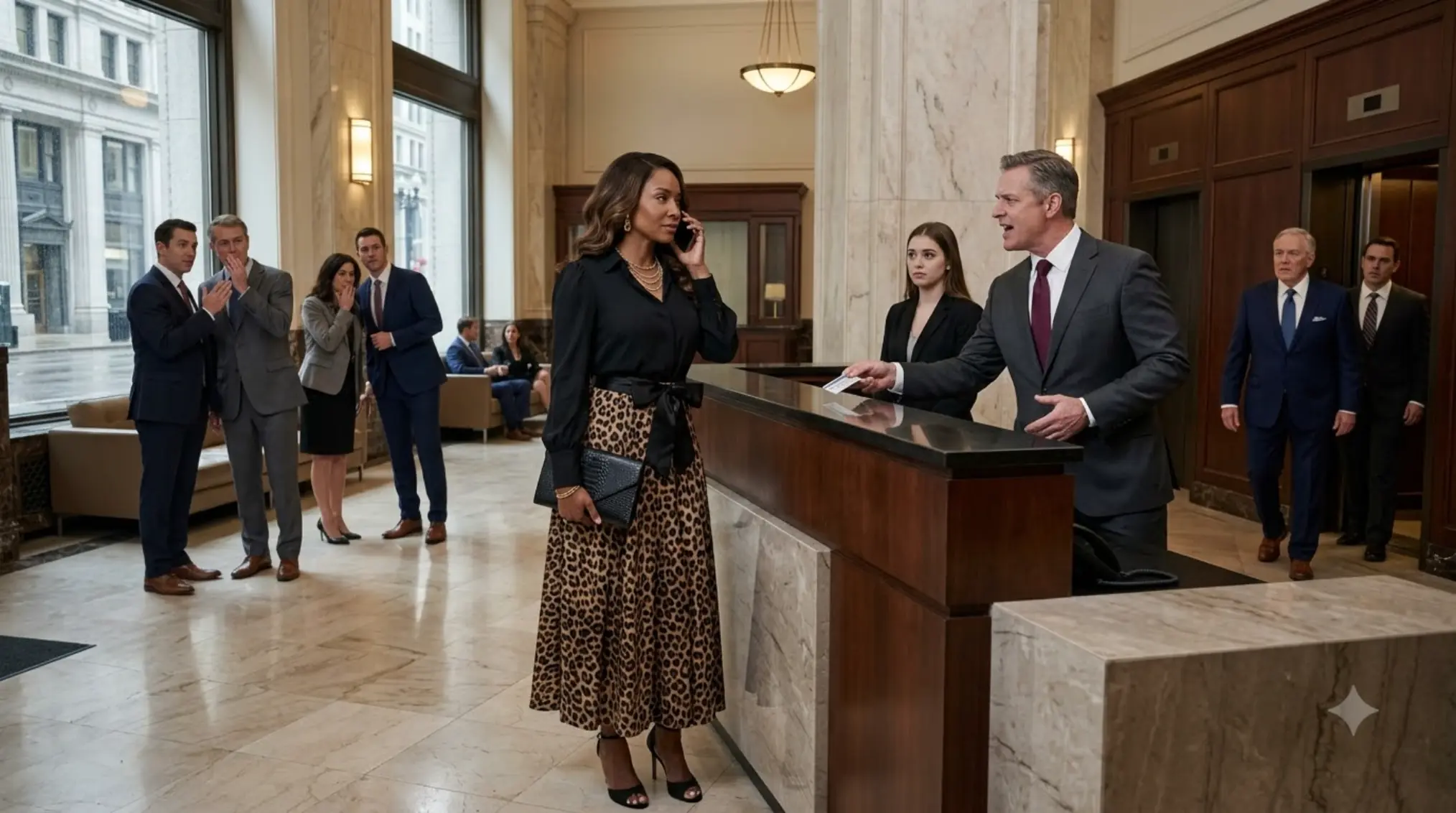
The marble lobby was designed to make ordinary people feel small.
Thirty-foot ceilings.
Veined stone columns.
Brass trim.
Leather chairs arranged beneath enormous windows overlooking LaSalle Street.
A private elevator stood behind the reception counter with access restricted to wealth-management clients, corporate executives, and people whose money was important enough that the bank preferred they never stand in line.
Amelia had used that elevator before.
Dozens of times.
Just never at this branch.
She crossed the lobby wearing a fitted black long-sleeve blouse with subtle puffed shoulders, layered gold necklaces, gold earrings, and a floor-length brown-and-black leopard-print skirt gathered at the waist beneath a broad black satin bow.
Black open-toe heels clicked softly against polished marble.
Her long dark hair fell in soft waves over her shoulders.
Several customers looked at her.
Amelia noticed.
She was accustomed to being noticed.
What interested her was why.
At forty-two, she had spent twenty years watching people construct biographies from surfaces.
Clothing.
Race.
Accent.
Car.
Neighborhood.
Who stood beside you.
Who did not.
Sometimes the assumptions were flattering.
Sometimes insulting.
Usually inaccurate.
She had stopped correcting strangers unless their assumptions interfered with something that actually mattered.
Today mattered.
At nine o’clock, First National Bancorp’s board was scheduled to sign the final documents transferring controlling interest in the regional banking group to Washington Meridian Holdings, the financial-services and technology conglomerate Amelia had spent twelve years building.
The acquisition was worth $3.8 billion.
It had consumed nine months of negotiations.
Regulatory reviews.
Capital-reserve studies.
Cybersecurity audits.
Employment contracts.
Loan-book analysis.
Branch-performance evaluations.
And, most recently, a confidential customer-treatment review Amelia had personally ordered after several complaints from minority business owners.
The Chicago flagship branch was one of the locations under review.
No employee in the lobby knew that.
That was intentional.
Amelia approached reception.
A young woman in a fitted black suit looked up.
“Good morning.”
“Good morning.”
“My name is Amelia Washington. I have an eight-fifty appointment upstairs.”
The receptionist’s professional smile remained.
“With whom?”
“Mr. Nathaniel Brooks.”
The woman’s fingers stopped above the keyboard.
Nathaniel Brooks was regional president.
Not a person ordinary walk-in customers requested casually.
“May I ask what the appointment concerns?”
“You may tell him Amelia Washington is here.”
The receptionist studied her for half a second.
Then smiled again.
“Of course.”
She began typing.
A voice came from behind her.
“Problem?”
The receptionist turned.
Richard Hale, branch manager.
Fifty-one.
White.
Tall.
Silver beginning at his temples.
Charcoal suit tailored perfectly.
Burgundy tie.
White pocket square.
Richard had spent twenty-six years in banking and had learned how to make judgment sound like procedure.
He glanced at Amelia.
Not her eyes first.
Her skirt.
Then clutch.
Then shoes.
Then face.
The inspection lasted perhaps two seconds.
Amelia saw all of it.
The receptionist said, “Ms. Washington says she has an appointment with Mr. Brooks.”
Richard’s eyebrows rose.
“Nathaniel Brooks?”
“Yes.”
Richard looked toward Amelia.
“Do you have documentation of that appointment?”
Amelia kept her expression neutral.
“My name should be on the schedule.”
Richard smiled.
Not warmly.
The kind of smile used before telling somebody they had misunderstood where they were.
“Mr. Brooks does not typically conduct customer meetings at branch level.”
“I’m aware.”
“Then perhaps you have the wrong location.”
“I don’t.”
Richard nodded slowly.
“May I see identification?”
Amelia opened her clutch.
She removed her driver’s license.
Placed it on the marble counter.
Richard picked it up.
He looked at the name.
AMELIA RENEE WASHINGTON.
He looked back at her.
No recognition.
Interesting.
He handed the card toward the receptionist rather than checking anything himself.
“Search standard customer profile.”
Amelia said:
“My appointment is not a retail appointment.”
Richard turned toward her.
“What type of account are you trying to access?”
“I’m not trying to access an account.”
“Then what exactly do you need from this branch?”
“To go upstairs.”
A customer nearby looked toward them.
Richard’s smile tightened.
“The private level is restricted.”
“I know.”
“To qualified clientele and scheduled institutional appointments.”
“Yes.”
“And you’re saying you have one.”
“I am.”
Richard looked toward the receptionist.
“Anything?”
She appeared uncomfortable.
“I’m not seeing her in branch appointments.”
Amelia asked:
“Are you checking the regional executive calendar?”
The receptionist looked toward Richard.
He answered for her.
“She doesn’t have access to that.”
“Then perhaps call upstairs.”
Richard folded his hands.
“Ma’am, Mr. Brooks has a very full schedule.”
“So do I.”
The receptionist lowered her eyes.
Richard leaned slightly closer.
“I’m going to save everyone some time.”
Amelia waited.
“This establishment serves qualified clientele only.”
The sentence landed softly.
Precisely.
He had probably said versions of it many times.
Amelia looked at him.
“What makes you think I’m not qualified?”
Richard glanced toward the customers behind her.
“I did not say you were not.”
“You just told me this establishment serves qualified clientele after refusing to check my appointment.”
“I’m explaining policy.”
“Which policy?”
His expression hardened slightly.
“Private-banking access.”
“Can I see it?”
Richard paused.
“What?”
“The policy.”
Amelia rested one hand on the counter.
“You said the private floor is for qualified clientele. What qualification are you applying?”
Richard smiled again.
“We assess eligibility based on account relationships and financial standing.”
“You haven’t checked either.”
Silence.
The receptionist looked toward her monitor.
Richard said:
“Your identification did not immediately return a qualifying private-banking profile.”
Amelia turned toward the receptionist.
“Did you run it?”
The young woman hesitated.
Richard answered:
“That isn’t relevant.”
Amelia looked back.
“It sounds extremely relevant.”
His face flushed slightly.
“Ma’am.”
There was that tone.
A warning disguised as patience.
“You’re creating unnecessary disruption.”
Amelia looked around.
Nobody was shouting.
Nobody had moved aggressively.
The disruption seemed to consist entirely of her asking follow-up questions.
She said:
“I gave you my name.”
“Yes.”
“My identification.”
“Yes.”
“I gave you the person I’m meeting.”
“Yes.”
“And rather than contact him, you decided I shouldn’t go upstairs.”
Richard straightened.
“I made a professional assessment.”
“Based on what?”
He looked at her outfit again.
This time he realized she saw him doing it.
His eyes returned quickly to her face.
Amelia waited.
Richard said:
“Based on the circumstances.”
That phrase.
She had heard it in boardrooms.
Hiring committees.
Security reports.
Customer complaints.
Whenever somebody wanted discretion without accountability, circumstances became useful.
Amelia nodded.
“All right.”
She reached for her license.
Richard placed it on the counter instead of handing it directly to her.
“Thank you.”
Amelia picked it up.
Then took out her phone.
Richard’s expression changed.
“If you intend to record employees—”
“I’m making a call.”
“We do not permit disruptive recording inside the branch.”
“I said I’m making a call.”
Amelia pressed one contact.
Nathaniel Brooks answered before the second ring.
“Amelia?”
“I’m downstairs.”
Silence.
Then:
“Downstairs where?”
“Your lobby.”
Another silence.
“You’re here?”
“Yes.”
“I thought security was bringing you directly up.”
“They haven’t.”
Richard was watching.
Amelia kept her eyes on him.
Nathaniel asked:
“Is there an issue?”
Amelia said:
“The branch manager says I’m not qualified to access the private level.”
Nothing came through the phone for several seconds.
Then:
“Who?”
“Richard Hale.”
The color in Richard’s face changed slightly.
He recognized his own name.
Nathaniel’s voice became very controlled.
“Do not leave.”
“I wasn’t planning to.”
“I’m coming down.”
The call ended.
Richard looked toward her.
“Who did you just call?”
Amelia placed her phone on the counter.
“Nathaniel Brooks.”
His expression flickered.
Then recovered.
“Anyone can claim to call someone.”
Amelia almost admired the commitment.
“True.”
Richard crossed his arms.
“I’m going to ask you to step away from the reception desk.”
“No.”
His jaw tightened.
“Excuse me?”
“I’m waiting for my appointment.”
“You are interfering with branch operations.”