The largest storm to hit Millbrook in more than a decade did not arrive with much warning.
One moment, the sky above the city was a bruised sheet of pewter, heavy and low, pressing down on office towers, church steeples, school rooftops, gas stations, and tired neighborhoods that stretched from the financial district to the outer industrial roads.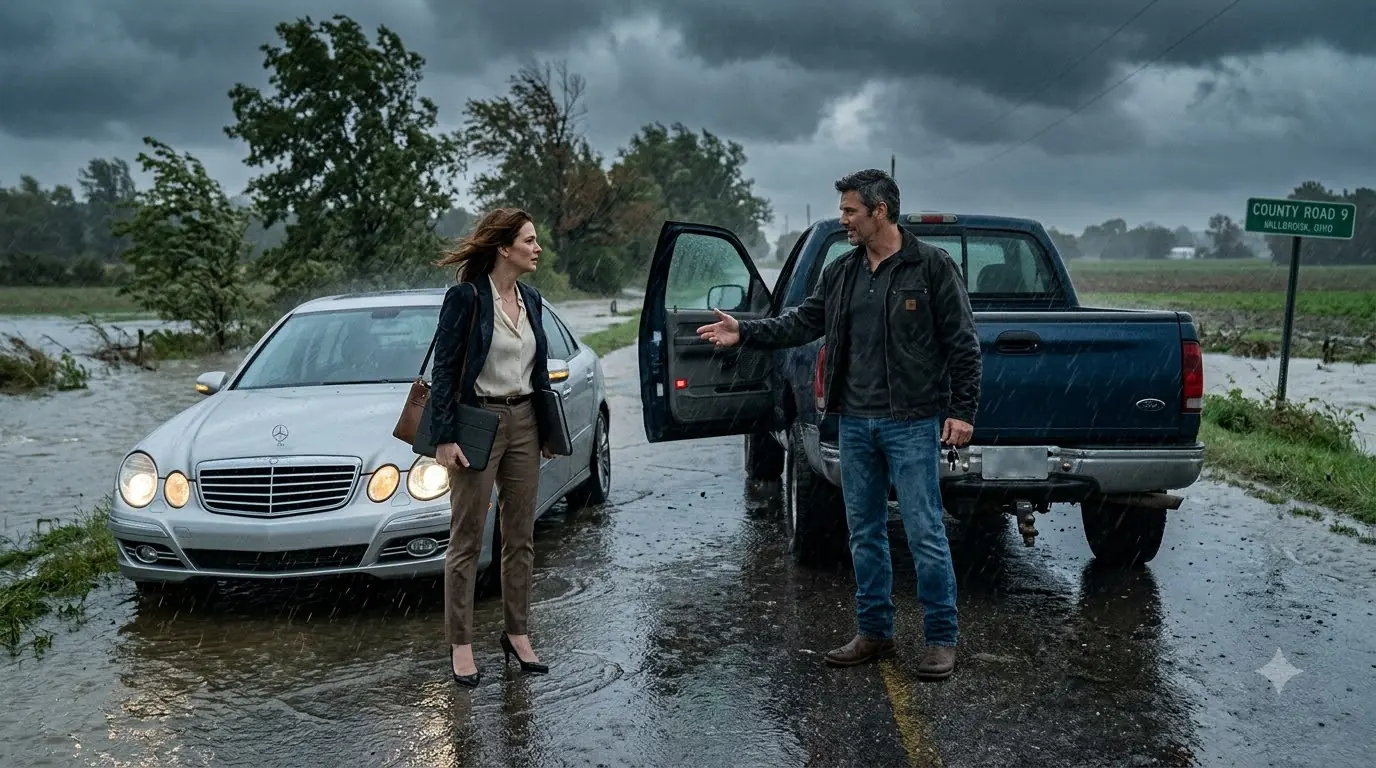
The air had that strange metallic stillness that sometimes came before violent weather, when birds disappeared, dogs grew restless, and people looked up from their errands with a feeling they could not quite name.
The next moment, the wind came roaring down Millbrook Avenue.
It tore through the oak trees with a sound like a freight train slipping off its rails. Branches snapped. Traffic lights swung wildly above intersections. Storefront signs rattled against brick walls. A blue recycling bin tumbled down Main Street, spinning across lanes before disappearing into a flooded gutter.
Weather alerts screamed from every television and phone in the county. Schools released children early. Businesses locked their doors. Gas stations ran out of fuel as people rushed to fill their tanks and get home before the storm turned the roads into rivers.
Highways clogged with the panicked impatience of people who had waited too long.
By midafternoon, the city that prided itself on efficiency, commerce, schedules, quarterly results, lunch appointments, and relentless forward motion had come to a complete and undignified stop.
Gutters overflowed.
Awnings ripped loose from storefronts and tumbled down sidewalks like discarded paper.
Rain came down so hard that the streets looked as if they were boiling.
Somewhere near the financial district, a transformer exploded with a flash of blue light and took out power to six blocks of office towers. The next morning, the Millbrook Herald would call that the storm’s most symbolically appropriate act.
By four o’clock, the river had already started climbing its banks. Police blocked two underpasses. Firefighters pulled a stranded delivery driver from waist-deep water near the old textile mill. A woman abandoned her sedan in the middle of Grant Street and carried her poodle through the rain under her coat while shouting that the city should have warned people sooner.
Still, somewhere in the middle of that chaos, on a flooded stretch of County Road 9, one quiet act of kindness had already begun to take shape.
It began in the headlights of a man who almost did not stop.
Ethan Carter had spent the morning beneath the belly of a 1972 Chevy pickup, elbow-deep in a transmission rebuild, when his assistant knocked hard on the garage bay door and told him the radio was saying everyone needed to clear the roads within the hour.
“Ethan,” Marcus Webb called from the open bay, rain already needling the asphalt outside. “They’re closing the east bridge. Emergency management says roads are going under fast.”
Ethan slid out from under the truck on a creeper, his gray T-shirt streaked with oil, one cheek marked by a black smudge he had not noticed.
He was forty-six years old, broad through the shoulders, with dark hair beginning to silver at the temples and the kind of calm that made people lower their voices around him without knowing why. He had strong hands, patient eyes, and the steady posture of a man who had learned not to waste motion unless something actually required it.
He listened to the emergency radio for ten seconds.
Then he looked toward the open bay.
The sky had gone almost green.
“Lock it down,” he said.
Marcus did not argue. Nobody at Carter Mechanical argued with weather, and nobody argued with Ethan when he used that particular tone.
Carter Mechanical sat at the edge of Millbrook’s industrial district, between a tire warehouse and a welding supply shop. It was a modest operation with three working bays, four loyal employees, a waiting room with mismatched chairs, a coffee pot that had survived two decades of abuse, and a reputation built on nearly ten years of honest work.
The sign above the office door was plain.
CARTER MECHANICAL
REPAIRS DONE RIGHT
It was not clever advertising.
It was simply the way Ethan lived.
Do good work.
Charge a fair price.
Do not make promises you are not prepared to keep.
If a repair cost less than expected, he said so. If a customer did not need a repair another shop had recommended, he said that too. Some months, that honesty cost him money. But it had earned him something he valued more.
The kind of sleep that did not argue with a man at night.
He wiped his hands on a rag that had long ago surrendered any claim to cleanliness, checked that the lifts were down, made sure the compressor was off, and waited until Marcus, Lena, Ray, and Joey had all left before locking the office himself.
“You heading straight home?” Marcus asked, pulling his hood over his head.
“That’s the idea.”
“Storm like this, idea and reality may have different plans.”
Ethan almost smiled.
“Drive slow.”
Marcus nodded and ran to his car.
Ethan stood under the awning for one extra moment, watching the rain turn the parking lot into a sheet of hammered steel. The industrial district looked abandoned already, all metal doors, dark windows, and water moving in shiny streams across cracked asphalt.
He could have stayed at the shop. There was a couch in the office, a coffee maker, and enough canned soup in the breakroom cabinet to survive a minor siege.
But the shop was not home.
Home was twelve minutes away.
A small clapboard house on Maple Ridge Lane, with a sloped roof, books on every available surface, a kitchen table scarred by use, and a porch that needed repainting whenever the weather decided to become reasonable again.
Ethan climbed into his truck.
It was a well-maintained Ford he had driven for eight years and intended to drive for at least eight more. He was that kind of man. He did not chase newer things just because newer things existed. He took what worked and held on to it.
His life was small by design.
Quiet.
Contained.
Unimpressive to anyone who valued scale for its own sake.
And exactly what he had needed it to become.
He had not always been a mechanic in Millbrook.
There were people in other cities, people who wore suits that cost more than his monthly shop rent, who once knew the name Ethan Carter in a very different context.
They knew him as the man who built Meridian Capital.
They knew him as the numbers prodigy from Ohio State who understood risk the way other men understood weather. They knew him as the founder who walked into investment rooms in his thirties and made older, richer, louder men stop speaking. They knew him as the one who saw value before markets admitted it existed.
And then they knew him as the man who disappeared.
No scandal.
No indictment.
No dramatic collapse.
No farewell interview.
One quarter he was there, guiding one of the most respected regional investment funds in the country. The next, Meridian Capital was dissolved, investor money was returned in full with interest, and Ethan Carter vanished from every conference list, boardroom, and financial profile.
Rumors grew in the empty space he left behind.
Burnout.
Secret illness.
Regulatory trouble.
A private tragedy.
Some said he had lost everything.
Some said he had made so much money that he no longer needed the world.
A few came close to the truth.
Not close enough.
By the time the rumors found him, he had already bought a small repair garage in Millbrook, learned the rhythm of honest physical work, and decided he liked engines because engines did not flatter you while hiding knives.
Engines were better than people that way.
They failed honestly.
Ethan was four blocks from home when the rain hit in earnest.
Not the gradual kind of rain that builds from drizzle to downpour, but a sudden wall of water that reduced visibility to almost nothing in thirty seconds. His wipers thrashed uselessly against the windshield. The road had already begun to flood near the ditches, water crossing the pavement in thin moving sheets.
His headlights caught leaves, broken branches, and a trash can rolling wildly across someone’s front lawn.
Then he saw it.
A silver Mercedes pulled halfway onto the shoulder, hazard lights blinking orange through the gray curtain of rain.
He almost kept going.
The rational part of his mind, the part that had learned through many years and many hard lessons not to invite complications into a life he had carefully simplified, told him to drive past and let someone else handle it.
A stranded luxury car was rarely simple.
Luxury cars came with owners who had expectations, insurance policies, lawyers, assistants, and a talent for turning favors into obligations.
Then his headlights swept across the figure standing beside the car.
A woman.
One hand pressed to the roof for balance against the wind.
The other holding her phone toward the sky as if she could drag a signal down from the clouds through sheer force of will.
She was soaked completely through. Her dark blazer was plastered to her frame. Her hair had come loose and was driven sideways by the gusts. Even from fifty feet away, Ethan could see she had nowhere to go and no available way of getting there.
He drove another twenty yards.
Then stopped.
He sat in the truck for one second, rain hammering the roof so loudly it sounded like a thousand small stones.
Then he exhaled.
“So much for not inviting complications,” he muttered.
He put the truck in reverse, backed carefully onto the shoulder, and cut the engine.
He got out without an umbrella because he had never owned one and had never seen the point. The rain hit him hard enough to sting. He jogged toward her with one hand raised in what he hoped was an obvious gesture of harmlessness.
The woman stepped back as soon as she saw him.
One hand dropped to the handle of the Mercedes. Her eyes moved over him quickly, assessing his size, his clothes, his face, his hands, the distance to her car, the distance to the road, the odds of trusting him versus the odds of staying alone in a storm that was already turning dangerous.
Ethan saw the calculation run across her face.
He had seen that look before.
Not fear exactly.
Measurement.
He stopped several feet away and let her finish measuring.
“I’m not going to bother you,” he called over the wind. “But your car isn’t starting in this weather, this road is going to flood, and I live about ten minutes from here.”
She stared at him.
The rain ran down her face, but she did not wipe it away.
“Dry house,” he added. “Working stove. You can use the phone when the line comes back, and I’ll leave you completely alone if that’s what you want.”
“I can call someone,” she said.
Her voice was controlled, clipped by cold, but still carrying authority.
Ethan pointed at her phone, then at the sky.
She looked down.
No signal.
The wind gusted so hard that the Mercedes rocked on its suspension. A sheet of water washed over the shoulder and ran across both their shoes.
A branch cracked somewhere behind them.
The woman looked back at the empty road.
Then at him.
Whatever she found in Ethan’s face was not comfort, exactly.
But it was enough.
“One night,” she said. “Just until it passes.”
Ethan nodded.
“One night.”
She opened the passenger door, grabbed a leather bag and a laptop case, then locked the car with hands that were trying very hard not to shake.
He did not mention the shaking.
He had learned that dignity sometimes depended on what you chose not to notice out loud.
They drove through the worst of it without speaking.
The radio flickered between emergency weather updates and static while Millbrook dissolved behind them into sheets of dark water. A warning tone blared from her phone, though it still had no signal. Ethan took the back roads when the main road ahead dipped too low.
The truck moved steadily through the rain, tires pushing through water with a low, heavy hiss. Twice, he had to stop and wait for floodwater to reveal where the edge of the road still was. Once, a broken limb blocked half the lane, and he had to get out, drag it aside, and return to the truck soaked even more thoroughly than before.
The woman sat rigidly in the passenger seat, wet bag in her lap, watching every turn.
She did not ask if he knew where he was going.
For some reason, that made him respect her.
His house was warm.
He had left the heat running that morning out of old habit, and the contrast when they stepped inside was immediate and physical, like crossing into another season.
The woman stood in the entryway and dripped onto the hardwood floor.
Her arms were folded across her chest. Her jaw was tight from cold. Her eyes moved through the room in the practiced way of someone who could read spaces quickly and extract information from them.
Books everywhere.
Two full walls of shelves packed tightly. Stacks on the coffee table. A paperback wedged beside the armchair. A half-finished chess puzzle on the corner desk. A framed photograph near the bookcase.
The photograph showed a mountain lake taken from low to the ground, water perfectly still, light flat and silver, as if the person behind the camera had been sitting right at the edge with nowhere else to be.
The woman stopped at that photograph.
Only for a second.
But Ethan noticed.
He had already gone to the linen closet. When he returned, he held out a towel and an old flannel shirt two sizes too large for her.
“Bathroom is down the hall,” he said. “There are dry socks in the cabinet under the sink. They’re clean. Not elegant, but clean.”
She took both.
“Thank you.”
He nodded and went directly to the kitchen.
For one small moment, standing alone in a stranger’s living room with the storm hammering the windows, something in the rigid architecture of her posture softened.
Not much.
Just enough.
Ethan made pasta.
Nothing elaborate. Rigatoni. Jarred sauce made better with garlic, dried oregano, black pepper, and a splash of red wine vinegar that had been sitting in the cabinet for months. It was hot, substantial, and prepared without any of the theatrical hospitality people sometimes perform when they want to be admired for being generous.
He put two bowls on the table.
She had changed into the flannel shirt and wrapped the towel around her hair. Sitting across from him, she looked for the first time that evening like something other than a woman still managing a crisis.
“My name is Olivia,” she said.
Just Olivia.
No last name offered.
None asked for.
“Ethan,” he said.
She repeated it once, carefully, the way someone does when storing information they expect to need.
“Ethan.”
He found a half-decent bottle of red wine at the back of the pantry and set it between them.
She reached for it before he did.
They ate while the wind threw branches against the windows and the lights flickered twice.
At first, the conversation was careful.
Weather.
Road closures.
The likelihood of her car being salvageable by morning.
The strange arrogance of people who believed hazard lights made a vehicle immune to floodwater.
Then it loosened.
Not quickly.
Not dramatically.
But steadily, the way a knot loosens when no one is pulling at it too hard.
Olivia was controlled without being cold. Precise without being stiff. She spoke like someone who had spent years deciding exactly how much of herself to reveal and how much to keep behind sealed doors.
Ethan recognized that kind of discipline.
He also recognized its cost.
In most rooms Olivia entered, she could feel the exact moment recognition landed.
The slight correction in posture.
The sudden brightness in the eyes.
The adjustment of tone.
People changed when they realized who she was.
Olivia Vale.
Chief executive of Valeon Group, one of the most visible companies in the region. Her face had appeared on the cover of two major financial publications in the past eighteen months. She sat on three boards, was constantly invited to speak at conferences, and had learned years ago to treat every public sentence as something that could be clipped, quoted, analyzed, and weaponized.
She was skilled at reading rooms before she entered them.
She knew which handshakes would cost her.
She knew which smiles were invoices in disguise.
She knew exactly how warm to be without inviting presumption.
It was a kind of labor she had performed so long that she no longer experienced it as labor.
But in Ethan Carter’s kitchen, wearing an oversized flannel shirt with a towel around her hair, she was simply a woman who had been caught in the rain.
The anonymity of it felt almost dizzying.
Like removing a piece of armor she had worn so long she had stopped noticing its weight.
She found herself saying things she had not said aloud in years.
Not names.
Not confidential details.
But truths.
The exhaustion of being required to decide everything.
The loneliness of being surrounded by people who wanted something.
The strange way success had filled her calendar while emptying her life.
“People think power means freedom,” she said at one point, turning the wineglass slowly between her fingers. “Most of the time, it means fewer safe rooms.”
Ethan looked at her across the table.
“Safe from what?”
She almost said enemies.
That would have been too dramatic, though not inaccurate.
She settled on the better word.
“Need.”
He nodded.
Not like he fully understood her world.
Like he understood the shape of what she meant.
“That’s a hard way to live,” he said.
“It is a useful way to live.”
“Those are different things.”
Olivia looked at him then.
Really looked.
Most people would have softened that sentence. They would have smiled, made it lighter, wrapped the truth in politeness so it would not risk offending her.
Ethan did not.
He also did not seem impressed with himself for saying it.
That made it harder to dismiss.
Her phone buzzed.
The signal had flickered back for a moment.
She looked at the screen and excused herself to take the call in the next room.
Ethan cleared the plates and began washing up.
From the kitchen, he could hear only the rhythm of the conversation, not every word.
Controlled urgency.
Then a male voice on the other end said clearly enough, “The entire board has been trying to reach you. The Hartwell acquisition, the minority shareholders are organizing, and Harrison won’t wait past Monday.”
Olivia’s voice changed in a single breath.
It steadied.
Sharpened.
Reassembled itself.
“Tell Marcus to circulate the capital memorandum with no revisions until I approve language personally. I want Harrison’s last two emails flagged. Also call Dana’s office and confirm whether she spoke with Crowe Capital before or after the vote notice.”
A pause.
“No, not tomorrow. Now.”
She handled the call in under five minutes.
When she returned to the kitchen doorway, she was already watching Ethan’s face to see what he had registered.
He was drying a glass.
He looked up.
“Want more wine?”
She stood in the doorway for a beat longer than necessary.
Then she said, “Yes.”
The storm did not break that night.
It settled over the city with the patience of something that had nowhere else to be. By midnight, the roads were closed, power had gone out twice, and the rain had become a steady roar.
They ended up in the living room with candles on the coffee table and the gas fireplace burning.
The conversation moved again.
This time, it became something neither of them had planned.
Ethan told her about what he privately thought of as his philosophy of small. He had never named it that before, but the words came naturally when she pressed him to explain the life he had built.
The quiet neighborhood.
The modest shop.
The controlled scale of things.
He said he had learned late that the size of a thing and the value of a thing were not the same measurement.
Often, they moved in opposite directions.
Olivia looked toward the shelves of books, the chess puzzle, the simple room arranged for use rather than display.
“I understand that intellectually,” she said. “But I cannot remember the last morning I woke without an agenda already running.”
“That’s probably why you were working at six at night when the roads were flooding and you couldn’t go anywhere anyway.”
She laughed.
Quickly.
Unguarded.
The sound seemed to surprise her more than it surprised him.
Ethan thought it was a very good sound.
Not polished.
Not useful.
Real.
Before she went to bed in the spare room, she passed the bookcase in the hallway. Candlelight caught the edge of an old folder on the bottom shelf.
Yellowed paper.