At 4:37 on a bright Saturday afternoon, Simone Carter turned onto Hawthorne Ridge Drive in Alexandria, Virginia, expecting nothing more complicated than an hour of yard work before dinner. The thirty-eight-year-old detective inspector had spent most of the morning reviewing case summaries downtown, and by the time she reached her quiet suburban neighborhood, she wanted distance from uniforms, reports, complaints, and people explaining why obvious evidence somehow required another meeting. She parked her dark-gray SUV beneath the maple tree beside her driveway, carried two grocery bags through the front door, and changed into a white button-up blouse, fitted blue jeans, and comfortable dark flats. Less than twenty minutes later, she stepped onto the lawn with gardening gloves, pruning shears, and absolutely no idea that before sunset, half her street would be filming her.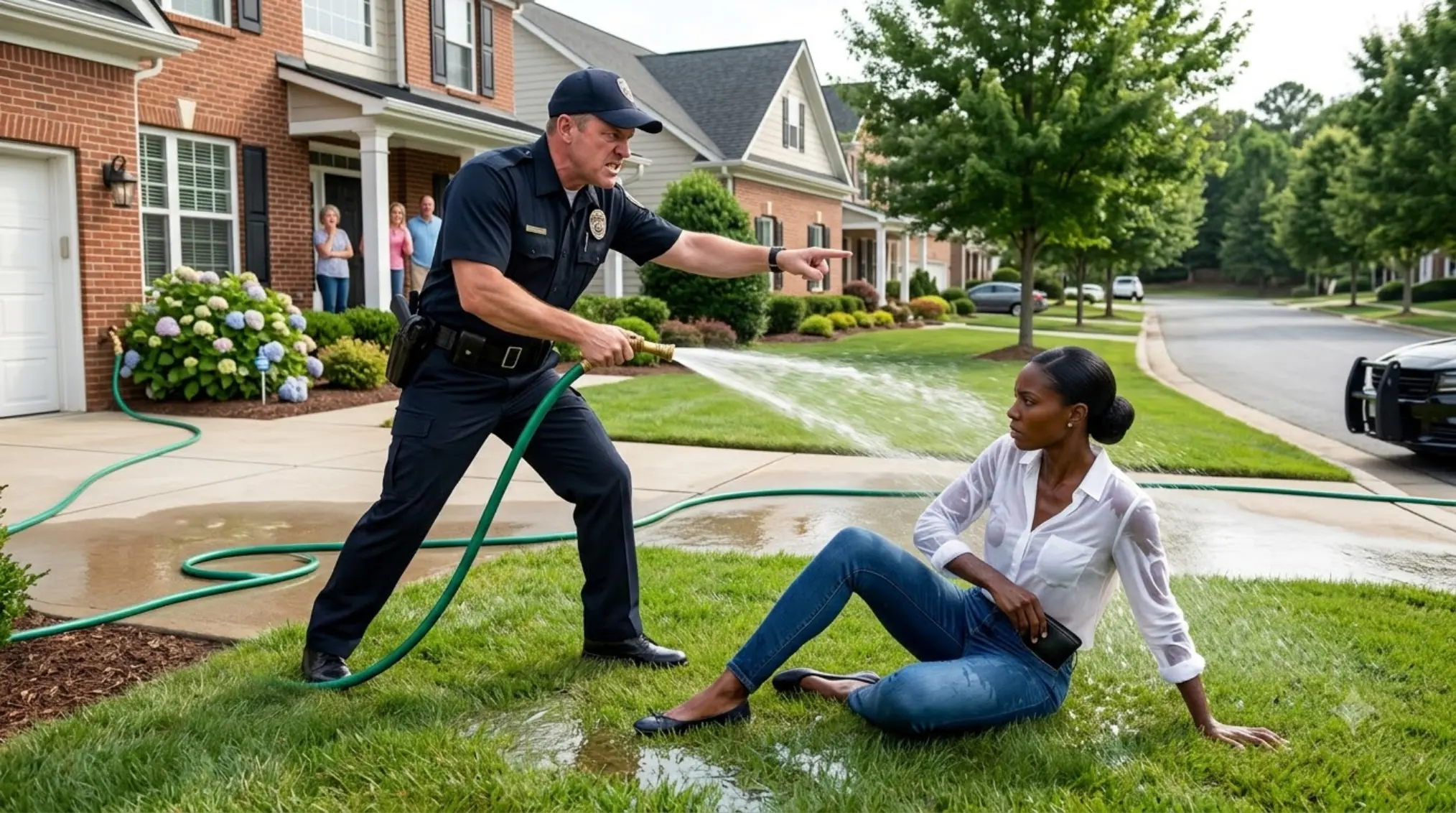
Simone had purchased the pale-yellow colonial home eleven months earlier after years of apartment living and transfers between investigative assignments. The house had white porch columns, black shutters, a narrow brick walkway, and a front lawn just large enough to make mowing it annoying without becoming a second job. Most of her neighbors were polite, and several had become genuinely friendly, but one woman across the street seemed unable to accept that Simone lived there permanently. Elaine Mercer, sixty-one, had introduced herself during Simone’s first week by asking whether she was “helping the homeowners settle in.”
Simone had answered, “I am the homeowner.”
Elaine had smiled strangely and said, “Oh.”
The conversation should have ended there.
Instead, Elaine began watching.
She watched Simone’s visitors. She watched delivery drivers. She once asked why a city-owned sedan had been parked outside Simone’s home overnight, and another time she questioned a contractor who was replacing two upstairs windows. Simone had ignored most of it because nosy neighbors were not crimes and because she had learned long ago that not every irritation deserved confrontation.
That afternoon, Simone was kneeling beside a flower bed when a marked patrol cruiser rolled slowly past her house.
She looked up.
The cruiser continued twenty yards, stopped, then reversed.
A second unit appeared behind it.
Simone rested the pruning shears beside the mulch and removed her gloves.
Two officers stepped out.
The first was Officer Brent Callahan, forty-two, a broad white man with short brown hair, a heavy jaw, and the impatient body language of someone who had already decided the answer before asking the question. The second was Officer Daniel Price, twenty-nine, leaner, younger, and noticeably less certain as he walked around the rear of the cruiser. Simone recognized both names, although neither officer recognized her.
That mattered.
Simone had recently been promoted into the department’s Office of Professional Accountability, where she supervised investigations involving excessive force, misconduct complaints, and failures of supervisory review. Her new assignment had not yet been circulated widely because she was finishing a transition from major crimes. Callahan’s name had appeared in a packet on her desk three days earlier.
He had three citizen complaints in twenty-two months.
None had been sustained.
Simone stood.
“Can I help you?”
Callahan stepped onto the grass.
“We received a report about someone trespassing at this residence.”
Simone glanced toward her house.
“Who?”
“You.”
She stared at him.
Price looked down at his mobile terminal as though the absurdity of the answer had also reached him.
Simone pointed toward the open garage. “This is my house.”
Callahan did not move.
“Identification.”
“My wallet is inside.”
“Don’t go inside.”
“I wasn’t asking permission.”
Callahan stepped closer.
“Ma’am, don’t make this difficult.”
Simone’s expression changed.
Very slightly.
Enough that Price noticed.
“What exactly was reported?” she asked.
Callahan looked irritated by the question.
“A suspicious woman was seen around the property.”
“Around the property?”
“Yes.”
“I was trimming my hydrangeas.”
“You entered the house.”
“I live in the house.”
Callahan looked toward the front door.
“Can you prove that?”
“Yes. You can also verify property records from your car in about thirty seconds.”
Price immediately glanced toward the cruiser.
Callahan did not.
“Stay where you are.”
Simone folded her arms.
“Officer, I am staying on my own lawn.”
Across the street, a curtain moved.
Simone saw Elaine Mercer standing behind the front window.
Everything suddenly made sense.
“Was Elaine Mercer the caller?”
Callahan’s eyes narrowed.
“How do you know who called?”
“Because she has questioned whether I belong here before.”
“You don’t need to worry about the caller.”
“I’m not worried about her.”
Callahan stepped closer again.
“I said show me identification.”
“I told you it’s inside.”
“Then why won’t you go get it?”
“You told me not to.”
Price looked away.
For a moment, nobody spoke.
Simone watched Callahan’s face and saw the exact moment embarrassment became anger. He knew his instructions had contradicted each other, but instead of correcting course, he treated her recognition of the contradiction as disrespect.
It was a pattern she had seen in complaints countless times.
The encounter stopped being about resolving uncertainty.
It became about winning.
Callahan pointed toward the sidewalk.
“Step off the lawn.”
Simone actually laughed once.
Not loudly.
Not mockingly.
Just from disbelief.
“No.”
“Excuse me?”
“You want the homeowner to leave her property because a neighbor says the homeowner looks suspicious?”
“I’m conducting an investigation.”
“Then investigate.”
Callahan clenched his jaw.
Price quietly said, “Brent, I can run the deed.”
Callahan shot him a look.
“I’ve got it.”
Price hesitated.
Simone heard those words and stored them away.
“I suggest you let him.”
Callahan looked back at her.
“I suggest you stop giving orders.”
Simone’s tone remained level.
“I’m giving you an easy exit.”
That made him angrier.
Callahan walked toward the side of the driveway, where Simone had left a green garden hose connected to the outdoor faucet. She initially assumed he was moving away to use his radio.
Instead, he picked up the hose.
Simone stared at him.
“What are you doing?”
Callahan twisted the nozzle.
Water burst onto the driveway.
“Move toward the sidewalk.”
Simone’s face hardened.
“Put the hose down.”
“Last warning.”
Price stepped forward.
“Brent, come on.”
Callahan ignored him.
Simone took one step toward the house.
The stream hit her across the chest.
The force was not powerful enough to cause serious injury, but the shock knocked her backward. Her white blouse instantly darkened with water. She threw up one arm, lost her footing on the wet grass, and fell onto her hip.
Several neighbors shouted.
Price froze.
Callahan kept spraying.
“Move!”
Simone twisted away, covering her face.
“What the hell are you doing?”
“Off the lawn!”
“This is my property!”
The hose stream hit her shoulder again.
Simone planted one palm against the grass and tried to rise.
Across the street, phones appeared.
A teenager two houses away began recording.
A middle-aged man stepped from his porch and shouted, “She lives there!”
Callahan swung his head toward him.
“Stay back!”
The man stopped but kept his phone raised.
Simone reached one knee.
Water ran down her hair, blouse, and jeans.
Her low bun had started loosening.
Her left flat had slipped halfway off.
Callahan stood five yards away gripping the nozzle with both hands, breathing hard, as though he were controlling a violent crowd rather than spraying a woman on her own lawn.
Simone wiped water from her eyes.
“Turn it off.”
Callahan kept the stream aimed at the grass directly in front of her.
“Get onto the sidewalk.”