Officer Daniel Mercer held the plastic packet between two fingers and smiled.
“Found it in your briefcase.”
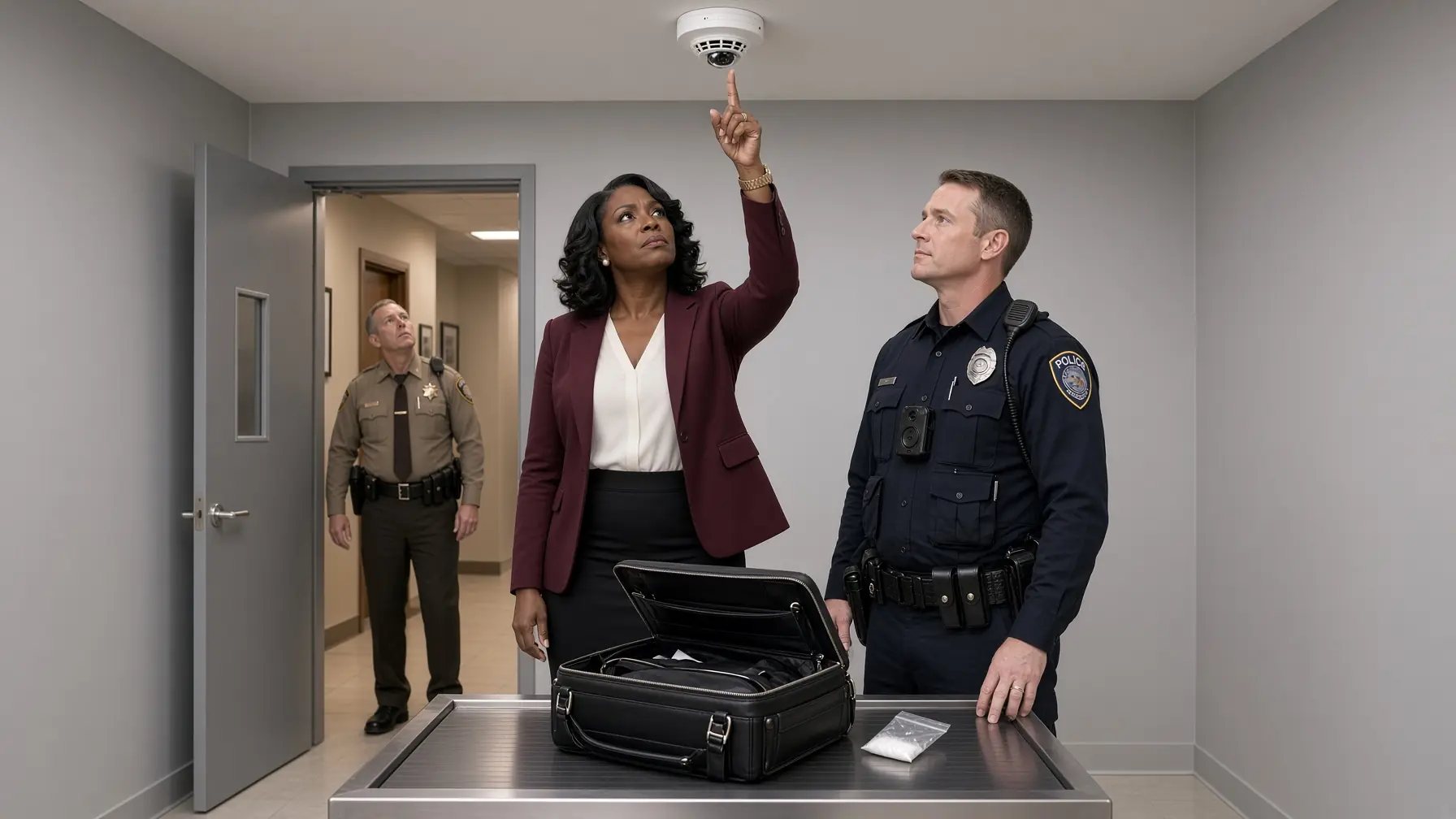
The late-morning light coming through the courthouse security-room windows caught the white powder inside the packet.
Mercer raised it slightly higher.
“You’re done.”
Judge Vanessa Cole did not look at the drugs.
She looked at Mercer.
Forty-eight years old.
Tall.
Elegant.
Burgundy blazer over an ivory blouse.
Tailored black skirt.
Pearl earrings.
Black heels.
Her structured leather briefcase remained open on the metal screening table between them, legal files and a yellow notebook still neatly arranged inside.
Vanessa’s hands rested at her sides.
Her breathing did not change.
“You’re absolutely certain that’s your story?”
Mercer laughed.
The courthouse deputy near the doorway shifted uncomfortably.
Mercer pushed the briefcase toward Vanessa.
“You think being a judge means you can explain this away?”
Vanessa finally looked at the packet.
Then at the officer’s face.
His body camera was active.
Red light blinking.
Good.
She slowly raised one finger.
Pointed above him.
“No.”
Mercer frowned.
Vanessa’s finger remained aimed at the ceiling.
“I was giving you one last chance before they replay what’s inside that smoke detector.”
Mercer’s smile vanished.
The deputy looked up.
White detector housing.
Circular vents.
Small status light.
And behind one dark opening—
a camera lens.
Mercer stared at it.
Then at Vanessa.
His face changed so quickly that the deputy saw the truth before anyone played a single second of footage.
Vanessa closed her briefcase.
“Deputy.”
“Yes, Judge?”
“Do not let anyone touch that table.”
Mercer’s voice rose.
“Hold on.”
Vanessa ignored him.
“Do not move the packet.”
“Judge Cole—”
“Do not touch my briefcase.”
Mercer stepped forward.
“You're not in charge of this investigation.”
Vanessa looked directly at him.
“I’m not conducting one.”
Then toward the deputy.
“I’m preserving one.”
The deputy reached for his radio.
Mercer’s hand moved toward the packet.
Vanessa’s voice sharpened.
“Don't.”
He froze.
Not because she was a judge.
Because something in her voice told him the mistake had already happened.
There was no fixing it with another one.
Twenty-three minutes earlier, Vanessa Cole had entered the Franklin County Courthouse through the east staff entrance carrying three things.
Her briefcase.
A cup of coffee she had barely touched.
And a sealed folder that several police officers desperately did not want opened.
She had been on the bench for eleven years.
Long enough that most courthouse employees no longer reacted when she walked through security.
Vanessa preferred it that way.
She disliked ceremony.
Titles were useful inside courtrooms because procedure needed structure.
Outside the courtroom, she wanted people to tell her when the elevator was broken without first saying:
Your Honor.
The courthouse had introduced mandatory staff screening six months earlier after a disgruntled defendant entered through a service corridor carrying a knife.
Judges complained.
Attorneys complained.
Court clerks complained.
Vanessa did not.
If defendants and families were searched, court staff could survive removing keys from their pockets.
That morning security was heavier than usual.
Courtroom Six was scheduled for an evidentiary hearing in State v. Jamison, a narcotics case that had quietly become something larger.
The defendant, Terrence Jamison, had been arrested nine months earlier after Officer Daniel Mercer claimed to have found cocaine beneath the passenger seat of Jamison’s car.
Ordinary possession case.
At first.
Then Jamison’s defense attorney requested body-camera footage.
The recording had a fourteen-minute gap.
Mercer wrote:
Device overheated and temporarily ceased recording.
Defense counsel requested technical logs.
The logs showed no thermal shutdown.
Instead they showed manual deactivation.
Then another attorney noticed something.
Her client had been arrested by Mercer four months earlier.
Her case also contained a body-camera gap.
Different explanation.
Battery failure.
Technical metadata showed 71% battery remaining.
One coincidence became two.
Two became five.
Five became eleven cases reviewed by the prosecutor’s office.
Now Judge Vanessa Cole had seventeen case files stacked inside the sealed folder beneath her arm.
Not because she had decided Mercer was corrupt.
She had decided the court needed answers.
There was a difference.
Vanessa spent most of her career defending that difference.
She had been a prosecutor first.
Then a civil litigator.
Then a judge.
She had learned early that certainty was emotionally satisfying and professionally dangerous.
The sealed folder contained a motion from the public defender’s office requesting an expanded evidentiary hearing into evidence handling by Mercer’s narcotics unit.