Marcus Bennett had been sitting on his own front porch reading for twenty-three minutes when Officer Cole Mercer pointed a handgun at his chest and ordered him to prove he belonged there.
Marcus did not shout.
He did not stand.
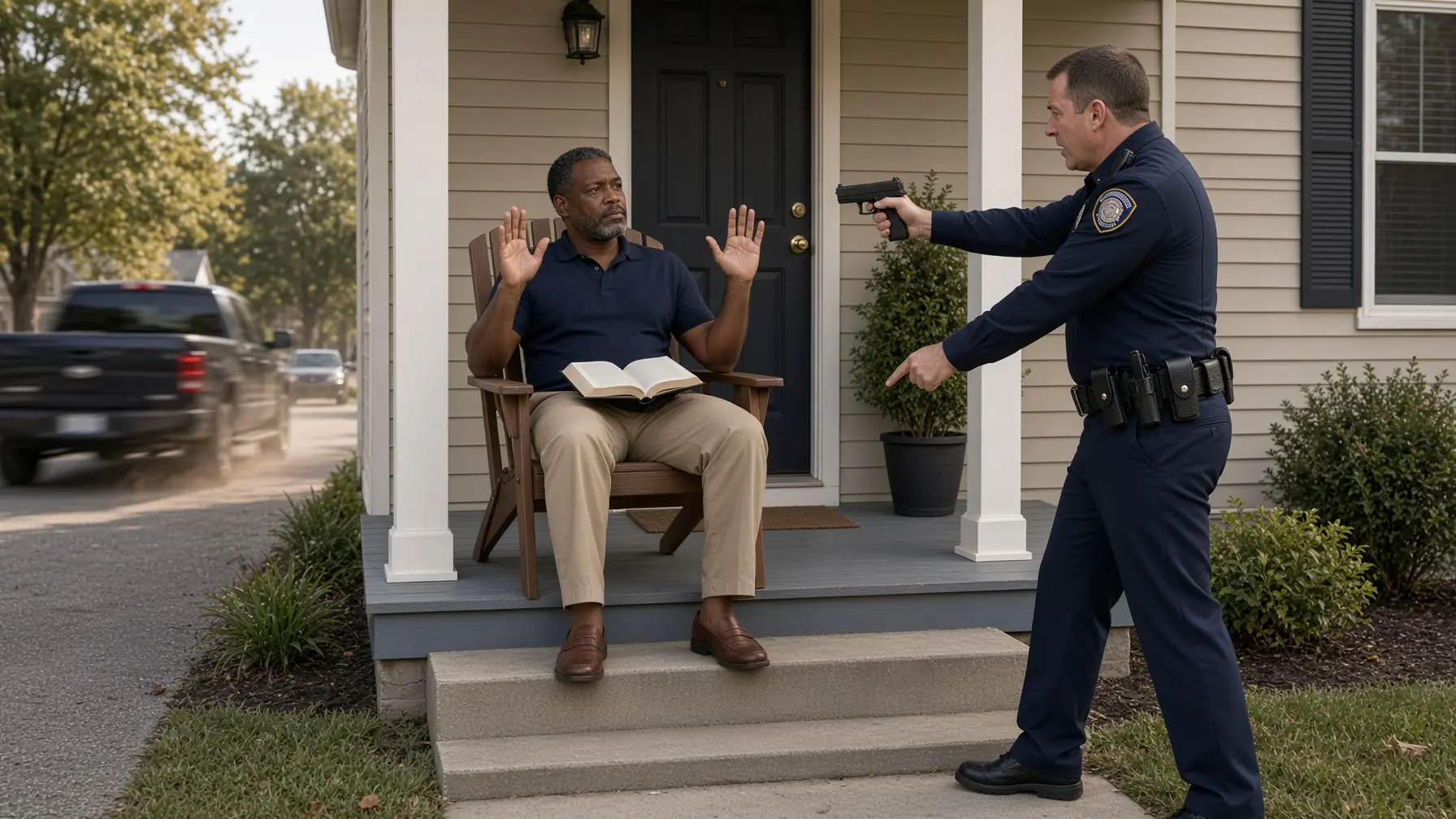
He simply raised his empty hands and asked the officer to tell him exactly how he wanted him to move.
Then three black SUVs turned onto the quiet suburban street.
A suited man stepped out of the lead vehicle, saw Mercer’s weapon, and shouted one command that drained the color from the officer’s face.
But the SUVs had not come to rescue Marcus.
They had been scheduled to arrive at his house before the police call was ever made—and what they had come to discuss explained why someone needed Marcus Bennett frightened, discredited, or dead before sunset.
Marcus Bennett had always believed there were few things more revealing than the way a neighborhood sounded at four-thirty in the afternoon.
Sprinklers ticking somewhere behind a hedge.
A lawn mower two streets over.
The metallic clatter of a garage door closing.
Children shouting at one another from a driveway basketball hoop.
The faint rush of tires from the main road beyond the subdivision.
Ordinary sounds.
Predictable sounds.
The kinds of sounds people stopped noticing when they felt safe.
Marcus noticed them.
He noticed almost everything.
At fifty-two, he had spent enough of his life listening while other people talked to understand that danger usually announced itself long before it became obvious.
Sometimes in a changed tone.
Sometimes in a missing sound.
Sometimes in the pause before a lie.
That afternoon, the first unusual thing was the patrol cruiser.
Marcus saw it from behind the pages of his book.
A navy-and-white vehicle moved slowly past his house.
Not unusual by itself.
Ashford Pines was a quiet suburban neighborhood outside Richmond, the kind of place where police usually appeared for noise complaints, package thefts, and the occasional teenager who drove too fast through the cul-de-sac.
But the cruiser did not continue.
It stopped two houses down.
Marcus lowered the book slightly.
The driver remained inside.
Thirty seconds.
A minute.
Then the cruiser backed up.
Slowly.
Stopped directly in front of Marcus’s house.
Marcus looked at the digital watch on his wrist.
4:37 p.m.
He had an appointment at five.
Three vehicles were expected.
Not police.
He closed the book halfway but left one finger between the pages.
The cruiser door opened.
Officer Cole Mercer stepped out.
Broad white man.
Early thirties.
Close-cropped brown hair.
Navy uniform.
Duty belt.
His sunglasses remained on even though the front of Marcus’s house sat mostly in shade.
Mercer looked toward the street number mounted beside the garage.
Then toward Marcus.
Then back to the number.
Marcus noticed that.
The officer already knew which house he wanted.
Mercer approached the sidewalk.
“Sir.”
Marcus remained seated in the wooden porch chair.
“Yes?”
“Need you to stand up.”
Marcus looked at him.
“Why?”
“Stand up.”
Marcus glanced toward the closed front door behind him.
Then back at the officer.
“Is there a problem?”
Mercer climbed one step from the sidewalk onto the walkway.
“Got a call about a suspicious person at this address.”
Marcus said nothing for a moment.
Then looked around his own yard.
Freshly trimmed shrubs.
Blue hydrangeas.
A newspaper still folded beside the porch column.
His sedan in the driveway.
Book open on his lap.
“What exactly am I doing that’s suspicious?”
Mercer’s mouth tightened.
“I’m asking the questions.”
“That wasn’t an answer.”
The officer took another step.
“Do you live here?”
“Yes.”
“ID.”
Marcus looked at the closed front door again.
“My wallet is inside.”
Mercer immediately stiffened.
“Don’t move.”
Marcus had not moved.
“I wasn’t going to.”
“Hands where I can see them.”
Marcus slowly placed both hands on the arms of the chair.
His book remained open across his lap.
Mercer’s right hand moved toward his holster.
That was when Marcus stopped thinking of the encounter as irritating.
It had become dangerous.
“You have a body camera?” Marcus asked.
Mercer’s expression sharpened.
“What?”
“Is it recording?”
“Stand up.”
Marcus did not.
“This is my home.”
“I said stand up.”
“You’re asking me to move after putting your hand on your weapon.”
“I didn’t ask you.”
Marcus looked at him steadily.
“No. You ordered me. So I’m asking how you want me to do it.”
Mercer took another step.
His hand closed around the pistol.
“Slowly.”
Marcus began moving his right hand from the chair arm.
Mercer drew.
Fast.
The pistol came up.
Marcus froze.
“Hands up!”
Marcus raised both hands.
The book slid slightly but remained across his thighs.
Mercer aimed directly at his chest.
“Get off that porch. Now.”
Marcus’s heartbeat increased.
His expression did not.
“This is my home. I’m reading a book.”
“I’ll decide whether you belong here. Stand up.”
Marcus stared at the muzzle.
There is a particular kind of clarity that comes when a gun is pointed at you.
Details become smaller.
Sharper.
Mercer’s finger remained outside the trigger guard.
Good.
His left foot was forward.
His breathing too fast.
Bad.
The body camera light was on.
Good.
The officer’s eyes kept shifting toward the upstairs windows.
Why?
Marcus lifted his empty hands another inch.
“You’re pointing a gun at me. Tell me exactly how you want me to move.”
“Stand up!”
“Do you want me to put the book down first?”
“Stand up!”
“With my hands raised?”
“Quit arguing!”
“I am trying to follow your command without giving you a reason to shoot me.”
Mercer’s jaw clenched.
“You think you’re clever?”
“No.”
Marcus looked directly at him.