Judge Malcolm Hayes had been inside the Richmond County Courthouse for less than four minutes when Officer Daniel Mercer stepped into his path and told him to take off the “costume.”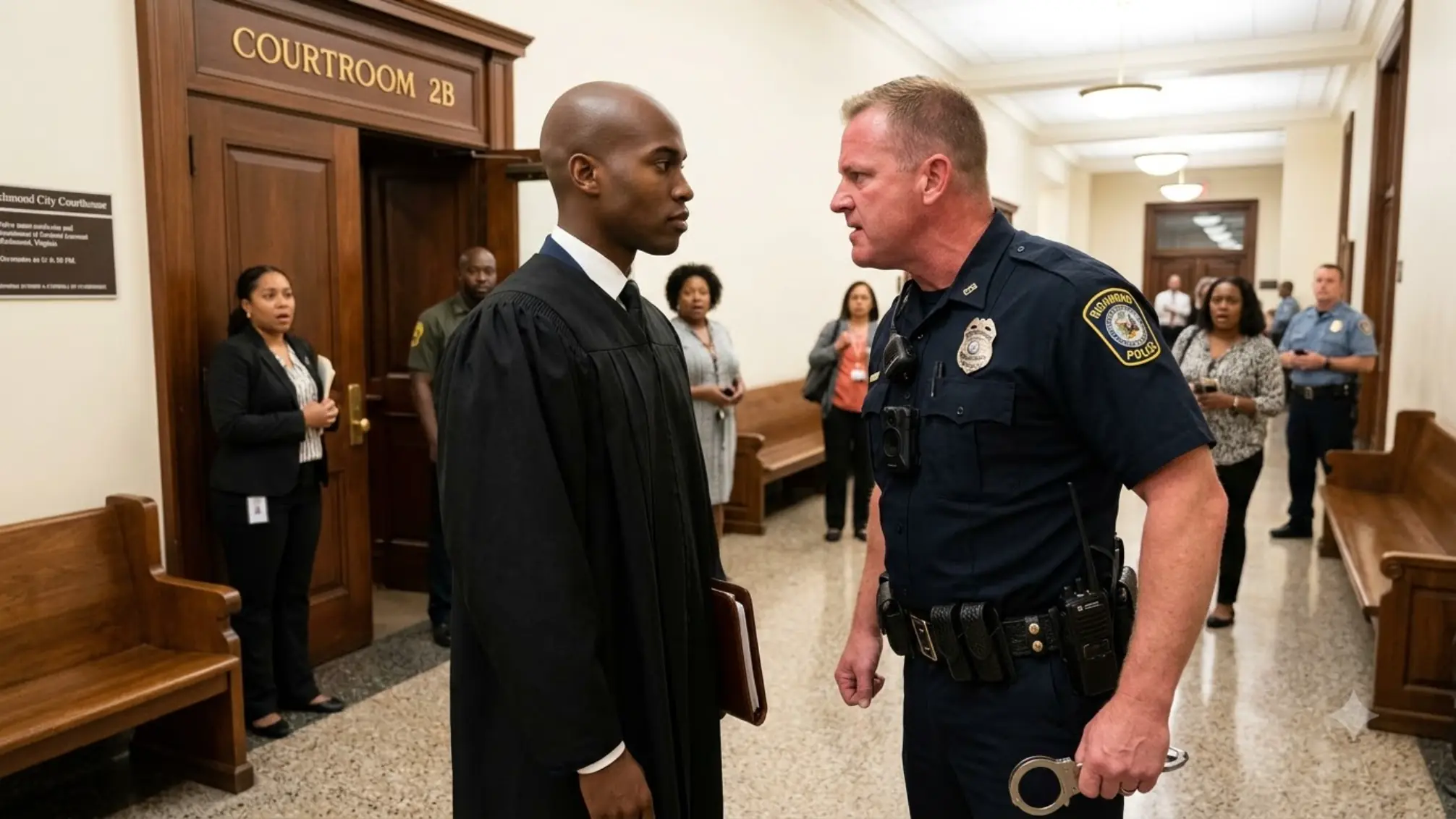
Malcolm stopped in the middle of the polished hallway. At thirty years old, he was younger than nearly every judge working in the building, and his completely shaved head and lean frame often made strangers underestimate his age and position. He wore a traditional black judicial robe over a crisp white shirt and dark tie, carrying nothing but a thin leather folder containing the morning’s hearing notes. Mercer stood directly in front of him with one hand hanging beside a pair of handcuffs.
“Take that costume off and move,” Mercer said. “Or I’ll drag you out in cuffs.”
Malcolm looked at the bodycam clipped to Mercer’s uniform.
“Touch me,” he replied evenly, “and you’ll explain in open court why you arrested the man running your department’s trial.”
Mercer laughed.
“You think that robe scares me? I can bury you before lunch.”
Malcolm did not move.
“Then cuff me now, Officer, and watch your badge die with the case.”
The courthouse hallway went silent.
Two clerks near the records office stopped walking. A deputy standing beside the elevator turned his head. Farther down the corridor, Assistant Commonwealth’s Attorney Rebecca Sloan emerged from a conference room and froze when she saw Mercer standing inches from Malcolm.
She knew exactly who Malcolm was.
More importantly, she knew exactly which case was scheduled to begin in twenty-six minutes.
Commonwealth v. Mercer County Police Department Special Enforcement Unit.
Officer Daniel Mercer was not the primary defendant. He had not yet been charged with anything. But he was one of fourteen officers named repeatedly in witness statements, overtime records, internal emails, bodycam reviews, and a sealed investigative report involving suspected evidence manipulation, selective enforcement, and falsified arrest documentation.
Mercer apparently had no idea the young Black man in front of him had been assigned to preside over the case.
Rebecca started toward them.
“Officer Mercer.”
He glanced over.
“Stay out of this.”
Her expression hardened.
“You need to step away from him.”
“He was wandering around a restricted courthouse corridor dressed like this.”
Malcolm looked toward the wooden courtroom doors six feet behind him.
“My courtroom is through that door.”
Mercer smirked.
“Sure it is.”
Rebecca’s mouth fell open slightly.
She looked at Malcolm.
He gave the smallest shake of his head.
Do not interfere yet.
Malcolm had spent years learning that sometimes the most important thing a person could do was allow arrogance to finish speaking.
Mercer turned back toward him.
“Identification.”
Malcolm held up the leather folder.
“My credentials are inside.”
“Put the folder down.”
Malcolm lowered it slowly onto a wooden bench.
Mercer moved closer.
“Hands where I can see them.”
The deputy near the elevator finally walked forward.
“Daniel, maybe check with courtroom security.”
Mercer snapped toward him.
“I know what I’m doing.”
The deputy stopped.
Malcolm noticed that.
Not because the deputy agreed.
Because he was afraid of challenging Mercer.
That was familiar.
It was also one of the reasons Malcolm had insisted on presiding over the upcoming corruption case instead of transferring it to another jurisdiction.
The investigation had started eighteen months earlier after three separate criminal defendants claimed narcotics had appeared in their vehicles only after Mercer’s unit searched them. Those accusations initially looked unrelated. Then a public defender named Claire Bennett compared arrest reports and found nearly identical language appearing across eleven different cases.
Same phrases.
Same probable-cause descriptions.
Same sequence of events.
Same officers.
That alone proved nothing.
Then bodycam discrepancies appeared.
In two cases, the official reports said narcotics were visible before officers entered the vehicle.
The footage showed nothing visible.
In another case, an officer claimed the defendant reached toward his waistband.
The video showed both hands on the steering wheel.
Internal Affairs opened an inquiry.
Someone leaked it.
Three days later, one of the key recordings disappeared from the evidence server.
That turned a misconduct investigation into something much larger.
The state police became involved.
Then outside prosecutors.
By the time Malcolm received the case assignment, investigators had assembled more than nine thousand pages of material.
He read all of it.
Every report.
Every transcript.
Every log.
Not because he had decided anyone was guilty.
Because the first duty of the court was to understand what everyone else wanted simplified.
The police union wanted a politically motivated investigation.
The prosecution wanted systemic corruption.
The defense wanted individual mistakes exaggerated into conspiracy.
Malcolm wanted evidence.
That made him inconvenient to everyone.
It also made Mercer’s behavior in the hallway particularly reckless.
Malcolm looked directly at him.
“Officer Mercer, I will give you one more opportunity to verify my identity before you escalate this.”
Mercer pulled his handcuffs free.
The metal clicked loudly.
“I’m done taking orders from you.”
Rebecca stepped forward again.
“Daniel.”
He raised one hand.
“Back off.”
She stopped.
Mercer reached for Malcolm’s wrist.
Malcolm did not resist.
The first cuff closed.
A courthouse employee gasped.
Mercer pulled Malcolm’s other hand behind him.
“Now we’ll find out who you really are.”
Malcolm looked toward the bodycam.
“Yes.”
The second cuff locked.
Mercer tightened them.
Too tight.
Malcolm’s face did not change.
“What are you arresting me for?”
“Failure to identify. Interfering with courthouse security.”
“This hallway is public access.”
“Not anymore.”
“Under what order?”
Mercer gave him a small shove toward the wall.
“You really don’t know when to shut up.”
Malcolm steadied himself.
“No.”
His voice became colder.
“That is probably why I became a judge.”
Mercer laughed again.
Then Rebecca spoke.
“Judge Hayes.”
Everything stopped.
Mercer’s smile disappeared.
He turned slowly.
Rebecca repeated herself.
“Judge Malcolm Hayes.”
The deputy beside the elevator closed his eyes.
Mercer looked at Malcolm.
Then at Rebecca.
Then back at the black robe.
“You’re serious?”
Rebecca stared at him.
“He is presiding in Courtroom Three.”
Mercer’s face changed from contempt to confusion.
Then confusion became fear.
“No.”
Malcolm remained handcuffed.
Rebecca stepped closer.
“Yes.”
Mercer swallowed.
“He never identified himself.”
Malcolm replied immediately.
“I tried.”
“You could’ve said you were a judge.”
“I did.”
“You said your courtroom was through there.”
“Yes.”
Mercer looked around.
The clerks were staring.
The deputy was staring.
A court reporter had come through the door and was now holding her phone.
Mercer immediately reached for the cuffs.
Malcolm stepped away.
“Don’t.”
Mercer froze.
“Judge, I’ll remove them.”
“Not yet.”
His voice was calm.
“Your bodycam is recording?”
Mercer stared.
“Yes.”
“Good.”
Malcolm turned toward the deputy.
“Please request courthouse security supervisor Captain Olivia Grant.”
The deputy nodded and moved quickly.
Mercer’s breathing became shallow.
“Your Honor, this was a misunderstanding.”
Malcolm looked at him.
“No.”
Mercer blinked.
“A misunderstanding is confusing Courtroom Two with Courtroom Three.”
He raised his cuffed wrists slightly.
“This involved choices.”
Rebecca remained silent.
Malcolm continued.
“You chose not to verify my identity.”
“You weren’t carrying identification visibly.”
“You chose not to ask courthouse staff.”
Mercer said nothing.
“You chose to dismiss two people who tried to tell you.”
The hallway became even quieter.
“And you chose handcuffs before confirmation.”
Mercer’s face reddened.
“I was protecting courthouse security.”
Malcolm nodded once.
“Then your recording will show that.”
That sentence frightened Mercer more than anger would have.
Captain Grant arrived two minutes later.
She was fifty-two, gray-haired, precise, and known throughout the courthouse for treating every incident like an evidence chain rather than an argument.
She stopped when she saw Malcolm.
“Your Honor?”
Malcolm lifted his wrists.
“Captain.”
Grant looked toward Mercer.
“What happened?”
Mercer began speaking immediately.
Grant raised one hand.
“Not yet.”
She looked at Malcolm.
“Are you injured?”
“No.”
“Do you want medical attention?”
“No.”
“Were the restraints applied by Officer Mercer?”
“Yes.”
Grant turned toward Mercer.
“Bodycam active?”
“Yes.”
“Do not touch it.”
His expression tightened.
Grant called another security officer.
“Photograph the cuffs before removal.”
Mercer stared.
“Captain, seriously?”
She looked at him.
“Very.”
The photographs were taken.
The cuffs were removed.
Malcolm rubbed his wrists once.
Red impressions circled both of them.
Grant inspected them.
“Judge Hayes, I need a written account.”
“You’ll have one.”
She turned toward Mercer.
“Hand over your bodycam.”
“What?”
“Now.”
“This is department property.”
“And this is a courthouse incident involving a sitting judge.”
Mercer glanced toward Malcolm.
“You’re doing this because he’s the judge.”
Malcolm answered before Grant could.
“No.”
Mercer looked at him.
“We’re doing it because evidence matters.”
Malcolm picked up his leather folder.
“That principle applies whether the person in cuffs is a judge or anybody else.”
At exactly 9:00 a.m., Malcolm entered Courtroom Three.
He had changed robes.
Not because the first was damaged.
Because Mercer’s hands had left dirt marks near the shoulder.
Rebecca stood for the prosecution.
Across from her sat six defense attorneys representing current and former members of the police department’s Special Enforcement Unit.
The gallery was full.
Reporters.
Families.
Police officers.
Civil-rights attorneys.
Local officials.
Mercer had been scheduled to sit with department observers in the second row.
His chair remained empty.
Malcolm took his seat behind the bench.
“All rise.”
The room stood.
For several seconds Malcolm looked across the courtroom.
Then he sat.
“Please be seated.”
No one yet knew what had happened in the hallway.
Malcolm intended to keep it that way until procedure caught up.
The corruption hearing concerned suppression motions in five criminal cases potentially affected by Special Enforcement Unit misconduct.
Defense counsel Thomas Wade stood first.
“Your Honor, we maintain that this prosecution has transformed clerical inconsistencies into accusations of systemic wrongdoing.”
Malcolm looked at him.
“Then the evidence should resolve that.”
Wade nodded.
“We agree.”
Rebecca called the first witness.
Internal Affairs analyst Evan Brooks testified about bodycam metadata showing multiple unexplained recording gaps. Some could be technical. Others corresponded closely with disputed searches.
Malcolm asked limited questions.
He did not accuse.
He did not speculate.
By lunchtime, the hearing had become far more serious than many officers in the gallery expected.
Then Captain Grant requested an emergency conference in chambers.
Malcolm allowed Rebecca and lead defense counsel to attend.
Grant placed a sealed evidence bag on the table.
Inside was Mercer’s bodycam.
“We reviewed the hallway footage.”
Wade looked confused.
“What hallway footage?”
Malcolm answered.
“Officer Mercer detained me this morning.”
Wade stared at him.
Rebecca had already known.
Grant continued.
“There’s more.”
She placed a printed incident log beside the bodycam.
Mercer had accessed the courthouse early that morning through a side entrance normally used by witnesses and officers.
His stated reason was courtroom security.
But courthouse records showed no request assigning him to security.
More importantly, he had entered the corridor outside Courtroom Three twenty minutes before Malcolm arrived.
Wade immediately became defensive.
“Are we suggesting he was waiting for the judge?”
Malcolm raised one hand.
“We are suggesting nothing.”
Grant nodded.
“Correct.”
Then she produced another document.
“However, Officer Mercer used his department-issued phone at 8:28 a.m. to photograph the courtroom assignment board.”
Rebecca’s expression changed.
The board listed:
Judge Malcolm Hayes — Courtroom Three.
Wade became completely still.
“What time was the hallway incident?”
“8:34.”
Six minutes later.
Malcolm looked down at the document.
For the first time that morning, something colder than anger moved through him.
If Mercer had seen the board, then the claim that he did not know Malcolm was a judge became questionable.
Rebecca spoke carefully.
“He may not have connected the name to the person.”
“Correct,” Malcolm said.
Grant nodded.
“We cannot establish intent from the photo alone.”
That was the right answer.
Malcolm appreciated it.
Facts first.
Inference later.
Then Grant added one final detail.
Mercer’s bodycam captured him speaking quietly into his department phone moments before confronting Malcolm.
The audio was partially obscured.
But forensic enhancement recovered enough.
A male voice on the other end asked:
“Is he there?”
Mercer answered:
“Yeah. Younger than I expected.”
Silence filled the chambers.
Wade’s face lost color.
Rebecca leaned forward.
“Who was on the call?”
Grant shook her head.
“Number routed through a prepaid device.”
Malcolm stared at the evidence bag.
The hallway incident had changed completely.
What appeared to be arrogance might have been interference.
Someone may have sent Mercer to intimidate the judge presiding over the department’s corruption trial.
Malcolm looked toward Wade.
“You understand the problem.”
Wade nodded slowly.
“If Officer Mercer was acting on behalf of anyone connected to my clients, that creates enormous issues.”
“Yes.”
Rebecca spoke next.
“We need immediate preservation orders for department communications.”
Malcolm agreed.
Within the hour, he issued a narrowly tailored order preserving relevant communications, duty assignments, device logs, and courthouse access records.
Not guilt.
Not arrests.
Preservation.
That mattered.
The investigation moved quickly after that.
The prepaid number contacted by Mercer had also communicated with Deputy Chief Robert Kane, the commander who oversaw the Special Enforcement Unit during most of the disputed arrests.
Kane denied knowing anything.
Then financial records revealed something else.
Mercer had received three unexplained cash deposits totaling twenty-one thousand dollars during the previous six months.
The money alone proved nothing.
But the timing aligned with deleted bodycam files and key witness intimidation complaints.
State investigators opened a separate obstruction case.
Mercer was interviewed.
For eleven hours he denied everything.
Then investigators played his hallway footage.
The officer watched himself saying:
“Take that costume off.”
Then:
“I can bury you before lunch.”
Then Malcolm’s warning.
Then the moment the cuffs closed.
Mercer looked away.
Investigators showed him the phone records next.
Finally, the photograph of the courtroom assignment board.
Mercer stopped talking.
His attorney requested a break.
Two days later, Mercer began cooperating.
The story he told was worse than anyone expected.
Deputy Chief Kane had spent years protecting the Special Enforcement Unit because its arrest numbers made the department look extraordinarily effective.
When officers made illegal searches, Kane buried complaints.
When bodycams contradicted reports, recordings disappeared.
When prosecutors raised questions, supplemental reports were created.
Not every officer participated.
Some suspected.
Some stayed quiet.
Others actively falsified documents.
Mercer had become Kane’s fixer.
His job was not usually violence.
It was pressure.
Talk to witnesses.
Visit complainants.
Remind officers what happened to people who became “disloyal.”
Malcolm was different.
Kane could not openly approach a judge.
So Mercer was told to create an embarrassing courthouse confrontation.
Not necessarily arrest Malcolm.
Just provoke him.
Make him angry.
Record him.
Create something defense lawyers could later use to accuse Malcolm of hostility toward police.
But Mercer lost control.
His prejudice and ego did the rest.
He put the cuffs on.
And that mistake transformed a hidden intimidation attempt into physical evidence.
Three months later, the corruption trial began.
Mercer entered Courtroom Three through the side door.
This time he was not wearing a uniform.
He wore a plain gray suit.
Malcolm sat behind the bench.
Their eyes met once.
Nothing was said.
Mercer testified for six hours.
He described pressure from Kane.
False reporting.
Bodycam deletions.
Witness intimidation.
Informal quotas.
The attempts to manipulate cases before they reached prosecutors.
Then Rebecca asked about the courthouse incident.
“Why did you approach Judge Hayes?”
Mercer looked toward Malcolm.
“To intimidate him.”
The gallery reacted.
Rebecca continued.
“Did Judge Hayes threaten you before you handcuffed him?”
“No.”
“Did he assault you?”
“No.”
“Did he refuse a lawful courtroom security instruction?”
Mercer swallowed.
“No.”
“Did you know he might be Judge Hayes?”
“Yes.”
The room became silent.
“How?”
“Kane sent me his photograph that morning.”
Malcolm’s expression did not change.
Rebecca looked toward the jury.
“So when you called his robe a costume?”
Mercer lowered his eyes.
“I knew exactly what it was.”
That sentence destroyed the last innocent explanation.
The trial lasted six weeks.
Not every allegation resulted in conviction.
Some evidence was weak.
Some witnesses were inconsistent.
Two officers were acquitted completely.
Malcolm emphasized repeatedly that association was not guilt.
That mattered to him.
Eventually, Deputy Chief Kane and three former Special Enforcement Unit officers were convicted on multiple counts connected to obstruction, falsified documentation, and conspiracy.
Mercer received reduced sentencing consideration because of his cooperation.
Some members of the public hated that.
Malcolm understood why.
But justice was not the same thing as maximum punishment.
Mercer had helped expose conduct that otherwise might have remained hidden.
Nearly a year after the hallway arrest, Malcolm received a letter.
No return address.
Inside were three paragraphs.
Mercer had written it.
He did not ask forgiveness.
That surprised Malcolm.
Instead he admitted something.
I knew who you were before I touched you. But I also know now that I would have treated you worse if I thought you were nobody. That is the part I am most ashamed of.
Malcolm read the sentence twice.
Then folded the letter.
That was the truth beneath everything.
The public story became simple.
Racist cop insults Black judge.
Cop discovers judge is powerful.
Officer falls.
It made an effective headline.
But Malcolm hated that version.
Because it suggested the outrage began when Mercer discovered he had targeted a judge.
It did not.
The wrong occurred before anyone said “Your Honor.”
It occurred when Mercer saw a Black man in a robe and decided respect depended on whether the man could punish him.
Months later, Malcolm spoke to a graduating class of new courthouse officers.
He did not tell them about corruption.
He did not mention Kane.
He described only the hallway.
“When Officer Mercer approached me, I had power he could not see.”
The room listened.
“I was a judge.”
He paused.
“But imagine I wasn’t.”
Nobody moved.
“Imagine I was a defendant’s father.”
Another pause.
“A witness.”
“An attorney.”
“A janitor.”
“A man lost in the wrong hallway.”
Malcolm looked across the room.
“Would the handcuffs become more acceptable?”
No one answered.
“Authority is tested most honestly when you believe the person in front of you has none.”
That sentence later appeared inside Richmond courthouse security training.
Malcolm never requested it.
Someone else wrote it down.
Years passed.
The corruption case became old news.
Malcolm advanced to increasingly complex cases.
His hair never grew back because he preferred the clean-shaven look.
His black robe remained plain.
No special embroidery.
No gold.
Nothing distinguishing him from judges twice his age.
Every few months, someone entering his courtroom for the first time still looked surprised.
He became used to it.
One afternoon, a newly assigned courthouse officer stopped Malcolm near a restricted entrance.
“Sir, credentials please.”
Malcolm reached into his folder.
The officer checked them.
His face changed.
“Judge Hayes. Sorry, Your Honor.”
Malcolm smiled.
“Why apologize?”
The young officer looked confused.
“I didn’t recognize you.”
“You checked.”
“Yes, sir.”
“You were respectful.”
“Yes.”
“Then you did your job.”
The officer relaxed.
Malcolm walked through the door.
That was the system working.
Not recognizing power instantly.
Verifying.
Following procedure.
Treating the person fairly before discovering the title.
Malcolm reached his courtroom and placed his folder on the bench.
Inside one drawer remained a small photograph Captain Grant had given him years earlier.
It showed the hallway.
Mercer holding the cuffs.
Malcolm standing in the black robe.
Two men inches apart.
One convinced the badge on his chest allowed him to decide who deserved dignity.
The other knowing that evidence would eventually decide which man had actually crossed the line.
Malcolm never framed the photograph.
He never displayed it.
He kept it as a reminder.
Because the most important moment had not been when Rebecca Sloan said, “Judge Hayes.”
It had happened seconds earlier.
Mercer had threatened a man he believed had no authority.
And Malcolm had remained calm enough to let the officer reveal exactly who he was.
Not the uniform.
Not the badge.
The man beneath it.
Years later, when someone asked Malcolm what he remembered most about that morning, they expected him to mention the cuffs.
He did not.
They expected the insult about the robe.
Not that either.
Malcolm always remembered the same sound.
Mercer laughing when Malcolm told him he was a judge.
That laugh contained everything.
Certainty.
Contempt.
Power without verification.
The belief that the person standing in front of him could not possibly be who he claimed.
And perhaps that was why Malcolm never celebrated Mercer’s downfall.
The man had already destroyed himself before anyone took his badge.
The courtroom merely made the consequences official.
Because in the end, Mercer’s greatest mistake was not arresting the judge presiding over his department’s corruption trial.
His greatest mistake was believing the man deserved respect only after he learned who was wearing the robe.