The Black man had been sitting on his front porch for thirty-seven minutes before the first patrol car appeared.
He knew the exact time because the newspaper across his lap had a coffee stain beside the clock on his phone, and he had checked it twice while waiting for a call.
It was a bright Saturday afternoon in Maple Grove, a wealthy American suburb where broad maple trees shaded carefully trimmed lawns and nearly every house had fresh siding, stone walkways, and a porch that seemed designed for magazine photographs.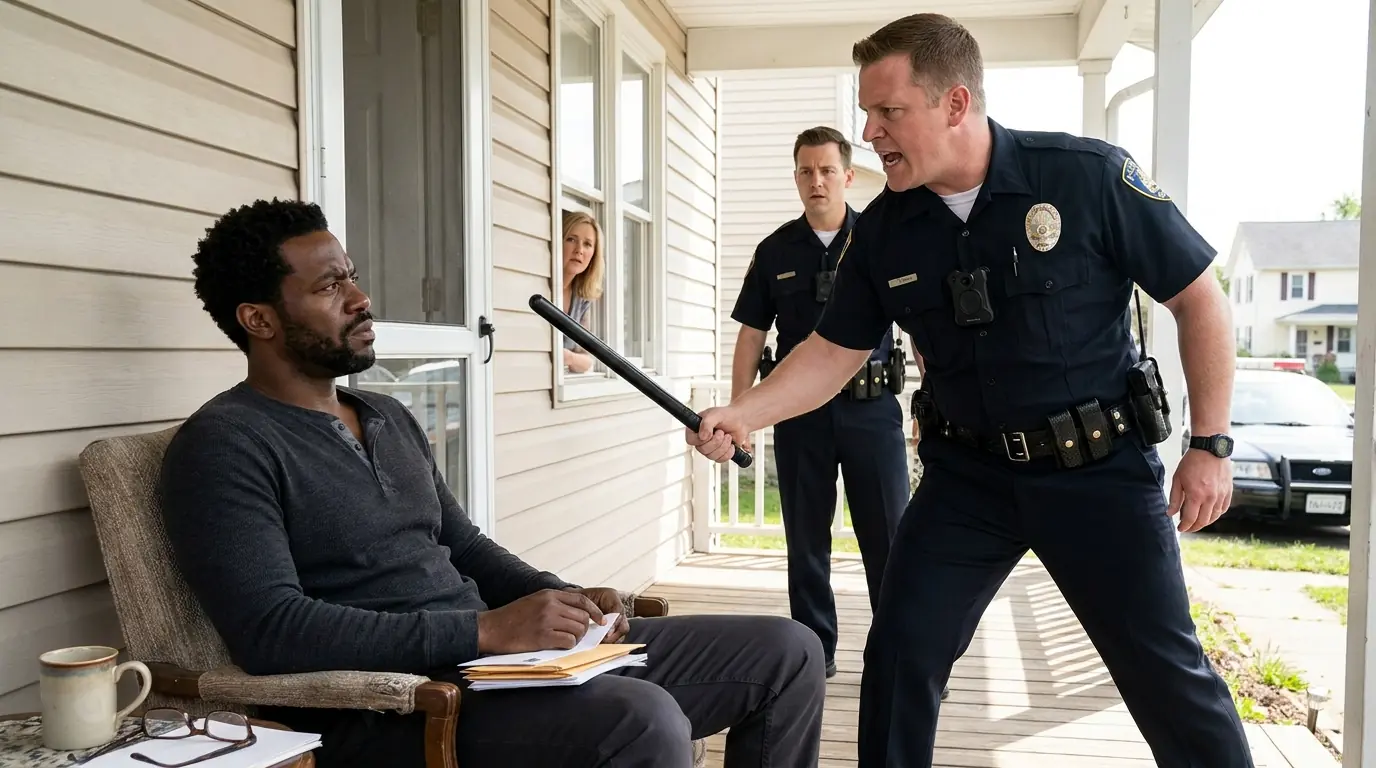
The Black man had lived there for six years.
His house was not the largest on the block.
It was not the smallest either.
It had pale gray siding, white trim, a covered porch, three upstairs bedrooms, and an old oak tree near the sidewalk that dropped enough leaves every October to make him question why he had ever wanted a yard.
He loved it anyway.
The porch was his favorite part.
Most Saturdays, he sat outside with coffee and worked through whatever he had not had time to read during the week.
Sometimes newspapers.
Sometimes reports.
Sometimes nothing.
That afternoon, a ceramic mug sat on the small metal table beside him with his keys and wallet.
A stack of unopened mail rested on his lap.
He wore a dark charcoal long-sleeve henley, black jeans, and comfortable house shoes.
He was in his early forties, tall, broad through the shoulders, with deep-brown skin, short curly black hair, and a trimmed beard.
He looked like a man enjoying his own afternoon.
That was exactly what he was doing.
Until the patrol car slowed.
The Black man watched it through the porch railing.
The cruiser rolled past once.
Then stopped.
Reverse lights appeared.
The vehicle backed toward his driveway and parked at the curb.
He frowned.
A white officer stepped out.
The officer was in his late thirties or early forties, broad-shouldered, short light-brown hair, clean-shaven, wearing a dark navy patrol uniform with a body camera, radio, badge, and duty belt.
A second white officer exited from the passenger side.
He was slightly younger, leaner, dark-haired, and seemed less certain about why they were there.
The Black man picked up his coffee.
He did not stand.
The lead officer walked across the lawn instead of using the sidewalk.
That was the first thing the Black man noticed.
The second was the expression.
Not curious.
Not cautious.
Already angry.
The lead officer stopped at the bottom of the porch steps.
“You live here?”
The Black man lowered the mug.
“Yes.”
“Name.”
The Black man gave it.
The officer looked toward the front door.
“Anyone else inside?”
“My wife.”
The officer glanced toward the window.
A white woman stood partly behind the curtain.
She had heard the cruiser.
Now she watched with concern.
The lead officer pointed toward the Black man’s lap.
“What are those?”
“Mail.”
“Your mail?”
“Yes.”
The officer stared at him for several seconds.
The Black man waited.
Finally he asked, “What can I help you with?”
The officer’s jaw tightened.
“We received a complaint.”
“About?”
“You.”
The Black man looked almost amused.
“What did I supposedly do?”
The lead officer took one step up.
“Don’t start with the attitude.”
The Black man’s expression changed.
“I asked what the complaint was.”
“I heard you.”
“Then answer.”
The second officer looked toward his partner.
The lead officer ignored him.
“We had a report of a suspicious man hanging around residences.”
The Black man looked at his chair.
Then at his front door.
Then back at the officer.
“I am sitting at my house.”
“We’re determining that.”
“You asked whether I live here.”
“And you said yes.”
“I do.”
The officer pointed toward the sidewalk.
“Stand up.”
The Black man did not move.
“Why?”
“So I can talk to you.”
“You’re talking to me now.”
The second officer looked down.
The lead officer’s face reddened slightly.
“I told you to stand.”
The Black man placed his coffee on the table.
“I heard you.”
“Then get up.”
“No.”
The answer was quiet.
The officer stared.
“What did you say?”
“I’m sitting on my own porch.”
The Black man folded the newspaper.
“If you need information, ask for it.”
The officer climbed another step.
“I don’t like repeating myself.”
“That makes two of us.”
The second officer stepped forward.
“Sir.”
The lead officer glanced back.
“What?”
“Maybe we should confirm the address first.”
The lead officer pointed toward the house.
“He says he lives here.”
“Yes.”
“So?”
The second officer hesitated.
“So we can verify.”
The lead officer looked annoyed.
“You want to run every person who claims a house belongs to them?”
The Black man answered from the chair.
“That would probably be smarter than threatening them first.”
The lead officer snapped toward him.
“I wasn’t talking to you.”
The Black man looked directly at him.
“You’re standing on my porch discussing me.”
The officer’s voice rose.
“Get up.”
The woman inside moved closer to the window.
The Black man saw her reflection.
He gave a tiny shake of his head.
Stay inside.
She understood.
The lead officer stepped onto the porch.
Now he stood only a few feet away.
“Last time.”
The Black man remained seated.
“Officer, what law are you investigating?”
The question seemed to surprise him.
“What?”
“You said you received a complaint.”
“Yes.”
“What crime did the caller report?”
The officer’s mouth tightened.
“Suspicious behavior.”
“That is not a crime.”
“You want to tell me how policing works?”
“No.”
The Black man folded his hands over the mail.
“I want you to tell me what I supposedly did.”
The officer leaned forward.
“You were seen sitting outside and watching houses.”
The Black man looked toward the street.
From his porch, he could see eight houses.
“So can everyone else on this block.”
“You were looking around.”
“I live here.”
“You keep saying that.”
“Because you keep acting like it doesn’t matter.”
The lead officer took another step.
The second officer stayed near the bottom of the porch.
His hand touched his shoulder radio.
The Black man noticed.
The lead officer noticed too.
“Don’t call anything yet.”
The second officer lowered his hand.
“Sir, I was just going to check dispatch notes.”
“I said wait.”
The Black man’s eyes narrowed slightly.
That was the first moment he became truly interested.
Not frightened.
Interested.
There had been rumors in Maple Grove for months.
Complaints.
Missing records.
Residents saying officers arrived without clear reasons.
Body-camera requests delayed until footage was supposedly unavailable.
People reporting that their written complaints had been reduced to “service concerns.”
Nothing had ever formed into a clear pattern publicly.
But the Black man had spent three months quietly collecting information.
That was why he was waiting for the phone call.
The officers had no idea.
The lead officer pointed at the chair.
“Stand up.”
The Black man looked at him.
“No.”
The officer reached toward the black collapsible baton on his belt.
The second officer immediately moved.
“Sir.”
The lead officer pulled it free.
The Black man’s wife covered her mouth behind the window.
The Black man did not move.
The baton remained closed at first.
The officer held it in one hand.
“You want this to become a bigger problem?”
The Black man looked at the baton.
“You’re the only person making it bigger.”
The officer snapped it outward.
The metal sections locked.
The sound cut through the quiet afternoon.
The second officer looked uncomfortable.
“Sir, he’s seated.”