Danielle Cross noticed Officer Brent Lawson long before he noticed her.
He was standing near the wooden access path with one hand resting on his duty belt, sunglasses reflecting the hard white light coming off the Atlantic.
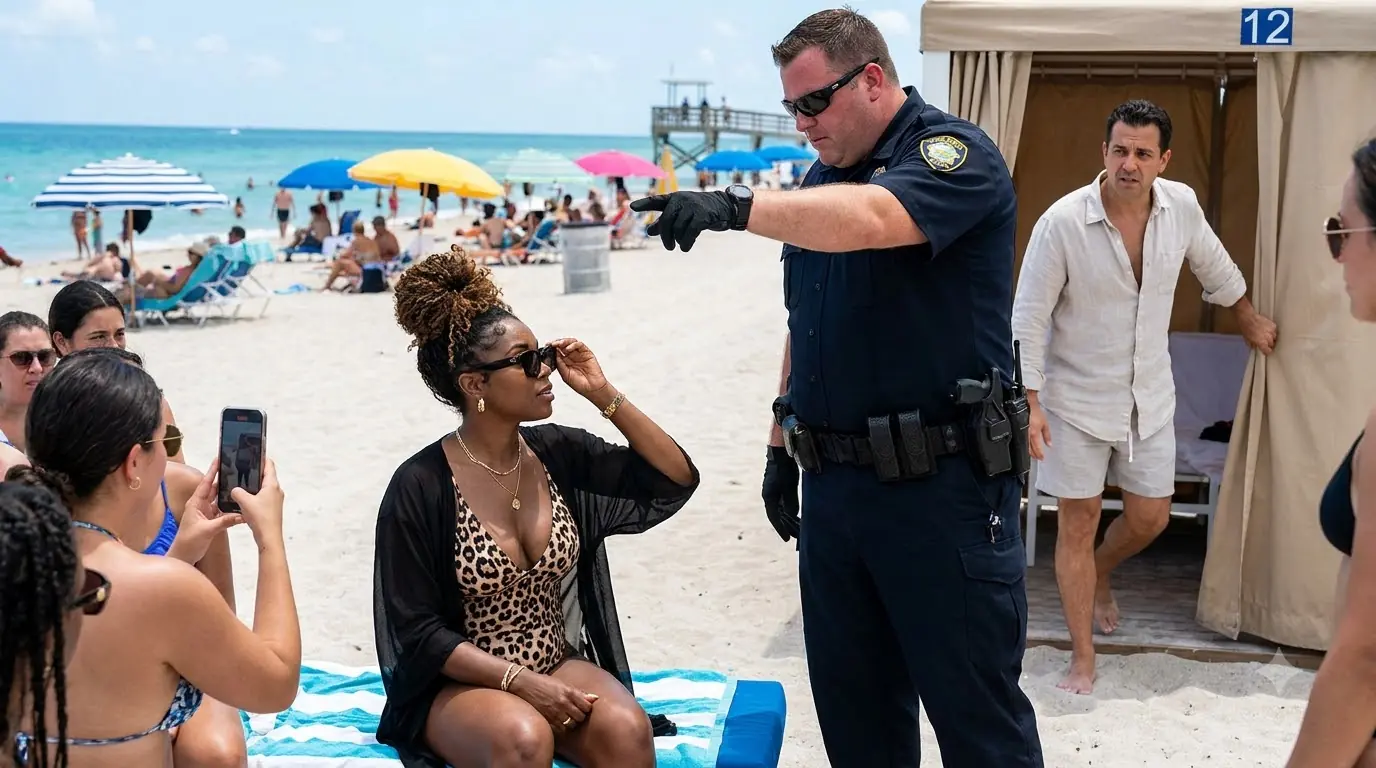
Every few seconds, Brent turned toward the crowd.
Not searching for anyone in particular.
Watching.
Danielle had spent enough years in courtrooms, public meetings, airports, hotel lobbies, and government offices to recognize the difference between someone observing a space and someone deciding who looked out of place inside it.
She continued walking.
The South Florida sun was already fierce even though it was barely eleven in the morning.
Turquoise water rolled toward the sand in clean, shallow waves while children ran between umbrellas and adults carried drinks back from the resort café.
Behind the beach rose two pale glass towers belonging to the Ocean Crest Resort.
Between them, a row of private-looking cabanas stretched along a landscaped section near the pool.
The resort property ended several yards before the waterline.
Beyond that was public beach.
That distinction mattered.
Danielle knew exactly where the line was.
She also knew most people did not.
She wore a leopard-print one-piece swimsuit beneath a sheer black beach cover-up that moved lightly in the ocean breeze.
Large sunglasses covered part of her face.
Thin gold bracelets circled one wrist.
Her textured black hair had been gathered into a high, loose bun.
A large black woven tote hung from her shoulder.
Nothing about her appearance suggested urgency.
That was intentional.
She had arrived forty minutes early.
Judge Samuel Whitmore had told her to meet him at Cabana Twelve at eleven-thirty.
Danielle preferred being early because arriving before everyone else gave her time to understand a place.
Who controlled the entrance.
Who watched the door.
Which employees were relaxed.
Which ones became tense around certain guests.
Where private rules ended and public space began.
It was a habit from work.
At thirty-six, Danielle was one of the youngest partners at Cross, Bennett & Hale, a Washington-based civil-rights and public-access law firm with offices in Miami and Atlanta.
She had built her reputation not by shouting in court, but by making people explain their own records.
Policies.
Logs.
Training manuals.
Emails.
Body-camera timestamps.
Complaint histories.
Contracts.
Maps.
Danielle believed people often revealed more when asked to explain ordinary paperwork than when accused directly.
She had come to South Florida for a judicial education retreat taking place at the Ocean Crest Resort.
Judge Whitmore was one of the organizers.
The retreat focused on local government authority, public accommodation law, access disputes, and the rapidly increasing conflict between private beachfront developments and public coastal rights.
Danielle had been invited to speak that afternoon.
Her presentation was called:
When Private Management Meets Public Space.
The title was boring.
She liked boring titles.
Boring titles often hid interesting problems.
The afternoon session would include judges, municipal attorneys, resort representatives, law professors, and law-enforcement administrators.
But before that, Whitmore wanted coffee.
He had sent Danielle a message that morning.
Cabana 12. 11:30. Come early if you want shade before the lawyers arrive.
Danielle had replied:
Judges count as lawyers.
Whitmore answered:
Not before coffee.
She smiled when she remembered it.
Then she reached an open stretch of sand approximately sixty yards north of the resort’s private pool entrance.
Several families had already set up beach chairs there.
A middle-aged white couple sat under a blue umbrella.
Three college-aged men tossed a football closer to the water.
An older Hispanic American woman read a paperback beneath a striped canopy.
Two young mothers watched children building a sandcastle.
Nobody wore resort wristbands that Danielle could see.
Nobody was being questioned.
She spread her towel.
Placed her tote beside it.
Sat.
For fifteen minutes, nothing happened.
She checked one email.
Then stopped.
The whole point of coming early was to look at ocean instead of screen.
Danielle leaned back on one arm.
The water was bright enough to hurt her eyes even through sunglasses.
A little girl nearby laughed when a wave destroyed a sand wall she had spent ten minutes building.
Her father laughed too.
The girl glared at him.
Then immediately started rebuilding.
Danielle smiled.
That was when a shadow fell across her towel.
She looked up.
Officer Brent Lawson stood over her.
Close enough that she could see his nameplate.
Dark navy uniform.
Badge.
Body camera.
Radio.
Duty belt.
Short brown hair.
Stocky build.
Forty-seven, maybe.
His expression carried the special impatience of someone arriving in the middle of an argument no one else knew had started.
“Ma’am.”
Danielle remained seated.
“Yes?”
“You need to pack up.”
She glanced around.
“Why?”
“This area is restricted.”
Danielle looked toward ocean.
Then toward the line of beach chairs extending in both directions.
“Restricted to whom?”
Brent’s mouth tightened slightly.
“Resort guests.”
Danielle looked at the nearest family.
They were twenty feet away.
The father wore no wristband.
Neither did his wife.
Danielle returned her attention to officer.
“Is this resort property?”
“This section is managed by Ocean Crest.”
“That wasn’t my question.”
Brent shifted his stance.
“Ma’am, I’m not going to debate beach regulations with you.”
“I’m not asking for debate.”
She pointed gently toward wet-sand line.
“I’m asking where the restricted boundary begins.”
Brent looked down at her.
“You staying at hotel?”
Danielle did not answer immediately.
“Does that determine whether I can sit here?”
“Answer the question.”
Danielle lowered her sunglasses slightly.
“Why?”
The officer exhaled.
People nearby had begun noticing.
The older woman with book turned a page but was no longer reading.
One of the mothers looked over.
A man farther up the beach pulled one earbud out.
Brent noticed them too.
His voice became firmer.
“Ma’am, I’m giving you a lawful instruction to gather your things and move to public access section.”
Danielle looked around again.
“Which direction?”
He pointed south.
“Past the marker.”
“What marker?”
“The blue post.”
Danielle followed his finger.
A narrow blue post stood near the resort service walkway, roughly seventy yards away.
She knew the municipal survey.
The post did not mark public-private ownership.
It marked the beginning of a city-approved vendor concession zone.
Different thing.
Danielle looked back.
“That post marks a commercial concession boundary.”
Brent paused.
“You work here?”
“No.”
“Then you don’t know what it marks.”
“I’ve read the permit.”
Now his expression changed.
A small thing.
But Danielle saw it.
“You’ve read the permit.”
“Yes.”
“Why?”
“Because it’s public.”
Brent laughed once.
Not amusement.
Dismissal.
“Okay.”
He gestured toward her tote.
“Pack it up.”
Danielle stayed seated.
“No.”
The word was calm.
That irritated him more than if she had raised her voice.
“You refusing?”
“I’m asking you to identify the rule you believe requires me to leave.”
“I just told you.”
“You said the area is for resort guests.”
“It is.”
“The municipal map says otherwise.”
Brent looked toward nearby beachgoers.
Then back.
“You people always think because you found something online you understand how everything works.”
Danielle became still.
Not angry yet.
Attentive.
“You people?”
Brent immediately realized the phrase had landed badly.
He chose not to correct it.
Instead he pointed again.
“I’m talking about people who argue every instruction.”
Danielle pushed herself upright slightly.
“I haven’t argued every instruction.”
“You’ve argued every sentence.”
“I asked what authority you’re using.”
“Same thing.”
“No.”
Danielle lowered sunglasses completely.
“That distinction matters.”
Brent glanced at her tote.
“You have identification?”
“For sitting on a public beach?”
“Do you?”
“Yes.”
“Let me see it.”
“Why?”
He gave a frustrated laugh.
“There it is again.”
Danielle looked around.
“I’m not required to identify myself merely because I’m sitting here.”
“You don’t tell me what you’re required to do.”
“I’m telling you what I understand the law to require.”
“Are you a lawyer?”
Danielle paused.
“Yes.”
Brent’s expression shifted into something almost triumphant.
“Of course.”
Danielle raised one eyebrow.
“What does that mean?”
“It means this is going to take longer than it needs to.”
“Only if you keep avoiding the original question.”
Brent stepped closer.
“Stand up.”
Danielle looked at his body camera.
A small indicator showed it was recording.
Good.
“Why?”
“I’m ordering you to stand.”
“For what reason?”
“Because I’m conducting an investigation.”
“Into what?”
“Whether you’re trespassing.”
Danielle nodded once.