Winter of 1887.
The blizzard howled through Wyoming Territory like a banshee’s cry, claiming lives and breaking hearts. At the lonely train station in Cheyenne, a woman sat frozen on a wooden bench, her breath forming white clouds in the bitter air.
She clutched a small leather bag containing everything she owned: three dollars, a faded photograph, and a heart full of dreams that seemed as cold as the night itself.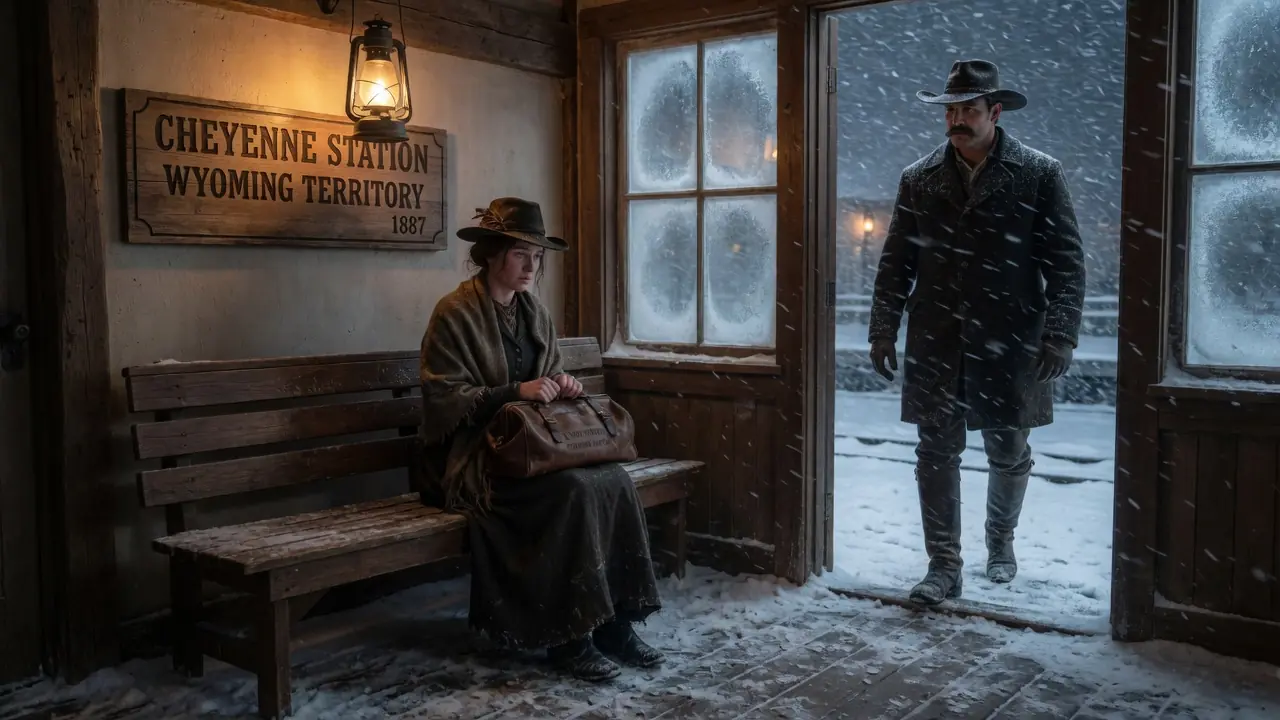
Her name was Elizabeth “Libby” Montgomery.
The wind cut through Cheyenne like a knife that December night. Libby pulled her thin shawl tighter around her shoulders, but it did little to keep out the cold. Her fingers had gone numb hours ago, and her lips were turning blue.
The last train east had left three hours earlier, and the next one would not come until morning, if the storm did not block the tracks.
Libby had been a nurse back in Philadelphia, working in a charity hospital where she had learned to tend wounds, deliver babies, and comfort the dying. But when trouble came with Dr. Harrison, a powerful physician who thought no one would believe her, Libby fought back.
She was dismissed from the hospital, and word spread through the medical community like wildfire. No respectable hospital would hire her after that.
So she had taken what little money she had and bought a train ticket west, hoping to find work in one of the mining towns where anyone with medical knowledge might still be valued.
But her money had run out in Cheyenne. The boarding house turned her away when she could not pay for another night.
Now she sat on a hard bench, watching her breath fog in the air, wondering if she would freeze before dawn.
Beside her sat her small leather medical bag, the only thing of value she owned. Inside were surgical tools, medicines, and the few certificates that proved her training.
Then she heard horse hooves striking frozen ground.
Through the swirling snow, she saw a rider approaching. He was a large man in a heavy coat and a wide-brimmed hat pulled low against the wind. His horse was a magnificent black stallion, and even through the storm, Libby could tell the man’s clothes were practical but finely made.
He dismounted, tied his horse to the hitching post, and stepped into the station. A gust of snow followed him inside.
“Evening, miss,” he said, touching the brim of his hat. His voice was deep and warm, with the slight drawl of a man who had spent time in Texas. “Mighty cold night to be sitting out here alone.”
Libby tried to speak, but her teeth chattered too hard. She managed only a small nod.
The man studied her with concern. He was perhaps 30 years old, with dark hair, a neat mustache, and a face weathered by sun and wind. Yet his eyes were kind.
“Name’s Jackson Thornton,” he said. “Most folks call me Jack. I own the Double T Ranch about 20 miles north of here. I was in town on business and saw you through the window.”
His eyes fell to her medical bag.
“Are you a doctor, miss?”
“Nurse,” Libby managed. “Elizabeth Montgomery. From Philadelphia.”
Jack’s eyes widened slightly. A trained nurse was rarer than gold in Wyoming Territory. Most towns were lucky to have a barber who could pull teeth and set bones.
“Miss Montgomery, you’re going to freeze if you stay here,” he said firmly. “The storm’s getting worse, and this station has no heat. Please, let me take you somewhere warm.”
Libby looked at him with a mixture of hope and wariness. She had learned not to trust men too easily. But she was desperate, and something about Jack Thornton seemed different. There was strength in him, but gentleness too.
“I don’t have money for a hotel,” she whispered.
“That is not your concern right now,” Jack said. “Getting you warm and fed is what matters. We can sort out the rest later.”
He removed his heavy coat and wrapped it around her shoulders. The warmth of it, still carrying his body heat, made her gasp with relief. It smelled of leather, horses, and pine soap.
“Can you walk?” he asked.
Libby tried to stand, but her legs were too stiff from the cold.
“The hotel is just across the street,” he said. “We’ll get you warm, fed, and safe.”
As they stepped into the storm, Libby found herself pressed against Jack’s chest, his strong arms holding her securely. For the first time in months, she felt safe.
She did not know this man. She did not know his intentions. But somehow, she trusted him.
The Cattleman’s Hotel was the finest establishment in Cheyenne, and when Jack Thornton walked through the front door carrying a half-frozen woman, every head in the lobby turned.
The desk clerk hurried forward.
“Mr. Thornton, sir, what happened?”
“Found this lady at the train station near frozen to death,” Jack said. “I need your best room. Send up hot food, coffee, blankets, and get Doc Williams if he’s still in town.”
“Right away, sir.”
Jack carried Libby upstairs into a spacious room with a large bed, fine furniture, and a fireplace. He set her gently in a chair by the fire and immediately began building the flames.
“The hotel will send up dry clothes,” he said, keeping his eyes respectfully away from her damp dress. “We need to get you warm.”
Soon, hot coffee, soup, and blankets arrived. Jack wrapped a blanket around her shoulders and poured coffee with surprisingly gentle hands.
“Drink slowly,” he said. “Too much heat too fast can be dangerous.”
Libby sipped gratefully as warmth spread through her chest.
“You seem to know something about medicine,” she said.
Jack smiled. “You learn a few things running a ranch. Men get hurt, animals get sick, and the nearest doctor might be a hundred miles away.”
He pulled up a chair across from her.
“What brought you west, Miss Montgomery, if you do not mind my asking?”
Libby studied his face in the firelight. He had honest eyes, and after what he had done for her, he deserved some truth.
“I worked in a hospital in Philadelphia,” she said carefully. “There was trouble with a doctor. When I defended myself, I was dismissed. No hospital back east would hire me after that.”
Jack’s jaw tightened.
“He mistreated you.”
“He tried,” Libby said. “I broke his nose with a bedpan.”
Despite the seriousness of the moment, Jack’s mouth twitched.
“Good for you. I hope it hurt.”
“It did,” Libby said, and for the first time in months, she almost smiled. “But it cost me my career. I thought perhaps in the West, where doctors are scarce, my past would not matter so much.”
“It does not,” Jack said firmly. “Out here, we judge people by what they do, not by the lies told about them back east. A trained nurse is worth her weight in gold in this territory.”
A knock interrupted them. A maid entered with an armload of women’s clothing.
“Begging your pardon, sir, but these are the finest we have. Mrs. Patterson said any woman caught in this storm deserves all the help we can give.”
“Thank Mrs. Patterson for her kindness,” Jack said. “I’ll wait downstairs while Miss Montgomery changes.”
As he reached the door, Libby called softly, “Mr. Thornton.”
He turned.
“Why are you helping me? You do not know me.”
Jack paused with his hand on the doorknob.
“Maybe because I know what it is to be alone in the world,” he said quietly. “And maybe because I have been praying for someone like you to come along.”
“Someone like me?”
“A healer.”
Then he left, closing the door gently behind him.
Libby sat by the fire, staring at the closed door. She had expected many things when she came west, but she had not expected to meet a man like Jackson Thornton.
The next morning, sunlight streamed through the hotel window. The storm had passed, leaving Cheyenne covered in clean white snow.
Libby had slept better than she had in weeks.
A soft knock came at the door.
“Miss Montgomery? It’s Jack Thornton.”
When she opened it, Jack stood in the hallway with a breakfast tray.
“Morning,” he said with a smile that made her heart skip. “Thought you might be hungry.”
They sat by the window as Libby ate eggs, bacon, biscuits, and jam. She realized how long it had been since she had eaten a proper meal.
“I do not have many plans,” she admitted. “I hoped to find work in one of the mining camps, but I do not know where to go.”
Jack leaned back.
“Mining camps are rough places for a woman alone. Dangerous too.”
“I can take care of myself.”
“I believe that,” Jack said. “But there might be another option.”
Libby looked up.
“My ranch covers 50,000 acres. I employ about 60 men year-round. During roundup and branding season, nearly 100. These men work hard and get hurt often. Broken bones, cuts, burns, snake bites. I need a nurse.”
“You’re offering me work?”
“I am offering you a position as the ranch nurse. Good pay, comfortable quarters, and all the medical supplies you need. You would have your own cabin near the main house, and Cookie, our cook, would make sure you were well-fed.”
It sounded too good to be true.
“What would you expect in return?”
“Honest work for honest pay. Tend the men when they are hurt, help when medical knowledge is needed, and perhaps teach some of the hands basic first aid.”
“And you would expect nothing personal?”
Understanding dawned in Jack’s eyes.
“Libby, I am not the kind of man who takes advantage of a woman in a desperate situation. If anything personal ever developed between us, it would be because we both wanted it, not because you felt obligated.”
Libby studied his face. His eyes were clear and honest.
“How far is your ranch?”
“Twenty miles north. The Double T, after my initials, Jackson Thomas Thornton. We raise cattle and horses, some of the finest in Wyoming Territory.”
“Have you tried to hire a doctor?”
“I have tried,” Jack said. “Most doctors want towns where wealthy patients can pay regular fees. Ranch work is uncertain, dangerous, and not profitable enough for most of them.”
“But you would hire a woman?”
“I would hire anyone with the skill and courage to do the job.”
Libby considered it carefully.
“What are you not telling me?”
Jack smiled faintly.
“Smart as well as skilled. All right. The Double T is a working ranch, not a fancy estate. Winters are hard, summers are hot, and we are 20 miles from town. You would be the only woman on the ranch most days, except for Cookie’s wife, Martha. It can be lonely.”
“I have been lonely in cities full of people,” Libby said quietly. “At least ranch loneliness would be honest.”
“There is something else,” Jack said. “My family has money. Quite a bit of it. My father made a fortune in shipping before the war, and I have done well with investments besides the ranch. Some people might say you are trying to catch a wealthy husband.”
Libby’s chin lifted.
“Let them say what they want. I know my own heart.”
“I believe you do,” Jack said softly.
They sat in silence, watching the snow-covered street.
Finally, Libby spoke.
“When would you want me to start?”
Jack’s face lit with a smile.
“Does that mean you’ll take the position?”
“It means I’ll try it. If it does not work out, I will move on with no hard feelings.”
Jack stood and offered his hand.
“Welcome to the Double T, Nurse Montgomery.”
As Libby shook his hand, a spark passed between them. From the look in Jack’s eyes, he felt it too.
The ride to the Double T took three hours through snow-covered countryside that stole Libby’s breath away. Jack had bought her a warm coat, riding boots, and other necessities in Cheyenne, refusing to let her protest.
“Consider it an advance on your salary,” he said.
They rode through open country beneath a sky so wide it seemed endless. Jack pointed out landmarks along the way: a creek where they watered horses, cottonwood trees that sheltered men during roundups, and finally the boundary markers of the Double T.
“There she is,” Jack said with pride as they crested a hill.
Libby gasped.
The ranch spread across the valley like a small town. The main house was built of logs and stone, with a wide front porch. Nearby stood the bunkhouse, stables, corrals, a blacksmith shop, and several outbuildings. Smoke rose from chimneys, and men worked despite the cold.
“It’s beautiful,” she said.
“Wait until spring,” Jack replied. “When the grass turns green and the wildflowers bloom, there is no prettier sight in Wyoming.”
As they rode into the yard, men began emerging to greet them.
“Boys,” Jack called, “meet Miss Elizabeth Montgomery. She is our new nurse.”
A cheer rose from the assembled cowboys.
A grizzled man with gray whiskers stepped forward.
“Name’s Tom Bradley, miss. Foreman here. Can’t tell you how glad we are to have someone with medical training on this ranch.”
“Thank you, Mr. Bradley,” Libby said. “I hope I can be of help.”
“Oh, you will be,” another cowboy said, holding up a bandaged hand. “I cut myself on barbed wire yesterday, and it has been paining me something fierce.”
“I’ll take a look after I get settled,” Libby promised.
Jack led her to a small but well-built cabin about 50 yards from the main house.
“This will be your home.”
Inside was a warm fireplace, simple furniture, a bedroom, a small kitchen, fresh linens, and a view of the mountains. It was modest, but to Libby it felt like a palace.
“There is one more thing,” Jack said.
He opened a door to a room she had not noticed.
Inside was a medical office.
An examination table. Cabinets full of supplies. Surgical instruments. Medicines. Everything clean, organized, and better equipped than some hospitals she had known back east.
“Jack,” she breathed. “This must have cost a fortune.”
“A good nurse is worth a fortune,” he said simply. “Besides, I ordered most of it months ago, hoping I would eventually find someone to use it.”
Tears pricked Libby’s eyes.
“Thank you.”
“Do not thank me yet,” Jack said with a smile. “Wait until you see what cowboys can do to themselves.”
As if to prove him right, there was a knock.
Tom Bradley entered, supporting a young cowboy who was hopping on one foot.
“Sorry to bother you, miss, but Billy here got stepped on by his horse.”
“Bring him into the medical room,” Libby said, immediately shifting into professional mode. “Let’s get that boot off.”
Billy’s foot was badly bruised, but not broken. Libby bandaged it and gave instructions for care.
When she looked up, Jack was watching from the doorway, smiling.
“What?” she asked.
“Nothing,” he said. “Just thinking this might work even better than I hoped.”
That evening, after treating three more minor injuries and meeting most of the hands, Libby sat in her cabin trying to understand how much her life had changed.
Two days earlier, she had been freezing and penniless at a train station. Now she had work, a home, and respect.
Then there was Jack Thornton himself.
Strong but gentle. Wealthy but unpretentious. Protective without treating her as weak.
A soft knock came at her door.
Jack stood on the porch with a steaming cup.
“Thought you might like hot chocolate before bed. Martha makes the best in Wyoming Territory.”
“That is very thoughtful,” Libby said. “Would you like to come in for a few minutes?”
Jack hesitated.
“I do not want to compromise your reputation.”
“I think my reputation can survive a brief conversation with my employer,” she said with a smile.
Jack entered and sat by the fire.
After a few quiet minutes, his expression grew serious.
“I want to be honest with you. When I found you at the station, it was not entirely by chance.”
Libby set down her cup.
“What do you mean?”
“I was in town on business, yes, but I was also asking about finding a nurse or doctor for the ranch. The hotel clerk mentioned a woman with medical training had been asking about work earlier that day. I went to the station hoping to find you.”
“So you knew who I was?”
“I knew a trained nurse was supposed to be in town. I did not know your name or circumstances until I found you.”
“Why did you not tell me?”
“Because I wanted you to take the job based on its merits, not because you felt obligated to the man who carried you out of the cold.”
Libby respected the honesty.
“Is there anything else I should know?”
Jack met her eyes directly.
“Just this. I am attracted to you, Libby. I have been since the moment I saw you. But your position here is secure regardless of your personal feelings toward me. I will not pressure you. Your work here depends only on your skill.”
Libby felt her heart skip.
“Thank you for being honest,” she said softly. “And for the record, the attraction is not one-sided.”
They looked at each other across the firelight, both aware that something significant had begun.
Spring came early to Wyoming Territory that year, and Libby settled into life at the Double T. She treated broken bones, snake bites, burns, and fevers. She helped deliver foals and calves. She even helped Martha in the garden when her medical duties were light.
The men came to trust her completely.
But her growing relationship with Jack occupied most of her thoughts. During the day, he maintained proper boundaries. In the evenings, their conversations on her cabin porch became a cherished routine.
One April evening, while the sunset painted the mountains gold and purple, Jack grew unusually quiet.
“Libby, there is something I need to tell you about my past.”
She set down her coffee.
“I was married before,” he said. “Her name was Rebecca. We were childhood sweethearts in Texas. We married when I was 22.”
“What happened to her?” Libby asked gently.
“Fever took her three years ago,” Jack said, pain clear in his voice. “We had hoped for children, but it never happened. When she died, I thought my chance at happiness died with her.”
“I am sorry,” Libby said, taking his hand. “She must have been very special.”
“She was,” Jack said. “But she was nothing like you. Rebecca was gentle and delicate, content to tend flowers. You are strong, independent, and willing to face hardship head-on. I love that about you.”
Libby’s heart stopped.
Jack seemed to realize what he had said.
“I know it is too soon,” he said quickly. “I know we work together, and that complicates things. But I cannot pretend my feelings are only professional respect.”
“Mine are not either,” Libby admitted. “But it is complicated. What would the men think? What would people in town say?”
“I do not care what they say,” Jack said. “But I care what you want.”
Before she could answer, Tom Bradley came running toward the cabin, pale with worry.
“Boss. Miss Libby. There has been an accident. Lightning spooked the horses. Young Danny got trampled. He is hurt bad.”
Libby was on her feet instantly.
“Where is he?”
“The bunkhouse.”
Libby grabbed her medical bag while Jack saddled a horse to ride for the doctor in Cheyenne.
But when Libby saw Danny’s injuries, she knew there was no time to wait. The 18-year-old cowboy was unconscious, his breathing shallow, his chest badly injured.
“Clear a table,” she ordered. “I need light, hot water, clean sheets, and steady hands. Tom, assist me.”
“Miss Libby,” Tom said uncertainly, “shouldn’t we wait for the doctor?”
“He may not survive that long,” Libby said firmly. “I have done this before. We act now.”
For three hours, she worked over Danny’s broken body. She repaired what she could, stopped the bleeding, set bones, and fought for his life while the cowboys watched in silent awe.
When she finally stepped back, exhausted but steady, Danny’s breathing had improved.
“He will live,” she said.
The bunkhouse erupted in cheers.
Jack returned with the doctor, who examined Danny and declared Libby’s work as fine as any surgeon in Denver could have done.
Later that night, under the moonlight, Jack and Libby sat on her porch.
“What you did tonight was incredible,” Jack said. “You saved that boy’s life.”
“It is what any trained nurse would have done.”
“No,” Jack said. “It is what you did. And it is why I love you.”
There it was, spoken plainly.
Libby looked at the man who had rescued her from the cold, given her work, believed her story, and now looked at her as if she were the most precious thing in the world.
“I love you too,” she said.
Jack kissed her then, gently and sweetly beneath the Wyoming sky.
When they parted, he took her hands.
“Marry me, Libby. I know it is fast. I know it is complicated. But I cannot imagine my life without you.”
“Jack…”
“You do not have to answer tonight,” he said. “Just promise you will think about it.”
“I will,” she whispered, though in her heart she already knew.
Word of Jack’s proposal spread across the ranch faster than wildfire. To Libby’s surprise, the reaction was overwhelmingly joyful. The cowboys respected her and saw how happy she made their boss.
The wedding was set for the first Saturday in June.
It became the social event of that part of Wyoming Territory. Cowboys from neighboring ranches, townspeople from Cheyenne, and even Jack’s business associates from Denver came to witness the union of the millionaire rancher and his nurse.
Libby wore an ivory silk dress Jack had ordered from San Francisco. Martha wove prairie wildflowers into her hair. Tom Bradley proudly escorted her in place of the father she had lost years earlier.
Jack waited on the front porch of the main house, dressed in his finest black suit, looking more nervous than Libby had ever seen him.
When their eyes met, his nervousness vanished.
The circuit preacher spoke of love, commitment, and partnership.
“Do you, Jackson Thomas Thornton, take Elizabeth Rose Montgomery to be your lawfully wedded wife?”
“I do,” Jack said clearly.
“And do you, Elizabeth Rose Montgomery, take Jackson Thomas Thornton to be your lawfully wedded husband?”
“I do,” Libby said, her voice strong and sure.
When the preacher pronounced them husband and wife, Jack kissed her, and the cowboys erupted in cheers and whistles.
The celebration became legendary. Cookie prepared roasted beef, fresh trout, vegetables from Martha’s garden, and a wedding cake brought carefully from Denver. There was music, dancing, and storytelling late into the night.
The most meaningful moment came when Danny, still recovering, stood to make a toast.
“To Mrs. Thornton,” he said, raising his glass of lemonade. “The woman who saved my life and made our boss the happiest man in Wyoming Territory. May your love story inspire generations to come.”
Libby cried happy tears as Jack squeezed her hand.
Later, when the guests began to leave, Jack and Libby stood alone on the porch of the main house.
“Well, Mrs. Thornton,” Jack said, taking her hands, “how does it feel to be a married woman?”
“It feels like coming home,” Libby replied. “Like everything before was only preparing me for this.”
Jack gave her a gold locket. Inside was a tiny photograph of them taken that day. Engraved on the other side were the words:
Forever and always, J.T.
“Now you will always have me close to your heart,” Jack said softly.
“I already do,” Libby whispered.
The first year of marriage brought joy and challenge. Libby continued her work as ranch nurse, but she also became Jack’s partner in business, helping with ranch operations and offering suggestions that saved money and improved efficiency.
Her medical skill became known throughout the territory. She treated illness in nearby Silver Creek, delivered twins during a blizzard, and removed a bullet from a wounded sheriff who had been chasing rustlers.
But in spring of 1889, Libby’s past returned.
Dr. Harrison arrived in Cheyenne, claiming to investigate illegal medical practice by unlicensed practitioners.
“He has come to cause trouble,” Libby told Jack.
“Let him come,” Jack said. “Things are different out here.”
Harrison arrived at the ranch three days later with a territorial marshal and official papers questioning Libby’s right to practice medicine.
“Mrs. Thornton,” Harrison said with false politeness, “or should I say Miss Montgomery? I am here to investigate reports of illegal medical practice.”
“My wife is a trained nurse,” Jack said, stepping beside her. “She has certificates proving her education.”
“Certificates mean little when a woman has been dismissed for moral failure,” Harrison said. “Did you tell your husband what happened in Philadelphia?”
“I told him the truth,” Libby said steadily. “You tried to ruin me because I defended myself.”
“Your word against mine,” Harrison sneered. “I am a respected physician.”
That was as far as he got before Jack struck him and sent him sprawling into the dirt.
The marshal reached for his sidearm, then noticed 30 angry cowboys had appeared from every direction.
“Now see here,” the marshal said nervously. “I am a federal officer.”
“And I am a citizen of Wyoming Territory,” Jack said calmly, though his eyes burned. “If you want to question my wife’s credentials, we will go to town and have a proper hearing.”
The hearing was held in Cheyenne three days later, and it seemed half the territory came to support Libby.
Patient after patient testified about her skill and compassion. The Cheyenne doctor praised her surgical ability. Even the territorial governor sent a letter recognizing her contributions to medical care.
Harrison’s accusations collapsed. It was revealed that he had been dismissed from his own position for drinking and incompetence, and that he had carried a grudge against Libby for years.
When Tom Bradley testified about how Libby had saved Danny’s life, the judge’s decision was swift.
“Mrs. Thornton,” the judge said, “your service to this territory has been exemplary. Your nursing certificate is hereby recognized by the territorial government, and you are authorized to practice medicine throughout Wyoming Territory.”
The courtroom erupted in cheers.
Jack swept Libby into his arms.
“It is over,” he whispered. “He cannot hurt you anymore.”
“We did it together,” Libby replied. “We can face anything together.”
By 1892, Jack and Libby Thornton had become one of the most influential couples in Wyoming Territory.
The Double T had expanded to more than 100,000 acres. Their cattle and horses were renowned throughout the West. But their greatest contribution was to the people.
Libby established the first real hospital in the territory, a modern facility in Cheyenne serving patients from hundreds of miles around. She also founded a nursing school, training young women to provide care in remote frontier communities.
Jack became a political force, serving in the territorial legislature and advocating for statehood. He invested in railroads, mining, and businesses that helped the region grow. On the southern border of the ranch, he built the town of Thornton, Wyoming, with schools, churches, shops, and homes for working families.
Their greatest joy, however, came from their children.
Twin boys were born in 1890, followed by a daughter in 1892. Thomas and Jackson Jr. inherited their father’s love for the land and their mother’s compassion. Baby Rebecca, named with Libby’s blessing for Jack’s first wife, became the light of their lives.
“She may be a healer like her mother,” Jack said one evening as they watched Rebecca sleep.
“Or a rancher like her father,” Libby replied.
“Maybe both,” Jack said, pulling his wife close. “In this family, we believe in unlimited possibilities.”
Years later, historians writing about early Wyoming always included the story of Jack and Libby Thornton.
Thomas became a respected cattleman and later served in public office. Jackson Jr. became a doctor and helped establish hospitals across the growing state. Rebecca married a rancher and raised six children, passing down the family stories of courage, love, and perseverance.
The town of Thornton grew into a thriving city. The hospital Libby founded became a major medical center. Her nursing school graduated hundreds of women who carried her legacy of frontier medicine across the American West.
But the real monument to Jack and Libby’s love was not in any building. It was in the lives they touched, the people they helped, and the generations who found courage in their story.
In the museum in Cheyenne, visitors can still see Libby’s medical bag, the one she carried on that freezing night in 1887. Beside it are Jack’s wedding ring and a copy of their marriage certificate.
The plaque reads:
Jack and Elizabeth Thornton, proof that love can conquer all, and that the greatest adventures begin with a single act of kindness.
On the hill overlooking the old Double T Ranch, two headstones stand side by side beneath the wide Wyoming sky.
Jack died in 1923 at the age of 86. Libby followed him three months later. They were buried together, as they had lived, heart to heart.
The inscription on their shared stone reads:
Forever and always.
A love that made history.
Even today, visitors come to Wyoming to see where the famous love story began. They visit the old Cheyenne station, tour the Double T Ranch, and walk through the town of Thornton.
They leave remembering the story of a wealthy rancher who found a freezing nurse at a train station and discovered that sometimes the greatest treasures are found in the most unexpected places.
The legend of Jack and Libby Thornton lives on, a testament to the promise of the American West and the truth that every great love story begins with someone caring enough to reach out to a stranger in need.