Rebecca Doyle had been walking since dawn, though by noon she no longer knew whether her feet were still obeying her or merely falling forward because the desert refused to let her stop gently. The Arizona sun sat white and merciless above the road, burning the color out of the world until everything became dust, glare, and pain. Behind her, a broken wooden cart dragged crooked through the sand, its left wheel wobbling with every turn. Inside it sat five children with cracked lips, hollow eyes, and silence where crying should have been.
Against Rebecca’s chest, her youngest baby, Caleb, lay wrapped in a faded cloth that had once been blue. He had stopped fussing an hour ago, and that terrified her more than any scream could have. His tiny mouth moved now and then, but no sound came out, and his skin felt too hot beneath her trembling hand. Rebecca kept whispering his name, because she was afraid that if she stopped saying it, the desert would take him without asking.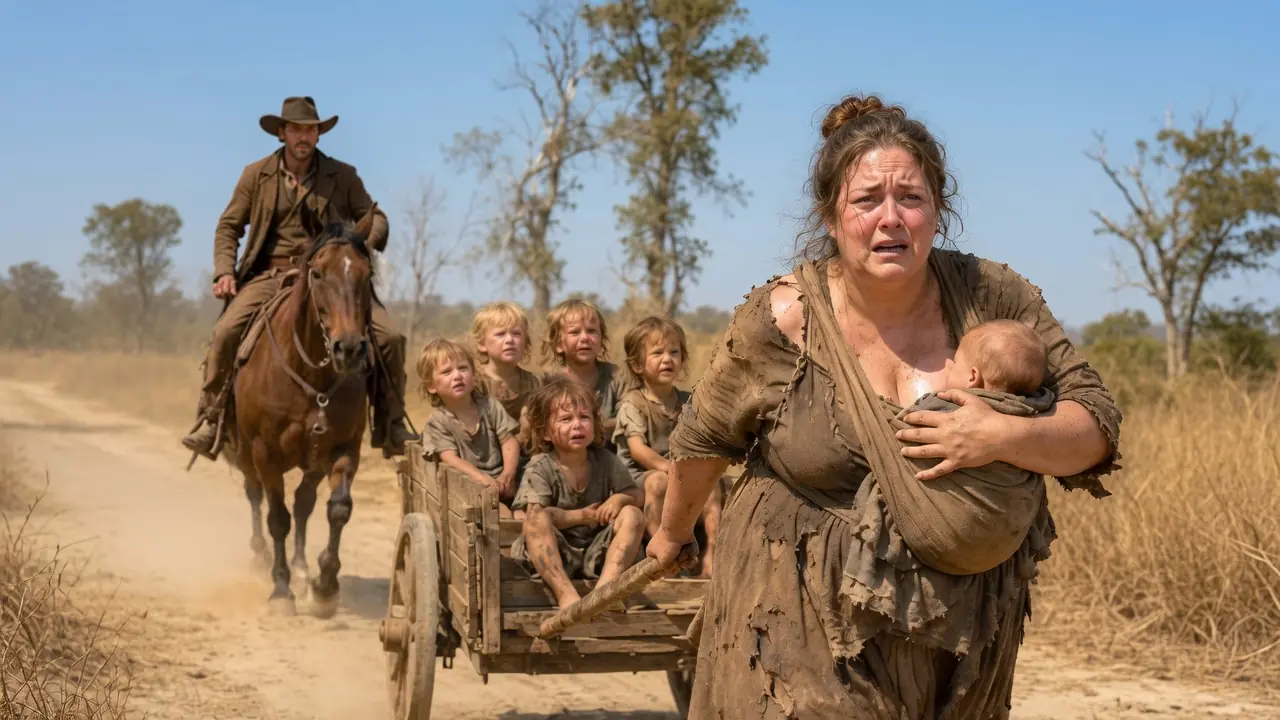
Her oldest boy, Samuel, was only twelve, but he had been walking beside the cart like a man twice his age. He kept one hand on the side rail, helping push whenever the wheel dug too deep. Behind him, eight-year-old Ruth held little Annie’s hand, while the twins, Jacob and Jonah, sat in the cart with their knees pulled to their chests. None of them complained anymore, and that was how Rebecca knew they were in danger.
Two months earlier, her husband, Daniel Doyle, had died in the Black Mesa copper mine collapse. The company called it an accident, paid her forty-three dollars, and sent a clerk to say how sorry they were. Rebecca had stood in her doorway with a baby in one arm and five frightened children behind her, listening to a man in a clean coat explain that no further compensation would be issued. After that, the rent came due, the pantry emptied, and every neighbor who had promised to help suddenly had troubles of their own.
So she had packed what remained of her life into the cart and started toward San Rosario, where someone told her there might be work washing laundry for a hotel. It was supposed to be eighteen miles. Then the mule went lame on the second morning, and Rebecca traded it for flour, two canteens, and a promise that had turned out to be worth nothing. By the third day, the canteens were empty, the flour was gone, and the road ahead seemed to grow longer each time she looked at it.
“Ma,” Samuel said, his voice rough from thirst. “I see something.”
Rebecca lifted her head. Heat shimmered over the road, twisting the distance into false water and false hope. At first she thought it was another trick of the light. Then she saw a rider moving slowly toward them, a dark shape against the pale desert, with a horse beneath him and a rifle across his saddle.
Her first instinct was fear. A woman alone with children learned to fear men before she learned their names. She gripped Caleb tighter and forced herself to straighten, though black spots crowded the edge of her vision. The rider came close enough for her to see his wide-brimmed hat, sun-browned face, and eyes that seemed to measure suffering without flinching from it.
He stopped his horse several yards away. “Ma’am.”
Rebecca swallowed against a throat dry as ash. “We’re fine.”
The man looked at the broken cart, the silent children, the baby’s limp body, and the blood darkening one of Rebecca’s sleeves where the cart handle had torn her skin. He swung down from his horse without hurry. Dust rose around his boots.
“You’re not fine,” he said.
Rebecca almost laughed, but the sound broke before it reached her mouth. “We just need to reach San Rosario.”
“That’s nine miles from here.”
“I can walk.”
The man’s gaze moved to Caleb. “That baby won’t survive another mile in this heat.”
Rebecca stepped back, though her knees almost failed beneath her. “I don’t know you.”
“No,” he said. “But you know the desert.”
That silenced her because the desert was already telling the truth. It was in Caleb’s stillness, in Ruth’s trembling fingers, in Samuel’s sunken eyes, in the way Annie had stopped asking for water. Rebecca had kept walking because stopping felt like surrender, but now a stranger had spoken aloud what she had been trying not to hear.
“My ranch is two miles east,” the man said. “There is water, shade, and food.”
Rebecca looked toward the children, then back at him. “What kind of man finds a woman half-dead on a road and asks her to follow him?”
His expression did not change, but something quiet moved behind his eyes. “The kind who has already buried too much.”
The words were not soft, but they were honest. That was why they frightened her less than kindness would have. He stepped past her, took the cart handle from her bleeding hands, and tested the weight. Then he looked at Samuel.
“You strong enough to walk beside me, boy?”
Samuel nodded, though his lips were cracked.
“Good. Stay close. If anyone falls, I carry them.”
Rebecca tightened her hold on Caleb. “I can carry my baby.”
The man looked at her hands, then at the child. “You can love him. Right now, that is enough. Let me carry the weight.”
She wanted to refuse. Pride rose in her even then, useless and brittle. But Caleb’s head slipped against her chest, and Rebecca felt how weak her arms had become. Slowly, as if handing over her own heart, she let the cowboy take the baby.
He held Caleb with surprising care. Then he pulled his canteen free and wet the corner of the cloth, touching it carefully to the baby’s lips. “Not too much,” he said. “Slow.”
“What’s your name?” Rebecca whispered.
“Elias Mercer.”
“Rebecca Doyle.”
He nodded once. “Come with me now, Rebecca Doyle.
They followed him off the main road and into a wash where the sun struck less directly. Elias led the horse with one hand and pulled the cart with the other, refusing Samuel’s help after the first quarter mile. He did not speak unless necessary. When Ruth stumbled, he stopped without complaint, gave her a sip of water, and waited until she could stand again.
The ranch appeared near sundown, tucked against a low ridge of red stone where a windmill turned slowly above a shaded well. It was not grand, but to Rebecca it looked like salvation built from wood and dust. A barn leaned beside the house, and a fenced corral held three horses that lifted their heads as the cart came in. Elias carried Caleb straight to the porch and kicked the door open.
Inside, the house was cooler than the air outside. The walls were thick adobe, the windows shaded, and a long table stood near a stone hearth. Elias laid Caleb on a blanket and brought water in a tin cup, then soaked another cloth and placed it along the baby’s neck. Rebecca sank to her knees beside him, stroking his tiny hand.
“Is he going to live?” she asked.
Elias looked at the baby for a long moment. “He has a chance now.”
That was more than Rebecca had been able to give him on the road. She bowed her head, and the first sob broke out of her like something torn loose. Ruth began crying too, then Annie, then one of the twins. Samuel stood stiffly near the door until Elias placed a hand on his shoulder.
“Let it happen,” Elias said. “You don’t have to be the man tonight.”
Samuel’s face crumpled.
Elias fed them beans, bread, and watered milk, making them eat slowly so their empty stomachs would not rebel. He gave the children blankets and let them sleep on the floor near the hearth, where the air stayed warm but not stifling. Rebecca refused to lie down until Caleb’s breathing steadied. Near midnight, when the baby finally made a small complaining sound, she covered her mouth and wept again.
“He cried,” she whispered.
Elias sat in the chair by the door, rifle across his knees. “That’s good.”
“It sounds like life.”
“It is.”
For three days, Elias asked very little. He did not press her for the full story, did not demand gratitude, and did not stare at the children like they were trouble he regretted inviting in. He left food where Rebecca could reach it, showed Samuel how to draw water from the well, and gave the twins small jobs gathering kindling from the shade line. His kindness was practical, almost rough, and that made it easier to accept.
Rebecca learned the ranch had once belonged to Elias’s older brother, Nathan. There had been a wife, Mary, and a son named Peter, but fever took them while Elias was away driving cattle north. He returned to a house with three graves behind the ridge and no voices inside it. After that, he kept the ranch alive because work was easier than remembering.
On the fourth evening, Rebecca stood in the doorway and watched Elias repair the broken cart wheel. Samuel held the lantern while Elias tightened the iron rim. The boy listened with intense seriousness as Elias explained each tool, each motion, each reason. For the first time since Daniel died, Samuel looked like a child learning instead of a child enduring.
“You’re good with him,” Rebecca said.
Elias did not look up. “He listens.”
“He has had to grow too fast.”
“Desert does that to boys.”
Rebecca folded her arms. “And grief does it faster.”
Elias paused then, one hand resting on the wheel. He looked toward the ridge where the graves were. “Yes,” he said. “It does.”
A strange peace settled over the ranch in the following week. Rebecca washed clothes, cooked when Elias allowed her, and mended torn shirts from a basket he had ignored for months. Ruth helped sweep the porch. Annie collected eggs with pride. The twins followed Elias around the barn until he pretended not to notice, then gave them harmless tasks that made them feel important.
Caleb grew stronger by the day. His fever broke, his cry returned, and he began gripping Rebecca’s finger with tiny stubborn strength. Elias never said much about it, but Rebecca caught him watching the baby sometimes with a look that made his whole face younger and sadder. He would look away when he noticed her seeing him.
One night, after the children were asleep, Rebecca found Elias outside by the well. The stars were sharp above the desert, and the air finally carried a hint of coolness. He stood with one hand on the windmill post, looking into the dark as if listening for something that would not answer.
“You saved us,” Rebecca said.
He shook his head. “I brought you water.”
“That was everything.”
“No,” he said quietly. “Everything would have been finding you sooner.”
Rebecca heard the grief beneath the words. “You still blame yourself for them.”
He did not ask who she meant. “I was two days away when Mary fell sick. I had gone because money was short. Came home with wages in my pocket and no one left to spend them on.”
Rebecca moved beside him. “Daniel died under a mine while I was baking bread.”
Elias looked at her.
“I spent months thinking if I had asked him not to work that shift, he might be alive.” Her voice trembled, but she continued. “Then one morning I realized grief will invent a thousand doors you should have closed. It doesn’t mean any of them were real.”
Elias looked toward the house, where her children slept. “You believe that?”
“Some days.”
A faint, painful smile touched his mouth. “Some days is more than I have managed.”
The next morning, the letter arrived.
It came with a rider from San Rosario, sealed with a law office stamp and addressed to Rebecca Doyle. Her hands tightened when she saw it. Elias watched from the barn doorway as she broke the seal and read the first page. The color drained from her face before she finished the second line.
“What is it?” Elias asked.
Rebecca pressed the paper against her chest. “They’re trying to take my children.”
The letter was from a lawyer named Horace Bellamy, representing the Doyle family’s distant relatives and the Black Mesa Copper Company. It claimed Rebecca was destitute, unstable, and incapable of supporting six minors. It stated that unless she appeared in San Rosario within five days with proof of income, housing, and guardianship fitness, the children could be placed under county protection. Worse, a cousin of Daniel’s, Luther Pike, had petitioned to take custody of the older boys for “work placement.”
Elias read the letter once, then again. His jaw tightened. “Work placement means mine labor.”
Rebecca’s hands began to shake. “Samuel and the twins.”
“They waited until you were desperate.”
“They knew I had nowhere to go.” Her voice cracked. “Maybe they are right. I have no home, no wages, no husband, no land.”
Elias looked at the children playing near the water trough. Then he looked back at Rebecca. “You have shelter here.”
“For now.”
“As long as needed.”
“That will not satisfy a lawyer.”
“No,” Elias said. “But a deed might.”
She frowned. “What?”
He folded the letter carefully. “Your husband ever mention a claim?”
Rebecca stared at him. “A claim?”
“Mining men don’t chase poor widows unless there is something under their feet.”
That sentence lodged in her mind like a spark. That night, she opened the oilcloth packet she had carried since leaving their rented room near the mine. Inside were Daniel’s last pay slip, their marriage paper, a worn photograph, and a folded map she had never understood. Elias spread the map across the table and leaned over it.
His finger stopped near a dry ridge west of Black Mesa. “This is not a road map.”
“What is it?”
“A claim boundary.”
Rebecca shook her head. “Daniel never owned land.”
“Maybe not surface land.” Elias tapped the paper. “But this marks mineral rights.”
Rebecca sat slowly. “Why would he have this?”
Elias’s face darkened. “Because the mine that killed him may have been pulling copper from ground he had a legal claim to.”
For a moment, the room spun. Rebecca thought of the company clerk, the forty-three dollars, the apology, the speed with which they had wanted her gone. She thought of Luther Pike suddenly caring about her children. She thought of a lawyer calling her unfit right after she started moving toward town.
“They don’t want my children,” she whispered. “They want me too frightened to claim what Daniel left.”
Elias nodded. “And if they take the children, they control you.”
Rebecca looked toward Samuel sleeping near the hearth. Her fear did not disappear, but it changed shape. It became anger with a spine in it. “Then I go to San Rosario.”
“You won’t go alone.”
“I cannot ask you to fight my war.”
Elias looked around the room, at the mended clothes, the children’s boots by the door, the baby sleeping in a crate lined with blankets because he had no cradle. “This house was dead before you came,” he said. “Your war found my door the day I found you on the road.”
The hearing took place in the back room of the San Rosario courthouse, where the windows stuck from heat and the ceiling fan turned too slowly to matter. Horace Bellamy sat with a neat stack of papers, Luther Pike beside him in a gray coat that did not fit his shoulders. Rebecca stood with Elias at her side and all six children behind her, washed, fed, and frightened but alive.
Bellamy began with polished cruelty. He spoke of Rebecca’s poverty, her dangerous journey through the desert, her lack of permanent residence, and the “questionable arrangement” of staying at Elias Mercer’s ranch. Luther Pike nodded solemnly whenever the lawyer mentioned the children’s welfare. Samuel’s fists clenched at his sides.
Then Elias stepped forward. “She has residence.”
Bellamy looked amused. “Temporary charity is not residence.”
Elias placed a folded paper on the table. “It is when the property owner grants household protection and employment.”
Rebecca looked at him sharply. “Elias—”
He did not look back. “Rebecca Doyle is employed as house manager of Mercer Ranch, with room, board, and wages. Her children are under my protection while she remains there.”
Bellamy’s smile weakened. “This is convenient.”
“So is your concern.”
The judge, a tired man named Albright, lifted his eyebrows. “Mr. Mercer, sit down unless asked.”
Elias sat, but his presence remained like a wall.
Then Rebecca unfolded Daniel’s map. Her hands trembled, but her voice did not. “Before anyone discusses taking my children, I want the court to record this claim boundary belonging to my late husband, Daniel Doyle.”
Bellamy went still.
Luther Pike leaned forward too quickly.
Judge Albright took the map, studied it, and looked over his glasses. “Where did you get this?”
“My husband’s papers.”
Bellamy cleared his throat. “Irrelevant to custody.”
Elias spoke quietly. “Then why did your client flinch?”
The room tightened.
Rebecca stepped forward. “My husband died in a mine collapse. The company paid me forty-three dollars and told me nothing else was owed. Now the company’s lawyer appears with a petition to take my children just as this map proves Daniel may have held mineral rights near their operation.”
Bellamy stood. “This is outrageous.”
Rebecca’s voice rose. “No. Outrageous is calling a starving widow unfit after making her poor.”
The judge called for order, but he did not dismiss the map. That was the first victory. The custody petition was delayed pending review of Rebecca’s residence, employment, and Daniel’s papers. Bellamy left angry. Luther Pike refused to meet her eyes.
Outside the courthouse, Rebecca nearly collapsed from relief. Elias caught her elbow. The children surrounded her, Samuel holding Caleb as if the baby were a flag they had carried through battle. Rebecca looked up at Elias.
“You signed employment papers without asking me.”
“You can fire me from being helpful later.”
She laughed once, shaky and surprised. “You are impossible.”
“I’ve been told.”
Her smile faded. “Why risk yourself like this?”
Elias looked down the dusty street where Bellamy and Luther had disappeared. “Because when I found you, you were still walking with death behind you and children in your arms. A woman like that is not unfit. She is the reason those children are alive.”
Rebecca’s eyes filled.
The legal fight lasted months. Daniel’s claim turned out to be real, though tangled beneath company lies and missing filings. Judge Albright ordered an investigation, and the Black Mesa Copper Company suddenly discovered a willingness to negotiate. Rebecca did not become rich overnight, but she gained something more powerful than charity: standing.
She used the first settlement payment to buy proper beds for the children and a cradle for Caleb. She insisted on paying Elias rent, and he insisted on calling it unnecessary until she threatened to leave. They settled on a small amount that allowed her dignity and allowed him to pretend he was not pleased. The children began calling Mercer Ranch home before the adults dared to.
Seasons changed. The desert cooled, then bloomed after rare rains. Samuel learned horses from Elias. Ruth learned numbers from Rebecca and kept the household accounts better than either adult expected. The twins became experts at finding trouble near the barn, while Annie followed Elias’s old dog everywhere. Caleb grew fat, loud, and determined to put everything in his mouth.
One evening, Rebecca stood by the corral as the sun lowered behind the ridge. Elias came to stand beside her, his hat pushed back, his face lined with dust and tired peace. For a while, they watched the children chase each other near the well.
“You once said you were the kind of man who had already buried too much,” Rebecca said.
Elias nodded. “I remember.”
“What are you now?”
He looked at the house, where smoke rose from the chimney and children’s voices filled the yard. “A man who hears noise and doesn’t hate it.”
Rebecca smiled softly. “That is a beginning.”
He turned to her. “And you?”
She looked at Caleb sitting in the dirt with Annie, both of them laughing at nothing. “A woman who stopped walking only because someone finally made stopping safe.”
Elias’s hand brushed hers, not taking, only asking. Rebecca let her fingers close around his. The desert wind moved around them, dry and gentle, carrying the smell of dust, horses, and supper waiting inside. Neither spoke of love yet, because some things deserved to grow slowly after so much loss.
But the ranch no longer felt empty.
Rebecca no longer felt hunted.
And Elias Mercer, the lone cowboy who had appeared on the road when the desert was ready to take them, had become something no legal paper could fully name.
A witness.
A shelter.
A man who saw a mother collapsing beneath the sun and told her the truth when she needed it most.
“You’re not fine.”
Those words had broken her pride.
Then they saved her children.
And in the long mercy that followed, they saved him too.