“Stay away from that engine,” the dealership CEO said, crossing her arms beside the open rear compartment of the orange Lamborghini. “Six certified experts failed, and you repair ordinary junk for cash.”
The mechanic did not look up. His faded gray T-shirt clung to his shoulders, and grease darkened the lines of his calloused hands as he pressed a modified stethoscope against the exposed V12. “Your experts searched for damage,” he replied. “I’m listening for what they displaced.”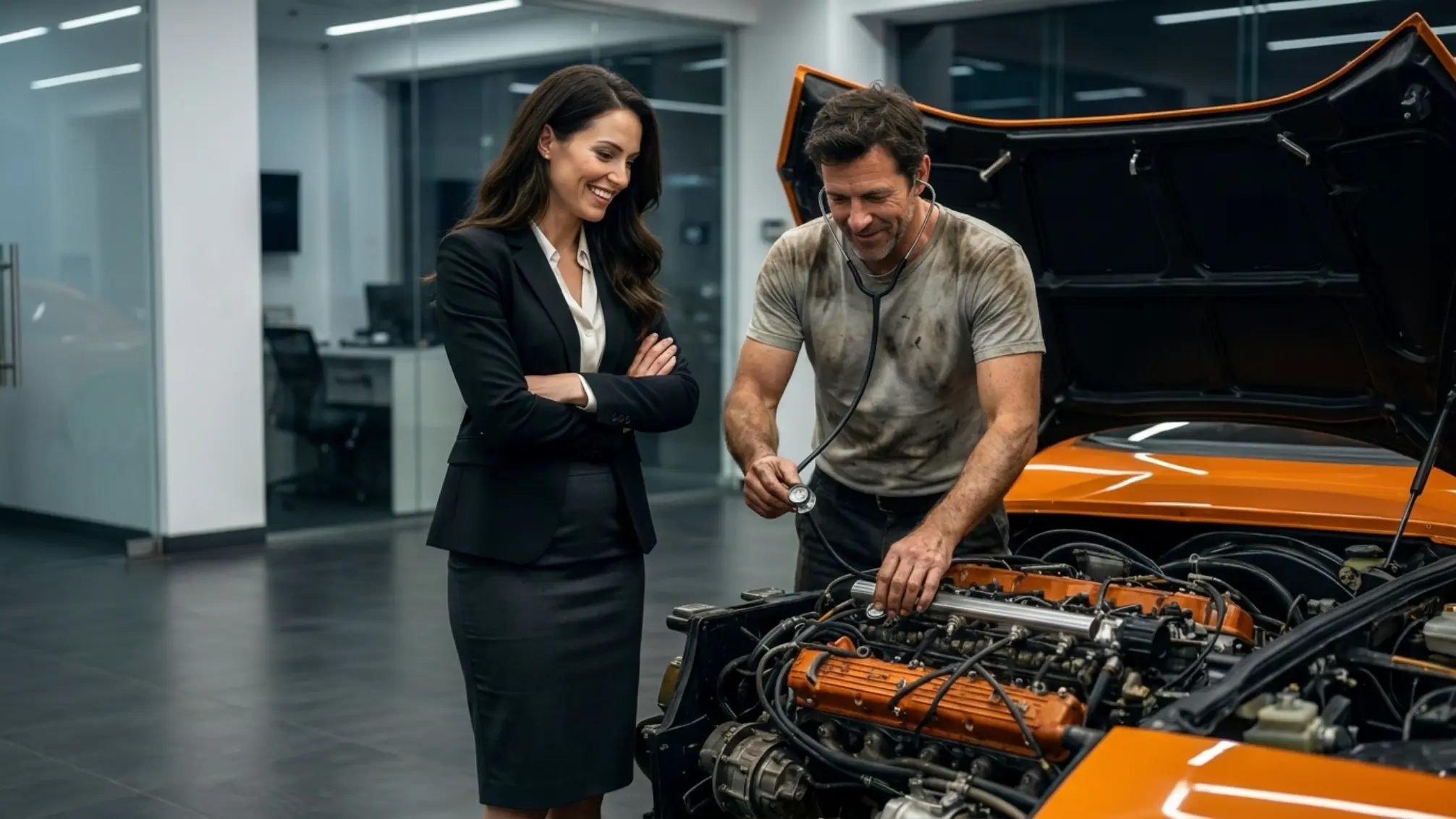
The woman’s blue eyes narrowed. “Touch one more component, and security removes you before you destroy five million dollars.”
The widowed single father moved the probe beneath the fuel rails and listened for several silent seconds. Then he reached toward a layer none of her technicians had noticed. “Keep the doors locked,” he said. “When this engine starts, your experts will explain why they never heard the broken resonance.”
Evelyn Hartwell had spent four days watching some of the most qualified automotive specialists on the East Coast fail. The 1971 Lamborghini Miura S sitting beneath Sterling Motors’ service lights was not merely a rare collector vehicle. It was the centerpiece of an exhibition that had taken her three years to secure, and it belonged to Harold Voss, a private collector whose consignment agreement placed almost five million dollars in automobiles under her control.
If the Miura did not run by Friday evening, Harold would withdraw his collection. He had delivered that warning in a quiet voice over the phone, which frightened Evelyn more than shouting would have. Men like Harold did not make threats twice.
The engine had stopped without warning during a final inspection. There had been no grinding, overheating, smoke, or gradual loss of power. One moment the V12 had been running perfectly, and the next it had become as lifeless as though someone had removed its heart.
Six certified technicians had tested the ignition system, fuel delivery, compression, electrical relays, and every component supported by available factory documentation. Their diagnostic equipment produced contradictory codes. Every attempted repair created more uncertainty.
Jason Caldwell, head of technical services, had finally signed a report declaring the engine unrecoverable. Evelyn had read the sentence three times before placing the document face down on her desk. An irreversible mechanical failure in a vehicle this rare would not merely cost her the exhibition; it could destroy Sterling Motors’ reputation.
She called three independent specialists. One refused to touch an undocumented modified engine. Another estimated eight weeks and half a million dollars before even seeing the car. The third drove two hours, examined the Miura for fifteen minutes, apologized, and left.
By Thursday morning, Evelyn had accepted that the exhibition might collapse.
Then her assistant placed a single page on her desk.
The name at the top was Owen Mercer.
According to the report, Owen had once served as the youngest chief engine architect in the history of Veltec Motorsport, a German engineering firm that advised European supercar manufacturers. He had written the most complete known analysis of Maurizio Rinaldi, the Italian engineer who had modified Harold’s Miura decades earlier.
Owen no longer worked in advanced automotive engineering. He operated a small two-bay repair shop on the east side of town, repairing sedans, delivery vans, and aging pickup trucks. He was also a widowed father raising a six-year-old son alone.
Evelyn recognized him immediately.
Three days earlier, Owen had entered Sterling Motors to collect a fuel-delivery valve he had ordered for a customer. He wore work boots and a plain jacket, while his son carried a scratched red plastic toolbox. The boy had stopped beside a silver Ferrari and stared at it with open wonder.
Jason Caldwell had approached them before the parts clerk finished processing the order.
“This counter isn’t for backyard mechanics,” Jason said loudly. “Try the warehouse on Route 9.”
The showroom had gone quiet.
Owen had shown Jason the confirmation number, but Jason barely glanced at it. Instead, he looked at the child and the red toolbox pressed against his chest.
“Bring your kid here again, and security will escort both of you out,” Jason said. “This isn’t a playground.”
Owen did not argue. He did not mention Veltec Motorsport, engineering credentials, or the research that had once made his name respected among specialists. He waited until the clerk brought the part, signed the receipt, and walked out holding his son’s hand.
Evelyn had witnessed the exchange from her second-floor office.
She could have intervened. Instead, she looked at her phone and continued walking.
Now the man her employee had humiliated was the only person who might save her dealership.
Evelyn drove to Mercer Auto herself that evening. The shop stood inside a converted furniture-repair building where the faint smell of sawdust still survived beneath oil and brake fluid. The sign had been painted by hand, but every tool inside hung in exact order.
Owen was finishing a coolant flush when her heels struck the concrete floor. He rolled out from beneath the pickup, stood, and recognized her without surprise. His expression revealed neither anger nor welcome.
A small boy slept on a cushioned stool in the corner. The red toolbox rested against his chest.
“I have a 1971 Lamborghini Miura with a modified V12,” Evelyn said. “Six technicians and two outside teams have failed. The exhibition is tomorrow.”
Owen wiped his hands with a rag. “Who modified it?”
“Maurizio Rinaldi.”
For the first time, something changed in his eyes.
“I need you,” Evelyn said.
Owen looked toward his sleeping son before returning his attention to her. “You were upstairs on Monday.”
It was not a question.
“Yes.”
“You watched.”
“Yes.”
The admission was more difficult than Evelyn expected. “I told myself I had not heard enough to intervene. That was not true. What happened in my showroom was wrong, and so was my silence.”
Owen studied her for a long moment. He had heard apologies from customers who wanted discounts and managers who feared consequences. Evelyn’s words were different because she did not decorate them or ask him to excuse her.
“What have your technicians done to the engine?” he asked.
She described every test, removed component, and failed theory. Owen interrupted only when he needed exact details. When she finished, he walked toward a shelf and removed a thick notebook bound in brown leather.
“I will examine it,” he said. “I’m not promising I can repair it.”
“That is more than anyone else will offer.”
Owen drove his sleeping son to an elderly neighbor’s home and followed Evelyn to Sterling Motors. They arrived shortly before eleven that night. The dealership’s polished showroom was empty, but the service bay remained brightly illuminated.
The Miura sat alone beneath the lights, its deep orange body shaped like something built for speed even while standing still. Owen placed his tool bag on the bench and walked around the car twice before touching it. Evelyn watched from several feet away.
He opened the engine compartment and remained motionless for almost a minute.
“Are you going to connect the diagnostic computer?” she asked.
“No.”
“Why?”
“Because the computer has already told your technicians three different stories.”
He removed a modified stethoscope from his bag. Its ordinary chest piece had been replaced by a narrow metal probe designed to transmit vibration through solid components. Owen began touching it to carefully selected points across the engine.
Evelyn checked the time. Eleven fifteen.
For twenty minutes, Owen said nothing. He shifted the probe from the cylinder banks to the fuel-delivery assembly and then to mounting points no technician had listed in the previous reports. The only sound in the bay came from distant rain against the glass and the faint ticking of cooling metal.
“Have you found something?” Evelyn finally asked.
“Not yet.”
“Then what are you hearing?”
“What should be there.”
She frowned.
Owen straightened slightly. “Rinaldi did not design engines the way most engineers do. He treated them as acoustic systems. Every major component had a natural frequency, and he calibrated their positions so the engine operated as one harmonic structure.”
“You are saying it was tuned like an instrument?”
“Closer to an orchestra.”
Evelyn looked at the exposed V12. “And if one part falls out of tune?”
“The whole system can collapse.”
“That sounds impossible.”
“It only sounds impossible because nobody writes diagnostic software for resonance patterns created by a dead engineer’s private modifications.”
He returned to the engine. Evelyn watched his hands move with unhurried precision, and for the first time she understood why his silence in the showroom had unsettled Jason. Owen did not need other people to recognize what he knew.
At midnight, he removed the first layer of the fuel-delivery assembly. Each bolt went into a labeled tray. Every position was photographed and recorded in his notebook before he moved deeper.
Evelyn brought him coffee. He accepted it without comment and left it untouched beside the workbench.
“What happened to your career?” she asked.
Owen kept working. “My wife died.”
The answer arrived without invitation or self-pity.
“She was driving home from work,” he continued. “A truck crossed the center line. Our son was three.”
Evelyn looked toward the empty stool where the boy’s toolbox had briefly rested before they left him with the neighbor. “And you left Veltec.”
“I was traveling constantly. Research, testing, conferences. None of that mattered more than being present for him.”
“You were the youngest chief architect in the company’s history.”
“That title could not raise my son.”
His words carried no bitterness, but Evelyn heard the sacrifice beneath them. Owen had not failed or been dismissed. He had abandoned a prestigious future because a frightened child needed one remaining parent who came home every night.
At one in the morning, Owen stopped.
He had reached a thin plate positioned between the primary and secondary fuel rails. It was barely visible beneath the assembly and appeared in none of the factory schematics. He removed it with specialized tweezers and held it beneath the inspection lamp.
“There.”
Evelyn stepped closer. “That piece caused all of this?”
“It was displaced.”
She stared at the plate. “By how much?”
“Three-tenths of a millimeter.”
“That cannot shut down an entire V12.”
“In a standard engine, no. In Rinaldi’s system, yes.”
Owen placed the metal under magnification. A hairline fracture crossed one edge. He explained that one of the dealership technicians had probably shifted the plate while inspecting the fuel rails, then forced it back into position. The change had broken the carefully balanced resonance, while the fracture prevented the component from recovering its original function.
“Can you replace it?” Evelyn asked.
“It was fabricated from a titanium-copper alloy. I need forty grams, a fine-grade grinder, precision calipers, and several hours.”
“It is after one.”
“I noticed.”
Evelyn made three phone calls. The first supplier refused to open its warehouse. The second lacked the correct alloy. The third operated an emergency fabrication service across town and agreed to release the material for a substantial surcharge.
Evelyn sent a driver.
When the alloy arrived, Owen used the original plate as a template. He measured the replacement at eleven separate points, ground the edges, measured again, and discarded his first attempt because one corner exceeded tolerance by less than the width of a human hair.
Evelyn watched the rejected plate fall into the scrap tray. “No one would notice that difference.”
“The engine would.”
At two thirty, he began a second plate. His hands never rushed. Urgency existed around him, but it never entered his movements.
Evelyn had spent years believing speed was evidence of competence. Owen worked differently. He treated patience as a technical requirement rather than a personality trait.
While he shaped the alloy, she studied his notebook. Pages of hand-drawn diagrams filled the leather-bound volume, accompanied by equations, vibration maps, and observations on Rinaldi’s methods. Some notes dated back years.
“You already knew this exact engine might fail this way,” she said.
“I knew Rinaldi’s designs could.”
“Why did nobody publish this?”
Owen continued grinding. “I stopped writing before the research was finished.”
“Because of your wife.”
“Yes.”
Evelyn closed the notebook carefully. “You could return.”
“To what?”
“To advanced engineering.”
He glanced at her. “My son still needs a father.”
“Those things do not have to be enemies.”
“They were before.”
At three fifteen, Owen completed the replacement plate. He installed it between the fuel rails and repositioned the assembly according to measurements derived from the notebook. Every bolt received exact torque.
Evelyn stood beside the driver’s door, no longer pretending she was unimpressed.
At three forty-five, Owen closed his tool case.
“Start it.”
Evelyn climbed into the Lamborghini. Her hand rested on the key, but she hesitated.
“What if it fails?”
“Then we keep looking.”
“And if it starts?”
“Then your technicians learn something.”
She turned the key.
The starter engaged. For one breath, nothing happened.
Then the V12 came alive.
The sound did not resemble the uncertain cough produced during earlier attempts. It exploded through the service bay in a deep, controlled roar before settling into a smooth, resonant idle that seemed to vibrate through the concrete floor.
Evelyn gripped the steering wheel. Four days of pressure released at once, leaving her unable to move.
Owen stood beside the open engine compartment, listening. He made one minor adjustment and nodded.
“That’s it.”
Evelyn shut off the engine and climbed out. “You fixed in five hours what my entire technical division declared impossible.”
“They were solving the problem they understood.”
“And you?”
“I listened for the problem that existed.”
Owen began cleaning his tools.
“How much?” Evelyn asked.
“I’ll send an invoice.”
“I am not asking for your standard repair rate.”
“That is what you will receive.”
“You just saved a five-million-dollar agreement.”
“I repaired an engine.”
“You are either the least ambitious man I have ever met or the most stubborn.”
Owen closed the bag. “Those are not opposites.”
By six in the morning, he had collected his son and returned home. The boy woke at the kitchen table while Owen drank coffee in the early light.
“Where did we go?” the child asked.
“I fixed a car.”
“A good one?”
Owen allowed himself a small smile. “A very good one.”
At Sterling Motors, Evelyn’s assistant arrived with archived articles and industry journals. One headline showed a younger Owen standing beside an experimental powertrain at Veltec Motorsport. Another article cited his unpublished Rinaldi research as the most comprehensive analysis ever written on the engineer.
Evelyn looked at the photographs for a long time.
Then she called Jason Caldwell into her office.
He entered already knowing the Miura had started. News had traveled through the technical staff before sunrise.
“You brought that mechanic back?” he asked.
“I brought an engineer who understood the system you declared unrecoverable.”
Jason’s face tightened. “He got lucky.”
“Luck does not manufacture a titanium-copper component to a tolerance of one-tenth of a millimeter.”
“My team did everything according to the manual.”
“The manual did not cover the modification.”
“Then no one could reasonably expect us to find it.”
“Owen did.”
Jason looked toward the window. “So this is about what happened at the parts counter.”
“It began before that.”
Evelyn placed a collection of complaints on the desk. Customers had reported being ignored because of their clothing, vehicle age, or perceived income. Junior technicians had complained that Jason dismissed ideas until senior employees repeated them.
“You believed expertise always arrives wearing a suit and carrying credentials you recognize,” Evelyn said. “That belief nearly cost this company five million dollars.”
Jason’s confidence weakened. “What are you doing?”
“You are being reassigned to a standard technician position. You will work under supervision until you demonstrate that your judgment is based on evidence rather than appearance.”
“You cannot humiliate me because that man embarrassed you.”
Evelyn’s expression hardened. “Owen Mercer did not embarrass me. My silence on Monday did.”
The exhibition opened Friday evening as scheduled. Guests moved between classic vehicles while a string quartet played near the showroom entrance. At the center of the room, the orange Miura sat on a raised platform with its engine idling perfectly.
Harold Voss arrived shortly after seven. He placed one hand against the bodywork and felt the steady vibration.
“You repaired it,” he said.
“Owen Mercer repaired it.”
Harold turned sharply. “The Rinaldi researcher?”
“You know his work?”
“I read part of his thesis years ago. I assumed the author had spent his entire career studying those engines.”
“He runs a neighborhood repair shop.”
Harold considered that information. “Perhaps the shop is where he needed to be.”
The collector found a business card and wrote a message on the back. He asked Evelyn to deliver it with no explanation.
Two days later, Owen received the card at Mercer Auto.
When you are ready to discuss what you still want to build, call me.
He placed it beside the brown notebook.
Evelyn visited the shop that afternoon. This time she wore no formal jacket, and she waited at the open bay until Owen acknowledged her. His son sat on the stool, arranging toy tools in a precise row.
“You transferred three times the invoice amount,” Owen said.
“The invoice did not reflect the value of the work.”
“I do not accept charity.”
“It was not charity. It was the price of expertise my company failed to recognize.”
He studied her, then returned to the sedan he was repairing. “That is an expensive lesson.”
“Not expensive enough.”
Evelyn approached the workbench and placed a folder beside the notebook. Inside was an offer for a flexible consulting arrangement with Sterling Motors. Owen would review rare-engine cases, train technicians, and continue operating his own shop.
He closed the folder without reading beyond the first page.
“My son comes first.”
“The schedule says the same thing.”
“I am not interested in becoming part of your company.”
“I am not asking you to become an employee. I am asking you to teach us what arrogance almost prevented us from learning.”
Owen looked toward the boy. The child was pretending to diagnose a metal bracket, placing the toy screwdriver against it with complete concentration.
“What changed?” Owen asked.
“You repaired the engine.”
“That changed your opinion of my skill. I asked what changed in you.”
Evelyn did not answer immediately.
“I watched Jason humiliate you,” she said. “I told myself it was not my responsibility because I had not personally spoken the words. Then I needed something from you, and suddenly your dignity became important to me.”
“At least you understand the order in which it happened.”
“I understand that recognition arrived too late.”
Owen opened the folder again. “One day per week. No evening calls unless a contract is at immediate risk. My shop remains independent.”
“Agreed.”
“My son can come with me when school is closed.”
Evelyn looked toward the red toolbox. “He will be treated as an honored guest.”
“No,” Owen said. “Treat him like a child who belongs there. That matters more.”
Three months later, Owen stood inside Sterling Motors’ technical bay while six technicians gathered around a dismantled engine. Jason stood among them in ordinary work clothes, no longer separated by title or office.
Owen placed a hand on the engine block.
“Machines tell you what is wrong,” he said. “The problem is that most people listen only for the answers they already understand.”
He taught them to identify harmonic imbalances, undocumented modifications, and small physical changes capable of disabling complex systems. He never mentioned the humiliation at the parts counter. He did not need to.
His son sat near the workbench with the red toolbox open.
Evelyn watched from the glass office above, but this time she did not turn away. She came downstairs, entered the service bay, and listened with everyone else.
Sterling Motors soon established a specialist division for rare and undocumented engines. Owen refused the director position but accepted credit for the technical program. His consulting income allowed him to reduce routine repair hours, spend more afternoons with his son, and finally complete the Rinaldi thesis he had abandoned after his wife’s death.
The work was published under his name the following year.
On the dedication page, he wrote two lines.
For Mara, who believed broken things could still carry beauty.
For Isaac, who taught me that starting again is also a form of repair.
The orange Miura returned to the dealership for the anniversary exhibition. This time, a small plaque beside it identified the engineer who had restored its engine. Guests asked Owen to pose for photographs, but he declined and remained near the service entrance with his son.
Evelyn found them there.
“You could stand beside the car,” she said.
“The car does not need me standing next to it.”
“Some people deserve to know who saved it.”
Owen watched his son tracing the Miura’s shape in a notebook. “The people who matter already know.”
Evelyn followed his gaze.
The boy looked up. “Dad says engines stop when people force the wrong answer.”
Evelyn smiled faintly. “Your father has said something similar about people.”
Owen raised an eyebrow.
“He did not need to,” she added. “I learned it anyway.”
The V12 started across the showroom, filling the building with the deep, even note Owen had restored. Conversations paused as guests turned toward the sound.
Evelyn heard an expensive collector car returning to life.
The technicians heard a system they now understood.
The boy heard proof that his father could repair anything worth saving.
Owen heard the careful harmony of hundreds of components operating as one.
And beneath it all, Evelyn heard the lesson her company had almost learned too late: real expertise does not always arrive with a title, polished shoes, or permission to enter the room.
Sometimes it arrives after midnight in a faded gray shirt.
Sometimes it carries grief quietly and leaves before anyone can applaud.
And sometimes the man everyone dismissed is the only person capable of hearing what the experts missed.