“Wow, look at that. You really thought I couldn’t find it.”
Deputy Grant Harlon stood beside the open driver’s door of Leila Bennett’s aging black sedan, holding a small evidence bag beneath the flashing red-and-blue lights. His smile arrived too quickly, before he had inspected what he claimed to have discovered, and that smile told Leila more than his words ever could. She stood several feet away with both hands resting against the side of her car, her beige blouse wrinkled from being ordered out so quickly, her dark jeans catching reflections from the patrol cruiser behind her. Leila turned her head just enough to look directly at him.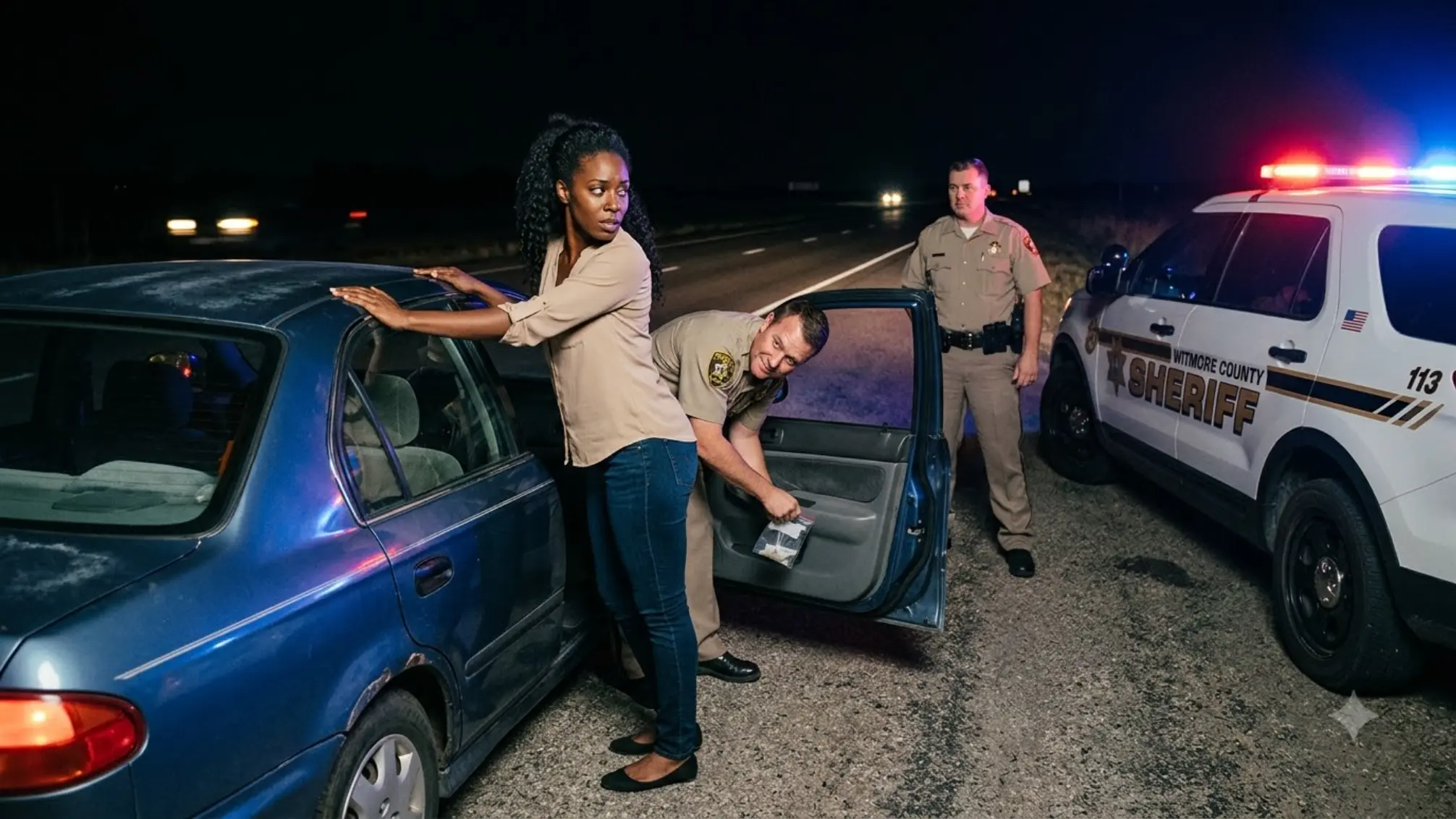
“Funny,” she said. “I watched your hand put it there.”
Harlon’s expression changed.
Only slightly.
He stepped toward her and lowered his voice. “Keep accusing me and this night gets a lot worse for you.”
Leila held his stare.
“Perfect. Keep talking. Your whole setup is being recorded.”
For the first time, Deputy Paige Sutton looked up.
She had been standing near the rear bumper with her arms folded, wearing the same tan Witmore County Sheriff’s Department uniform as Harlon. Sutton was thirty-seven, exhausted around the eyes, and had barely spoken since arriving. Yet when Leila mentioned recording, Sutton’s gaze moved from Harlon to the sedan and then toward the road.
Harlon laughed.
“You people always say that.”
Leila said nothing.
He interpreted silence as defeat.
That was exactly what she wanted.
Two months earlier, Leila Bennett had entered Witmore County under a name that was entirely real but a purpose that almost nobody knew. On paper, she was a thirty-four-year-old independent insurance compliance consultant from Houston who had recently rented a small furnished house outside Mill Creek. She drove an inexpensive sedan with Oklahoma plates, dressed plainly, bought coffee at the same convenience store most mornings, and asked very few questions.
In reality, Leila worked for a special investigative unit reviewing misconduct allegations involving local law enforcement agencies receiving state funding.
The assignment had started with a spreadsheet.
Twenty-three complaints.
Twenty-three different drivers.
Twenty-three allegations involving traffic stops by the Witmore County Sheriff’s Department over a period of four years.
The complaints varied in detail, but the pattern was striking. Drivers reported being stopped for minor or unexplained reasons. Deputies claimed to smell something suspicious. Vehicles were searched. Contraband appeared. Arrests followed.
Then the complaints disappeared.
Some were marked “unsubstantiated.”
Others had no final disposition.
Three were closed because the complainants accepted plea agreements.
Five complainants later moved away.
One man lost his commercial driving job.
A woman named Carla Jennings spent four months fighting a possession charge before the evidence was suddenly declared unusable because of a documentation problem.
The same deputy’s name appeared repeatedly.
Grant Harlon.
Leila’s supervisor initially wanted a records audit.
Leila wanted more.
“We already have records,” she said during a conference call. “The problem is the records were created by the people we’re reviewing.”
Her supervisor, Daniel Price, remained cautious.
“You’re suggesting field observation?”
“I’m suggesting we determine whether the pattern still exists.”
“That county is already defensive.”
“Then they shouldn’t know we’re there.”
The plan that followed was approved reluctantly.
Leila would spend several weeks in Witmore County establishing a normal routine. She would not provoke officers, violate traffic laws, or create circumstances that did not occur naturally. Her vehicle would contain legal surveillance equipment installed under proper investigative authority, documenting the cabin, doors, and immediate interior.
If nothing happened, nothing happened.
For seventeen days, nothing did.
Leila drove the same roads.
She went grocery shopping.
She visited a diner near the courthouse.
She attended a county planning meeting because one complainant said Sheriff Harlon often watched newcomers who publicly questioned county decisions.
She noticed a tan patrol SUV behind her three times that week.
The fourth time, she recognized Harlon.
He did not stop her.
Not yet.
Leila began reading the old complaint files every night.
The people behind the reports became more than case numbers.
There was Marcus Dean, a fifty-three-year-old appliance repairman who claimed Harlon searched his van after telling him he had crossed the center line. Marcus insisted he had not.
There was twenty-nine-year-old Denise Walker, who said Harlon repeatedly asked whether she could afford the SUV she was driving.
There was Anthony Price, whose complaint included one sentence that bothered Leila more than the others.
Deputy smiled before finding it.
That was exactly what Harlon had done tonight.
The stop began at 11:18 p.m.
Leila had driven back from Mill Creek after buying groceries.
The road was straight.
Weather was clear.
She maintained the speed limit.
Then lights appeared behind her.
She pulled onto the shoulder immediately.
Harlon approached slowly with one hand resting near his belt.
“License and registration.”
Leila handed them over.
He studied the Oklahoma plate.
“You live here?”
“Recently moved.”
“For what?”
“Work.”
“What kind?”
“Consulting.”
Harlon looked through the passenger window.
“Car yours?”
“Yes.”
“You sure?”
Leila turned toward him.
“It’s registered to me.”
He held her license another few seconds.
Then came the sentence she had read in four previous complaints.
“I smell weed.”
Leila looked directly at him.
“No, you don’t.”
Harlon paused.
That answer was not part of the routine.
“Excuse me?”
“There’s nothing in this car.”
“I didn’t ask what was in it.”
“You said you smelled something.”
His eyes hardened.
“Step out.”
Leila complied.
Minutes later Sutton arrived.
Leila recognized her name immediately.
Paige Sutton appeared in seven complaint files but was never listed as the primary officer.
Always secondary.