Snow was falling heavily across a lonely highway in Montana.
It came down in thick white sheets, covering the road, the pine trees, the old fence lines, and the faded yellow stripes that usually guided drivers through the dark.
Headlights appeared and disappeared in the storm like frightened fireflies. The wind pushed against everything it touched, rattling windows, bending signs, and making even large trucks move slower than usual.
Beside that empty highway stood a small roadside diner called Maggie’s Grill.
Its neon sign flickered red and blue through the snow.
Inside, the diner was warm, bright, and crowded with the kind of people who had not planned to stop but knew better than to keep driving. Truckers sat over coffee.
A young couple shared fries near the window. An old man in a wool cap read the same newspaper page for nearly twenty minutes. The air smelled of hot grease, coffee, pie crust, wet coats, and the steady comfort of a place that stayed open when the road became uncertain.
At the corner table near the back sat a teenage girl in a wheelchair.
Her name was Lily Carter.
She was sixteen years old, quiet, shy, and trying desperately to hide the tears gathering in her eyes.
In front of her sat a half-finished strawberry milkshake, a basket of fries, and an old sketchbook with a cracked black cover. Her hands rested lightly on the wheels of her chair, fingers tense, ready to move if she needed to leave quickly.
But leaving was not simple for Lily.
It never was.
The aisle between tables was narrow. The snow outside was deep. The ramp near the diner entrance was slick with ice. And her mother, Nora Carter, was still working a double shift at the gas station two miles down the highway. Lily had agreed to wait at the diner until Nora could pick her up after closing.
She had done this many times before.
Usually, she liked it.
Maggie, the owner, let her sit in the corner booth as long as she ordered something small. Sometimes Lily drew for hours while the storm moved outside and the diner hummed around her. It was one of the few public places where she almost felt invisible in a peaceful way.
But that night, invisibility failed her.
At the table across from her sat three college boys.
They had come in twenty minutes earlier, loud, restless, and full of the careless confidence of young men who had never been made to feel small by strangers. They wore university hoodies under expensive winter jackets and kept glancing around the diner as if it was beneath them but still useful for food.
At first, Lily tried not to notice them.
She lowered her head and continued drawing.
Her pencil moved carefully over the page, shaping the front wheel of a motorcycle. Then the handlebars. Then the curve of the gas tank. Then the chrome details she had memorized from photographs, old memories, and her father’s stories.
Lily loved motorcycles.
Not because they were loud.
Not because they looked dangerous.
Because they reminded her of her father.
Daniel Carter had once been a biker.
Not the reckless kind people whispered about.
The loyal kind.
The kind who stopped for stranded drivers, raised money for sick children, fixed old engines for neighbors, and carried extra gloves in his saddlebag because someone always forgot theirs. He wore leather, yes, and rode with a club, but Lily remembered him most for the way he smelled like cold air, coffee, and engine oil when he came home and lifted her into his arms.
When Lily was little, he would sit beside her bed and draw motorcycles for her.
“This one is for long roads,” he would say.
“This one is for mountain turns.”
“This one is for a girl who will go wherever she wants one day.”
Then he would hand her the pencil and let her add stars, flames, flowers, or whatever else made the machine hers.
Three years earlier, Daniel Carter had not come home.
The official words were softer than the loss itself.
A late-night road emergency.
A bad stretch of highway.
A final act of helping someone else.
Lily did not like hearing the details. She only knew that her father had stopped to help people in trouble and never returned to his family afterward.
After that, the world became harder.
Money became tighter.
Her mother worked longer hours.
The house grew quieter.
And Lily’s wheelchair, once simply part of her life, became something other people stared at more openly when her father was not there to stand nearby with calm eyes and broad shoulders.
Some people were kind.
Some were awkward.
Some acted like Lily was fragile glass.
And some were cruel because cruelty made them feel powerful.
The boys at the table across from her belonged to the last group.
One of them pointed at her wheelchair.
“Look,” he said loudly. “Fast and Furious, parking lot edition.”
The other two burst into laughter.
Lily lowered her head.
She had heard jokes before.
Rolling jokes.
Chair jokes.
Slow jokes.
Pity jokes.
She had learned that reacting often fed the laughter. So she focused on the sketchbook and tried to keep her face still.
But the boys were bored.
And bored cruelty always searches for a second target.
“Hey,” one of them said. “What’s she drawing?”
Lily’s fingers tightened around her pencil.
“Don’t,” she whispered, though no one had touched anything yet.
The tallest boy stood from the table.
He had dark hair, a red university sweatshirt, and a smile too sharp to be friendly. He walked toward her with exaggerated casualness, like he was performing for the other two.
“What do we have here?” he said.
Lily pulled the sketchbook closer.
“Please leave me alone.”
The boy laughed.
“Relax. I just want to see.”
Before she could stop him, he grabbed the sketchbook from the table.
Lily’s heart jumped.
“No, please. Give it back.”
The other boys stood too, laughing as the first one flipped through the pages.
He held the book up.
“Look at these.”
One of his friends snatched it and turned pages quickly.
“Wow. Little biker girl.”
“She going to ride one of these down the sidewalk?”
The third boy leaned over the table and made engine noises under his breath.
Lily’s face burned.
“Please,” she said again, quieter now. “That was my dad’s.”
The tallest boy paused.
Then smirked.
“Your dad drew these?”
“Some of them,” Lily said. “Some are mine.”
He looked at one page, then held it at arm’s length.
“Honestly, they’re not bad.”
For one tiny second, Lily thought maybe the cruelty would end there.
Then he added, “For someone who probably can’t even reach the pedals.”
The table erupted again.
Lily’s hands began to tremble.
The waitress behind the counter looked over, uncertain. A trucker near the window frowned but did not move. The old man with the newspaper lowered the page slightly. Several people saw what was happening.
Nobody stepped forward.
That was something Lily already knew about cruelty.
It did not need everyone to join.
It only needed enough people to look away.
“Give it back,” Lily said.
The boy tossed the sketchbook onto her table, but not gently. It slid across the surface, hit the milkshake glass, and knocked it sideways. Pink liquid spilled across the table, down the edge, and onto Lily’s coat and lap.
She gasped.
The cold sweetness soaked into her clothes.
One of the boys laughed louder.
“Oh no. Speed racer crashed.”
Lily reached for napkins, but the tallest boy stepped too close.
“Careful,” he said. “Don’t roll away too fast.”
Then he put both hands on the back of her wheelchair and shoved.
Not far.
Just hard enough.
The chair jolted forward and struck the table leg. The milkshake glass tipped completely, spilling the rest over the floor. Lily’s sketchbook fell open and landed partly in the puddle.
The entire diner went silent.
Lily froze.
Her breath caught in her throat.
Tears spilled before she could stop them.
She hated crying in public.
She hated giving them that.
But the sketchbook was on the floor, wet at the edges, and her father’s old drawings were inside it.
The boys laughed again, but the sound was less certain now because even they could feel the room turning.
“Crybaby,” one muttered.
Lily reached down awkwardly, trying to get the sketchbook, but the angle was wrong. Her chair was too close to the table. Her hands were shaking too badly.
The waitress took one step forward.
Then stopped.
The trucker shifted in his seat.
Nobody moved fast enough.
Then the sound came.
At first, it was distant.
A low rumble beneath the wind.
Then another.
Then many.
The roar of motorcycles rolled across the snowy highway like thunder coming over the mountains.
One engine.
Two.
Then dozens.
The sound grew louder until the diner windows began to tremble in their frames. Everyone inside turned toward the glass.
Headlights appeared through the storm, one after another, cutting through the snow in a long, disciplined line.
Black motorcycles pulled into the parking lot.
Heavy tires rolled carefully over slush and ice.
Leather jackets shone with melted snow.
Boots hit the ground.
Men and women climbed off their bikes with the calm precision of people who had ridden through worse and survived it.
Their patches showed a black eagle with silver wings wrapped around a mountain road.
IRON EAGLES MC
The diner seemed to shrink.
The college boys stopped laughing.
The old man lowered his newspaper completely.
The waitress stood frozen near the counter with napkins in her hand.
Outside, nearly twenty bikers moved toward the entrance.
The diner door opened slowly.
A tall biker stepped inside first.
He had a thick gray beard, cold blue eyes, and a large scar along one side of his neck. Snow clung to the shoulders of his black leather vest. His boots left wet prints on the floor. A silver ring shaped like an eagle’s head flashed on his right hand as he removed his gloves one finger at a time.
The patch on his vest read:
GRANT “WOLF” MERCER
PRESIDENT
The entire diner became silent.
Wolf’s eyes moved slowly across the room.
He saw the college boys.
He saw the spilled milkshake.
He saw the sketchbook lying open on the floor.
Then he saw Lily.
Her wet coat.
Her trembling hands.
Her lowered head.
Her tears.
His expression darkened instantly.
Behind him, more bikers stepped inside. A woman with short silver hair and a long braid. A huge man with a red beard. A thin man wearing glasses. A younger rider with snow melting from his shoulders.
No one spoke.
Wolf walked toward Lily’s table.
The college boys tried to straighten, tried to become casual again, but their faces betrayed them.
Wolf crouched slowly beside the sketchbook. He picked it up with surprising care, shaking off the edge where the milkshake had touched it.
Then he looked at the boys.
His voice was quiet.
“Who touched the girl?”
No one answered.
The tallest boy forced a laugh.
“Relax, old man. It was just a joke.”
Wolf stood.
He was not loud.
He did not need to be.
“Jokes are supposed to be funny.”
The boy swallowed.
“It wasn’t a big deal.”
Wolf looked at Lily’s soaked clothes, then at the spilled milkshake, then at the wheelchair pressed awkwardly against the table.
“That is not your decision.”
The red-bearded biker stepped forward.
The woman with the silver braid lifted one hand slightly, and he stopped. There was control in that group. Discipline. They did not move like men looking for an excuse. They moved like people who had rules.
Wolf took one step closer to the college boys.
“Son,” he said, “being disabled does not mean being weak.”
The boy’s face drained of color.
Wolf continued.
“And being able to stand does not make you strong.”
The diner held its breath.
Then Wolf turned away from him and knelt beside Lily’s wheelchair.
The movement surprised everyone.
This dangerous-looking man, broad and scarred and snow-covered, lowered himself carefully so he was not towering over her.
He held out the sketchbook.
“I believe this belongs to you.”
Lily wiped her face quickly.
“Thank you,” she whispered.
“I’m sorry it got wet.”
Her fingers touched the corner of the book.
“It was my fault.”
Wolf’s eyes sharpened.
“No.”
The word was firm enough to stop her.
“It was not.”
Lily looked down.
The female biker with the silver braid came closer.
“My name is Ruth,” she said gently. “Can I help clean your coat, honey?”
Lily nodded, embarrassed.
Ruth took napkins from the waitress, then removed her own warm jacket and draped it carefully around Lily’s shoulders.
The warmth made Lily’s eyes fill again.
Wolf opened the sketchbook to check the damage.
Then he froze.
His eyes narrowed.
He turned one page.
Then another.
His face changed.
The anger did not vanish, but something else joined it.
Shock.
Recognition.
He stared at a page showing a motorcycle drawn in sharp detail. Not just any motorcycle. A custom black Harley with eagle wings painted along the tank and three small stars near the rear fender. Beneath it, in careful lettering, was a patch design.
IRON EAGLES
FOREVER ROAD
Wolf’s fingers trembled.
Ruth saw his face and stepped closer.
“What is it?”
Wolf did not answer immediately.
He turned another page.
There was an older drawing, different from Lily’s newer work. The lines were heavier. More confident. In the corner was a signature.
D. Carter
Wolf looked at Lily.
“Where did you get these drawings?”
Lily’s voice was small.
“My dad used to draw them for me.”
Wolf’s face went pale beneath his beard.
“What was your father’s name?”
“Daniel Carter.”
The name landed like a bell struck in an empty church.
Outside, several bikers who had not entered the diner seemed to go still, as if the silence had passed through the glass.
Ruth covered her mouth.
The red-bearded biker whispered, “No way.”
Wolf stepped back once.
Then again.
His eyes filled with tears.
Lily stared at him, confused.
“You knew my dad?”
Wolf swallowed hard.
“Yes.”
His voice had changed completely.
The cold command was gone.
In its place was grief.
And love.
“Daniel Carter was my brother,” he said.
Lily’s breath caught.
“My dad had no brothers.”
Wolf placed one hand over the Iron Eagles patch on his vest.
“Not by blood.”
The diner remained silent.
Even the college boys stopped moving.
Wolf looked at the sketchbook again, then back at Lily.
“Your father rode with us for twelve years. He was the man who stopped first when someone needed help. He carried extra tools, extra gloves, extra food, extra hope. He used to say a rider’s strength wasn’t in the engine. It was in whether he turned around for somebody stranded behind him.”
Lily’s lips parted.
Her mother had told her stories, but not all of them. Nora Carter could barely speak Daniel’s name without breaking, so she had given Lily fragments. A road trip here. A charity ride there. A leather vest folded in a closet. A patch Lily was not allowed to touch because it made her mother cry.
Wolf knelt again.
This time, his knee touched the wet diner floor and he did not seem to care.
“Your father saved my life on a mountain road outside Butte,” he said. “A fuel truck had jackknifed in the snow. I was trapped under my bike near the guardrail. Everyone else thought the fire would spread. Daniel ran toward it anyway. Pulled me clear before the whole road lit up behind us.”
His voice broke.
“I had a wife then. Two daughters. Four grandchildren now. I have lived thirteen more years because your father did not leave me behind.”
Lily’s tears changed shape.
They were no longer only humiliation.
They were grief opening into pride.
“My dad did that?”
Wolf nodded.
“He did more than that.”
He reached into the inside pocket of his vest and pulled out a small worn photograph. He unfolded it carefully and showed it to her.
In the picture, a younger Daniel Carter stood beside a line of motorcycles, grinning with one arm around Wolf’s shoulders. His vest was covered in patches. His hair was windblown. His eyes were bright in the way Lily only remembered from old home videos.
Lily touched the edge of the photo with trembling fingers.
“That’s him,” she whispered.
Wolf’s face softened.
“Yes.”
Then, in front of the entire diner, the dangerous-looking biker bowed his head slightly beside Lily’s wheelchair.
“Your father was one of the greatest men I ever knew.”
No one spoke.
The college boys looked truly frightened now, but Wolf was not finished.
He rose slowly and turned toward them.
“You mocked a girl,” he said, voice becoming cold again, “without knowing her strength. You put your hands on her chair without permission. You damaged something that carried her father’s memory. And then you laughed.”
The tallest boy began stammering.
“Look, we’re sorry. We didn’t know—”
Wolf cut him off.
“You did not need to know who her father was to treat her like a human being.”
That sentence hit harder than any threat.
The boy looked down.
The other two mumbled apologies.
Lily did not look at them.
Wolf pointed toward the counter.
“You will pay for the milkshake. You will pay for the food at her table. You will pay for a new sketchbook, waterproof case, and any cleaning needed for her coat.”
The red-bearded biker, whose name patch read Bear, stepped closer and smiled without warmth.
“And you will write your names and phone numbers for the diner owner, in case anything else was damaged.”
One boy tried to protest.
Ruth turned toward him.
“Choose your next words carefully.”
He closed his mouth.
They paid.
They wrote down their information.
Then Wolf looked at the waitress.
“Do you have a mop?”
The waitress blinked.
“Yes.”
“Bring it.”
She did.
Everyone expected one of the staff to clean the spill.
Instead, Wolf handed the mop to the tallest college boy.
“You made the mess.”
The boy stared.
Wolf said nothing.
The boy took the mop.
His face burned red as he cleaned the floor in front of the entire diner.
His friends stood beside him, humiliated and silent.
No one laughed now.
That was the difference.
Cruel people enjoyed public shame when it belonged to someone vulnerable.
They hated it when accountability turned the light back on them.
While the boys cleaned, the Iron Eagles gathered around Lily.
Not crowding her.
Protecting her.
Ruth helped wipe the milkshake from Lily’s coat. Bear ordered fresh fries, hot chocolate, and a slice of apple pie. The thin biker with glasses, named Preacher, asked the waitress for a dry towel and carefully patted the wet edge of the sketchbook pages.
Another biker pulled a clean hoodie from his saddlebag.
“It’s new,” he told Lily awkwardly. “Never worn. Still has the tag.”
Lily almost smiled.
“Thank you.”
He looked embarrassed by gratitude.
“Sure.”
Wolf sat across from her, the old photograph still on the table between them.
“You draw like your father,” he said.
Lily looked down at the sketchbook.
“I’m not as good.”
“He said the same thing about himself.”
That surprised her.
“He did?”
“All the time. Then he would draw a bike from memory with one pencil and make the rest of us feel useless.”
For the first time that night, Lily laughed.
It was small.
Shaky.
But real.
Ruth smiled.
“There she is.”
Lily looked around at the bikers.
“Why didn’t I know about all of you?”
Wolf’s expression turned sad.
“After Daniel passed, your mother was hurting. We came to the funeral, but she could barely stand. After that, I wrote twice. She answered once. Said every motorcycle sound made you cry and made her feel like the ground was falling away again. I thought giving space was kindness.”
Lily nodded slowly.
“I used to cry when I heard bikes.”
“And now?”
She looked at the drawings.
“Now I draw them.”
Wolf’s eyes softened.
“Then maybe the road found its way back to you.”
The diner door opened suddenly.
Cold air swept in.
Nora Carter stepped inside wearing a gas station uniform under her winter coat, hair pulled back, face pale with exhaustion. Snow clung to her boots. Her eyes searched the diner quickly.
“Lily?”
Then she saw the scene.
Nearly twenty bikers surrounding her daughter.
Her daughter wrapped in a biker’s jacket.
A spilled milkshake on the floor.
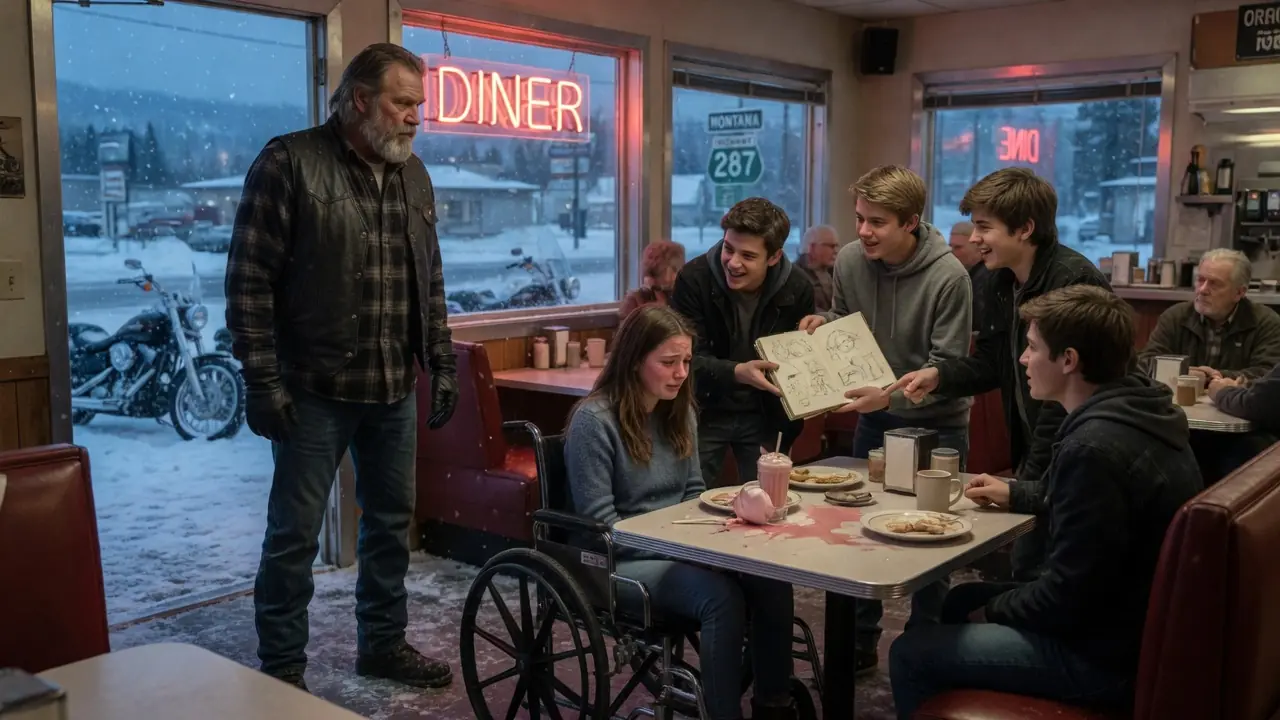
Three college boys standing silently near the counter.
For one terrible second, Nora’s face filled with fear.
She rushed forward.
“What happened?”
Lily turned.
“Mom, I’m okay.”
Nora did not look convinced.
Wolf stood slowly and kept his hands visible.
“Mrs. Carter.”
Nora stared at him.
She knew that vest.
She knew that patch.
Her eyes moved to his face.
“Grant?”
Wolf’s expression softened.
“Yes, ma’am.”
Nora’s mouth trembled.
“Oh my God.”
He stepped forward carefully.
“We did not mean to frighten you. Some boys were bothering Lily. We handled it without violence.”
Nora looked at Lily.
“Baby?”
Lily reached for her mother’s hand.
“They knew Dad.”
Nora’s face broke.
The exhaustion, fear, grief, and shock all seemed to hit at once.
Wolf lowered his voice.
“Your husband saved our lives, Nora. More than once. We should have been closer. I am sorry we weren’t.”
Nora covered her mouth.
For years, she had carried everything alone.
Medical bills.
Work shifts.
School meetings.
Lily’s grief.
Her own grief.
The broken van lift.
The rent.
The silence left by a man everyone said was a hero but nobody seemed to help remember.
Now the men and women who had once ridden beside Daniel Carter stood in a snowy diner, looking at his daughter like she mattered beyond sympathy.
Nora began to cry.
Ruth stepped forward and hugged her gently.
“We’re here now,” she said.
Before leaving that night, Wolf removed a small leather patch from inside his vest.
It was not his club patch.
Not exactly.
It was smaller, worn at the edges, and carefully preserved.
Daniel Carter’s old support patch.
Across it were the words:
FOREVER FAMILY
Wolf held it out to Lily.
“This belonged to your father. Your mother gave us his vest after the service and asked us to keep it safe because she couldn’t bear to look at it. I kept this piece separate. I think it was waiting for the right person.”
Lily took the patch with both hands.
Her lips trembled.
“Can I keep it?”
Wolf smiled through tears.
“It was always yours.”
That night, the Iron Eagles stayed until Nora and Lily were ready to leave.
They cleared the ramp outside the diner.
Bear salted the ice.
Preacher carried Lily’s sketchbook in a dry plastic sleeve from his saddlebag.
Ruth helped Nora get Lily safely into their old van.
Before the van pulled away, Wolf leaned near Lily’s window.
“Sunday,” he said.
Lily blinked.
“What?”
“We eat at this diner every Sunday when weather allows. If you want, there will be a seat for you.”
Lily looked at her mother.
Nora wiped her face and nodded.
Lily looked back at Wolf.
“I’d like that.”
Wolf tapped the side of the van gently.
“Then we’ll see you Sunday, little Carter.”
The story spread by morning.
Not because Wolf wanted attention.
Because the diner had customers, and customers had phones.
Someone had recorded the college boys cleaning the milkshake while a line of bikers stood around Lily. Someone else had filmed Wolf kneeling beside her wheelchair with Daniel Carter’s photo in his hand. The clip went online with a simple caption:
They bullied a disabled girl in a diner. Then bikers found out she was family.
By the next night, the video had thousands of views.
By the end of the week, it had spread across the country.
Messages poured in.
Some from disabled teenagers who said they knew exactly how Lily felt.
Some from bikers who remembered Daniel.
Some from artists praising Lily’s motorcycle drawings.
Some from strangers asking how they could help.
Nora did not know what to do with the attention.
Wolf did.
He created a fund, but not one based on pity.
He called it the Daniel Carter Road Forward Fund.
Its purpose was simple: support Lily’s medical needs, adaptive equipment, accessible transportation, and art education.
Within weeks, enough money came in to repair the lift on Nora’s van.
Then to replace the van entirely.
Then to build a proper ramp at their home.
Then to pay for art classes, therapy, and a specialized drawing table Lily could use comfortably from her wheelchair.
Lily’s drawings became famous online.
Not overnight famous in a shallow way.
Real famous.
People shared them because they carried feeling. Her motorcycles were not just machines. They looked alive, like they were carrying memory, grief, speed, freedom, and love all at once.
One drawing showed a black motorcycle riding through snow with a small wheelchair symbol hidden inside the wheel spokes.
Another showed a biker vest hanging beside a girl’s sketchbook.
Another showed a road stretching between mountains under the words:
FREEDOM DOES NOT STAND ON TWO FEET.
SOMETIMES IT ROLLS.
That one became a print.
The Iron Eagles helped her sell it.
Orders came from every state.
Bikers bought them.
Families bought them.
Disability advocates bought them.
Teachers bought them for classrooms.
Nora cried the day Lily received her first real payment.
Lily stared at the check like it was impossible.
“I made this?”
Nora hugged her.
“You did.”
Wolf and Ruth came over that Sunday with a frame for the first print.
Bear brought pie.
Preacher brought a waterproof portfolio.
The club did not simply appear once and vanish.
They stayed.
Every Sunday, weather permitting, the Iron Eagles returned to Maggie’s Grill and ate with Lily.
Sometimes five came.
Sometimes twenty.
They made sure the ramp was cleared.
They made sure the college boys never bothered her again.
They did not threaten anyone.
They did not need to.
Their presence changed the way people treated Lily.
But more importantly, their respect changed the way Lily saw herself.
She stopped hiding in the corner.
She began sitting closer to the window.
She spoke more.
She laughed louder.
She asked Wolf questions about her father, and he answered every one he could.
“What was Dad’s bike like?”
“Black Road King. Loud enough to wake sinners.”
“Did he ride fast?”
“Not when he had something to protect.”
“Did he ever talk about me?”
Wolf’s eyes softened.
“All the time. He said you could see details grown men missed.”
Lily kept drawing.
Months passed.
Then a year.
The viral attention faded, as all attention does, but the real changes remained.
Lily entered an adaptive arts program in Bozeman.
The Iron Eagles rode her there on the first day, with Nora driving behind in the accessible van. Lily wore Daniel’s Forever Family patch sewn onto a denim jacket Ruth had modified for her.
At the school entrance, Lily hesitated.
Wolf crouched beside her chair.
“Nervous?”
“Yes.”
“Good.”
“How is that good?”
“Means it matters.”
She looked at the building.
“What if I’m not good enough?”
Wolf smiled faintly.
“Then you practice until you are. Same as riding.”
Lily touched the sketchbook in her lap.
“My dad would have liked this?”
“Your dad would be crying so hard we’d all have to pretend not to notice.”
That made Lily laugh.
She rolled through the doors.
Three years later, Lily Carter’s work was featured in a regional art exhibition called Wheels of the Open Road.
She was nineteen then.
Still shy in some ways.
Still soft-spoken.
But no longer trying to disappear.
Her wheelchair was matte black now, with small silver eagle decals near the wheels. The Forever Family patch was displayed in a glass case beside her artist statement. On the wall behind her hung six large motorcycle illustrations, each one more detailed than the last.
The center piece was titled The Ones Who Stayed.
It showed a snowy diner glowing beside a lonely highway. Inside, seen through the wide window, a girl in a wheelchair sat at a table with a sketchbook. Outside, dozens of motorcycles surrounded the building, not like a threat, but like a shield.
Wolf stood in front of that piece for a long time.
Ruth held his hand.
Bear pretended to be interested in the lighting fixtures because his eyes were wet.
Nora stood beside Lily, one hand resting on her daughter’s shoulder.
“You did this,” Nora whispered.
Lily looked at the painting.
“We did.”
That night, during the exhibition speech, Lily rolled to the microphone.
A room full of people turned toward her.
Artists.
Bikers.
Teachers.
Reporters.
Families.
Disabled students.
Old friends from Maggie’s Grill.
Lily’s hands trembled slightly, but she did not lower her head.
“My name is Lily Carter,” she began. “When I was sixteen, I thought being seen was dangerous.”
The room went quiet.
“I thought people noticed my wheelchair before they noticed me. Sometimes they did. Sometimes they were cruel. One night, in a diner during a snowstorm, three boys made me feel like I was nothing.”
Wolf’s jaw tightened in the front row.
Lily continued.
“But then a group of bikers walked in. They didn’t treat me like I was weak. They didn’t treat me like I was broken. They treated me like I belonged to someone worth remembering. My father.”
She looked toward Wolf.
“Then they became family too.”
A tear slipped down Nora’s cheek.
Lily took a breath.
“The money from tonight’s center piece will not go to me. It will go to the Daniel Carter Road Forward Fund. We are expanding it.”
Wolf looked up sharply.
Ruth turned to Lily in surprise.
Lily smiled.
“We are creating art scholarships and emergency travel support for disabled teenagers in rural towns who need equipment, classes, transportation, or just one adult to believe their dream is not ridiculous.”
The room erupted in applause.
Wolf covered his mouth.
Lily waited for the sound to settle.
Then she looked directly at the Iron Eagles.
“You helped me when I had nothing to give back. So I am not giving it back.”
Her voice softened.
“I am giving it forward.”
That became Lily’s repayment.
Not one gesture.
A life.
She designed a new memorial emblem for the Iron Eagles’ charity rides: an eagle wing wrapped around a wheelchair wheel and a motorcycle tire, with the words:
FOREVER FAMILY RIDES TOGETHER
The emblem raised more money than anyone expected.
It appeared on shirts, patches, posters, and ride banners.
The annual charity ride grew from forty motorcycles to four hundred.
Then six hundred.
Then more than a thousand riders came one year, filling the Montana highway with engines, leather, sunlight, and purpose.
The money funded ramps, adaptive art tools, accessible vans, therapy support, and scholarships for young artists with disabilities.
Lily attended every ride.
Sometimes she spoke.
Sometimes she simply sat beside Nora and watched the road fill with people who once would have seemed frightening to her.
Now they looked like proof.
Proof that strength could be gentle.
Proof that loyalty could outlive death.
Proof that kindness, once received, could become a road wide enough for others.
One winter, five years after the night in the diner, Wolf’s life changed.
He was older now. Slower to stand. His beard almost fully white. His hands, once steady on handlebars for hours, had begun to ache in cold weather. The club tried not to show concern, but Lily noticed.
She always noticed details.
One Sunday at Maggie’s Grill, Wolf struggled slightly while removing his gloves.
Lily saw him hide the pain.
After breakfast, she rolled beside him near the window.
“You’re pretending.”
He looked at her.
“Pardon?”
“You’re pretending your hands don’t hurt.”
Ruth, passing behind them, said, “Finally, someone said it.”
Wolf glared at her.
She ignored him.
Lily studied him.
“You need help.”
“I am fine.”
“That’s what people say when they don’t want help.”
He looked amused despite himself.
“You been saving that line?”
“For years.”
The truth came out over the next month.
Wolf needed treatment. Not emergency treatment, but serious enough to affect riding, work, and his independence. He refused to ask the club for money. He refused to slow down. He refused nearly everything until Lily arrived at the clubhouse with Nora, Ruth, and a folder.
Wolf looked at the folder suspiciously.
“What is that?”
Lily placed it on the table.
“Your schedule.”
“My what?”
“Medical appointments. Transportation. Meal rotation. Hand therapy. Modified controls for your bike if your doctor approves riding again.”
Wolf stared at her.
“No.”
“Yes.”
“Lily.”
“You said family doesn’t leave people behind.”
His mouth closed.
She leaned forward slightly.
“You taught me that asking for help is not weakness. Do not make me discover you were only saying it because I was sixteen and crying.”
Ruth crossed her arms.
“She has you there.”
Wolf looked at Lily for a long time.
Then his eyes filled.
“You little menace.”
Lily smiled.
“Forever Family.”
That was the first time Wolf let the club care for him without turning everything into a joke.
Lily designed adaptive grips for his motorcycle with help from a local mechanic and an engineering student who had received one of her scholarships. They were practical, beautiful, and engraved with Daniel Carter’s initials on the underside where only Wolf knew they were.
When Wolf rode again months later, slowly, carefully, with his club surrounding him, Lily waited at the end of the route outside Maggie’s Grill.
He parked in front of her.
Removed his helmet.
And cried openly.
This time, Bear did not pretend to look at the lighting.
He cried too.
Wolf stepped close to Lily and placed one hand over his heart.
“Your father saved my life once,” he said. “You just gave part of it back.”
Lily shook her head.
“No. I kept the road open.”
Years passed, and Lily became known across the country for her motorcycle art and disability advocacy. She spoke in schools, community centers, art programs, and biker fundraisers. She still hated large crowds, but she learned to speak anyway because she remembered what silence had felt like in the diner before the motorcycles arrived.
She always told the story carefully.
She never made the bikers sound like violent heroes.
They had not saved her by hurting anyone.
They saved her by standing where others looked away.
They saved her by kneeling when the world expected them to tower.
They saved her by knowing her father’s name and giving her back a piece of him she thought had been lost.
And later, she repaid them not by handing back money, but by becoming the kind of person her father had been.
Someone who turned around for others stranded behind her.
At twenty-five, Lily opened a small studio attached to Maggie’s Grill.
The diner had expanded by then, partly because the annual charity rides brought in travelers from across the country. The owner, Maggie’s daughter, offered Lily the empty storage space next door at almost no rent.
Lily named the studio Carter Road Art.
On the front window, she painted three things:
A motorcycle.
A wheelchair wheel.
An eagle wing.
Inside, disabled teens came for weekend workshops. Some drew. Some painted. Some designed helmets, jackets, patches, or posters. Some came only because their parents said they needed to get out of the house. Lily welcomed them all.
On the back wall hung her father’s old drawing.
The one Wolf had found in her wet sketchbook.
It had been restored, framed, and placed under soft light. Beneath it hung the Forever Family patch.
One snowy evening, much like the night everything began, a girl named Ava arrived at the studio.
She was fourteen, recently injured, angry at the world, and refusing to speak to anyone. Her father carried her art bag. Her mother apologized too much. Ava kept her hood up and her eyes down.
Lily rolled over to her.
“Hi,” she said. “I’m Lily.”
Ava looked at her wheelchair.
Then at Lily’s face.
“Do people ever stop staring?”
Lily smiled gently.
“No.”
Ava’s jaw tightened.
“Great.”
“But you get better at deciding which stares matter.”
Ava looked around the studio.
“Is this a biker place?”
“Sometimes.”
“I don’t like loud noises.”
“Then we’ll start with pencils.”
Ava looked at the wall, at the motorcycles and patches and drawings.
“Why motorcycles?”
Lily turned toward her father’s framed sketch.
“Because one night, when people made me feel trapped, motorcycles reminded me I was still part of the road.”
Ava did not answer.
But she took out a pencil.
That was enough.
At the next annual charity ride, Ava’s drawing appeared on the event poster.
Then another teen’s design.
Then another.
The fund grew.
The scholarships grew.
The reach grew.
And Lily understood more deeply each year that repayment did not always travel backward.
Sometimes the people who saved you did not need you to return the exact gift.
They needed you to carry it onward until it became bigger than all of you.
Years after the diner incident, Maggie’s Grill still kept Lily’s corner table open every Sunday.
Sometimes she sat there with Nora.
Sometimes with Wolf and Ruth.
Sometimes with students from her studio.
Sometimes alone, sketching while snow fell outside.
The diner had changed. The old jukebox was repaired. The ramp outside was heated now, paid for by donations after Lily insisted accessibility should not depend on weather. A framed photo hung near the entrance showing Daniel Carter with the Iron Eagles, smiling beside his motorcycle.
Beneath it was a plaque:
DANIEL CARTER
BROTHER, FATHER, ROAD GUARDIAN
NO ONE LEFT BEHIND
People often stopped to read it.
Some asked Lily if she knew him.
She always smiled.
“Yes,” she said. “He was my dad.”
And when people asked about the bikers who still came every Sunday, she would say, “They were his family. Then they became mine.”
One Sunday, a young boy pointed at her wheelchair and asked his mother loudly why Lily had “that chair.”
His mother turned red with embarrassment.
Lily smiled at the boy before shame could teach him silence.
“Because it helps me move,” she said.
The boy thought about that.
“Like wheels on a bike?”
“Exactly.”
He looked impressed.
“Cool.”
Lily laughed.
“Very cool.”
Wolf, sitting across from her, smiled into his coffee.
“What?” she asked.
“Nothing.”
“That means something.”
He leaned back.
“Your father used to do that.”
“Do what?”
“Turn awkward moments into lessons without making anyone bleed from shame.”
Lily looked at the photo near the door.
“I wish I remembered more of him.”
Wolf’s voice softened.
“You remember enough to keep becoming like him.”
For a moment, Lily could not speak.
Outside, snow moved across the highway.
Inside, the diner glowed warm.
The same road that once brought cruelty to her table had also brought family, purpose, and a future she had never imagined when she sat sixteen years old, soaked in milkshake, trying not to cry.
She still had that first sketchbook.
The damaged pages had been dried and preserved. The milkshake stain remained faintly visible across the lower corner of one drawing. Lily never removed it.
People asked why.
She always gave the same answer.
“Because that was the night the story turned.”
Not the night she became unbreakable.
She did not believe in that word.
Everyone breaks in some places.
But it was the night she learned broken places could become doors.
Through one came Wolf.
And Ruth.
And Bear.
And Preacher.
And the Iron Eagles.
Through another came her own courage.
Through another came all the young artists who would one day roll, limp, walk, crutch, sign, speak, or wheel into her studio and discover they did not have to earn respect before receiving it.
The boys who bullied her became a footnote.
The people who looked away became a lesson.
But the people who stepped forward became the road.
And Lily Carter spent the rest of her life widening that road for others.
Because sometimes family is not built by blood.
Sometimes it is built by loyalty.
Sometimes it is built by kindness.
Sometimes it is built in a snowy diner when rough-looking bikers kneel beside a crying girl and remind her whose daughter she is.
And sometimes the best way to repay the people who saved you is to become shelter for the next person who thinks no one is coming.