“Give me a job on your ranch.”
Will Harding stood at the doorway of the weathered farmhouse with his dusty hat pressed against his chest. Three days of Texas wind had settled into the seams of his faded cream shirt, his worn leather vest, and the scuffed boots that had carried him from one temporary job to another. At twenty-eight, he had repaired fences from Abilene to San Angelo, broken horses for men who never remembered his name, and slept in enough barns to know better than to expect kindness from strangers. Still, something about the Callaway place—the red barn, the cared-for porch, the cattle moving across the dry western pasture—made him hope this door might open differently.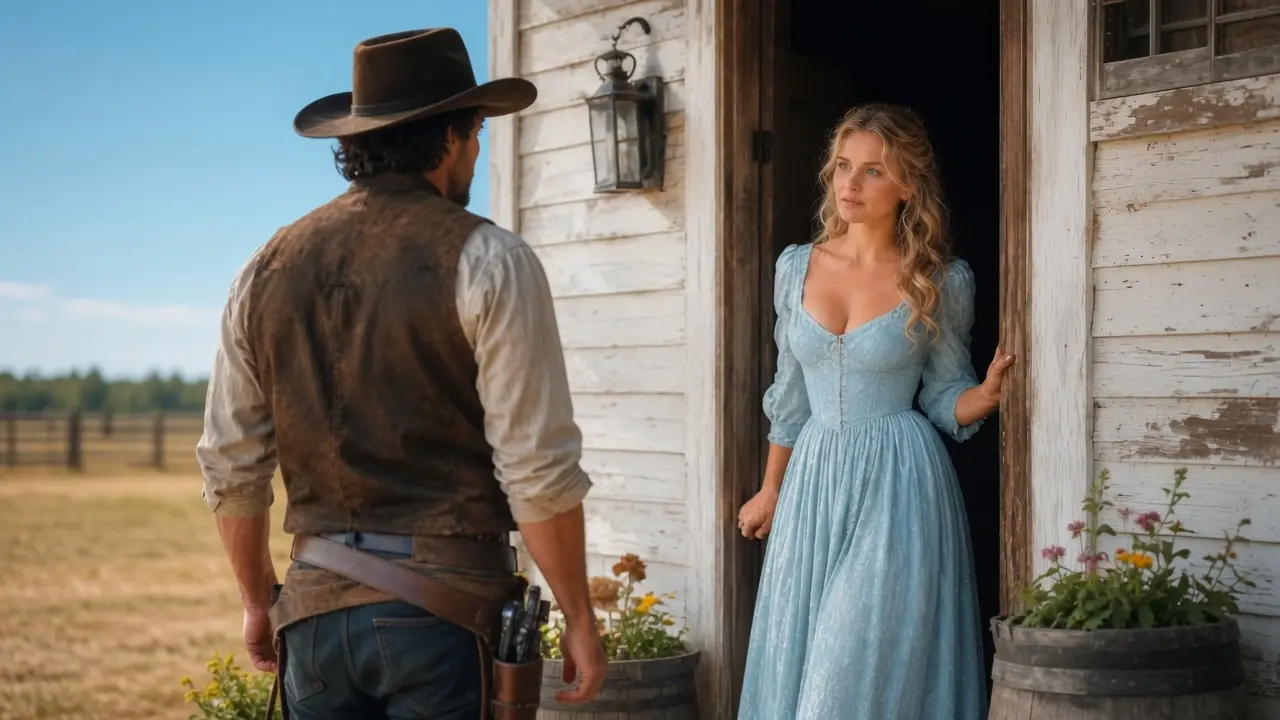
The woman standing before him was younger than he expected. May Callaway looked no older than twenty-six, with fair freckled skin, sharp green eyes, and long golden-blonde hair loosely pinned behind her head. She wore a fitted blue cotton dress with the sleeves pushed to her elbows, and one mud-stained hand gripped a thick account ledger as though it were the last weapon she possessed. She studied Will from hat to boots before answering.
“I don’t need a cowboy,” she said coldly. “I need a husband.”
Will thought the Texas heat had finally damaged his hearing.
“You’d marry a stranger just to keep this land?”
May opened the door wider. “Come inside—the bank takes my ranch Friday unless you say yes.”
The kitchen was clean but nearly bare. A cast-iron pot sat cooling on the stove, three jars of preserves occupied a shelf near the window, and unpaid notices lay beneath a chipped coffee cup. May sat across from Will at a heavy pine table and opened the ledger between them. Every page contained numbers written with remarkable care—cattle counts, feed costs, fencing repairs, interest payments, and one debt large enough to swallow the entire property.
Her husband, Daniel Callaway, had died eight months earlier after a fever moved through Mill Haven. He left May three hundred acres, sixty cattle, two horses, and a four-hundred-twenty-dollar loan owed to Mill Haven Savings Bank. Daniel had borrowed the money to expand the herd, believing cattle prices would rise before winter. Instead, the market weakened, the fever took him, and the bank president refused to refinance the debt with a woman whose estate remained tangled in probate.
“Harlon Briggs gave me until Friday,” May said. “He says a husband’s signature would satisfy the bank because the land would have a man legally responsible for it.”
Will turned his hat slowly in his hands. “And in return?”
“A room. Food. Forty dollars each month after the first cattle sale, and one-quarter ownership if you remain through winter.” Her eyes held his without apology. “The marriage would be practical. Separate rooms. Separate lives unless we both decide otherwise.”
“You have asked other men?”
“Two.”
“What happened?”
“The first laughed. The second wanted the property placed entirely in his name before the ceremony.”
Will looked around the kitchen. Nothing in the house suggested wealth, but everything suggested effort. The table had been repaired twice. The curtains were clean despite their age. Outside the window, a section of broken fence had been tied temporarily with rope, and a thin line of smoke drifted from the bunkhouse chimney even though no hired men remained.
“You don’t know me,” he said.
“I know you asked for work instead of charity. You removed your hat before entering my home, and you listened before deciding I was foolish.” May closed the ledger. “That is more than most men have offered me.”
She gave him until sunrise.
Will slept in the barn on fresh hay beside his saddle. At least, he tried to sleep. The offer circled his mind while the cattle shifted beyond the walls and an owl called from the cottonwoods near the creek. Marriage had always seemed like something that happened to men with family names, steady land, and reasons to remain in one place.
Will had none of those things.
His father had died in a rail accident when Will was twelve. His mother survived four more years before illness took her, leaving him with a horse, a rifle, and no one expecting him to return. Since then, movement had become easier than belonging. A job ended, he collected his wages, and he left before anyone could decide he was unnecessary.
Near midnight, he heard a horse on the eastern ridge.
Will rose quietly and looked through a gap in the barn wall. A lone rider sat beneath the moon, watching the farmhouse from beyond the fence. The figure remained motionless for several seconds before turning east toward the neighboring Holland ranch.
That settled something inside him.
At six the next morning, May entered the kitchen and found Will seated at the table with the ledger open before him. He had read every page.
“Yes,” he said.
Her guarded face softened for one brief moment. “You understand what I am asking?”
“I understand the debt, the cattle count, and the terms.” He tapped one page. “I also understand you are losing nearly eight dollars a month because the north pasture trough leaks beneath the ground.”
May stared at him. “How did you know that?”
“The water purchases increased after March, but the herd did not.”
She sat slowly.
Will closed the ledger. “If I sign those papers, I am not doing it as a name on a page. I work the land, help manage the accounts, and get a say when someone threatens either.”
May extended her hand. “Agreed.”
They married Wednesday afternoon inside Reverend Thomas Bell’s small church. The ceremony lasted eleven minutes. May wore her cleanest blue dress, and Will wore a white shirt borrowed from the reverend because his own collar had torn. The witnesses were the reverend’s wife and an elderly rancher who happened to be waiting outside with a broken wagon wheel.
When Reverend Bell pronounced them husband and wife, May and Will stood awkwardly before one another.
“You may kiss the bride,” the reverend said.
May’s eyes widened slightly.
Will lowered his voice. “Not part of the business agreement?”
“Not yet.”
He touched his forehead to hers instead. “Then we save it.”
The next morning, they drove to Mill Haven Savings Bank. Harlon Briggs sat behind a broad oak desk beneath a portrait of himself. He was a narrow man with a silver mustache and the patient smile of someone who enjoyed watching debtors struggle. Beside him stood Garrett Holland, owner of the largest cattle operation east of town.
Holland was forty-three, clean-shaven, and dressed in a black coat too fine for ranch work. His property surrounded much of the Callaway land, and he had offered May less than half its value two weeks after Daniel’s funeral. She refused him three times.
Briggs examined the marriage certificate. “Quick courtship.”
“Urgent circumstances,” May replied.
Briggs ignored her and looked at Will. “You understand the obligation you have assumed?”
“I understand every figure in the account.”
Holland smiled. “A wandering hand reads one ledger and thinks himself a rancher.”
Will met his gaze. “A wealthy rancher spends a lot of time inside banks.”
The smile disappeared.
Briggs asked detailed questions about cattle numbers, water access, expected sale dates, and winter feed. Will answered without looking toward May. He had memorized the ledger and inspected most of the property before sunrise.
The bank refinanced the loan for six months.
Outside, May stopped beside the wagon. “You answered like the ranch was already yours.”
“I read the ledger before I said yes.”
“You truly meant to stay.”
“I meant not to lie.”
Her expression changed, as if she were adjusting to a version of him more dangerous to her defenses than the drifting cowboy she expected.
The first month was work from darkness to darkness. Will replaced forty-seven rotting fence posts, repaired the leaking trough, patched the barn roof, and moved the weaker cattle into better grazing. May handled accounts, cooked meals, and rode beside him whenever the work required two people. She was not delicate, helpless, or grateful for every task he completed.
When he repaired something badly, she said so.
When she made a poor financial decision, he challenged her.
Their arguments became the most honest conversations either had experienced in years.
Small habits formed without discussion. May left coffee beside the barn door before sunrise. Will sharpened her tools when he sharpened his own. At supper, they shared the events of the day and reviewed the ledger together. Their bedrooms remained separate, but the distance between them gradually felt less like a rule and more like a question neither was ready to answer.
One evening, Will discovered a note written in Daniel Callaway’s hand near the back of the ledger.
Holland offered again. Land office shows discrepancy from 1874 survey. Ask John Pratt in Abilene.
Will read it twice.
The eastern pasture contained forty acres of the ranch’s best grazing land and the only reliable creek access during dry months. If the original boundary was incorrect, Holland might claim it legally. Will remembered the rider watching from the ridge and wrote to John Pratt that night.
He did not tell May immediately.
Garrett Holland arrived three days later while Will was repairing the eastern fence. He rode a black gelding and stopped without dismounting.
“Heard May found a man to save her papers.”
“She found a husband,” Will replied. “The papers were a side effect.”
Holland looked over the pasture. “That east land has been disputed since before Daniel Callaway bought it. The survey line may belong a quarter mile west of this fence.”
“Then the county records will tell us.”
“Records can be interpreted.”
“So can threats.”
Holland smiled thinly. “I am offering friendly advice. Do not spend too much labor on land another man may own.”
Will drove the next post into the earth with three hard strikes. “Then another man should prove it before stepping onto mine.”
That night, he told May everything.
Her face hardened when she saw Daniel’s note. “Why did you wait?”
“Because you already carry the bank, the herd, and a dead husband’s mistakes. I wanted an answer before I gave you another fear.”
“I am not a child who needs protection from facts.”
“No. You are a woman who has survived eight months alone. That does not mean you should have to carry every problem the moment it appears.”
May stood beside the kitchen table, anger and something softer moving across her face. “Did you write the surveyor?”
“Two weeks ago.”
“And if the land is Holland’s?”
“Then we fight for compensation and protect what remains.”
“And if it is ours?”
“Then Holland learns he waited too long.”
John Pratt arrived in mid-November carrying old maps, a compass, and the confidence of a man who trusted measurements more than neighbors. He spent two days walking the boundary with Will and May. On the third morning, he placed the original 1874 survey beside his calculations.
“The old surveyor made a compass correction twice,” Pratt said. “The eastern line was recorded incorrectly. Forty-two acres east of the disputed fence belong legally to the Callaway property.”
May released a breath she seemed to have held for years.
The corrected survey was filed at the county office on Thursday.
On Friday night, someone cut three sections of eastern fence.
Will discovered the damage before dawn. Nearly a quarter mile of wire lay in the frozen grass, posts had been pulled from the earth, and most of the herd had been driven toward Holland’s property. Horse tracks showed at least three riders.
He saddled his horse, then stopped.
The old Will would have gone alone. The man he had become turned back toward the house.
May was dressed within minutes, her rifle strapped behind her saddle. “They are my cattle.”
“Our cattle,” Will corrected.
They rode into the darkness as the first northern wind struck the pasture. Snow began falling before sunrise, thin and sharp, cutting across the land. Will and May found the herd scattered along a ravine near Holland’s boundary.
Two riders waited beneath the cottonwoods.
“This is Holland land,” one called.
“The survey was filed yesterday,” Will replied. “Move.”
The rider spat into the snow. “Paper does not move cattle.”
“No,” May said, riding beside Will. “But rifles can move thieves.”
Both men recognized her determination. After a tense silence, they turned toward the eastern ridge.
Will and May worked through the morning, pushing frightened cattle toward the repaired boundary while the storm strengthened. The snow thickened, the temperature fell, and wind erased their tracks almost as quickly as the horses made them.
By noon, the entire herd was in danger.
The great winter storms of the 1880s had already destroyed ranches farther north. Cattle trapped on open ranges froze standing, while others wandered into drifts and disappeared. The Callaway herd lacked enough shelter for such weather, and the broken fence had scattered them across miles of exposed land.
Will tied rope around his waist and handed the other end to May. “If one of us falls in the whiteout, the other follows the rope.”
“We should bring the herd through the cottonwood cut.”
“The creek may freeze over.”
“The south ridge is worse.”
She was right.
Together, they drove the cattle into the narrow cut while wind roared through the trees. May rode behind the weakest animals, firing her revolver into the air whenever they tried to turn. Will led from the front, breaking a path through deepening snow.
A frightened steer slipped near the frozen creek and struck May’s horse. She fell hard, disappearing beneath blowing snow. Will felt the rope jerk and turned immediately.
He found her half buried beside the animal, one ankle trapped beneath the saddle.
“Leave the horse,” she shouted.
“I am not leaving either of you.”
He cut the saddle strap, freed her leg, and pulled her upright. The horse rose limping but able to walk. May tried to mount and nearly collapsed.
“You cannot ride.”
“I can.”
“May.”
“They are our cattle.”
Will stared at her through the storm. “And you are my wife.”
The words silenced her more effectively than any command.
He lifted her onto his horse and climbed behind her. They led the injured animal and continued driving the herd. By nightfall, every surviving cow reached the protected pasture behind the barn.
They lost four cattle.
They could have lost sixty.
May’s ankle swelled badly, forcing her to remain inside for several days. Will moved his blanket to a chair outside her room because she developed a fever after exposure to the cold. He cooked terrible soup, changed wet cloths against her forehead, and slept in short intervals whenever her breathing became steady.
On the third night, May awakened and found him seated beside the bed.
“You stayed,” she whispered.
“Where else would I go?”
“That is what you always do. You leave when the job is done.”
Will leaned forward. “The job is not done.”
“When will it be?”
He looked at her pale face, tangled hair, and the hand resting near his on the blanket. “I do not know anymore.”
May slipped her fingers around his.
Garrett Holland’s attack did not remain secret. One of the riders, frightened by the worsening storm and Holland’s refusal to pay, confessed to the county sheriff. Holland had ordered the fence cut, the cattle scattered, and brands altered on any animals that crossed his land.
He was arrested for livestock theft and property destruction. The bank discovered that Holland had also pressured Harlon Briggs to force foreclosure, promising the banker a share of the property after May lost it.
Briggs resigned before the bank directors could remove him.
Holland sold part of his ranch to cover legal fees and restitution. The Callaways received enough compensation to pay down half their remaining debt.
Winter remained brutal, but the ranch survived.
As May healed, she and Will became less careful around one another. Their hands touched while passing plates. Their conversations continued after the ledger closed. On cold evenings, they sat beside the stove, speaking about childhoods, losses, and the lives they once imagined.
Will told her how frightening belonging had always seemed.
“If you never stay,” May said, “no one can ask you to leave.”
He looked toward the fire. “That was the idea.”
“And now?”
“Now someone has given me a reason to be afraid.”
She smiled faintly. “You are afraid of me?”
“I am afraid this became real before I noticed.”
May moved closer. “I noticed.”
Their first kiss occurred in the kitchen, nearly four months after the wedding. It was quiet, hesitant, and nothing like the business agreement that brought them together. Will touched her cheek as though she might disappear, while May held the front of his shirt and refused to let him retreat.
By spring, the pastures turned green again.
They sold twenty cattle at a favorable price, paid the remaining bank interest, and purchased seed for a new hay field on the recovered eastern acres. May added Will’s name beside hers in the ledger, not because the law required it, but because the ranch had become something they built together.
On the anniversary of Daniel’s death, May rode alone to the small hill where he was buried. Will did not follow until she returned at sunset.
“I loved him,” she said.
“I know.”
“I thought loving you would betray what he was.”
Will took her hand. “The dead do not need us to stop living for them.”
Tears filled her eyes. “When did you become wise?”
“I spent years making every foolish mistake available.”
She laughed and leaned against him.
That summer, they expanded the barn, hired two ranch hands, and replaced the old farmhouse porch. Will carved their names beneath the new railing where no visitor would see them. May and Will Harding, 1887.
One evening, May found him looking toward the western road.
“Thinking of leaving?” she asked.
He shook his head.
“What, then?”
“Thinking about all the doors I knocked on before yours.”
“And?”
“Glad they stayed closed.”
May stepped beside him and rested her head against his shoulder. The cattle moved across the pasture beyond the fence, the barn stood repaired beneath the fading light, and the home behind them no longer felt borrowed.
Will Harding came to the Callaway ranch asking only for work.
May offered him a marriage without love, a debt without certainty, and a fight against men determined to take everything she owned. Neither understood that the desperate agreement would give them more than land.
It gave a widow someone willing to stand beside her rather than rule over her.
It gave a drifting cowboy the first place that asked him to stay.
And after surviving betrayal, theft, and a winter that nearly buried them beneath the Texas snow, the two strangers discovered that the strongest marriage was not the one created by a signature.
It was the one they chose again every morning after.