The loader tractor was already pushing the first pumpkins toward the dumpster when Clara May Harlan pulled into the rear lot of Route 9 Farm Market. It was the last Tuesday of October, cold enough for yesterday’s mud to crack beneath her boots, and six hundred unsold pumpkins lay in a broken orange heap beside the loading dock. Many were split from frost, others had softened around their stems, and patches of green-gray mold covered the worst of them. To everyone else, they were a disposal problem; to Clara, they were a calculation waiting to be finished.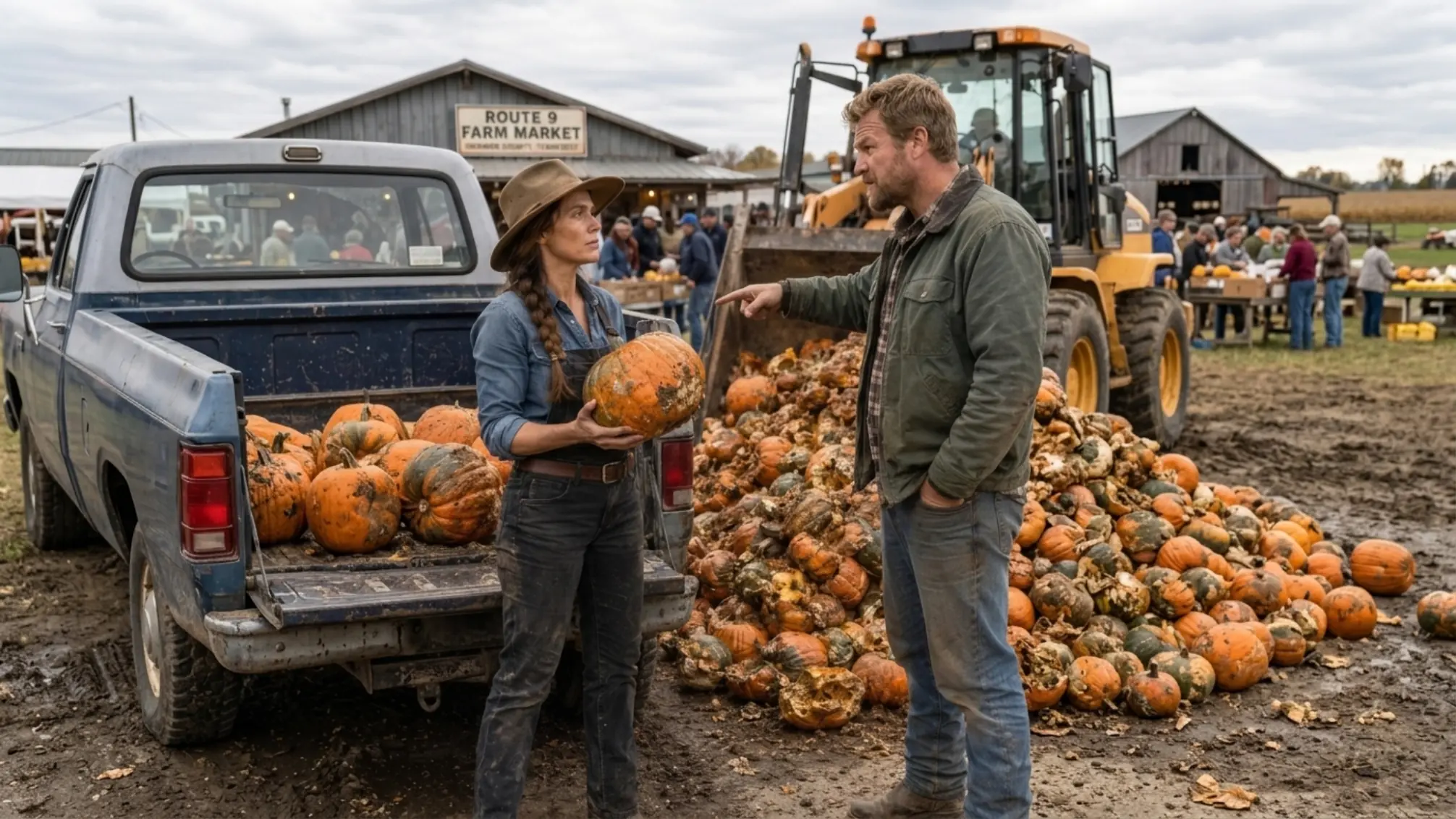
Phil Gentry, the market manager, watched her approach with both hands buried inside his jacket. He had managed the place for eleven years and was pleased that the pumpkins would be gone before another hauling bill arrived. The Halloween season had ended badly after an early cold snap reduced school visits and family sales. By Wednesday morning, the market planned to pay forty dollars to have the entire pile dumped.
“We’re clearing them out,” Phil said. “They’re finished.”
Clara studied the pile instead of answering immediately. At thirty-seven, she had the patient expression of someone accustomed to making decisions before other people understood the problem. Her chestnut-brown hair was braided over one shoulder beneath a wide tan farming hat, and faded denim sleeves were rolled above her forearms. Mud covered her boots and the lower legs of her dark bib overalls.
“What will you take for all of them?” she asked.
Phil glanced from her to the tractor. “All six hundred?”
“All of them.”
“These aren’t market pumpkins anymore, Clara.”
“I’m not opening a market.”
Phil named a figure lower than the hauling cost because receiving even a few dollars was better than paying someone to remove the pile. Clara agreed without bargaining and backed her old pickup toward the loading area. She had lifted only the third pumpkin when Garrett Walsh called from the tailgate of another truck.
“You paid money for six hundred rotten pumpkins?” he shouted.
Garrett raised goats several miles beyond Millerton and possessed the broad shoulders and loud confidence of a man who enjoyed performing for other farmers. His friend beside him laughed before Clara even responded. Garrett pointed toward the mold spreading over the pile.
“What are you going to do, bake six hundred funeral pies?”
Clara lifted another heavy pumpkin into her truck bed.
“My pigs will eat while yours drain your bank account.”
Garrett stepped closer, amused by the answer. “That moldy trash will ruin your entire herd.”
Clara met his eyes. “Then count all forty-three when spring comes.”
She loaded pumpkins for two hours.
The task became harder as the truck bed filled and the weight settled over the rear axle. Clara sorted nothing at the market because daylight was disappearing and Phil wanted the lot cleared. She made three careful trips along the slower county roads, watching the truck’s suspension and keeping below fifty miles per hour.
By the time she unloaded the final pumpkin, darkness had covered the Harlan farm.
Clara switched on the barn floodlights and marked three separate areas on the floor with baling twine. Pumpkins with cracked skins or soft outer spots but firm orange interiors went into the first section. Intact pumpkins showing little deterioration went into the second, while completely collapsed or deeply molded fruit went near the compost door.
She inspected every pumpkin before placing it.
Nearly four hundred remained suitable for animal feed once the damaged areas were removed. Sixty were firm enough to provide viable seed, while the rest had decomposed beyond anything she would allow near her pigs. The worst pumpkins were not useless, however; they simply needed a different job.
At ten-thirty, Clara checked the hog barn.
All forty-three pigs were warm, calm, and accounted for. Eight came from the breeding line her father had spent decades developing, while the others were feeder pigs expected to carry most of the farm’s income through the year. She stood in the doorway listening to their steady breathing before returning to the farmhouse.
Inside, she opened the thick notebook that contained every serious decision made on the farm. She recorded the pumpkin count, their condition, current grain inventory, estimated animal weights, and her feeding plan for the next twelve weeks. Only after the numbers balanced did she allow herself to sleep.
Clara had returned to the sixty-one-acre Harlan property three years earlier after being medically separated from the United States Army. A fragment of metal remained inside her right leg following an incident overseas, and cold weather made her walk slightly stiffly. She rarely discussed the injury or the circumstances behind it.
Her father had died while she was still deployed.
James Harlan had raised hogs on Route 9 for thirty years and understood the farm as a connected system rather than separate fields, animals, and expenses. Chickens consumed scraps while producing manure for gardens. Hogs cleared damaged crops that would otherwise rot. Compost returned nutrients to soil that had spent years feeding everything else.
When Clara was twelve, she once asked why they kept chickens when selling eggs earned so little.
“Chickens don’t make money only from eggs,” James told her. “They make money from everything eggs aren’t.”
At twelve, Clara thought it was another confusing lesson adults offered when they did not want to provide a simple answer. Running the farm alone finally taught her what he meant. Survival depended on noticing the second and third purpose hidden inside something everyone else considered finished.
That autumn, grain prices were the highest Harmon County had seen in six years. A summer drought had damaged corn yields, and Dennis Kolk at the feed store had raised prices twice since September. Several local farmers were already discussing early livestock sales because carrying animals through winter might cost more than the animals would earn.
Clara’s hog operation could not absorb another major increase.
The pumpkins changed the equation.
She began processing the feed-grade pile the morning after the purchase. Using her father’s three-pound hatchet, she split each pumpkin across an old cutting block, removed deeply damaged sections, and quartered the clean flesh. The work was slow, physical, and repetitive, but it allowed her to inspect every piece before feeding it.
The pigs approached the first wheelbarrow with immediate enthusiasm.
They pushed toward the unfamiliar food, sniffed the bright orange flesh, and began eating with the intense concentration pigs gave anything interesting. They consumed the soft flesh, seeds, and rind. Clara remained beside the enclosure for twenty minutes, watching for hesitation or discomfort.
She did not replace their grain all at once.
For two days, pumpkin represented approximately one-third of the daily ration. Clara gradually increased the amount while maintaining protein, mineral, and vitamin supplements. By the second week, the animals received roughly forty percent of their nutrition through pumpkins and sixty percent from grain.
Every three days, Clara ran her hands across their backs and ribs, checking body condition exactly as her father had taught her. She recorded water intake, feed consumption, waste, temperament, and visible weight changes. None of the forty-three pigs showed digestive distress or declining condition.
Their grain consumption fell by thirty-eight percent.
On Saturday evening, Clara calculated the savings at her kitchen table. Maintaining that reduction through a twelve-week winter would preserve enough money to cover several major expenses, including electricity, veterinary care, and spring seed. It would not make her wealthy, but small farms rarely survived through fortunes.
They survived through margins.
The sixty pumpkins in the second section received different treatment. Clara opened them over galvanized basins, removed their seeds, washed away the pulp, and spread them across old wire screens inside the mudroom. She turned them every few days and separated any showing signs of rot.
She did not know the exact varieties because the market had stocked several decorative and carving pumpkins. What she knew was that they had been grown locally and had already survived the county’s soil, weather, and growing season. Her father believed seed adapted through local generations possessed advantages catalog descriptions could never promise.
“Seed grown here knows how to grow here,” he used to say. “Catalog seed only knows how to look good in the photograph.”
Clara labeled every batch with the collection date, visible characteristics, and probable variety. She intended to plant them on the eastern strip, forty yards of clay-heavy ground her father had struggled with for twenty years. The strip became hard as fired brick during summer and swallowed boots during spring.
It needed organic matter.
That was where the third pumpkin pile became useful.
Clara split even the most damaged pumpkins before placing them inside the three-bay compost system behind the barn. She layered the wet fruit with straw, fallen leaves, manure, and used bedding. The pumpkins provided nitrogen-rich moisture while straw balanced the pile with carbon.
Within a week, the center reached 142 degrees.
Clara turned it every four days with a manure fork, measured internal temperature, adjusted moisture, and recorded every change. Managed correctly, the pile would become finished compost within ten weeks rather than sitting untouched for a year. She planned to spread it across the eastern clay strip before spring thaw.
Garrett visited the farm during the second week of November, supposedly to return a fence post his brother had borrowed. He found Clara splitting pumpkins beside the barn, with organized stacks visible behind her. The laughter he carried at the market had disappeared.
“You’re actually feeding them,” he said.
“Yes.”
“And they’re healthy?”
“Gaining weight. Eating thirty-eight percent less grain.”
Garrett stared at the wheelbarrow of quartered pumpkins. “How long did you plan this?”
“Twenty minutes.”
He frowned. “You bought them four days after seeing the loader.”
“The planning took twenty minutes. Execution takes longer.”
He stepped inside the barn and noticed the intact pumpkins stacked against the eastern wall. “What are those for?”
“Seed.”
“You’re planting pumpkins too?”
“On the clay strip.”
“That ground won’t grow weeds properly.”
“The compost will change its structure. The pigs will work it into the soil, and the pumpkin vines will cover the surface.”
Garrett looked from the seed pumpkins to the compost bay and then toward the hog enclosure.
“So the good ones feed the pigs, the intact ones become seed, and the worst ones become soil.”
“Yes.”
He remained quiet for several seconds.
“I said something stupid in the parking lot.”
“You didn’t have the information.”
“I made assumptions.”
“Most people do.”
Garrett collected the fence post and began walking toward his truck. Before leaving, he asked how much money Clara expected to save on grain. She gave him the figure from her notebook.
He looked back at the pumpkins.
“I have goats,” he said.
“I know.”
“Goats eat squash.”
“Yes.”
He nodded slowly. “Maybe I should ask Phil what else he throws away.”
By December, feed prices rose again.
Roy Demler sold twenty cattle early rather than carry them through February. Gerald Prewitt reduced his herd’s daily ration and hoped they would maintain enough weight to avoid losses. Farmers gathered at Dennis Kolk’s store and discussed numbers in voices that became increasingly serious.
Clara arrived to purchase supplements rather than full grain orders.
Gerald watched Dennis prepare the smaller amount. “Still feeding those pumpkins?”
“Yes.”
“Your pigs holding condition?”
“They’re gaining.”
He studied her notebook while she explained the ration. “What made you think pumpkins would work?”
“My father fed scraps to hogs his whole life. Pumpkins are scraps with structure.”
Dennis leaned across the counter. He had known James Harlan for nearly thirty years and remembered every strange experiment that succeeded after the rest of the county dismissed it.
“James would have bought those pumpkins.”
Clara looked at him.
Dennis did not mean it as praise. He said it because he believed it was true.
“Probably,” she answered.
January arrived with two nights at eight degrees.
Frozen waterlines, insufficient bedding, and underfed animals became serious threats across the county. Clara had insulated her pipes in November while splitting pumpkins, drying seed, and turning compost. Her preparation seemed excessive when the weather remained mild; when the cold finally arrived, it looked necessary.
The pipes held.
So did the pigs.
Clara checked them twice daily, pressing her hands along backs and flanks while monitoring respiration, drinking, and appetite. Deep bedding kept the barn warm enough, and their maintained body condition protected them through the coldest nights. None became sick.
On January eighth, Clara wrote in the notebook:
All forty-three accounted for. All eating well. Pumpkin stock sufficient through early March. No visible weight loss.
Behind the barn, the compost remained warm at its center despite the frozen ground. Microbial activity generated its own heat, and the pile continued breaking down when everything around it appeared motionless. Clara turned it beneath a gray sky and thought about how often life survived by working where no one could see it.
The feed-store conversations changed.
No one announced that Clara had been right. Rural communities rarely reversed themselves with speeches. They updated their opinions through quieter actions: asking questions, driving slowly past her barn, requesting numbers, and pretending the interest had always been respectful.
Roy asked Dennis how her pigs were doing.
Garrett said he had inspected the system himself and found it practical.
“James Harlan would have thought of it,” Dennis said.
“He did,” Garrett replied. “She made it work.”
In February, the compost pile cooled to the surrounding temperature. The material was dark, uniform, and smelled like fertile soil rather than rotting fruit. Clara moved it across the frozen eastern strip in wheelbarrow loads and spread it over the clay.
The pumpkins everyone called garbage had become organic matter her father could never afford to purchase.
When the ground softened in March, Clara moved small groups of pigs through the strip. Their rooting mixed compost deeper into the surface, but she rotated them carefully to prevent compaction. Three weeks later, a soil probe pushed eleven inches before meeting dense clay.
The previous October, it stopped at eight.
The field was not repaired.
But it was changing.
In April, Clara planted the saved pumpkin seeds alongside crimson clover. She expected germination in approximately twenty days. Green shoots emerged after seventeen.
The seedlings grew unevenly because soil improvement remained inconsistent, yet they grew where nothing useful had grown in years. By June, vines spread across the eastern strip, their broad leaves shading the soil and reducing moisture loss. By July, the canopy suppressed most weeds.
Garrett stopped beside the fence one afternoon.
“Those came from Phil’s rotten pumpkins?”
“From the best seeds inside them.”
He surveyed the green vines covering what had once been gray clay. “That ground finally grew something.”
“It was always capable. It needed help.”
Garrett leaned on the fence. “I bought sixty pounds of soft winter squash and fifteen boxes of unsold produce from Phil last spring.”
“For the goats?”
“They loved it. Saved enough money to notice.”
He smiled faintly.
“My neighbor asked where I got the idea. I told him I watched someone load garbage while I laughed.”
Clara looked toward the vines. “At least you were paying attention.”
The first harvest produced only eleven pumpkins.
By commercial standards, the number meant failure. To Clara, it meant that the clay strip had produced its first crop in two decades. She selected seeds from the strongest three fruits, fed several pumpkins to the pigs, and placed the damaged remains into a new compost pile.
The cycle had completed once.
Feed became manure.
Waste became compost.
Compost became soil.
Soil became vines.
Vines produced seed for the following year.
Phil Gentry visited in early October. He stood beside his pickup while Clara showed him selected pages from the farm notebook: grain savings, pig weights, compost temperatures, soil-depth measurements, germination records, and harvest numbers.
“You planned all this when you bought them?”
“The idea started then.”
He stared at the eastern strip. “That ground looks different.”
“It is.”
“From my pumpkins?”
“From your pumpkins, my pigs, my time, and a system connecting them.”
Phil rubbed one hand across his chin. “I’ve been paying to dump those things for eleven years.”
“You had no use for them.”
“You did.”
“I had a problem. The pumpkins fit it.”
He looked toward the barn, where all forty-three pigs remained healthy.
“Next season, do you want first call on everything we would normally haul away?”
“What do you usually have?”
“Pumpkins, squash, ornamental corn, gourds, unsold vegetables.”
“What does removal cost?”
Phil told her.
“I’ll take it for the amount you would have paid the hauler.”
He stared at her. “You’re asking me to pay you?”
“No. You save the hauling cost. I receive the material. Both farms keep something that would otherwise disappear.”
Phil extended his hand.
“Deal.”
One year after the loader tractor began pushing the pumpkins toward the dumpster, Clara walked across the eastern strip before sunrise. The spent vines lay over darker soil that now held together beneath her boots instead of sealing into hard clay. Eleven pumpkins from the first harvest rested inside the barn beside winter squash and vegetables collected under the new market agreement.
All forty-three pigs remained alive.
Not one had lost dangerous weight during winter. Feed costs had fallen enough to protect the farm during the most expensive season Harmon County had experienced in six years. The compost had improved soil measurements at eight of twelve testing points.
At the feed store, Dennis wrote Clara’s savings figure on a piece of paper and placed it beside the register.
“What is that for?” she asked.
“People keep asking how to survive another expensive winter.”
“Tell them the produce must be sorted. Some goes to animals, some to seed, and some to compost. Feeding rotten material without inspecting it will make them sick.”
Dennis wrote that beneath the number.
“I’ll tell them.”
By the second year, three neighboring farms were collecting clearance vegetables from markets instead of allowing them to enter dumpsters. Garrett used squash to supplement his goats. Mike Tierney began building organic matter on a wet clay strip beside his western fence.
Neither man copied Clara exactly.
They adapted the principle to their own animals, soil, and available material. That mattered more than imitation. Systems survived only when farmers understood why each step existed.
Clara never placed a sign beside the road or called a newspaper. She continued opening the barn before daylight, measuring feed, checking animals, turning compost, and documenting results. The work did not need an audience.
The county had already heard its answer.
A year earlier, Garrett had pointed toward six hundred moldy pumpkins and predicted they would destroy Clara’s herd. She had told him to count the pigs when spring arrived.
Spring came.
Then summer.
Then another autumn.
Forty-three pigs stood inside the barn.
All forty-three.
The pumpkins had not saved them through luck, magic, or blind desperation. They survived because Clara inspected every fruit, separated risk from value, balanced the ration, maintained supplements, protected waterlines, deepened bedding, monitored weight, and prepared before the cold arrived.
Other people saw garbage.
Clara saw feed, seed, soil, and time.
Her father had taught her that waste was merely something waiting for its next job. She finally understood that the same principle applied to people and places others dismissed too quickly.
The county saw a wounded veteran returning to a struggling farm.
It saw a woman operating hog barns without a husband or father beside her.
It saw cracked pumpkins, mold, heavy clay, and a decision worth laughing at.
Clara saw what each of those things could become after enough patience and work.
And by the time everyone stopped laughing, the pigs had survived, the soil was growing again, and half the county wanted to know where she would find next winter’s “garbage.”