“No farmer will pay ninety dollars for tannery trash.”
Roland Kettering’s laughter carried across the worn wooden counter of the Agri Valley Cooperative in St. John, Kansas. He held Marlene Halverson’s handmade tool belt with two fingers, as if the rich brown leather might stain his reputation. Across from him, Marlene stood perfectly still in a fitted plaid work shirt, faded jeans, muddy farming boots, and the tan canvas apron she wore inside her workshop. Her gray-green eyes stayed fixed on the man who controlled what nearly every farmer in Stafford County believed was worth buying.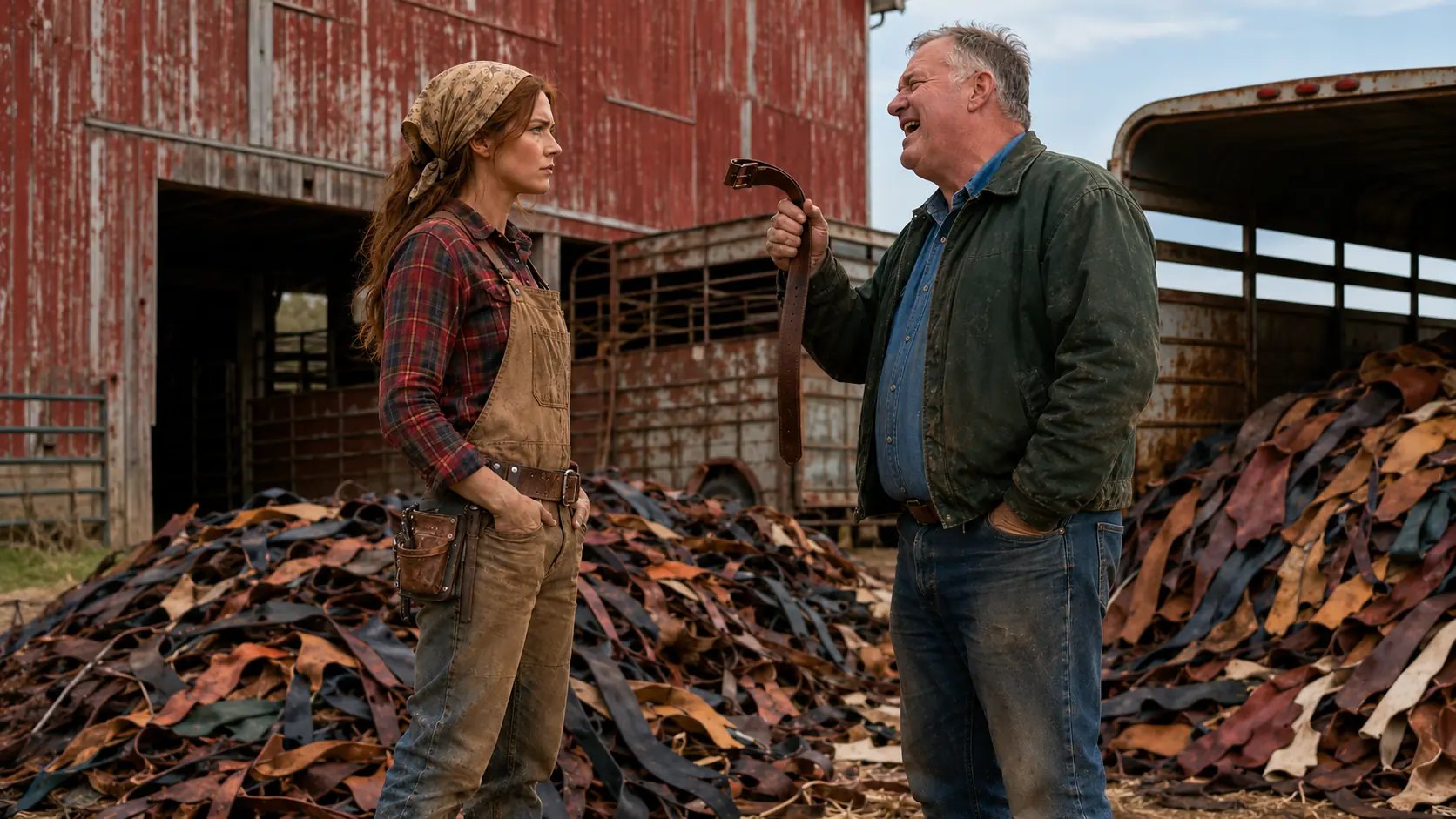
“Then keep selling belts that fall apart,” she replied.
Roland’s smile thinned. He had spent nearly three decades deciding which products reached the cooperative shelves and which disappeared before customers ever knew they existed. Men trusted his judgment because their fathers had trusted it first. He leaned across the counter, lowering his voice as though explaining the rules to someone too inexperienced to understand them.
“I’ll keep yours out of every store in this county.”
Marlene lifted the belt from his hand and placed it carefully inside her canvas bag. “Do it,” she said. “Then come begging when this trash owns your shelves.”
She walked out before Roland could answer.
The bell above the cooperative door rang once when she pushed it open and again when it swung shut behind her. Marlene crossed the gravel parking lot without allowing herself to look back. Her old white pickup waited beneath a pale April sky, its passenger seat holding a second tool belt and the black notebook in which she recorded every price, mistake, customer, and refusal.
The drive home took fifteen minutes.
Kansas farmland stretched flat and green on both sides of the county road. The wind entered through her open window, carrying the smell of damp soil and early wheat. Marlene did not turn on the radio. She replayed Roland’s laughter instead, listening closely to what it revealed.
It was not the laughter of a cruel man.
Cruelty could be confronted.
Roland’s laughter was worse because it came from certainty. He believed he understood the market before the market had been given the chance to speak. He believed Marlene was a farmer’s daughter playing at business, and he believed himself kind for warning her before failure embarrassed her publicly.
Marlene pulled into the Halverson farm shortly after ten.
The red barn stood beside a sprawling mound of leather scraps left by the Stafford County Leather Works. The tannery had dumped similar loads every few months for more than a year, saving itself disposal fees while assuming Marlene’s family would use the material for repairs, padding, or firewood. To most people, the pile looked like industrial waste.
To Marlene, it looked like inventory.
Her husband, Wyatt, stood at the kitchen sink washing grease from his hands when she entered. He was thirty-four, lean and dark-haired, with the large hands of a mechanic and the quiet patience of a man who understood that his wife spoke only after arranging her thoughts. His own tool belt—the first one Marlene had ever made—hung from a chair beside the table.
Wyatt looked at the untouched sample bag.
“He laughed?” he asked.
“He called it a hobby.”
Wyatt dried his hands and sat opposite her. “Did he say why?”
“He says farmers buy thirty-dollar belts and replace them every few years.”
“They do.”
“He says that means they’re satisfied.”
“They aren’t.”
Marlene opened her notebook to a fresh page and wrote the date. Beneath it, she recorded Roland’s words exactly as he had spoken them. Then she wrote three additional lines.
Formal durability testing.
Build outside the cooperative network.
Return when permission no longer matters.
Wyatt watched her close the notebook. “What now?”
“Now I prove the belt lasts ten years.”
He glanced at the original belt hanging nearby. Marlene had built it from a thick top-grain shoulder cut retrieved from the first pile beside the barn. She had drafted the pattern from grocery-bag paper, punched every stitch hole individually, and used an old rosewood awl left behind by her grandfather.
The first version had not been perfect. One pocket sat a quarter inch too low, and the stitching drifted slightly along the left edge. Wyatt had worn it for a week before giving her two corrections: raise the front pouch and reinforce the hammer loop with another copper rivet.
Everything else, he told her, was better than any tool belt he had owned.
That sentence transformed Marlene’s project from an experiment into a product.
She began testing the leather six weeks after Roland’s rejection. In one corner of an equipment shed, she built twelve wooden frames. Six held panels cut from tannery scraps. The remaining six held material taken from inexpensive commercial belts purchased at a farm supply store.
Wyatt helped her rig an electric motor to flex each panel repeatedly beneath a fifteen-pound load. The mechanism ran for hours each day, imitating years of bending, pulling, and twisting on a working man’s waist. Every Sunday, Marlene photographed the panels from identical angles and examined the stitch holes beneath a jeweler’s magnifying lens.
By week eight, three commercial panels showed fiber separation.
By week twelve, one had cracked through the primary flex line.
By week twenty-four, every cheap panel had failed.
Marlene’s leather remained intact.
She pasted the photographs into a binder and labeled the final comparison in careful handwriting: The leather fails before the seam. Ours does neither.
Roland never saw the binder.
Marlene had stopped seeking his approval.
Her first customers came through Wyatt’s repair shop in Pratt. Plumbers, fence contractors, roofers, and mechanics noticed the heavy belt around his waist and asked where he bought it. Wyatt never delivered a sales pitch. He said only that his wife made them from regional leather and that his had survived treatment that destroyed three cheaper belts.
Ray Enfield, a plumber with twenty years of experience, ordered the first one.
Marlene charged him eighty-five dollars. He put it on in the farm driveway, loaded the pockets with tools, and walked around his truck in silence. After a minute, he looked up at her.
“How many can you make?”
“As many as I have leather for.”
“You’re going to need more leather.”
Ray told two plumbers. They told four contractors. Within three months, Marlene had six standing orders and a request from a Wichita plumbing supplier to bring samples.
The tannery truck continued arriving.
Each time it backed toward the barn, hundreds of pounds of unwanted leather slid into the gravel. Marlene sorted every piece by grain quality, thickness, flexibility, and moisture. She built labeled storage bays along the barn wall and learned to identify shoulder, belly, and side cuts before lifting them from the pile.
Harlan Booth, the tannery’s operations manager, visited the farm after the third delivery.
He stood inside the barn examining rows of finished belts hanging from wooden pegs. Harlan had worked around leather for thirty years, yet his own company had discarded the material without considering another use. He picked up one belt and pressed his thumb along the saddle stitching.
“Where did you buy this hide?”
“You brought it.”
He looked at her sharply.
“All three truckloads,” Marlene added. “This piece came from the first.”
Harlan turned the belt over twice. “How much of our waste is usable?”
“All of it.”
He removed his cap. “I have thrown this material away for four years.”
“It wasn’t useful to your factory.”
“It’s useful to you.”
“That’s the difference.”
Harlan left without making fun of her. Three weeks later, the tannery increased its deliveries because Marlene was taking material that would otherwise cost thousands of dollars to dump.
By the end of the year, Marlene sold belts at county fairs, hardware stores willing to take small consignments, and trade exhibitions in Wichita and Tulsa. She kept a record of how every customer discovered her. Some came through Wyatt. Others came through Ray. A growing number arrived through people Marlene had never met.
That mattered more than any single sale.
Word of mouth meant the business had begun moving without her pushing every step.
In 2011, she sold 240 belts.
She raised the retail price to one hundred dollars.
Not one customer canceled.
Roland noticed.
He never called Marlene directly. Instead, he began mentioning her operation during conversations at the cooperative and Farm Bureau meetings. He described it as a respectable little side business that would eventually reach the natural limit of handmade products.
At a county meeting in October, he told several farmers Marlene would return to full-time farming within eighteen months.
The comment reached her father, Emmett.
Emmett Halverson had spent his life measuring worth through crops, cattle, and acreage. When the first leather arrived, he had regarded Marlene’s interest as another attempt to keep the farm alive during declining wheat margins. He allowed her to use the barn but never called what she was doing a company.
That evening, he entered the kitchen and repeated Roland’s prediction.
Marlene wrote it in her notebook.
“Is he right?” Emmett asked.
“No.”
Her father waited.
“He’ll be wrong for a long time before he understands why.”
Emmett studied his daughter’s face and gave the smallest nod. “I believe that.”
The pressure began quietly.
A hardware store in Great Bend stopped returning Marlene’s calls. A construction supplier in Salina canceled a sample order. Another retailer mentioned concerns about warranty liability that had never been raised before.
Marlene drove to Great Bend and confronted the owner politely. After several uncomfortable minutes, he admitted that someone influential in Stafford County had warned regional retailers that Marlene’s operation lacked stability and proper protections.
He refused to give a name.
She did not need one.
Roland was not merely predicting failure anymore. He was attempting to ensure it.
Marlene returned home and wrote another sentence in the notebook.
Every door he closes shows me where his influence ends.
She stopped pursuing stores connected to the agricultural cooperative network. Instead, she contacted construction suppliers along Interstate 70, roofing companies near Kansas City, and trade organizations in Oklahoma and Colorado. These buyers did not know Roland. They did not care who her father was or whether the local cooperative considered her legitimate.
They judged the belt in their hands.
At a Tulsa construction exhibition, Marlene sold forty-two belts in two days. A Denver distributor placed an order for twenty more. By the end of 2012, she had sold more than three hundred units and hired her first employee.
Delaney Prescott was twenty-four and had won state leatherworking championships as a teenager before spending years as a bank teller. On her first day inside Marlene’s workshop, she picked up the old rosewood awl and handled it with the familiarity of someone greeting a part of herself she had abandoned.
Marlene trained her in three weeks.
A year later, she hired Inez Blodgett, an upholsterer with exceptional control over leather under tension. Production tripled. Emmett gave Marlene the abandoned equipment shed behind the north windbreak, and Wyatt insulated, wired, and ventilated it.
The small operation became a workshop.
Workbenches lined one wall. Patterns hung on another. Finished belts filled labeled shelves near a dedicated shipping station. The air smelled of leather, linseed oil, and brass hardware warmed beneath the hydraulic rivet press.
Roland continued calling it a hobby.
Then he stopped laughing.
The change came during the summer of 2014, when two threats arrived on the same day. First, Marlene’s bank delayed an $80,000 expansion loan after an unnamed person raised doubts about her material supply and long-term sales. Hours later, Harlan called from the tannery.
A Missouri company had offered forty cents per pound for exclusive rights to the entire scrap output.
At current volume, the tannery could earn $36,000 annually instead of giving the leather to Marlene.
“The board will consider it,” Harlan warned. “I wanted you to know before the meeting.”
Marlene stood beside the kitchen window, looking toward the workshop. She had known her free supply would eventually attract attention. Two years earlier, she had drafted an agreement giving her first refusal rights to all qualifying tannery scraps, but the contract would expire at year’s end.
The Missouri offer could end everything.
Wyatt arrived after six and found her surrounded by reports.
“What are you going to do?” he asked.
“Make the tannery understand why keeping me is better business.”
She worked until two in the morning.
Marlene calculated how much the tannery had saved in disposal fees. She included transportation costs avoided by using a local buyer, the reliability of her pickup schedule, and the growing volume her company could absorb. She compared that with the Missouri firm’s untested promise and the risk that it might abandon the arrangement after market conditions changed.
At seven-thirty the following morning, she waited outside Harlan’s office.
They spoke for more than two hours.
He carried her report into the board meeting.
At two-fifteen that afternoon, Harlan called.
“The vote was unanimous,” he said. “The Missouri offer is rejected. Your agreement will be renewed.”
Marlene closed her eyes briefly.
The leather was secure.
The bank still delayed the loan, so she expanded through cash flow instead. It forced her to postpone equipment purchases, hold less hardware inventory, and work longer hours. She recorded each unnecessary expense in a section of her notebook labeled Roland Kettering’s Interest Bill.
By the end of the year, the amount exceeded $11,000.
Yet that same year brought the worst drought Stafford County had seen in more than a decade. Wheat yields collapsed. Families postponed repairs and drew heavily from operating credit.
The Halverson farm lost nearly $38,000 in projected crop revenue.
The tool belt company had its best quarter.
Demand from construction workers in Denver, Kansas City, Tulsa, and Oklahoma City did not depend on Kansas rainfall. The business Marlene built from discarded leather protected the farm when the weather could not.
One evening, Emmett sat at the kitchen table examining both sets of numbers.
The farm report showed loss.
The workshop report showed growth.
“You were right,” he said.
Marlene stood near the counter, unable to answer immediately. She had imagined those words for years, but hearing them did not feel like victory. It felt like her father finally seeing the same horizon she had been facing alone.
“What do you need?” Emmett asked.
“Two more workers, another cutting press, and a larger shipping station.”
“Do it.”
The company grew steadily.
Retailers who had rejected her began reconsidering. Articles appeared in regional trade magazines. A hardware chain in Tulsa placed an initial order for four hundred belts and demanded proof that quality would remain consistent at a larger volume.
Marlene answered with records.
She showed them thousands of shipped units and zero product returns from her four largest accounts. She required a thirty-percent deposit before increasing production and refused to lower her wholesale price.
The buyer agreed.
By 2019, Halverson Tool Works passed one million dollars in annual revenue.
Marlene wrote the figure inside her notebook, drew one line beneath it, and went to prepare supper. Wyatt saw the page and understood. At dinner, they lifted their water glasses and touched them together without speaking.
The tannery kept delivering.
The workshop expanded.
The first tool belt remained hanging on a wooden peg in the original barn, its stitching imperfect and its pocket slightly low. Marlene never sold it. It reminded her that an imperfect beginning did not prevent a durable future.
Then, on an October afternoon, Roland Kettering drove onto the farm.
Marlene saw his pickup through the workshop window. He parked between the barn and a mountain of newly delivered leather scraps. For several seconds, he remained beside the truck holding his cap.
He looked older than he had behind the cooperative counter. His shoulders had lowered, and the certainty that once softened his laughter had disappeared.
Marlene stepped outside wearing her farming apron and leather tool belt.
Roland looked toward the expanded workshop. Eight women worked inside, cutting, stitching, riveting, inspecting, and packing belts for shipment across several states.
“I heard you’re doing a million dollars this year,” he said.
“Not yet. Seven hundred thousand this year. A million next year if Colorado holds.”
“May I see the operation?”
“You may.”
She turned and walked away without checking whether he followed.
Inside, Roland moved slowly between workstations. He examined the pattern library, grading bays, commercial presses, outgoing orders, and boxes addressed to distributors in Denver and Tulsa. He watched Delaney complete a saddle stitch with a speed and precision no factory machine could imitate.
“I told you handmade goods had a ceiling,” he said.
Marlene faced him.
“You said it in April 2010 behind your counter,” she replied. “Then you repeated it after the Farm Bureau meeting in October 2011. I wrote down both statements.”
Roland looked toward the workers, all of whom had stopped pretending not to listen.
“I did not build the little craft business you imagined,” Marlene continued. “I built a manufacturing company using handcraft methods to make a product the market was failing to provide.”
His fingers tightened around his cap.
“The ceiling belonged to your assumption,” she said. “Not to my business.”
Roland remained silent.
At last, he spoke the sentence Marlene had expected for more than five years.
“I would like to carry your belts at the cooperative.”
Marlene entered the small office at the rear of the workshop and returned with a folder. Inside were a wholesale price sheet and a vendor agreement she updated every quarter.
Roland read the first page.
“This price is higher than I expected.”
“Yes.”
“Thirty-unit minimum?”
“Yes.”
“Net thirty, with a personal guarantee on the first order?”
“Yes.”
“Those terms are firm?”
“They’re the terms offered to retailers who tried to block my business before asking to profit from it.”
He raised his eyes.
Marlene’s voice stayed calm. “You wanted every store in the county closed to me. You succeeded for a while. But you also forced me to build a network beyond your reach.”
Roland closed the folder. “I’ll review this and call tomorrow.”
“No.”
His brows drew together.
“You’ll read it in your truck before reaching the county road,” Marlene said. “Then you’ll return with the signed copy.”
“You seem certain.”
“You taught me the value of understanding the person across the counter. You make decisions quickly once the numbers defeat your assumptions.”
Roland stared at her for a long moment.
“You are not the woman I thought you were.”
“I’m exactly the woman I was then,” Marlene replied. “You can no longer ignore the numbers. That is the only difference.”
Roland walked out carrying the folder.
His truck door closed.
The engine did not start.
Ten minutes later, his boots returned across the gravel. He entered the workshop and handed Marlene the signed vendor agreement.
She checked the signature.
“First order ships in six weeks,” she said.
Roland nodded. “Thirty units.”
“Payment begins when they leave this building.”
“I understand.”
He walked away without asking for another concession.
After his truck disappeared, Delaney appeared in the office doorway with one hand covering her mouth. Her shoulders began shaking with silent laughter. Inez joined her, followed by the other workers.
Marlene looked down at the signed agreement.
For the first time since Roland laughed behind the cooperative counter, she laughed too.
The news traveled quickly.
Within months, stores that had once refused her calls returned asking for vendor agreements. Marlene sent every one the same pricing sheet. She raised wholesale prices twelve percent the following year and lost none of the returning accounts.
Roland became one of her most dependable retailers.
When customers complained about the cost, he explained the top-grain leather, copper rivets, saddle stitching, and ten-year ownership arithmetic. Without admitting it, he repeated the argument Marlene had made across his counter years earlier.
One afternoon, she entered the cooperative unnoticed and heard him speaking to a farmer holding one of her belts.
“You can buy three cheap ones over ten years,” Roland said, “or buy this once and stop worrying about it.”
The farmer paid in cash.
Roland looked up and saw Marlene near the end of the aisle.
Neither spoke.
He nodded once.
She returned the gesture.
There was no apology and no need for one. He had finally reached the truth by a longer road.
Marlene purchased a box of nails and drove home with the window open. That evening, she wrote three lines inside her notebook.
Roland used my argument in his own voice.
The customer bought the belt.
Nothing remains between us that requires words.
She closed the book.
Outside, another tannery truck backed toward the barn. Hundreds of pounds of leather scraps slid onto the gravel, exactly as they had years earlier. The driver pulled away without ceremony, still believing he had delivered waste.
Marlene stepped outside in her farming boots and apron.
Behind her stood a million-dollar workshop filled with workers, orders, and shelves once controlled by a man who had laughed at her.
Ahead of her lay another pile of leather no one else had understood.
She crouched, lifted the first piece, and began sorting.