“I’m not paying $199 for a hose and a few minutes of work.”
Victoria Sterling pushed the invoice across the steel counter as though the paper itself had insulted her. Behind her, a silver luxury SUV sat beneath the bright lights of Callaway Auto Repair, its engine now running smoothly after arriving three hours earlier with steam pouring from beneath the hood. Ryder Callaway stood opposite her in grease-marked charcoal coveralls, holding the cracked cooling hose he had removed from the vehicle. Four mechanics nearby stopped working as Victoria lifted one hand dismissively and reached for her keys.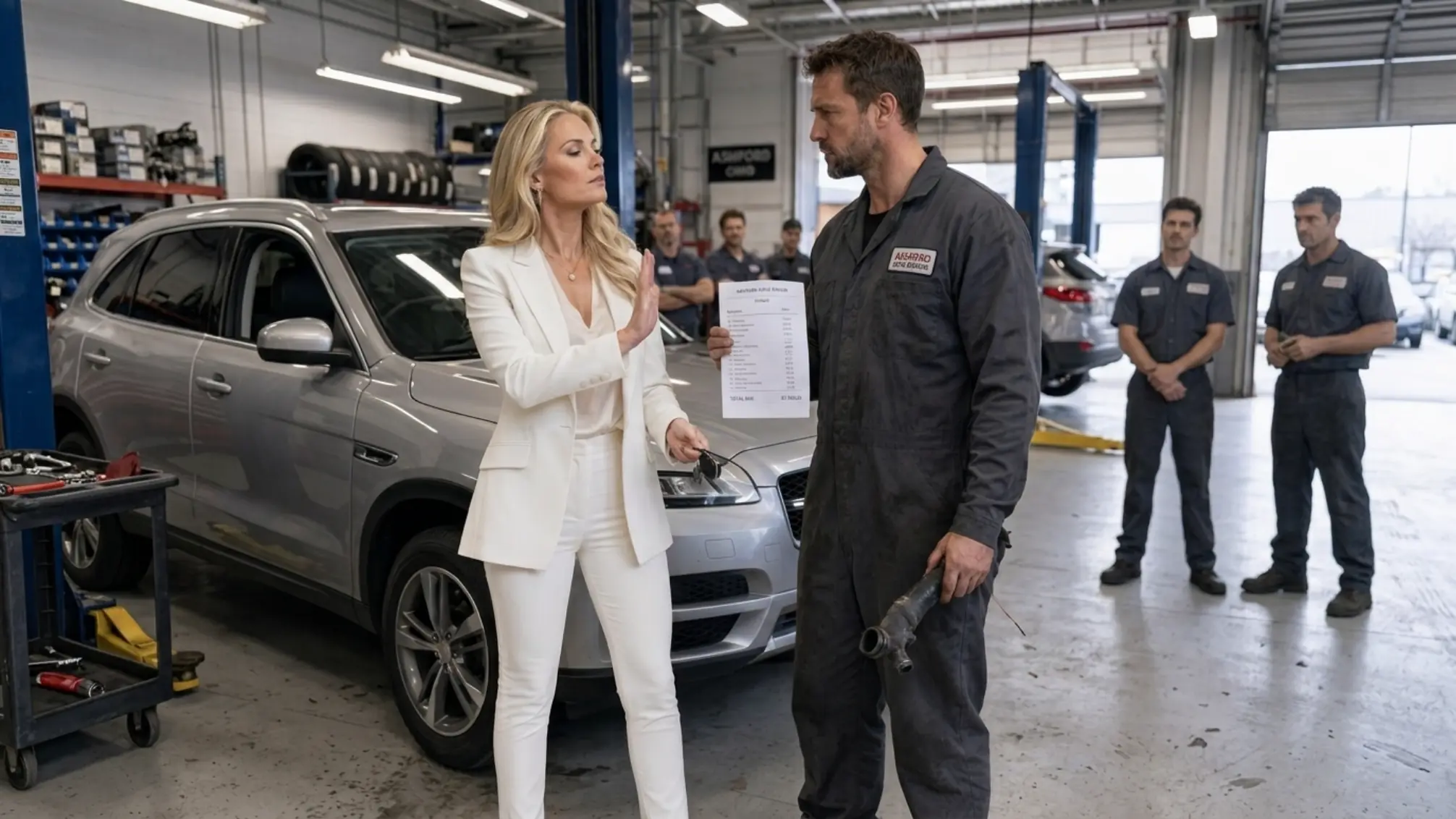
“Three hours,” Ryder said evenly. “The hose split, the thermostat failed, and the coolant had to be replaced. Another ten miles could have destroyed your engine.”
Victoria barely glanced at the damaged part. At thirty-nine, she was the founder and CEO of Sterling Dynamics, one of Ohio’s fastest-growing technology companies. Her tailored white pantsuit, gold jewelry, and pointed heels looked almost unreal against the oil-stained floors and scarred tool cabinets of the small-town garage.
“You’re a small-town mechanic,” she said. “Be grateful I stopped here at all.”
Ryder’s jaw tightened, but his voice remained calm. “The invoice lists every part and every minute of labor.”
“I know how businesses like this operate,” Victoria replied. “You saw an expensive vehicle and assumed the owner would pay whatever number you wrote down.”
Ryder placed the damaged thermostat beside the hose. “I charged less than the dealership would have.”
“That doesn’t make it fair.”
“It makes it honest.”
The word caused a faint silence across the garage. Victoria stared at him, clearly unaccustomed to being contradicted without fear. Then she snatched the keys from the counter and turned toward the repaired SUV.
Ryder stepped from behind the counter but did not block her path. “Ms. Sterling, you authorized the repair.”
“I authorized you to inspect it.”
“You signed the work order.”
“I’m not giving you a single dollar.”
One of the younger mechanics shifted angrily, but Ryder stopped him with a look. He had spent too many years protecting the shop’s reputation to let one humiliating confrontation become a shouting match. Victoria opened the driver’s door, slid behind the wheel, and started the engine he had just saved.
“Drive away,” Ryder said from several feet behind her. “Then explain the invoice when someone finally asks what really happened.”
Victoria lowered the window. “Nobody important is going to ask.”
The SUV disappeared down the road.
For several seconds, the only sound inside the garage came from an air compressor near the back wall. Ryder remained at the open service door, watching the taillights shrink against the Ohio countryside. He was not thinking about revenge or lawsuits.
He was thinking about groceries.
The unpaid invoice represented more than three hours of work. Ryder had purchased the replacement hose and thermostat with money already stretched across several overdue accounts. The utility company had issued another warning, the mortgage payment was late, and his nine-year-old daughter needed new cleats before her next soccer game.
For Victoria, $199 was smaller than the cost of lunch at many of the restaurants she visited.
For Ryder, it was electricity.
He returned to the counter and folded the invoice carefully. One of his mechanics, twenty-four-year-old Caleb Turner, shook his head in disbelief.
“You should have kept the SUV.”
“The repair authorization didn’t give me the right to seize her car.”
“She stole the work.”
“She refused payment. That’s different.”
“Different word, same result.”
Ryder looked toward the employees watching him. “Finish the truck in Bay Three. Mrs. Harper needs it before the clinic opens tomorrow.”
Caleb stared at him. “She still owes us from last month.”
“She paid half.”
“And the other half?”
“She’ll pay when she can.”
Caleb muttered something beneath his breath but returned to work. Ryder understood his frustration. Every act of patience made the business slightly harder to save, yet he could not look at a widow living on retirement income and treat her transportation like leverage.
Callaway Auto Repair had once belonged to Ryder’s father. The building was neither modern nor attractive. Its white paint had faded toward gray, the waiting-room chairs had torn vinyl along their edges, and the coffee machine required a hard strike against its side before it worked.
But people trusted the place.
Ryder repaired what needed repairing and refused to replace what could still be fixed. He gave elderly customers payment plans, inspected vehicles for struggling families without charging, and quietly covered emergency repairs when someone needed a car to keep a job.
Those decisions earned loyalty.
They did not always earn money.
Three years earlier, Ryder’s wife, Emma, had died after a sudden illness that moved faster than either of them could understand. One month she was helping their daughter with a school project at the kitchen table. Two months later, Ryder sat beside a hospital bed holding her hand while monitors slowly became silent.
He became a widower at thirty-five.
From that morning onward, every part of life divided into tasks that once belonged to two people. He packed school lunches before sunrise, opened the garage at seven, worked until soccer practice, cooked dinner, washed uniforms, reviewed homework, and returned to the office after Tessa fell asleep.
He did not feel heroic.
He felt tired.
Yet every morning, Tessa entered the kitchen with Emma’s hazel eyes and reminded him why surrender was not available.
That evening, Ryder closed the garage later than usual. He locked Victoria’s unpaid invoice inside the desk drawer and drove his faded pickup to the community soccer field. Tessa waited beside the fence with her backpack and muddy shoes, her dark ponytail swinging as she ran toward him.
“You’re late,” she said.
“Four minutes.”
“Coach says four minutes can decide a game.”
“Coach sounds exhausting.”
Tessa climbed into the passenger seat and studied his face. “What happened?”
“Nothing.”
“That means something happened.”
Ryder started the truck. “A customer didn’t want to pay.”
“Did you fix the car?”
“Yes.”
“Was it fixed right?”
“Yes.”
“Then why didn’t she pay?”
He glanced at his daughter. “She thought the work wasn’t worth the price.”
Tessa considered that with the seriousness children reserved for things adults had learned to tolerate. “Was she poor?”
“No.”
“Then she was just mean.”
Ryder almost laughed. “Life is usually more complicated than that.”
“Mean people always say that.”
At home, they ate grilled cheese sandwiches and canned tomato soup because Ryder had not had time to shop. Tessa talked about soccer practice, a science project, and the classmate who insisted Pluto deserved to remain a planet. Ryder listened while mentally rearranging bills that no longer fit the money available.
After dinner, he opened the utility notice again.
Tessa watched from across the table. “Are we losing the lights?”
“No.”
“You looked at that paper yesterday.”
“It’s just a bill.”
“Bills make you look sad.”
Ryder folded it. “We’re okay.”
She disappeared into her bedroom and returned a few minutes later carrying a small piece of notebook paper. She placed it beside his plate and slid it toward him.
Ryder unfolded it.
You’re the best dad in the world. Things always get better.
The letters leaned unevenly across the page, surrounded by two small hearts and a drawing of a wrench. Ryder swallowed and looked toward her.
“Where did this come from?”
“My brain.”
“That’s a dangerous place.”
She smiled. “Keep it.”
He placed the note inside his wallet behind Emma’s photograph.
Hours later, after Tessa fell asleep, Ryder returned to the garage office. Rain tapped lightly against the windows while he reviewed payroll, insurance, supplier balances, and the utility warning. The figures showed what he already knew.
The garage had less than two months.
He could cut one employee, delay the mortgage, or sell the tow truck. None of those choices solved the deeper problem. A corporate repair center had opened thirty miles away, advertising low inspection prices before charging customers dealership-level rates for repairs.
Ryder could not compete with its marketing budget.
He rested his forehead against one hand.
Across town, Victoria Sterling sat at the opposite end of a polished dining table from her father.
Theodore Sterling was seventy-two and had built a manufacturing empire before his daughter entered high school. He owned factories, logistics companies, industrial patents, and enough land that local newspapers regularly attempted to calculate his wealth.
Unlike Victoria, Theodore rarely appeared on television. His suits were expensive but plain, his voice was quiet, and he remembered the names of factory employees he had met only once. He had grown up in a two-room house where winter entered through cracks in the walls and meat appeared on the table only twice a week.
Money had changed his circumstances.
He refused to let it erase his memory.
Victoria told him about the garage while describing her day. She expected him to admire how firmly she challenged an inflated bill.
“The mechanic wanted $199,” she said. “For a hose and a thermostat.”
“Did he repair the vehicle?”
“Yes.”
“Does it work correctly?”
“It seems to.”
“Was the price unreasonable?”
Victoria hesitated. “Not technically.”
Theodore set down his fork.
She noticed the change in his expression. “Father, mechanics overcharge people constantly.”
“Did this one?”
“He charged for three hours.”
“Did he spend three hours?”
“I wasn’t standing over him.”
“Did you authorize the work?”
Victoria looked toward the window. “I signed something.”
“Then you refused to pay a fair invoice for work you authorized.”
“You’re making it sound worse than it was.”
Theodore leaned back. “How should it sound?”
“He was rude.”
“What did he say?”
Victoria replayed the exchange and found fewer insults than she remembered. “He told me the work was honest.”
“Was it?”
“Yes, but that isn’t the point.”
“That is exactly the point.”
She placed her glass down sharply. “I built a company by questioning prices. I don’t hand over money just because someone prints a number on paper.”
“You also don’t take completed work without paying for it.”
“It was $199.”
Theodore’s eyes hardened. “Then why did you need to keep it?”
Victoria stared at him.
He rose from the table.
“Where are you going?”
“To discover who my daughter decided was too insignificant to pay.”
Theodore entered his study and made the first of several calls. He spoke with the town clerk, a retired banker, a pastor, a school principal, and the owner of a regional parts supplier. Each person told him a different story about Ryder Callaway.
The banker described a mechanic who had paid a stranded family’s hotel bill during a winter breakdown.
The pastor told him Ryder repaired the church van for the cost of parts after learning it carried elderly residents to medical appointments.
The principal explained that an anonymous donor had funded two vocational scholarships for students entering automotive programs. She discovered Ryder’s identity only when the bank mistakenly included his name on a receipt.
The parts supplier said Ryder always paid eventually, even during months when larger businesses ignored their accounts.
Theodore’s final call went to Ruth Harper, a seventy-six-year-old widow whose truck Ryder’s employees had been repairing when Victoria left.
“He never asks whether helping me is profitable,” Ruth said. “He only asks when I need the truck back.”
By midnight, Theodore had learned enough to be angry.
By two in the morning, he had learned enough to make a decision.
Years earlier, he had established the Sterling Community Growth Fund. It invested in people whose work strengthened towns without attracting wealthy backers: rural doctors, teachers, firefighters, manufacturers, and small-business owners.
The fund rarely gave donations.
It built sustainable systems around trustworthy people.
Theodore reviewed Ryder’s garage, its debts, its reputation, and the regional shortage of affordable technical training. Then he contacted his attorney and instructed him to prepare an investment agreement.
At 8:03 the next morning, a black luxury sedan entered the Callaway Auto Repair parking lot.
Caleb stopped rolling a tire across the floor. Another mechanic leaned beneath a raised hood and stared through the open service doors. Ryder stepped from his office holding a cup of coffee.
Theodore Sterling emerged from the rear seat.
Ryder recognized him immediately.
The older businessman approached and offered his hand. “Mr. Callaway?”
“Yes, sir.”
“I’m Theodore Sterling.”
“I know.”
“I believe you met my daughter.”
Ryder’s expression became guarded. “Yesterday.”
“May we speak privately?”
Inside the office, Theodore noticed the peeling paint, the crowded desk, and the photographs of Tessa taped beside a faded picture of Emma. Ryder cleared invoices from the second chair.
“I assume this concerns the repair bill.”
“It begins there.”
Ryder removed Victoria’s invoice from the drawer. “I documented every part and labor charge. The security cameras recorded the entire repair and our conversation.”
“I believe you.”
Ryder paused.
Theodore placed $199 in cash on the desk, followed by another envelope. “This covers my daughter’s debt.”
Ryder pushed the extra envelope back. “The repair was $199.”
“The second envelope is not payment.”
“Then what is it?”
“Open it.”
Inside was a certified check.
Ryder looked at the figure once, then again, certain exhaustion had changed the number.
$19,000,000.
His hands became still.
“This is a mistake.”
“No.”
“I can’t accept this.”
“It is not a gift.”
Ryder looked up.
Theodore placed a formal proposal beside the check. “My investment fund wants to finance the expansion of Callaway Auto Repair into a regional service and training network. You would retain operational control. Part of the capital would eliminate existing debts, modernize this facility, and establish an apprenticeship program.”
Ryder looked again at the check.
“Why me?”
“Because I spent last night speaking to people who know what you do when no one is watching.”
“That doesn’t make me qualified to manage nineteen million dollars.”
“No. Your financial records, customer retention, repair standards, and employee loyalty make you qualified. Your character makes the investment worth considering.”
Ryder stood and walked toward the small office window. Beyond it, Caleb was pretending not to watch.
“There are better garages.”
“Bigger ones.”
“More profitable ones.”
“Currently.”
Ryder turned. “Your daughter refused to pay me yesterday, and today you’re offering nineteen million dollars. That doesn’t happen in real life.”
Theodore’s expression softened. “Real life changes when someone decides the pattern should not continue.”
Ryder removed Tessa’s note from his wallet. He read the crooked letters again.
Things always get better.
Tears filled his eyes before he could stop them. He sat down slowly and looked at Emma’s photograph on the wall.
“She should be here.”
“Your wife?”
Ryder nodded.
Theodore waited without offering empty comfort.
After several moments, Ryder folded the note carefully. “What happens to my employees?”
“They keep their jobs.”
“My customers?”
“You decide the pricing policies.”
“The people who can’t pay immediately?”
“The proposal includes a community repair fund.”
Ryder finally opened the investment agreement.
He did not sign immediately.
For three days, he reviewed every page with a local attorney, questioned the control provisions, reduced his own proposed salary, and demanded written protection for employees and low-income customers. Theodore agreed to nearly every change.
Victoria did not.
When she learned about the investment, she drove back to Ashford in the repaired SUV. This time she entered the garage without sunglasses and found Ryder reviewing architectural plans beside the same counter where she had refused the invoice.
“You used my father to humiliate me,” she said.
Ryder set down the plans. “I didn’t contact him.”
“He would never have found you without me.”
“That part is true.”
“You think this makes you better than me?”
“No.”
“Then why accept his money?”
“Because it can create jobs and train young mechanics.”
Victoria laughed bitterly. “That sounds noble.”
“It’s supposed to sound practical.”
She stared at him. “You could have sued me.”
“For $199?”
“For what I said in front of your employees.”
“I needed payment, not revenge.”
The answer unsettled her.
Ryder handed her a copy of the original invoice with PAID BY THEODORE STERLING stamped across it.
“You’re free of the debt.”
Victoria looked at the paper. “My father says I have to apologize.”
“You don’t.”
Her eyes lifted.
“An apology ordered by someone else isn’t worth much.”
She remained in the garage for several moments, watching employees move between ordinary vehicles belonging to ordinary families. Then she looked toward the cracked hose still resting on a shelf near the counter.
“You really saved the engine?”
“Yes.”
“How much would replacement have cost?”
“Between eleven and fourteen thousand dollars.”
She looked down at the $199 invoice.
“I was wrong.”
Ryder said nothing.
Victoria’s voice became quieter. “And cruel.”
“That matters more.”
She nodded, folded the invoice, and left.
The transformation of Callaway Auto Repair took eighteen months. The old building was renovated rather than demolished. Ryder kept the scarred counter, the imperfect coffee machine, and the hand-painted sign his father had installed above the entrance.
A second service building opened beside the original garage. It contained modern diagnostic equipment, training classrooms, and twelve apprenticeship bays. Students received paid instruction rather than accumulating debt, and graduates agreed to work in underserved communities for at least two years.
Ryder created an emergency repair fund for families who risked losing employment because of broken vehicles. Theodore insisted the fund carry Emma’s name.
The Emma Callaway Road Home Program repaired hundreds of cars during its first year.
Ryder paid off the garage mortgage and his house but refused to buy a luxury car. He continued driving his old pickup until Tessa complained that the passenger-side window required “a special prayer” to close.
He replaced it with a reliable used truck.
Victoria changed more slowly.
She began visiting manufacturing floors without announcing her arrival. She reviewed contractor payment terms, eliminated policies that delayed small vendors for ninety days, and required executives to spend one day each quarter working beside customer-service and maintenance teams.
Some employees believed the reforms were public relations.
Over time, they realized she was listening.
One afternoon, nearly two years after the unpaid invoice, Victoria returned to the garage carrying no attorney, assistant, or camera crew. Ryder was teaching apprentices how to diagnose a cooling-system failure.
She waited until the class ended.
“My company is building a technical scholarship program,” she said. “We need someone to review it.”
“You have education consultants.”
“I want someone who knows the difference between helping people and making an announcement about helping people.”
Ryder studied her for a moment.
“I’ll review it.”
“Thank you.”
She placed a framed object on the counter. Inside was the original $199 invoice.
Beneath it, a small engraved plate read:
THE MOST EXPENSIVE BILL I EVER REFUSED TO PAY.
Ryder almost smiled. “That’s a strange thing to frame.”
“I needed the reminder.”
Years later, visitors entering the expanded Callaway Training Center expected to see newspaper covers, awards, or a copy of the $19 million check displayed near the office.
They found none of those things.
Beside Ryder’s door hung a small piece of notebook paper protected behind glass. The handwriting was uneven, two hearts surrounded a drawing of a wrench, and the message remained more valuable to him than every number added to the company’s accounts:
You’re the best dad in the world. Things always get better.
Tessa had written it on the night Ryder believed he might lose the garage.
The next morning, a black sedan arrived carrying enough money to change his circumstances. But the investment succeeded because the money did not change the man receiving it.
Ryder never became wealthy because he chased wealth.
He became wealthy because, for years, he treated people as though their dignity mattered more than what they could immediately pay.
Victoria once believed $199 was too much for a small-town mechanic’s work.
Her father understood something she had forgotten:
The most powerful investments are not made in buildings, machines, or companies.
They are made in people who have already proven what they will do when nobody important is watching.