They came because of half a peanut butter sandwich, the only food the girl had left, which she had shared with a starving man on a bench.
She did not know he was important to anyone, and she did not consider what she would lose by giving away part of her only meal. She simply saw a hungry person and shared what she had. Richmond, Virginia, had neighborhoods where streetlights flickered more than they shone, where every other storefront was boarded up, and where the bus arrived late if it came at all.
On the East Side, in one of those neighborhoods, lived nine-year-old Mylah Scott. She was skinny, quiet, and almost never complained, not because everything was fine, but because she had learned early that complaining rarely changed anything. Mylah lived with her grandmother, Lorraine Scott, who was sixty-five and moved carefully because of bad knees and arthritic hands.
Lorraine worked part-time cleaning office buildings on the other side of town, the kind of job where people did not learn her name but noticed immediately if the trash was not emptied.
Lorraine was all Mylah had left. Mylah's mother, Denise, had died three years earlier in a traffic collision on a rainy night, when Mylah was six. Mylah did not talk about her mother often. A photograph of Denise hung on the living room wall, showing a young woman smiling in a yellow sundress. Every morning, Mylah passed that photograph on her way to the kitchen. She never stopped, but she always glanced at it. Their house was small, with two bedrooms, one bathroom, a dripping faucet, and kitchen linoleum peeling at the corners. Yet the house was spotless because Lorraine believed a home could be poor without being dirty.
Cleanliness was one of the few forms of pride hardship had not taken from her. She polished the old furniture, swept the floors, and kept the curtains washed even when she had to choose between detergent and something else they needed. On a Tuesday morning, Mylah woke at six without an alarm. She made her bed, folded her pajamas, and walked into the kitchen. When she opened the refrigerator, she found ketchup, half a stick of butter, and leftover rice from two nights earlier. She closed the door without reacting and opened the cabinet. One jar of peanut butter sat inside, almost scraped clean. There were only two slices of bread left, both heels from the end of the loaf.
Mylah spread the remaining peanut butter across them, pressed them together, wrapped the sandwich in a paper towel, and placed it in her backpack. It was her lunch and the only food she had for the school day. Lorraine emerged from her bedroom moving slowly, one hand gripping the doorframe before she stepped into the hall. Her knees were especially painful that morning. "You eat something, baby?" she asked. "Yes, ma'am. I had cereal." There was no cereal. Mylah lied because she knew Lorraine would skip her own food if she believed her granddaughter was hungry. At nine years old, Mylah already carried the kind of responsibility that should never have belonged to a child. Lorraine sat at the kitchen table beside a stack of envelopes. She opened one bill, tightened her mouth, and placed it facedown. She did the same with another, then picked up the phone and called their landlord. "Mr. Brennan, this is Lorraine Scott. Yes, sir, I know it's overdue. I just need one more week. I get paid Friday, and I can..." She stopped and listened. Her jaw clenched. "Yes, sir. I understand. Thank you." After hanging up, Lorraine pulled another envelope from the stack. She did not open it because she already knew what it contained: a thirty-day eviction notice. Before Mylah returned to the kitchen, Lorraine slid it beneath the fruit bowl. "Grandma, I'm heading out." "You got your lunch?" Mylah patted her backpack. "Yes, ma'am." "You be good." "Always am." Mylah walked down the porch steps and followed the cracked sidewalk six blocks to the bus stop. She passed a payday loan shop glowing with neon signs, a church handing out free coats, and a barber shop where old men sat outside arguing about nothing important. At the bus stop, she sat on the bench, set her backpack on her lap, swung her legs, and hummed a melody her mother used to sing. At the far end of the bench sat a white man in his mid-fifties. He was not merely thin but hollowed out, as if something had been consuming him from the inside for years. His jacket was torn, his hands shook, and he slumped forward with his eyes half closed. He looked as though he had not eaten in days. Mylah looked at him, looked away, then looked back. She did not calculate what she would lose or debate whether helping him was sensible. She reached into her backpack, unwrapped her sandwich, and tore it in half. She did not divide it evenly; she gave him the larger piece. She placed it gently on his knee without touching him or saying a word. The man's eyes opened, and he stared first at the sandwich and then at her. His lips trembled. "Why would you do that?" he asked. Mylah shrugged as casually as if someone had asked why she chose a blue crayon. "You looked hungrier than me." She took a bite from her smaller half and looked toward the street. The bus was approaching from several stops away. The man lifted the sandwich with both trembling hands, took one bite, and closed his eyes as tears rolled down his face. He was not crying only because of the food. He was crying because someone had seen him as a person. For longer than he could remember, people had passed him without really looking. This child had looked directly at him and shared the last thing she had. The bus pulled up. Mylah grabbed her backpack, climbed aboard, and found a seat by the window. She did not wave, wait for thanks, or look back. She was already thinking about her spelling test. The man remained on the bench, holding half a peanut butter sandwich made from the final two slices of bread in a child's home. His shoulders began to shake, and he broke down. Pedestrians continued past him. A woman drew her child closer and crossed the street, while a man in a suit glanced over and kept walking. Across the street, however, a security camera mounted on the wall of a convenience store recorded everything. It captured the sandwich, the tears, and the girl who gave without checking whether anyone was watching. That footage would soon matter more than anyone knew. While Mylah sat in school, Lorraine rode the bus across town to clean three floors of office space. She scrubbed bathrooms, wiped break rooms, and emptied conference room trash cans containing half-eaten lunches. She returned home around four in the afternoon, tired in a way sleep never repaired. A voicemail from Mylah's school waited on the phone. The fourth-grade science museum trip was scheduled for the next month, and the fee was twenty-five dollars. Permission slips were due Friday. Lorraine listened twice, then deleted the message and called the school. "Mylah won't be able to go," she said. "She'll be sick that day." After hanging up, Lorraine stared at the wall. Twenty-five dollars was all the trip cost, yet she did not have it. Mylah came home that evening and immediately sensed that Lorraine was more tired than usual. She did not ask questions. She set down her backpack, completed her homework at the kitchen table, and ate the leftover rice cold with ketchup. Later, in her bedroom, she opened a worn notebook with pages softened from handling. On the first page, in careful nine-year-old handwriting, she had written, "Things I'll buy Grandma when I grow up." Number one was a house with a dishwasher. Number two was new shoes that did not hurt Lorraine's feet. Number three was a very large television so Lorraine could watch her shows without squinting. That night, Mylah added a fourth item: a full refrigerator. She closed the notebook, placed it beneath her pillow, and went to sleep. Across town, at Richmond General Hospital, paramedics wheeled a barely conscious man through the emergency entrance. He was dehydrated and severely malnourished. While checking his pockets for identification, a paramedic found a crumpled veteran's card bearing the name Edward Whitmore. The paramedic froze when he read it. He looked at his partner and said, "Call this in. Now." Downtown Richmond, the police headquarters occupied a building of glass and stone, with security officers wearing earpieces and elevators that did not stop on every floor. On the fifth floor, Commissioner Gerald Whitmore sat behind an oak desk in a corner office. An American flag stood beside photographs of him shaking hands with governors, senators, and generals. Gerald was sixty-two, with silver hair and a jaw that seemed carved from granite. He had led the Richmond Metropolitan Police Department for eleven years and carried the authority of a man accustomed to rooms becoming quieter when he entered. He believed problems should be managed efficiently and privately, without disorder. He was reviewing budget reports when his private line rang. "Commissioner Whitmore," he answered. As he listened, his pen stopped moving and slipped from his hand. "Say that again." He stood and reached for his coat. "Where? Which hospital?" His aide, a young officer near the door, noticed the change. "Sir, is everything all right?" Gerald buttoned his coat and said quietly, "They found Eddie." "Your brother?" Gerald walked past him without answering. Edward Whitmore was fifty-four, eight years younger than Gerald. He had served two tours overseas and returned profoundly changed. The Eddie who left had been loud and funny, the person who made everyone laugh at Thanksgiving. The Eddie who returned barely spoke, could not sleep, could not sit comfortably in crowded rooms, and struggled with severe post-traumatic stress. Alcohol followed, then other forms of self-destruction. Gerald tried to help, but he understood help mostly as control. Two years earlier, he arranged an expensive private treatment program and arrived with paperwork and a car waiting outside. Eddie looked at his brother and said, "I'm not your case to manage, Gerald." Then he walked away and disappeared. For two years, there were no phone calls, no address, and no reliable sightings. Gerald searched at first, filed reports, and sent officers to places Eddie might have gone, but his brother knew how to vanish. After six months, the trail went cold. After a year, Gerald stopped talking about him, not because he stopped caring, but because hope had become too painful. Now Eddie had been found alive at a bus stop in East Richmond, collapsed and barely breathing. Gerald drove himself to the hospital without a motorcade or sirens. He parked, crossed the lobby, and moved toward Room 412 without stopping at the front desk. Inside, Eddie lay beneath a hospital blanket, painfully thin, with an IV in his left hand and monitors beeping beside him. His eyes, however, were open and clear. Gerald stood in the doorway, unable to move or speak. Eddie turned his head and saw him. Two years of silence seemed to fill the room before Eddie spoke. "Before you say anything, I didn't call you. I wouldn't have called you." Gerald swallowed and nodded. "I know." He pulled a chair beside the bed and sat. "Then who found you?" Eddie's expression softened. "A little girl." Gerald leaned forward. "A little girl?" "I was on a bench at the bus stop on Garrison Street. I don't know how many days I'd been there. Two, maybe three. I couldn't stand anymore." "I couldn't think straight. Everything was just noise. Then she sat down." Gerald waited without interrupting. "Little Black girl, nine or ten. Backpack bigger than she was. She sat at the other end of the bench and looked at me. Not the way people usually look. Not the look where they avoid your eyes or decide whether to call somebody. She looked at me like I was a person sitting beside her." Eddie stared at the ceiling. His voice began to crack. "She pulled out a peanut butter sandwich. I could smell it. Then she tore it in half and gave me the bigger piece." Gerald remained still. "I asked her why. You know what she said?" Gerald shook his head. "You looked hungrier than me." The heart monitor continued its steady rhythm. Eddie turned toward his brother with tears in his eyes. "I've been on those streets for two years. Hundreds of people passed me every day. Some threw change. Most pretended I wasn't there. Some told me to get a job." "A nine-year-old girl who clearly didn't have much herself sat beside me and shared her only food. She didn't even give me an equal half. She gave me the bigger one." Gerald stared at his hands. "She didn't know me. She didn't ask my name or ask for anything. She just gave, then got on the bus and left as if it were nothing. That was the first time in two years someone treated me like a human being." Gerald sat silently while the machines filled the room with soft mechanical sounds. Then he took out his phone. "What did she look like?" "Small, thin, school uniform, navy blue. Braids tied with a white ribbon. She boarded the number fourteen bus heading east." Gerald called Lieutenant Brenda Holloway, his community liaison officer. Brenda was organized, observant, and remembered names and details others forgot. "Brenda, I need security footage from the bus stop on Garrison Street this morning between seven and seven-thirty. There's a convenience store camera across the street." Brenda did not ask why. "Give me an hour." She needed only forty minutes. "Commissioner, I have the footage. I'm sending it now." Gerald opened the video and held the phone where Eddie could see it. The footage was grainy but clear enough. A little girl sat on the bench, removed a sandwich wrapped in a paper towel, tore it carefully, and placed the larger piece on the man's knee. She kept the smaller portion, ate it quietly, and boarded the bus. There was no hesitation, performance, or glance toward the camera. It was kindness without an audience. Gerald watched the clip three times before speaking. "Kindness without an audience is the only kind that counts," he said. He lifted the phone again. "Brenda, find this girl. Her name, school, address, everything." Brenda traced the bus route, contacted the school district, and cross-referenced the uniform. Within two hours, she had the information. "Her name is Mylah Scott. Nine years old, fourth grade at Eastwood Elementary. She lives with her grandmother, Lorraine Scott, on Maple Drive. Her mother died three years ago, and there is no father listed in the records." Brenda paused before continuing. "Commissioner, I pulled the household records. The grandmother works part-time as a custodian. They're three months behind on rent, and an eviction notice has been filed." Gerald closed his eyes. The child who had given away her last sandwich was about to lose her home. Eddie had fallen asleep by the time Gerald ended the call. Gerald remained in the hospital room and made three more calls. The first went to the Richmond Police Community Fund. "I need three months of back rent covered for a family in East Richmond. Process it tonight. Keep it anonymous." His second call went to Brenda. "Organize a collection from officers. School supplies, groceries, clothes, whatever people can contribute by morning." Then came the third call. "Brenda, I want fifty officers in full dress uniform at this girl's house tomorrow at seven in the morning." There was silence on the other end. "Fifty, sir?" "Fifty. Line them from the sidewalk to her front door. I want her to open that door and understand that what she did mattered, that someone saw it even though she never thought anyone was watching." Brenda was quiet for another moment. "I'll make it happen." Gerald hung up, looked at his sleeping brother, and pulled the blanket higher over Eddie's shoulders. "She did what I couldn't do," he whispered. "She brought you back. Now we take care of her." That same night, Lorraine tucked Mylah into bed, pulled the covers beneath her chin, and smoothed her braids. "Grandma?" "Yes, baby?" "I gave my sandwich away today to a man at the bus stop. He was really hungry." Lorraine's hand stopped. "You gave your lunch away?" "Just half. I gave him the bigger half, but I wasn't that hungry." She had been hungry all day. She simply did not say so. Lorraine blinked quickly and forced a smile. "That was a kind thing to do, baby." "Is it okay? I know we don't have much." Lorraine stroked her forehead and lied for the second time that day. "We have plenty, sweetheart. Don't you worry." Mylah fell asleep within minutes. Lorraine returned to the kitchen, opened the refrigerator, stared at the empty shelves, then closed the door softly. She sat at the table in darkness, unaware that three months of rent had already been paid and fifty police officers were pressing their dress uniforms for the morning. At six the next morning, the sun was only a thin line of gold along the rooftops of Maple Drive. The neighborhood remained quiet except for a distant dog and the creak of a screen door. Inside the house, Mylah woke as she always did, made her bed, and walked into the kitchen. She opened the cabinet and found no bread, no peanut butter, and nothing else she could pack. She closed it without complaining and poured herself a glass of water. Lorraine was already in the hallway, speaking into the phone with the same careful, tired voice she had used the day before. "Mr. Brennan, I just need until Friday. I'll have something by Friday. Please?" Mylah pretended not to hear. She put on her navy-blue school uniform, tied a white ribbon around her braids, and slipped on her backpack. She did not know the morning was already different. Two blocks away, police cruisers began arriving one by one without lights or sirens. Officers stepped out in full dress uniform, with dark blue coats, brass buttons, white gloves, and polished shoes. They formed two silent rows along the sidewalk, creating a path from the street to Mylah's front porch. Neighbors peeked through blinds and opened doors. People stepped onto porches in bathrobes and slippers, whispering questions. Some assumed someone had been arrested. Others feared something terrible had happened at the Scott house. A dark sedan stopped at the end of the block. Gerald Whitmore stepped out wearing a gray suit rather than a uniform. Behind him, a second vehicle arrived, and Eddie emerged slowly. Eddie wore clean clothes and had received a haircut. He remained thin and slightly unsteady, but he was standing on his own feet. He took a place at the back of the formation, and the last officer in line gave him a respectful nod. Brenda Holloway walked the rows one final time, checked collars and gloves, then looked toward Gerald. "We're ready, sir." Gerald took a breath. "Let's go." Three firm knocks sounded at the Scott family's door. Lorraine froze with the telephone still against her ear. Mylah looked up from the kitchen table. Three more knocks followed. Lorraine ended the call and approached the door slowly. "Mylah, stay behind me." "What's wrong, Grandma?" Lorraine did not answer. Her hand trembled as she turned the knob and opened the door. Fifty officers stood in perfect formation, two rows stretching from the porch to the street. The morning light caught the brass on their uniforms, and their white-gloved hands rested at their sides. Lorraine grabbed the doorframe as her knees weakened. "Oh, my God. What is this? What happened?" Mylah squeezed past her grandmother and stood on the porch in her uniform with her backpack still on. Her eyes widened. "Grandma, did we do something wrong?" Sergeant Darren Cole, a tall, broad-shouldered officer with twenty years of service, stepped forward. He removed his hat and lowered himself to one knee so he could look directly into Mylah's eyes. "Sweetheart, we're not here because you did something wrong. We're here because you did the only thing that was right." Mylah blinked without understanding. Gerald stepped between the two lines of officers and stopped at the foot of the porch. "Mrs. Scott, my name is Gerald Whitmore. I'm the commissioner of the Richmond Metropolitan Police Department." Lorraine stiffened. Every instinct told her that a police commissioner at her door meant bad news. "Ma'am, I'm not here in an official capacity. I'm here as a brother." Gerald removed a tablet from his coat and turned the screen toward Lorraine and Mylah. "Yesterday morning, at the bus stop on Garrison Street, your granddaughter did something extraordinary." He played the security footage. The image showed Mylah sitting on the bench, taking out the sandwich, dividing it, and placing the larger portion on Eddie's knee. Lorraine watched as the girl ate the smaller half and boarded the bus without expecting recognition. Lorraine slowly raised a hand to her mouth. She turned toward her granddaughter. "Baby, you gave away your lunch?" Mylah looked down. "He was hungry, Grandma." "That was all we had." "I know." Lorraine's face crumpled, not from anger but from the knowledge that Mylah had spent the school day hungry and had eaten cold rice with ketchup for dinner without one complaint. She pulled the child into her arms and held her tightly. Gerald waited before continuing. "Mrs. Scott, the man on that bench is my brother, Eddie Whitmore. He's a veteran who served two tours and has been struggling for a long time. For two years, he's been lost to us and to himself." His voice remained controlled, but his eyes were wet. "Yesterday, your granddaughter was the first person in two years who looked at him like he was human. She shared her last meal with him, and because she was there, he is alive. He received medical care and is getting better." Lorraine began to cry quietly. Gerald lowered himself to Mylah's level. "Mylah, do you remember the man you gave your sandwich to?" She nodded. "Do you know who he is?" She shook her head. "His name is Eddie, and he's here." Gerald stepped aside. From the rear of the formation, Eddie moved forward. He wore a clean flannel shirt and jeans, and although his steps were unsteady, his eyes were clear. Mylah recognized him immediately. "Eddie?" She ran down the porch steps and between the officers. Eddie dropped to his knees and caught her in an embrace. Both of them were shaking. "You saved my life with half a sandwich," he whispered into her hair. Mylah did not answer. She simply held on. The officers remained at attention, but many blinked hard. Sergeant Cole turned his head and wiped one eye with the back of a white glove. Lorraine stood on the porch with one hand over her mouth, watching her granddaughter embrace a man she had saved with the only food she possessed. Brenda stepped forward and opened a small velvet box. "Mylah Scott, on behalf of the Richmond Metropolitan Police Department, it is my honor to present you with a civilian commendation medal for an extraordinary act of kindness representing the highest values of our community. You are the youngest person in Richmond's history to receive this honor." Mylah accepted the gold engraved medal with both hands and stared at it. "Grandma, look." Lorraine nodded but could not speak. Gerald then handed her an envelope. "Mrs. Scott, this is from the Richmond Police Community Fund. Your three months of back rent have been paid." Lorraine opened the envelope and read the letter. Her hands trembled, and she looked at Gerald several times without finding words. "Your granddaughter earned this," Gerald said. "Every bit of it." A small truck pulled to the curb. During the night, officers and their families had donated groceries, school supplies, clothing, a new backpack, and a winter coat. Officers carried boxes onto the porch one after another. The neighbors watched from their yards and porches. A woman across the street began to clap. Her husband joined, then the man next door, until applause rolled down Maple Drive. Mylah stood in the center of it with the medal in one hand and Eddie's hand in the other. She could not fully understand what had happened. She only knew that she was not going to be hungry that day. By noon, local reporter Clive Rawlings had posted the security footage along with video of the fifty officers on Maple Drive. His report spread quickly across social media. Within an hour it had ten thousand views, by mid-afternoon two hundred thousand, and by dinner more than a million. Thousands of comments appeared. Many people admitted they had cried over a peanut butter sandwich. Others praised Mylah's humanity and shared stories about strangers who had paid grocery bills, offered directions, provided meals, or simply stopped to listen. A stranger in North Carolina created a crowdfunding page titled, "For Mylah and Lorraine, Because Kindness Deserves a Safety Net." Five thousand dollars arrived in the first hour, then ten thousand, then twenty. Lorraine knew none of this while she stood in the kitchen placing groceries in cabinets and repeatedly touching the cans as if checking that they were real. Mylah sat at the kitchen table doing homework, her medal beside her pencil case. Every few minutes she touched its edge and returned to her worksheet. The attention, however, brought noise as well as kindness. By evening, cruel comments appeared, accusing the police of staging a publicity stunt, questioning why race mattered, and claiming the family was being used for emotional spectacle. Lorraine found the comments when a neighbor sent her a link. She should not have read them, but she did. Each one twisted her granddaughter's private act into something ugly. Lorraine turned off the phone, placed it facedown, and sat at the kitchen table as the peaceful air in the house changed. The next morning, Lorraine called Gerald. "Mr. Whitmore, I want to thank you for everything you've done, but I need to say something. I don't want my granddaughter to become a display or a headline." "She's nine years old. She gave a man a sandwich because she's a good child. That's all." Gerald listened without interrupting. "She didn't do it for a medal or cameras. I don't want her growing up believing kindness only matters when someone is filming. You said yesterday that kindness without an audience is the kind that counts. That's what Mylah did, and now it feels as though we've put an audience around it. I don't like that." Gerald remained silent for a long time. Lorraine's words held up a mirror to his actions. He had praised kindness without an audience, then created the largest audience in Richmond. "You're right, Mrs. Scott," he said. "And I'm sorry." That afternoon, Gerald declined every interview request and ended media access to the family. Through Brenda, the department issued a statement explaining that the Scott family had asked for privacy and that their request would be honored. Brenda contacted the crowdfunding platform and asked that comments be disabled. Donations continued, but the noise stopped. That evening, Eddie called Mylah from the hospital. "Hey, kid. Are you doing okay?" "I'm okay. Are you eating?" Eddie laughed, the first genuine laugh he had produced in years. "Yeah. Three meals a day. They won't let me skip." "Good." After a pause, Mylah said, "Eddie, I don't like being on the internet." "Me neither, kid." "Can it just be normal again?" Eddie looked out the hospital window. "It's going to be better than normal. I promise." Two weeks later, Eddie remained at the VA hospital, but he had changed. He ate three meals each day, slept through most nights, walked the hallways in the mornings, and spoke with counselors because he wanted to rather than because anyone forced him. He also began occupational therapy in the hospital wood shop. The instructor taught him to carve simple birds with smooth edges. Eddie discovered that the repetition, the scraping of the blade, and the grain slowly revealing itself quieted his thoughts. He was especially proud of a small wren he had been sanding for three days. A nurse asked, "Who is that for?" Eddie held the bird toward the light. "For the girl who sat with me." Gerald, meanwhile, practiced something unfamiliar: asking permission. One afternoon, he sat beside Eddie in the hospital courtyard. They were on a different bench in a different world, but the silence between them remained recognizable. "I talked to the VA director," Gerald said. "There's a full rehabilitation program with housing support, job training, counseling, and long-term care. It's not a thirty-day program. It's the real kind." Eddie stared at the trees. "I'm not telling you to do it," Gerald added quickly. "I'm asking. It's your choice." Eddie turned toward him. "Two years ago, you showed up with papers and a car and told me I was going whether I liked it or not. Do you remember what I said?" Gerald nodded. "You said you weren't my case to manage." "And I meant it. So what's different now?" Gerald looked down at his hands. "I watched that video from the bus stop and saw that little girl sit down. She didn't give a speech or try to fix everything. She just sat beside you and shared what she had." He swallowed before continuing. "I realized that was what you needed from me. You didn't need me to manage you. You needed me to be there, the way she was." Eddie studied his brother's face, searching for a hidden calculation. For once, he found none. "You really mean that?" "I do." Eddie looked back at the trees. A bird landed on the fence and hopped along the railing. "Okay, but I decide. Every step, I decide." "You decide." "If I want to stop, I stop. No guilt and no pressure." "No pressure." Eddie released a long breath. "Okay." There was no handshake or embrace, only the word. Yet Gerald's eyes were red when he stood, and Eddie pretended not to notice. Soon afterward, Lorraine received a letter from the Richmond Community Justice Center. Because envelopes had so often carried bad news, she opened it cautiously. The letter explained that Brenda Holloway had referred her rental case to the organization and that a pro bono attorney had reviewed the lease. The attorney had found years of unlawful charges. Mr. Brennan had added maintenance fees for repairs never made, hidden improper costs in the fine print, and imposed a late penalty three times higher than the legal limit. The letter offered free representation and stated that a formal complaint had already been filed with the housing authority. Lorraine sat at the same kitchen table where she had once hidden the eviction notice. She read every line twice, then called the number at the bottom. "Ms. Dawson? This is Lorraine Scott. I received your letter." "Mrs. Scott, thank you for calling. You have a very strong case. Your landlord has been violating the law for at least three years. We can have the eviction notice dismissed and reduce your rent by approximately forty percent." Lorraine pressed one hand flat against the table. "Nobody ever told me I had rights." Claire Dawson's voice softened. "You do, Mrs. Scott, and we're going to make sure they're respected." Two days later, the eviction was canceled and the lease renegotiated. Lorraine's monthly payment fell by nearly half. She no longer had to beg Mr. Brennan for one more week. Gerald did not call a judge, send an officer, or use his office to force the result. Brenda saw a family in need and connected Lorraine with a legal professional. Claire used the law as it was intended. The outcome came not from improper influence, but from people doing their jobs and caring enough to connect the right pieces. On the evening the agreement became official, Lorraine returned from work and opened the refrigerator. It was full. Crowdfunding donations had provided gift cards and grocery deliveries, and a local church had organized a food drive for the family. Mylah was working at the kitchen table. She looked up and asked, "Grandma, why is the refrigerator so full?" Lorraine set down her bag and smiled more genuinely than she had in years. "Because people remembered how to be fair, baby." Mylah tilted her head. "What do you mean?" "Sometimes the world gets it right. Not always, but sometimes." Mylah thought about that, nodded, and returned to her homework. Lorraine opened the refrigerator again simply to look at the shelves: milk, eggs, bread, and more than the two unwanted heels from the end of a loaf. She closed her eyes and whispered too softly for Mylah to hear, "Thank you, Denise. Our baby is going to be all right." Then she wiped her eyes and began preparing a real dinner with enough for seconds. One month later, warm October sunlight stretched across the Scott kitchen. Lorraine stood at the stove stirring homemade chicken soup filled with vegetables and broth. It was the kind of meal whose smell filled a house with the certainty that someone inside was loved. A gentle knock sounded at the door. This time there were no rows of officers, only one man standing on the porch. Mylah ran to answer it. Eddie wore a clean flannel shirt, jeans that fit, and neatly trimmed hair. He was still thin, but his eyes were steady, clear, and present. He held something behind his back. "Hey, kid." "Eddie!" Mylah grabbed his hand and pulled him inside. "Grandma made soup, the real kind." "I know. I could smell it from the sidewalk." Lorraine came from the kitchen, wiping her hands on a towel. "You look good, Eddie." "I feel good, Mrs. Scott. That's the first time I've been able to say that and mean it." He brought his hand forward and revealed the wooden bird. It was small, smooth, and carefully finished. Eddie knelt beside Mylah. "I made this for you in the hospital wood shop. It's a wren." Mylah accepted it as carefully as she had accepted the medal. "Why a wren?" Eddie considered the little bird in her hands. "Because it's small, but it still has a song people can hear." They ate soup together at the small kitchen table. Eddie's hand trembled slightly when he lifted his spoon. Mylah noticed without drawing attention to it and moved the bread closer so he could reach it easily. Lorraine said grace, and Eddie bowed his head. It was the first time in more than two years that he had eaten at a table with people who felt like family. After dinner, Mylah asked about his time in the service. Eddie avoided the painful parts and told her a funny story about a sergeant who was terrified of spiders. Mylah laughed until she snorted, Lorraine laughed at Mylah, and Eddie laughed at both of them. The kitchen, table, and house were all small. Yet nothing about the evening felt small. After Eddie left, Mylah and Lorraine sat together on the porch while fireflies began blinking in the yard. Mylah held the wooden wren in her lap. Lorraine wrapped an arm around her shoulders. "Do you know why I'm proud of you?" "Because I helped Eddie?" Lorraine shook her head. "Because you helped him when nobody was watching." Mylah rested her head against her grandmother's shoulder and closed her eyes. The porch creaked beneath them as the evening sky turned purple. Six months later, Eddie lived in a clean, quiet apartment near the VA. It was not luxurious, but it was his. Three wooden birds stood on the windowsill, each carved by his own hands. He volunteered at a veterans shelter on weekends and taught other men how to work with wood. When someone called himself broken, Eddie always gave the same answer. "You're not broken. You're stuck. There's a difference." Every Sunday, Eddie drove to Maple Drive for dinner. The Scott family's table now had three permanent chairs. Mylah's school created a program called the Kindness Bench. A wooden bench was placed near the front entrance, where any student who needed companionship could sit. A teacher, counselor, or another child would always come and join them. A plaque on the side read, "Inspired by Mylah Scott, because sitting down matters." Lorraine eventually received the dishwasher Mylah had promised to buy her someday. When it was installed, Mylah opened the notebook beneath her pillow, found the first item on her list, and crossed it out with a thick red marker. She grinned until her cheeks hurt. Gerald attended an addiction awareness fundraiser. He did not speak from the stage or arrange photographs. He sat in the back row, listened, and learned. Afterward, he sent an anonymous donation to Mylah's school with no note, no name, and no audience. What began with half a peanut butter sandwich changed several lives because a nine-year-old child with almost nothing chose to share. She did not know the starving man was the police commissioner's brother. She did not know a camera was recording or that fifty officers would one day stand outside her home. She saw someone who was hungry and sat beside him. That was all. Yet it brought Eddie back to treatment, taught Gerald how to support his brother without controlling him, connected Lorraine with legal protection, and gave Mylah's school a place where lonely children would no longer have to sit alone. The wooden wren remained on Mylah's dresser beside the civilian commendation medal. She valued both, but the bird meant something the medal never could. It came from the man on the bench, carved by hands that had once been too weak to hold half a sandwich. Sometimes Mylah opened her notebook and read the remaining promises. New shoes for Lorraine. A large television. A full refrigerator. The refrigerator was full now, and the shoes would come soon enough. The largest change, however, could not be crossed from a list. Mylah no longer believed she and Lorraine were invisible. Lorraine no longer believed she had to face every envelope alone. Eddie no longer believed the world had forgotten he was human. All of it began on a bus-stop bench when Mylah gave away the larger half.Fifty police officers showed up at a nine-year-old girl's door. They were not there to arrest anyone or deliver bad news. They came because of half a peanut butter sandwich, the only food the girl had left, which she had shared with a starving man on a bench. She did not know he was important to anyone, and she did not consider what she would lose by giving away part of her only meal. She simply saw a hungry person and shared what she had.
Richmond, Virginia, had neighborhoods where streetlights flickered more than they shone, where every other storefront was boarded up, and where the bus arrived late if it came at all. On the East Side, in one of those neighborhoods, lived nine-year-old Mylah Scott. She was skinny, quiet, and almost never complained, not because everything was fine, but because she had learned early that complaining rarely changed anything.
Mylah lived with her grandmother, Lorraine Scott, who was sixty-five and moved carefully because of bad knees and arthritic hands. Lorraine worked part-time cleaning office buildings on the other side of town, the kind of job where people did not learn her name but noticed immediately if the trash was not emptied. Lorraine was all Mylah had left. Mylah's mother, Denise, had died three years earlier in a traffic collision on a rainy night, when Mylah was six.
Mylah did not talk about her mother often. A photograph of Denise hung on the living room wall, showing a young woman smiling in a yellow sundress. Every morning, Mylah passed that photograph on her way to the kitchen. She never stopped, but she always glanced at it.
Their house was small, with two bedrooms, one bathroom, a dripping faucet, and kitchen linoleum peeling at the corners. Yet the house was spotless because Lorraine believed a home could be poor without being dirty. Cleanliness was one of the few forms of pride hardship had not taken from her. She polished the old furniture, swept the floors, and kept the curtains washed even when she had to choose between detergent and something else they needed.
On a Tuesday morning, Mylah woke at six without an alarm. She made her bed, folded her pajamas, and walked into the kitchen. When she opened the refrigerator, she found ketchup, half a stick of butter, and leftover rice from two nights earlier. She closed the door without reacting and opened the cabinet.
One jar of peanut butter sat inside, almost scraped clean. There were only two slices of bread left, both heels from the end of the loaf. Mylah spread the remaining peanut butter across them, pressed them together, wrapped the sandwich in a paper towel, and placed it in her backpack. It was her lunch and the only food she had for the school day.
Lorraine emerged from her bedroom moving slowly, one hand gripping the doorframe before she stepped into the hall. Her knees were especially painful that morning. "You eat something, baby?" she asked.
"Yes, ma'am. I had cereal."
There was no cereal. Mylah lied because she knew Lorraine would skip her own food if she believed her granddaughter was hungry. At nine years old, Mylah already carried the kind of responsibility that should never have belonged to a child.
Lorraine sat at the kitchen table beside a stack of envelopes. She opened one bill, tightened her mouth, and placed it facedown. She did the same with another, then picked up the phone and called their landlord.
"Mr. Brennan, this is Lorraine Scott. Yes, sir, I know it's overdue. I just need one more week. I get paid Friday, and I can..."
She stopped and listened. Her jaw clenched. "Yes, sir. I understand. Thank you."
After hanging up, Lorraine pulled another envelope from the stack. She did not open it because she already knew what it contained: a thirty-day eviction notice. Before Mylah returned to the kitchen, Lorraine slid it beneath the fruit bowl.
"Grandma, I'm heading out."
"You got your lunch?"
Mylah patted her backpack. "Yes, ma'am."
"You be good."
"Always am."
Mylah walked down the porch steps and followed the cracked sidewalk six blocks to the bus stop. She passed a payday loan shop glowing with neon signs, a church handing out free coats, and a barber shop where old men sat outside arguing about nothing important. At the bus stop, she sat on the bench, set her backpack on her lap, swung her legs, and hummed a melody her mother used to sing.
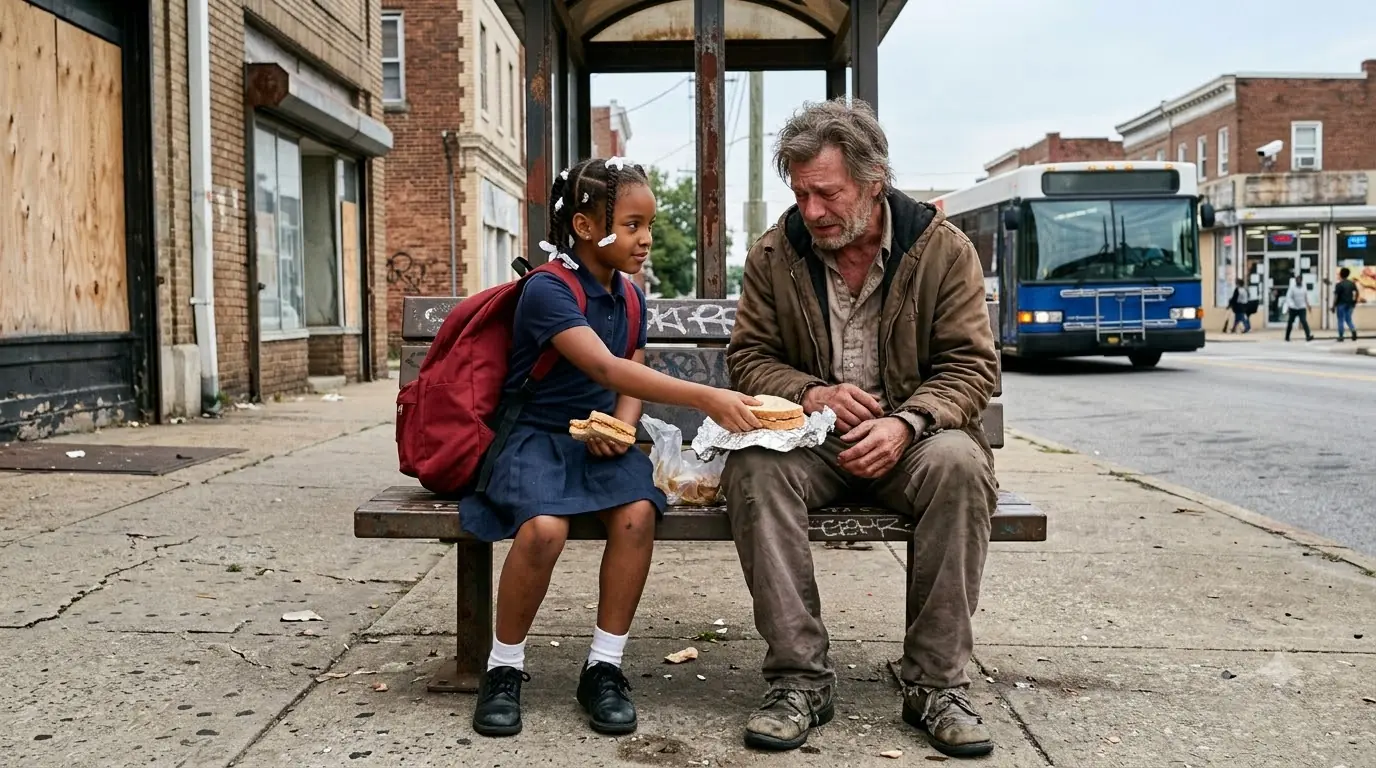
At the far end of the bench sat a white man in his mid-fifties. He was not merely thin but hollowed out, as if something had been consuming him from the inside for years. His jacket was torn, his hands shook, and he slumped forward with his eyes half closed. He looked as though he had not eaten in days.
Mylah looked at him, looked away, then looked back. She did not calculate what she would lose or debate whether helping him was sensible. She reached into her backpack, unwrapped her sandwich, and tore it in half. She did not divide it evenly; she gave him the larger piece.
She placed it gently on his knee without touching him or saying a word. The man's eyes opened, and he stared first at the sandwich and then at her. His lips trembled.
"Why would you do that?" he asked.
Mylah shrugged as casually as if someone had asked why she chose a blue crayon. "You looked hungrier than me."
She took a bite from her smaller half and looked toward the street. The bus was approaching from several stops away. The man lifted the sandwich with both trembling hands, took one bite, and closed his eyes as tears rolled down his face.
He was not crying only because of the food. He was crying because someone had seen him as a person. For longer than he could remember, people had passed him without really looking. This child had looked directly at him and shared the last thing she had.
The bus pulled up. Mylah grabbed her backpack, climbed aboard, and found a seat by the window. She did not wave, wait for thanks, or look back. She was already thinking about her spelling test.
The man remained on the bench, holding half a peanut butter sandwich made from the final two slices of bread in a child's home. His shoulders began to shake, and he broke down. Pedestrians continued past him. A woman drew her child closer and crossed the street, while a man in a suit glanced over and kept walking.
Across the street, however, a security camera mounted on the wall of a convenience store recorded everything. It captured the sandwich, the tears, and the girl who gave without checking whether anyone was watching. That footage would soon matter more than anyone knew.
While Mylah sat in school, Lorraine rode the bus across town to clean three floors of office space. She scrubbed bathrooms, wiped break rooms, and emptied conference room trash cans containing half-eaten lunches. She returned home around four in the afternoon, tired in a way sleep never repaired.
A voicemail from Mylah's school waited on the phone. The fourth-grade science museum trip was scheduled for the next month, and the fee was twenty-five dollars. Permission slips were due Friday. Lorraine listened twice, then deleted the message and called the school.
"Mylah won't be able to go," she said. "She'll be sick that day."
After hanging up, Lorraine stared at the wall. Twenty-five dollars was all the trip cost, yet she did not have it.
Mylah came home that evening and immediately sensed that Lorraine was more tired than usual. She did not ask questions. She set down her backpack, completed her homework at the kitchen table, and ate the leftover rice cold with ketchup.
Later, in her bedroom, she opened a worn notebook with pages softened from handling. On the first page, in careful nine-year-old handwriting, she had written, "Things I'll buy Grandma when I grow up." Number one was a house with a dishwasher. Number two was new shoes that did not hurt Lorraine's feet. Number three was a very large television so Lorraine could watch her shows without squinting.
That night, Mylah added a fourth item: a full refrigerator. She closed the notebook, placed it beneath her pillow, and went to sleep.
Across town, at Richmond General Hospital, paramedics wheeled a barely conscious man through the emergency entrance. He was dehydrated and severely malnourished. While checking his pockets for identification, a paramedic found a crumpled veteran's card bearing the name Edward Whitmore.
The paramedic froze when he read it. He looked at his partner and said, "Call this in. Now."
Downtown Richmond, the police headquarters occupied a building of glass and stone, with security officers wearing earpieces and elevators that did not stop on every floor. On the fifth floor, Commissioner Gerald Whitmore sat behind an oak desk in a corner office. An American flag stood beside photographs of him shaking hands with governors, senators, and generals.
Gerald was sixty-two, with silver hair and a jaw that seemed carved from granite. He had led the Richmond Metropolitan Police Department for eleven years and carried the authority of a man accustomed to rooms becoming quieter when he entered. He believed problems should be managed efficiently and privately, without disorder.
He was reviewing budget reports when his private line rang. "Commissioner Whitmore," he answered.
As he listened, his pen stopped moving and slipped from his hand. "Say that again."
He stood and reached for his coat. "Where? Which hospital?"
His aide, a young officer near the door, noticed the change. "Sir, is everything all right?"
Gerald buttoned his coat and said quietly, "They found Eddie."
"Your brother?"
Gerald walked past him without answering.
Edward Whitmore was fifty-four, eight years younger than Gerald. He had served two tours overseas and returned profoundly changed. The Eddie who left had been loud and funny, the person who made everyone laugh at Thanksgiving. The Eddie who returned barely spoke, could not sleep, could not sit comfortably in crowded rooms, and struggled with severe post-traumatic stress.
Alcohol followed, then other forms of self-destruction. Gerald tried to help, but he understood help mostly as control. Two years earlier, he arranged an expensive private treatment program and arrived with paperwork and a car waiting outside.
Eddie looked at his brother and said, "I'm not your case to manage, Gerald."
Then he walked away and disappeared. For two years, there were no phone calls, no address, and no reliable sightings. Gerald searched at first, filed reports, and sent officers to places Eddie might have gone, but his brother knew how to vanish. After six months, the trail went cold. After a year, Gerald stopped talking about him, not because he stopped caring, but because hope had become too painful.
Now Eddie had been found alive at a bus stop in East Richmond, collapsed and barely breathing. Gerald drove himself to the hospital without a motorcade or sirens. He parked, crossed the lobby, and moved toward Room 412 without stopping at the front desk.
Inside, Eddie lay beneath a hospital blanket, painfully thin, with an IV in his left hand and monitors beeping beside him. His eyes, however, were open and clear. Gerald stood in the doorway, unable to move or speak.
Eddie turned his head and saw him. Two years of silence seemed to fill the room before Eddie spoke.
"Before you say anything, I didn't call you. I wouldn't have called you."
Gerald swallowed and nodded. "I know."
He pulled a chair beside the bed and sat. "Then who found you?"
Eddie's expression softened. "A little girl."
Gerald leaned forward. "A little girl?"
"I was on a bench at the bus stop on Garrison Street. I don't know how many days I'd been there. Two, maybe three. I couldn't stand anymore."
"I couldn't think straight. Everything was just noise. Then she sat down."
Gerald waited without interrupting.
"Little Black girl, nine or ten. Backpack bigger than she was. She sat at the other end of the bench and looked at me. Not the way people usually look. Not the look where they avoid your eyes or decide whether to call somebody. She looked at me like I was a person sitting beside her."
Eddie stared at the ceiling. His voice began to crack.
"She pulled out a peanut butter sandwich. I could smell it. Then she tore it in half and gave me the bigger piece."
Gerald remained still.
"I asked her why. You know what she said?"
Gerald shook his head.
"You looked hungrier than me."
The heart monitor continued its steady rhythm. Eddie turned toward his brother with tears in his eyes.
"I've been on those streets for two years. Hundreds of people passed me every day. Some threw change. Most pretended I wasn't there. Some told me to get a job."
"A nine-year-old girl who clearly didn't have much herself sat beside me and shared her only food. She didn't even give me an equal half. She gave me the bigger one."
Gerald stared at his hands.
"She didn't know me. She didn't ask my name or ask for anything. She just gave, then got on the bus and left as if it were nothing. That was the first time in two years someone treated me like a human being."
Gerald sat silently while the machines filled the room with soft mechanical sounds. Then he took out his phone.
"What did she look like?"
"Small, thin, school uniform, navy blue. Braids tied with a white ribbon. She boarded the number fourteen bus heading east."
Gerald called Lieutenant Brenda Holloway, his community liaison officer. Brenda was organized, observant, and remembered names and details others forgot.
"Brenda, I need security footage from the bus stop on Garrison Street this morning between seven and seven-thirty. There's a convenience store camera across the street."
Brenda did not ask why. "Give me an hour."
She needed only forty minutes. "Commissioner, I have the footage. I'm sending it now."
Gerald opened the video and held the phone where Eddie could see it. The footage was grainy but clear enough. A little girl sat on the bench, removed a sandwich wrapped in a paper towel, tore it carefully, and placed the larger piece on the man's knee. She kept the smaller portion, ate it quietly, and boarded the bus.
There was no hesitation, performance, or glance toward the camera. It was kindness without an audience. Gerald watched the clip three times before speaking.
"Kindness without an audience is the only kind that counts," he said.
He lifted the phone again. "Brenda, find this girl. Her name, school, address, everything."
Brenda traced the bus route, contacted the school district, and cross-referenced the uniform. Within two hours, she had the information.
"Her name is Mylah Scott. Nine years old, fourth grade at Eastwood Elementary. She lives with her grandmother, Lorraine Scott, on Maple Drive. Her mother died three years ago, and there is no father listed in the records."
Brenda paused before continuing. "Commissioner, I pulled the household records. The grandmother works part-time as a custodian. They're three months behind on rent, and an eviction notice has been filed."
Gerald closed his eyes. The child who had given away her last sandwich was about to lose her home.
Eddie had fallen asleep by the time Gerald ended the call. Gerald remained in the hospital room and made three more calls. The first went to the Richmond Police Community Fund.
"I need three months of back rent covered for a family in East Richmond. Process it tonight. Keep it anonymous."
His second call went to Brenda. "Organize a collection from officers. School supplies, groceries, clothes, whatever people can contribute by morning."
Then came the third call. "Brenda, I want fifty officers in full dress uniform at this girl's house tomorrow at seven in the morning."
There was silence on the other end. "Fifty, sir?"
"Fifty. Line them from the sidewalk to her front door. I want her to open that door and understand that what she did mattered, that someone saw it even though she never thought anyone was watching."
Brenda was quiet for another moment. "I'll make it happen."
Gerald hung up, looked at his sleeping brother, and pulled the blanket higher over Eddie's shoulders. "She did what I couldn't do," he whispered. "She brought you back. Now we take care of her."
That same night, Lorraine tucked Mylah into bed, pulled the covers beneath her chin, and smoothed her braids.
"Grandma?"
"Yes, baby?"
"I gave my sandwich away today to a man at the bus stop. He was really hungry."
Lorraine's hand stopped. "You gave your lunch away?"
"Just half. I gave him the bigger half, but I wasn't that hungry."
She had been hungry all day. She simply did not say so.
Lorraine blinked quickly and forced a smile. "That was a kind thing to do, baby."
"Is it okay? I know we don't have much."
Lorraine stroked her forehead and lied for the second time that day. "We have plenty, sweetheart. Don't you worry."
Mylah fell asleep within minutes. Lorraine returned to the kitchen, opened the refrigerator, stared at the empty shelves, then closed the door softly. She sat at the table in darkness, unaware that three months of rent had already been paid and fifty police officers were pressing their dress uniforms for the morning.
At six the next morning, the sun was only a thin line of gold along the rooftops of Maple Drive. The neighborhood remained quiet except for a distant dog and the creak of a screen door. Inside the house, Mylah woke as she always did, made her bed, and walked into the kitchen.
She opened the cabinet and found no bread, no peanut butter, and nothing else she could pack. She closed it without complaining and poured herself a glass of water. Lorraine was already in the hallway, speaking into the phone with the same careful, tired voice she had used the day before.
"Mr. Brennan, I just need until Friday. I'll have something by Friday. Please?"
Mylah pretended not to hear. She put on her navy-blue school uniform, tied a white ribbon around her braids, and slipped on her backpack. She did not know the morning was already different.
Two blocks away, police cruisers began arriving one by one without lights or sirens. Officers stepped out in full dress uniform, with dark blue coats, brass buttons, white gloves, and polished shoes. They formed two silent rows along the sidewalk, creating a path from the street to Mylah's front porch.
Neighbors peeked through blinds and opened doors. People stepped onto porches in bathrobes and slippers, whispering questions. Some assumed someone had been arrested. Others feared something terrible had happened at the Scott house.
A dark sedan stopped at the end of the block. Gerald Whitmore stepped out wearing a gray suit rather than a uniform. Behind him, a second vehicle arrived, and Eddie emerged slowly.
Eddie wore clean clothes and had received a haircut. He remained thin and slightly unsteady, but he was standing on his own feet. He took a place at the back of the formation, and the last officer in line gave him a respectful nod.
Brenda Holloway walked the rows one final time, checked collars and gloves, then looked toward Gerald. "We're ready, sir."
Gerald took a breath. "Let's go."
Three firm knocks sounded at the Scott family's door. Lorraine froze with the telephone still against her ear. Mylah looked up from the kitchen table.
Three more knocks followed. Lorraine ended the call and approached the door slowly.
"Mylah, stay behind me."
"What's wrong, Grandma?"
Lorraine did not answer. Her hand trembled as she turned the knob and opened the door.
Fifty officers stood in perfect formation, two rows stretching from the porch to the street. The morning light caught the brass on their uniforms, and their white-gloved hands rested at their sides. Lorraine grabbed the doorframe as her knees weakened.
"Oh, my God. What is this? What happened?"
Mylah squeezed past her grandmother and stood on the porch in her uniform with her backpack still on. Her eyes widened.
"Grandma, did we do something wrong?"
Sergeant Darren Cole, a tall, broad-shouldered officer with twenty years of service, stepped forward. He removed his hat and lowered himself to one knee so he could look directly into Mylah's eyes.
"Sweetheart, we're not here because you did something wrong. We're here because you did the only thing that was right."
Mylah blinked without understanding. Gerald stepped between the two lines of officers and stopped at the foot of the porch.
"Mrs. Scott, my name is Gerald Whitmore. I'm the commissioner of the Richmond Metropolitan Police Department."
Lorraine stiffened. Every instinct told her that a police commissioner at her door meant bad news.
"Ma'am, I'm not here in an official capacity. I'm here as a brother."
Gerald removed a tablet from his coat and turned the screen toward Lorraine and Mylah. "Yesterday morning, at the bus stop on Garrison Street, your granddaughter did something extraordinary."
He played the security footage. The image showed Mylah sitting on the bench, taking out the sandwich, dividing it, and placing the larger portion on Eddie's knee. Lorraine watched as the girl ate the smaller half and boarded the bus without expecting recognition.
Lorraine slowly raised a hand to her mouth. She turned toward her granddaughter.
"Baby, you gave away your lunch?"
Mylah looked down. "He was hungry, Grandma."
"That was all we had."
"I know."
Lorraine's face crumpled, not from anger but from the knowledge that Mylah had spent the school day hungry and had eaten cold rice with ketchup for dinner without one complaint. She pulled the child into her arms and held her tightly.
Gerald waited before continuing. "Mrs. Scott, the man on that bench is my brother, Eddie Whitmore. He's a veteran who served two tours and has been struggling for a long time. For two years, he's been lost to us and to himself."
His voice remained controlled, but his eyes were wet. "Yesterday, your granddaughter was the first person in two years who looked at him like he was human. She shared her last meal with him, and because she was there, he is alive. He received medical care and is getting better."
Lorraine began to cry quietly. Gerald lowered himself to Mylah's level.
"Mylah, do you remember the man you gave your sandwich to?"
She nodded.
"Do you know who he is?"
She shook her head.
"His name is Eddie, and he's here."
Gerald stepped aside. From the rear of the formation, Eddie moved forward. He wore a clean flannel shirt and jeans, and although his steps were unsteady, his eyes were clear.
Mylah recognized him immediately. "Eddie?"
She ran down the porch steps and between the officers. Eddie dropped to his knees and caught her in an embrace. Both of them were shaking.
"You saved my life with half a sandwich," he whispered into her hair.
Mylah did not answer. She simply held on.
The officers remained at attention, but many blinked hard. Sergeant Cole turned his head and wiped one eye with the back of a white glove. Lorraine stood on the porch with one hand over her mouth, watching her granddaughter embrace a man she had saved with the only food she possessed.
Brenda stepped forward and opened a small velvet box. "Mylah Scott, on behalf of the Richmond Metropolitan Police Department, it is my honor to present you with a civilian commendation medal for an extraordinary act of kindness representing the highest values of our community. You are the youngest person in Richmond's history to receive this honor."
Mylah accepted the gold engraved medal with both hands and stared at it. "Grandma, look."
Lorraine nodded but could not speak. Gerald then handed her an envelope.
"Mrs. Scott, this is from the Richmond Police Community Fund. Your three months of back rent have been paid."
Lorraine opened the envelope and read the letter. Her hands trembled, and she looked at Gerald several times without finding words.
"Your granddaughter earned this," Gerald said. "Every bit of it."
A small truck pulled to the curb. During the night, officers and their families had donated groceries, school supplies, clothing, a new backpack, and a winter coat. Officers carried boxes onto the porch one after another.
The neighbors watched from their yards and porches. A woman across the street began to clap. Her husband joined, then the man next door, until applause rolled down Maple Drive.
Mylah stood in the center of it with the medal in one hand and Eddie's hand in the other. She could not fully understand what had happened. She only knew that she was not going to be hungry that day.
By noon, local reporter Clive Rawlings had posted the security footage along with video of the fifty officers on Maple Drive. His report spread quickly across social media. Within an hour it had ten thousand views, by mid-afternoon two hundred thousand, and by dinner more than a million.
Thousands of comments appeared. Many people admitted they had cried over a peanut butter sandwich. Others praised Mylah's humanity and shared stories about strangers who had paid grocery bills, offered directions, provided meals, or simply stopped to listen.
A stranger in North Carolina created a crowdfunding page titled, "For Mylah and Lorraine, Because Kindness Deserves a Safety Net." Five thousand dollars arrived in the first hour, then ten thousand, then twenty. Lorraine knew none of this while she stood in the kitchen placing groceries in cabinets and repeatedly touching the cans as if checking that they were real.
Mylah sat at the kitchen table doing homework, her medal beside her pencil case. Every few minutes she touched its edge and returned to her worksheet.
The attention, however, brought noise as well as kindness. By evening, cruel comments appeared, accusing the police of staging a publicity stunt, questioning why race mattered, and claiming the family was being used for emotional spectacle. Lorraine found the comments when a neighbor sent her a link.
She should not have read them, but she did. Each one twisted her granddaughter's private act into something ugly. Lorraine turned off the phone, placed it facedown, and sat at the kitchen table as the peaceful air in the house changed.
The next morning, Lorraine called Gerald. "Mr. Whitmore, I want to thank you for everything you've done, but I need to say something. I don't want my granddaughter to become a display or a headline."
"She's nine years old. She gave a man a sandwich because she's a good child. That's all."
Gerald listened without interrupting.
"She didn't do it for a medal or cameras. I don't want her growing up believing kindness only matters when someone is filming. You said yesterday that kindness without an audience is the kind that counts. That's what Mylah did, and now it feels as though we've put an audience around it. I don't like that."
Gerald remained silent for a long time. Lorraine's words held up a mirror to his actions. He had praised kindness without an audience, then created the largest audience in Richmond.
"You're right, Mrs. Scott," he said. "And I'm sorry."
That afternoon, Gerald declined every interview request and ended media access to the family. Through Brenda, the department issued a statement explaining that the Scott family had asked for privacy and that their request would be honored. Brenda contacted the crowdfunding platform and asked that comments be disabled. Donations continued, but the noise stopped.
That evening, Eddie called Mylah from the hospital.
"Hey, kid. Are you doing okay?"
"I'm okay. Are you eating?"
Eddie laughed, the first genuine laugh he had produced in years. "Yeah. Three meals a day. They won't let me skip."
"Good."
After a pause, Mylah said, "Eddie, I don't like being on the internet."
"Me neither, kid."
"Can it just be normal again?"
Eddie looked out the hospital window. "It's going to be better than normal. I promise."
Two weeks later, Eddie remained at the VA hospital, but he had changed. He ate three meals each day, slept through most nights, walked the hallways in the mornings, and spoke with counselors because he wanted to rather than because anyone forced him. He also began occupational therapy in the hospital wood shop.
The instructor taught him to carve simple birds with smooth edges. Eddie discovered that the repetition, the scraping of the blade, and the grain slowly revealing itself quieted his thoughts. He was especially proud of a small wren he had been sanding for three days.
A nurse asked, "Who is that for?"
Eddie held the bird toward the light. "For the girl who sat with me."
Gerald, meanwhile, practiced something unfamiliar: asking permission. One afternoon, he sat beside Eddie in the hospital courtyard. They were on a different bench in a different world, but the silence between them remained recognizable.
"I talked to the VA director," Gerald said. "There's a full rehabilitation program with housing support, job training, counseling, and long-term care. It's not a thirty-day program. It's the real kind."
Eddie stared at the trees.
"I'm not telling you to do it," Gerald added quickly. "I'm asking. It's your choice."
Eddie turned toward him. "Two years ago, you showed up with papers and a car and told me I was going whether I liked it or not. Do you remember what I said?"
Gerald nodded. "You said you weren't my case to manage."
"And I meant it. So what's different now?"
Gerald looked down at his hands. "I watched that video from the bus stop and saw that little girl sit down. She didn't give a speech or try to fix everything. She just sat beside you and shared what she had."
He swallowed before continuing. "I realized that was what you needed from me. You didn't need me to manage you. You needed me to be there, the way she was."
Eddie studied his brother's face, searching for a hidden calculation. For once, he found none.
"You really mean that?"
"I do."
Eddie looked back at the trees. A bird landed on the fence and hopped along the railing.
"Okay, but I decide. Every step, I decide."
"You decide."
"If I want to stop, I stop. No guilt and no pressure."
"No pressure."
Eddie released a long breath. "Okay."
There was no handshake or embrace, only the word. Yet Gerald's eyes were red when he stood, and Eddie pretended not to notice.
Soon afterward, Lorraine received a letter from the Richmond Community Justice Center. Because envelopes had so often carried bad news, she opened it cautiously. The letter explained that Brenda Holloway had referred her rental case to the organization and that a pro bono attorney had reviewed the lease.
The attorney had found years of unlawful charges. Mr. Brennan had added maintenance fees for repairs never made, hidden improper costs in the fine print, and imposed a late penalty three times higher than the legal limit. The letter offered free representation and stated that a formal complaint had already been filed with the housing authority.
Lorraine sat at the same kitchen table where she had once hidden the eviction notice. She read every line twice, then called the number at the bottom.
"Ms. Dawson? This is Lorraine Scott. I received your letter."
"Mrs. Scott, thank you for calling. You have a very strong case. Your landlord has been violating the law for at least three years. We can have the eviction notice dismissed and reduce your rent by approximately forty percent."
Lorraine pressed one hand flat against the table. "Nobody ever told me I had rights."
Claire Dawson's voice softened. "You do, Mrs. Scott, and we're going to make sure they're respected."
Two days later, the eviction was canceled and the lease renegotiated. Lorraine's monthly payment fell by nearly half. She no longer had to beg Mr. Brennan for one more week.
Gerald did not call a judge, send an officer, or use his office to force the result. Brenda saw a family in need and connected Lorraine with a legal professional. Claire used the law as it was intended. The outcome came not from improper influence, but from people doing their jobs and caring enough to connect the right pieces.
On the evening the agreement became official, Lorraine returned from work and opened the refrigerator. It was full. Crowdfunding donations had provided gift cards and grocery deliveries, and a local church had organized a food drive for the family.
Mylah was working at the kitchen table. She looked up and asked, "Grandma, why is the refrigerator so full?"
Lorraine set down her bag and smiled more genuinely than she had in years. "Because people remembered how to be fair, baby."
Mylah tilted her head. "What do you mean?"
"Sometimes the world gets it right. Not always, but sometimes."
Mylah thought about that, nodded, and returned to her homework. Lorraine opened the refrigerator again simply to look at the shelves: milk, eggs, bread, and more than the two unwanted heels from the end of a loaf.
She closed her eyes and whispered too softly for Mylah to hear, "Thank you, Denise. Our baby is going to be all right."
Then she wiped her eyes and began preparing a real dinner with enough for seconds.
One month later, warm October sunlight stretched across the Scott kitchen. Lorraine stood at the stove stirring homemade chicken soup filled with vegetables and broth. It was the kind of meal whose smell filled a house with the certainty that someone inside was loved.
A gentle knock sounded at the door. This time there were no rows of officers, only one man standing on the porch. Mylah ran to answer it.
Eddie wore a clean flannel shirt, jeans that fit, and neatly trimmed hair. He was still thin, but his eyes were steady, clear, and present. He held something behind his back.
"Hey, kid."
"Eddie!" Mylah grabbed his hand and pulled him inside. "Grandma made soup, the real kind."
"I know. I could smell it from the sidewalk."
Lorraine came from the kitchen, wiping her hands on a towel. "You look good, Eddie."
"I feel good, Mrs. Scott. That's the first time I've been able to say that and mean it."
He brought his hand forward and revealed the wooden bird. It was small, smooth, and carefully finished. Eddie knelt beside Mylah.
"I made this for you in the hospital wood shop. It's a wren."
Mylah accepted it as carefully as she had accepted the medal. "Why a wren?"
Eddie considered the little bird in her hands. "Because it's small, but it still has a song people can hear."
They ate soup together at the small kitchen table. Eddie's hand trembled slightly when he lifted his spoon. Mylah noticed without drawing attention to it and moved the bread closer so he could reach it easily.
Lorraine said grace, and Eddie bowed his head. It was the first time in more than two years that he had eaten at a table with people who felt like family.
After dinner, Mylah asked about his time in the service. Eddie avoided the painful parts and told her a funny story about a sergeant who was terrified of spiders. Mylah laughed until she snorted, Lorraine laughed at Mylah, and Eddie laughed at both of them.
The kitchen, table, and house were all small. Yet nothing about the evening felt small.
After Eddie left, Mylah and Lorraine sat together on the porch while fireflies began blinking in the yard. Mylah held the wooden wren in her lap. Lorraine wrapped an arm around her shoulders.
"Do you know why I'm proud of you?"
"Because I helped Eddie?"
Lorraine shook her head. "Because you helped him when nobody was watching."
Mylah rested her head against her grandmother's shoulder and closed her eyes. The porch creaked beneath them as the evening sky turned purple.
Six months later, Eddie lived in a clean, quiet apartment near the VA. It was not luxurious, but it was his. Three wooden birds stood on the windowsill, each carved by his own hands.
He volunteered at a veterans shelter on weekends and taught other men how to work with wood. When someone called himself broken, Eddie always gave the same answer.
"You're not broken. You're stuck. There's a difference."
Every Sunday, Eddie drove to Maple Drive for dinner. The Scott family's table now had three permanent chairs.
Mylah's school created a program called the Kindness Bench. A wooden bench was placed near the front entrance, where any student who needed companionship could sit. A teacher, counselor, or another child would always come and join them.
A plaque on the side read, "Inspired by Mylah Scott, because sitting down matters."
Lorraine eventually received the dishwasher Mylah had promised to buy her someday. When it was installed, Mylah opened the notebook beneath her pillow, found the first item on her list, and crossed it out with a thick red marker. She grinned until her cheeks hurt.
Gerald attended an addiction awareness fundraiser. He did not speak from the stage or arrange photographs. He sat in the back row, listened, and learned. Afterward, he sent an anonymous donation to Mylah's school with no note, no name, and no audience.
What began with half a peanut butter sandwich changed several lives because a nine-year-old child with almost nothing chose to share. She did not know the starving man was the police commissioner's brother. She did not know a camera was recording or that fifty officers would one day stand outside her home.
She saw someone who was hungry and sat beside him. That was all. Yet it brought Eddie back to treatment, taught Gerald how to support his brother without controlling him, connected Lorraine with legal protection, and gave Mylah's school a place where lonely children would no longer have to sit alone.
The wooden wren remained on Mylah's dresser beside the civilian commendation medal. She valued both, but the bird meant something the medal never could. It came from the man on the bench, carved by hands that had once been too weak to hold half a sandwich.
Sometimes Mylah opened her notebook and read the remaining promises. New shoes for Lorraine. A large television. A full refrigerator. The refrigerator was full now, and the shoes would come soon enough.
The largest change, however, could not be crossed from a list. Mylah no longer believed she and Lorraine were invisible. Lorraine no longer believed she had to face every envelope alone. Eddie no longer believed the world had forgotten he was human.
All of it began on a bus-stop bench when Mylah gave away the larger half.