Isaac Blackwood had deliberately let the fire die.
The last orange glow inside the stone fireplace had collapsed into a bed of dark coals, and Isaac sat several feet away with his boots planted against the floorboards, staring into the fading light as though watching something disappear was easier than admitting he had extinguished it himself.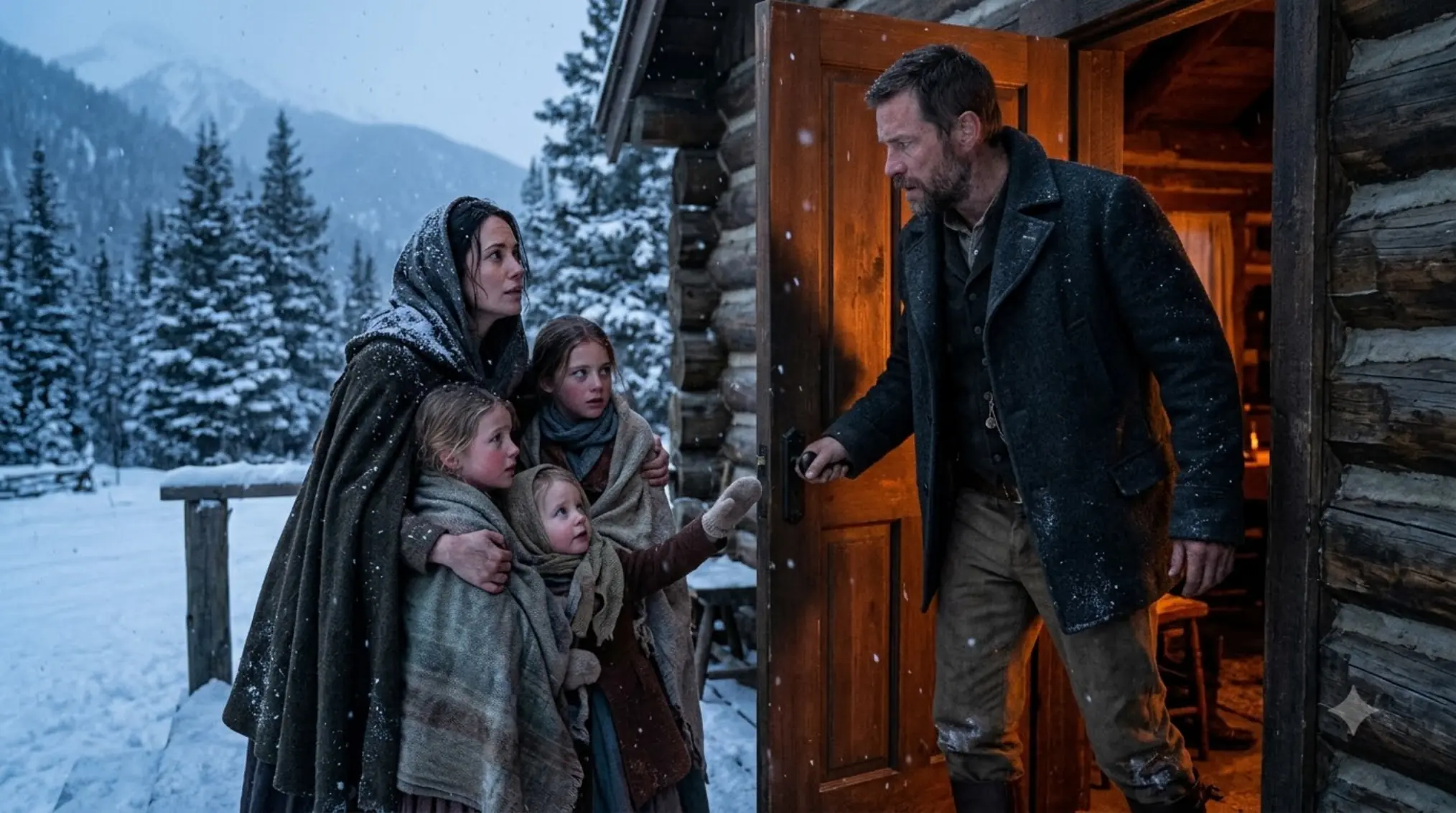
Outside, Christmas Eve had vanished beneath a Colorado blizzard.
Wind hammered the cabin walls.
Snow covered the windows.
The mountain trail had disappeared hours earlier.
Isaac did not care.
At forty years old, he owned a good ranch, healthy cattle, a sturdy house, two barns, enough stored grain to survive the winter, and absolutely no desire to celebrate the evening.
Christmas had once been different.
Three years earlier, the cabin had smelled of cinnamon, pine, and roasted meat.
His wife Mary had hung red ribbon around the mantel.
Their six-year-old daughter Lily had spent a week asking when Isaac would bring home the Christmas tree.
He had promised.
Then Christmas Eve arrived.
A section of fence collapsed in the south pasture.
Isaac stayed behind to repair it.
Mary needed several things from town.
Lily wanted to go.
Isaac remembered kneeling beside his daughter while she pulled on her little coat.
“Go on without me,” he had said. “I’ll finish here and have everything ready when you come back.”
They never came back.
The storm arrived sooner than expected.
Mary’s wagon left the road near the creek crossing.
Isaac searched until his hands were numb.
He found the wagon before midnight.
He found Mary.
He found Lily.
And every Christmas after that became punishment.
No decorations.
No candles.
No tree.
No visitors.
No celebration.
Only darkness.
This year was supposed to be the same.
Then somebody knocked on his door.
Isaac lifted his head.
At first he thought the wind had thrown something against the porch.
Then came another knock.
Weak.
Fast.
Desperate.
Isaac stood.
Nobody should have been outside.
He crossed the dark room and opened the door.
The wind exploded inward.
Four figures stood in the snow.
A woman and three girls.
The woman looked about thirty. Snow covered her dark hair and shoulders. Her cheeks had turned pale beneath the cold, and her arms were wrapped around the three children as though she had tried to make her own body into a wall against the storm.
The oldest girl appeared eleven.
Another perhaps eight.
The smallest could not have been more than five.
The little one was the worst.
Her face had lost most of its color.
She was not shivering.
Isaac knew what that meant.
The woman looked at him.
“Please.”
Her voice barely survived the wind.
“The children. Just let me get them warm.”
Isaac stared.
Something old and terrible moved inside his chest.
Another storm.
Another little girl.
Another Christmas Eve.
The smallest child lifted her face toward him.
Her lips trembled.
“Sir…”
Isaac bent slightly.
“What?”
The little girl whispered:
“Are you Santa Claus?”
He stopped breathing.
The child continued.
“Mama said if we found a house… maybe Santa lived there.”
The woman closed her eyes.
“I’m sorry. She’s confused.”
Isaac did not answer the girl.
He reached forward.
“Give her to me.”
The woman hesitated only long enough to understand his meaning.
Isaac lifted the little girl into his arms.
She weighed almost nothing beneath the frozen blankets.
“You two,” he said to the older girls, “inside.”
They moved.
Isaac stepped back.
The woman followed.
He slammed the door against the storm.
Then he turned toward the dead fireplace.
Three years of darkness ended with one command.
“Get them near the fire.”
The woman’s name was Abigail Finch.
The girls were Hattie, eleven; Junie, eight; and Bess, five.
Isaac learned that later.
For the first hour, names did not matter.
Heat mattered.
He threw pine into the fireplace.
Then more.
The flames climbed quickly.
Abigail removed the girls’ wet coats while Isaac brought blankets.
Bess remained frighteningly still.
Isaac wrapped her in wool and sat beside the fire rubbing warmth into her hands.
Abigail knelt opposite him.
“She stopped shaking ten minutes before we found your house.”
“I know.”
Her eyes filled.
“Is that bad?”
Isaac looked at her.
“Yes.”
He did not lie.
“But she’s breathing.”
He rubbed Bess’s small fingers harder.
“We’re not losing her.”
The words came out sharper than he intended.
Abigail stared at him.
Isaac looked down again.
“Not tonight.”
He warmed broth.
Not hot.
Warm enough to drink safely.
Bess swallowed a few spoonfuls.
Then another.
Hattie sat wrapped in two blankets with Junie tucked against her shoulder.
Neither complained.
Isaac noticed how Hattie watched Bess.
Too carefully.
Too responsibly.
Eleven-year-old children should not watch their younger sisters like exhausted mothers.
After almost an hour, Bess began trembling.
Abigail gasped.
Isaac exhaled.
“That’s good.”
“She’s shaking.”
“That means her body is fighting again.”
Abigail covered her mouth.
Tears fell immediately.
Isaac turned away.
Relief was dangerous.
Relief opened doors he had spent three years keeping locked.
But he could not prevent the feeling.
The child was going to live.
By midnight, all three girls slept together near the fireplace.
Abigail sat at the kitchen table holding a cup of coffee with both hands.
Isaac remained standing.
“You were traveling in this?”
“The storm came quickly.”
“Where?”
“Silverton.”
“Why?”
Abigail looked toward the children.
“They have a great-aunt beyond the ridge.”
Isaac waited.
Abigail’s voice softened.
“The girls belonged to my sister Ruth.”
Belonged.
Past tense.
Isaac understood.
“She died?”
“Autumn fever.”
“And their father?”
“Year before.”
Isaac looked toward the sleeping girls.
“So you took them.”
“Yes.”
“Why are you giving them to the great-aunt?”
Abigail stared into the coffee.
“Because wanting children and feeding them are two different things.”
Isaac said nothing.
“I’m a widow. I have almost no property. Ruth left nothing. I can keep them loved, Mr. Blackwood.”
Her voice cracked.
“I cannot keep them fed through a mountain winter.”
Isaac looked around his enormous, empty house.
Shelves full of preserved food.
Smokehouse stocked.
Cellar filled.
Bedrooms upstairs unused for three years.
He said nothing.
But a thought entered the room.
And refused to leave.
Morning arrived white and silent.
The blizzard had not stopped.
Snow pressed halfway up the windows.
Isaac stood at the stove frying potatoes when he heard small footsteps.
He turned.
Bess stood behind him wrapped in one of his blankets.
Her blonde curls had dried into a tangled cloud.
“You should be lying down.”
“I’m hungry.”
Isaac almost smiled.
“That’s an improvement.”
Bess climbed onto a chair.
“Is it Christmas?”
Isaac froze.
There was the word.
Christmas.
He had successfully avoided saying it for three years.
“Yes.”
Bess looked around.
“Where’s your tree?”
“I don't have one.”
“Why?”
Isaac turned back toward the pan.
“Because I don't.”
Bess considered this inadequate.
“Did Santa forget your house?”
Isaac closed his eyes.
Children, he decided, were merciless without meaning to be.
Abigail entered.
“Bess, leave Mr. Blackwood alone.”
“I’m asking about Santa.”
“I heard.”
Bess leaned toward Isaac.
“Did you answer?”
“No.”
“Why?”
Abigail gently lifted her from the chair.
“Because people are allowed not to answer every question you think of.”
Bess frowned.
“That seems unfair.”
Isaac almost laughed.
Almost.
Junie appeared next.
Then Hattie.
Within twenty minutes the silent kitchen had become crowded with girls asking questions.
Why did he own so many horses?
Did bears come near the barn?
Why was the house so big?
Could Junie help feed cattle?
Why did Bess have to finish her eggs?
Isaac answered more questions before breakfast than he had answered anyone during the previous month.
After eating, he went to the barn.
Junie followed.
“You can stay inside.”
“I want to help.”
“It’s cold.”
“I was colder yesterday.”
Isaac stopped.
Fair point.
He handed her a small feed scoop.
“Stay where I can see you.”
Junie grinned.
“Yes, sir.”
Bess followed fifteen minutes later holding Abigail’s hand.
Isaac was brushing one of the mares.
Bess stared.
“Can I touch her?”
“Slowly.”
She approached.
The horse lowered its head.
Bess touched its nose.
Her entire face lit.
Isaac looked away.
Lily had loved horses.
Especially this barn.
For one second he could almost hear her voice.
Papa, she likes me.
His hand stopped moving.
Abigail noticed.
She did not ask.
That mattered.
The storm continued through Christmas Day.
By afternoon, the girls had occupied the house as though they had been born inside it.
Hattie found flour and helped Abigail make bread.
Junie discovered Isaac’s collection of ranch maps.
Bess discovered everything else.
Including the wooden box.
Isaac had placed it high on a shelf.
Not high enough.
Bess dragged a chair across the floor.
Climbed.
Opened it.
Then came running into the main room carrying a small carved wooden star.
“Mr. Blackwood!”
Isaac turned.
The world stopped.
The star rested between Bess’s hands.
Isaac had carved it four years earlier.
Lily wanted a star for the Christmas tree.
Not a store-bought ornament.
“One Papa made.”
So Isaac carved one.
Smoothed the edges.
Cut tiny lines into the wood.
Lily had danced around the workshop when she saw it.
The next Christmas would be the first time they used it.
That Christmas never happened.
Isaac crossed the room quickly.
Abigail immediately sensed something was wrong.
“Bess.”
The girl looked up.
“Did you make this?”
Isaac stared.
“Yes.”
“It’s beautiful.”
He could not speak.
Bess smiled.
“We should put it on the tree.”
There was no tree.
Abigail stepped forward.
“Sweetheart, let's put that back.”
“No.”
Everyone turned toward Isaac.
His voice was rough.
Abigail stopped.
Isaac knelt in front of Bess.
The child held out the star.
“I made this for another little girl.”
Bess’s smile disappeared.
“Where is she?”
Isaac swallowed.
“She died.”
Hattie lowered her head.
Junie moved closer to Abigail.
Bess looked at the star.
“I’m sorry.”
Isaac nodded.
“Her name was Lily.”
“Was she little?”
“Six.”
“I’m five.”
“I know.”
Bess looked toward the dark corner where a Christmas tree should have been.
Then back at Isaac.
“Would Lily be mad if I used her star?”
That question broke something.
Isaac blinked hard.
“No.”
His voice failed.
He tried again.
“No, sweetheart.”
A tear ran down his face.
“I think Lily would be very happy if somebody finally put it where it belongs.”
Bess brightened.
“Then we need a tree.”
Isaac looked toward Abigail.
She was crying silently.
Not pity.
Understanding.
Isaac stood.
Reached for his coat.
Junie stared.
“Where are you going?”
“To find a tree.”
They found a small pine near the barn.
Isaac cut it himself.
Junie helped drag it.
Hattie cleared space near the fireplace.
Abigail found ribbon inside Mary’s old storage chest after Isaac gave her permission to open it.
Every item hurt.
Every item also became useful again.
A strange transformation.
Mary’s red ribbon became loops around pine branches.
Lily’s paper ornaments went beside decorations the girls made from dried berries and folded scraps.
Isaac watched.
He had preserved those things like graves.
The girls treated them like life.
When the tree was finished, only the top remained empty.
Bess held the star.
Isaac crouched.
“Come here.”
He lifted her.
The movement almost destroyed him.
Lily had once sat on his shoulders in this exact room.
But Isaac did not stop.
Bess reached upward.
The wooden star settled onto the tree.
Everyone stepped back.
Isaac stared.
The room blurred.
His knees weakened.
Abigail touched his arm.
That was all.
Isaac covered his face.
Three years arrived at once.
Mary.
Lily.
The creek.
Snow.
Cold water.
His own voice.
Go on without me.
He cried.
Not politely.
Not quietly.
He sank into the chair and cried like a man whose grief had finally become too heavy to carry privately.
Abigail stayed beside him.
The girls remained near the tree.
Eventually Isaac whispered:
“I hated Christmas.”
Abigail squeezed his arm.
“I know.”
“I made this day into their grave.”
He looked toward the star.
“Mary loved Christmas.”
His voice broke again.
“She would have opened that door last night before I even got there.”
Abigail smiled through tears.
“She sounds like someone I would have liked.”
Isaac nodded.
“The best person I knew.”
He looked around.
The fire.
The girls.
The tree.
The star.
“I've been sitting in the dark for three years thinking that was loyalty.”
Abigail sat beside him.
“Grief can make punishment feel like devotion.”
Isaac looked at her.
She understood.
Of course she did.
She had buried a husband.
A sister.
And now believed love required giving away the only family she had left.
Isaac wiped his face.
“Maybe Mary deserves better than darkness.”
Abigail looked toward the window.
“Then keep the light burning.”
He waited.
“So somebody lost in the next storm can find it.”
Isaac stared at her.
That sentence stayed.
That night, after the girls finally fell asleep beneath the tree, Isaac and Abigail sat by the fire.
The storm had softened.
Abigail repaired a tear in Hattie’s coat.
Isaac watched her.
“You don't want to give them away.”
Her hands stopped.
“No.”
“Then why are you?”
“I told you.”
“You said you can't feed them.”
“Yes.”
Isaac leaned forward.
“What if you could?”
Abigail looked at him.
“What?”
“I have food.”
She stared.
“Isaac—”
“I have rooms.”
“Mr. Blackwood.”
“Isaac.”
She stopped.
He continued.
“I have more land than one man needs and more house than one man can fill.”
Abigail’s expression became careful.
“You have known us two days.”
“Three.”
“That does not improve the argument.”
Isaac almost smiled.
“Fair.”
He looked toward the sleeping girls.
“I’m not proposing marriage.”
Abigail’s eyebrows lifted.
“That is a relief.”
He actually laughed.
A small sound.
The first real one in years.
Abigail stared.
Isaac heard himself and looked almost surprised.
Then he continued.
“I’m asking for a winter.”
“A winter?”
“Stay here.”
She said nothing.
“Take one of the upstairs rooms. Keep the girls with you. Help around the ranch if you want. Don't if you don't.”
“Isaac—”
“You said you were taking them away because you couldn't provide a warm house and food.”
“Yes.”
“I can.”
Abigail’s eyes filled.
He continued carefully.
“So don't cross another mountain in winter just to hand them to strangers.”
“She’s their great-aunt.”
“Still a stranger to them.”
Abigail looked toward Hattie.
Isaac lowered his voice.
“Hattie is eleven.”
“I know.”
“She watches those two like she's forty.”
Abigail looked away.
“I know.”
“She needs to stop.”
Tears rolled down Abigail’s cheeks.
Isaac continued:
“Junie needs horses to ask questions about.”
Abigail laughed through tears.
“God help the horses.”
“And Bess…”
They both looked toward the smallest child.
Bess slept with one hand beneath her cheek.
“She asked me if I was Santa Claus.”
Abigail smiled.
Isaac looked at the tree.
“I didn't answer.”
“What would you say now?”
Isaac considered.
“That I’m just a man who opened the door.”
Abigail shook her head.
“That was enough.”
Silence.
Then Isaac said:
“Stay until spring.”
Abigail stared at him.
“Then?”
“Then you choose.”
“No promises?”
“None.”
“No debt?”
“No.”
“And if we leave?”
“I’ll take you wherever you want to go.”
Abigail looked at this stranger who had become something else during three days of snow and firelight.
“You really mean that.”
“Yes.”
“How can I know?”
Isaac looked at her.
“You can't yet.”
The answer surprised her.
“So stay long enough to find out.”
Abigail lowered her head.
Her shoulders began shaking.
Isaac did not touch her.
He let her cry.
Finally she whispered:
“Yes.”
He leaned closer.
“What?”
“We'll stay.”
Isaac exhaled.
Abigail wiped her eyes.
“For the winter.”
“For the winter.”
“And in spring, we decide again.”
“Yes.”
She held his gaze.
“Open hand.”
“Open hand.”
They shook on it.
Not romantic.
Not yet.
Something better.
Trust beginning.
Winter changed the Blackwood house.
Hattie stopped waking before everyone to make breakfast.
Isaac insisted.
“You're eleven.”
“But Aunt Abigail needs help.”
“Then help after sunrise.”
Hattie looked suspicious.
“What am I supposed to do before sunrise?”
“Sleep.”
The concept apparently required practice.
Junie became impossible to remove from the barn.
Isaac taught her how to brush horses, repair tack, recognize lame cattle, and close every gate behind herself.
Bess followed Isaac everywhere.
She asked approximately forty questions per hour.
“Why do cows sleep standing?”
“Sometimes.”
“Why?”
“I don't know.”
“You own cows.”
“That doesn't mean I know everything about them.”
Bess considered.
“That's disappointing.”
Isaac laughed more often.
Abigail noticed every time.
She filled the kitchen without taking it over.
Mary’s belongings remained where Isaac wanted them.
Abigail never asked him to remove the blue shawl.
Never suggested Lily’s small boots should disappear.
One evening Isaac noticed her dusting around Lily’s framed drawing.
She did not move it.
“Thank you,” he said.
Abigail looked puzzled.
“For what?”
“For knowing the difference between making room and erasing something.”
She understood.
“My husband’s coat is still in storage.”
Isaac nodded.
“Then you understand.”
“I do.”
Their relationship grew that way.
Not through grand declarations.
Through shared work.
Abigail leaving coffee beside Isaac’s chair.
Isaac repairing her boots.
Abigail teaching Bess letters at the kitchen table.
Isaac taking Hattie into town and returning with books because he noticed she had read every book in the house twice.
The winter became months.
Then melting snow appeared beneath fences.
Spring arrived.
Nobody mentioned the great-aunt.
Not until Abigail forced herself to.
One evening she sat across from Isaac.
“The road will be clear in two weeks.”
He understood instantly.
“Yes.”
“You said spring.”
“Yes.”
The children were outside.
This conversation belonged to adults.
Abigail folded her hands.
“You promised I could choose.”
“I did.”
“And you still mean it?”
Isaac’s jaw tightened.
“Yes.”
Even if her choice destroyed him.
She nodded.
“I wrote to the girls’ great-aunt.”
Isaac remained silent.
“She wrote back.”
He waited.
“She is seventy-two.”
Isaac blinked.
Abigail smiled faintly.
“She admitted she was terrified of taking three children but didn't want them sent somewhere worse.”
“And?”
“She asked if they were safe here.”
Isaac looked at her.
“What did you say?”
“Yes.”
His shoulders loosened slightly.
Abigail continued.
“She said…”
Her voice softened.
“She said if they have a real home here, I should stop treating blood relation like the only kind of family that counts.”
Isaac stared at her.
“Wise woman.”
“Apparently.”
Abigail smiled.
“She gave her blessing.”
Isaac looked down.
“Meaning?”
“Meaning I’m not taking them over the mountain.”
He closed his eyes.
Three seconds.
Maybe four.
Then opened them.
“And you?”
“What about me?”
“Are you staying because they are?”
Abigail’s smile disappeared.
She understood.
Isaac continued.
“I promised open hand.”
“Yes.”
“I meant it.”
“I know.”
“So if the girls remain and you want something else…”
“Isaac.”
He stopped.
Abigail leaned forward.
“I've spent four months watching you make Hattie a child again.”
He listened.
“I've watched Junie turn your barn upside down.”
“Daily.”
“I've watched Bess decide you're her personal property.”
“That seems permanent.”
Abigail smiled.
Then became serious.
“And I've watched this house become warm again.”
She took a breath.
“I don't want something else.”
Isaac’s eyes remained locked on hers.
“What do you want?”
“You.”
No elaborate speech.
One word.
Isaac swallowed.
Abigail continued.
“But not because you rescued us.”
“I know.”
“Not because we need your money.”
“I know.”
“And not because Christmas made us sentimental.”
Isaac smiled faintly.
“I had concerns about that one.”
“I want you because I know who you are in February.”
His smile vanished.
Abigail reached across the table.
“And March.”
She placed her hand beside his.
“And because you know who I am when there isn't a blizzard forcing us into the same room.”
Isaac turned his hand beneath hers.
Their fingers met.
“Abigail Finch.”
“Yes?”
“I believe I’d like to marry you.”
She laughed.
“You said something remarkably similar on Christmas.”
“I was practicing.”
“You've improved.”
“So?”
She squeezed his hand.
“Yes.”
They married in May.
Nothing extravagant.
Neighbors.
A preacher.
Three girls wearing new dresses Abigail had sewn.
Hattie stood beside her aunt looking younger than she had in years.
Junie had mud on one shoe fifteen minutes before the ceremony.
Bess held the wooden star.
Nobody understood why until she explained loudly:
“It brought us here.”
Isaac corrected her gently.
“The storm brought you here.”
Bess shook her head.
“No.”
She held up the star.
“This made you keep us.”
Everyone laughed.
Isaac did too.
After the ceremony, Bess asked:
“Do we call you Papa now?”
The entire gathering quieted.
Isaac looked at Abigail.
She nodded.
Then at Hattie and Junie.
Hattie’s eyes were wet.
Junie smiled.
Isaac crouched in front of Bess.
“If you want.”
Bess threw her arms around his neck.
“Papa!”
Junie joined.
Then Hattie.
Isaac disappeared beneath three girls.
Abigail covered her mouth.
Somebody behind her sniffed loudly.
Isaac looked over the children’s shoulders toward his wife.
Family.
Not replacing Mary.
Not replacing Lily.
Nothing could.
This was new.
Grief and love standing in the same room without fighting for ownership.
Years passed.
Every Christmas Eve, Isaac lit a candle.
Always in the same window.
The one facing the mountain trail.
Bess asked about it when she was seven.
“So Santa can find us?”
Isaac smiled.
“Something like that.”
When she was older, he explained.
Mary.
Lily.
The storm.
The creek.
The night Abigail and the girls arrived.
Bess cried.
Then asked about the star.
Isaac took it down from the box.
“The last thing I made for Lily.”
“And you let me put it up?”
“Yes.”
“Why?”
Isaac thought.
“Because keeping something hidden isn't always the same as loving it.”
Bess held the star carefully.
“Do you miss her?”
“Every day.”
“Even when you're happy?”
“Especially then sometimes.”
Bess leaned against him.
“Is that allowed?”
Isaac kissed her hair.
“Yes.”
That became the Blackwood family understanding.
You could miss someone and love someone else.
You could remember grief without living inside it.
You could open a door without betraying the people who had once walked through it.
The wooden star went onto their Christmas tree every year.
Hattie placed it once.
Junie twice.
Bess many times.
Later, grandchildren took turns.
Isaac always watched.
Sometimes with tears.
Always with gratitude.
And every Christmas Eve, long after the ranch expanded and the once-empty house became too crowded for the dining table, Isaac lit the candle in the window before anything else.
Abigail would stand beside him.
“Still think somebody’s coming?”
Isaac would look toward the snow.
“Somebody is always lost somewhere.”
Then he would light it.
A small flame.
Nothing miraculous.
Nothing magical.
Just enough light to tell whoever happened to be outside:
There is a house here.
There is warmth here.
There is food.
There is room.
Knock.
Someone will open the door.
Three years earlier, Isaac Blackwood had believed Christmas Eve was the night when everything good had been taken from him.
Then another Christmas Eve arrived carrying a widow and three freezing girls.
The smallest asked whether he was Santa Claus.
Isaac never became anything so grand.
He became something more ordinary.
More difficult.
And perhaps more important.
A man willing to open his door again.
And that was enough to save five people.
Four standing outside in the snow.
And one who had been freezing inside the house for three years.