The first thing Cole Harper smelled when he entered his ranch house before sunrise was frying bacon.
He stopped in the doorway with one hand still gripping the leather strap of his rifle. For nearly three years, his kitchen had smelled only of cold ashes, burnt coffee, and whatever plain meal he managed to prepare after working until dark. But that morning, heat rolled from the cast-iron stove, biscuits browned inside the oven, and two eggs hissed beside strips of bacon in a black skillet.
A strange woman stood over the stove.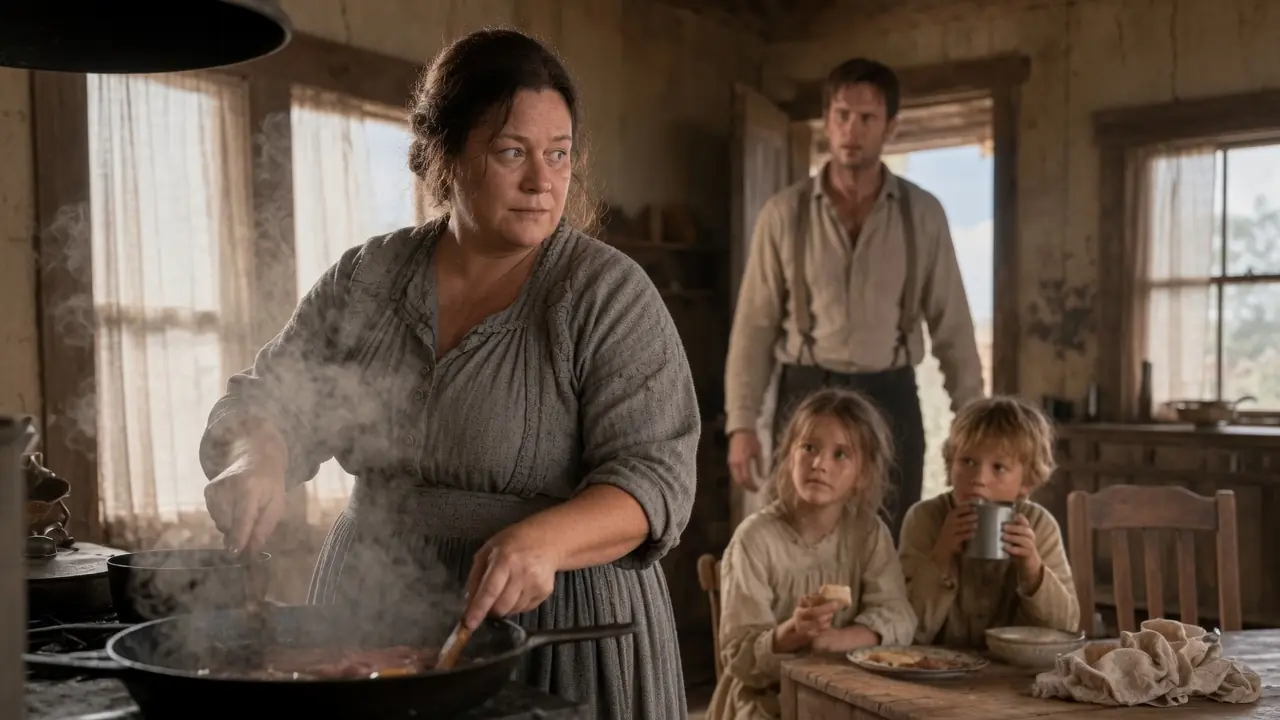
She was broad-shouldered and weary, perhaps forty-two, with dark brown hair pinned loosely beneath a faded shawl. Her charcoal dress was frayed at the cuffs, her boots were crusted with mud, and her rough hands carried the red marks of cold nights and hard work. Yet she moved around the kitchen with quiet confidence, as though she had cooked there every morning of her life.
Cole’s daughter Ellie sat at the table holding a biscuit with both hands. Eight-year-old Caleb clutched a tin bowl of beans and watched his father with terror spreading across his thin face.
Cole stepped inside.
“Who are you, and why are you in my kitchen?”
The woman turned slowly.
She did not reach for a knife or attempt to escape. Instead, she placed herself between Cole and the children, one hand still holding a wooden spoon.
“Your children were hungry,” she said. “I couldn’t ignore them.”
Cole’s gaze moved to the open pantry. A sack of flour had been disturbed, two eggs were missing from the basket, and several strips had been cut from the small piece of bacon he had been saving.
“You broke into my house.”
“The back door wasn’t locked.”
“That does not make it yours.”
“No, sir.”
Caleb stood so quickly that his chair scraped the floor.
“Please don’t send her away, Pa,” he said, clutching his bowl. “She made the house feel warm again.”
The words struck Cole harder than any accusation could have.
Ellie lowered her biscuit and whispered, “She fixed Molly, too.”
The little girl lifted a cloth doll Cole’s late wife had sewn. One arm had been hanging loose for months because Cole did not know how to repair the tiny stitches. Now the arm sat neatly in place.
Cole looked back at the stranger.
“What is your name?”
“Margaret Dawson.”
“Where did you come from?”
“The road.”
“That isn’t an answer.”
“It is the only home I have left.”
Cole’s anger remained, but uncertainty had entered it. The woman did not look like a thief. A thief would have taken food and disappeared. Margaret had used his stove, mended Ellie’s doll, and set the table with three bowls while leaving none for herself.
Then he noticed three coins beside the flour sack.
They were worn and tarnished, but together they represented nearly everything a homeless traveler might possess.
“What is that money?”
“Payment for the flour, bacon, and eggs.”
“It isn’t enough.”
“It is all I had.”
Cole lowered the rifle strap, though he did not set the weapon aside.
“You entered a stranger’s home, spent your last coins, and risked being shot to feed children you had never met.”
Margaret turned back toward the stove. “The eggs will burn.”
She removed the skillet from the heat and divided the food between Caleb and Ellie. Neither child waited for permission. They ate quickly, with the desperate concentration of people who had learned meals could disappear before hunger did.
Cole felt shame settle beneath his anger.
His children were not starving because the ranch lacked food. The smokehouse still contained meat, and grain filled several storage barrels. They were hungry because Cole left before sunrise, returned after dark, and often assumed the bread or cold beans he placed on the table were enough.
He had convinced himself survival was the same as care.
“Why were they alone?” Margaret asked.
“I was checking the north pasture.”
“At this hour?”
“A fence broke during the night.”
Margaret looked toward the window. “The western fence beside the creek?”
Cole’s eyes narrowed. “How do you know?”
“I repaired it before coming inside.”
“You repaired my fence?”
“Three rails had fallen. Your cattle were already pushing toward the opening.”
Cole crossed the kitchen and looked through the window. In the gray morning light, the distant fence line appeared upright again.
“You expect me to believe you walked onto my land, repaired a fence, then wandered into my kitchen out of kindness?”
“I don’t expect you to believe anything.”
“Then what do you expect?”
Margaret finally looked at him directly.
“To be gone before the sun is fully up.”
She removed her shawl from the chair and wrapped it around her shoulders. Beneath it, Cole saw how thin her dress really was. The autumn cold had already hardened the ground at night, and the mountains carried the first pale signs of snow.
Margaret touched Caleb’s shoulder once, then bent to Ellie.
“Eat slowly,” she said. “Your stomach will hurt if you rush.”
Ellie took her hand.
“Where will you go?”
Margaret’s expression softened. “Wherever the road goes.”
“You can sleep in my bed.”
Cole stiffened. “Ellie.”
The girl ignored him. “I can sleep with Caleb.”
Margaret gently freed her hand. “Your father has every right to send me away.”
Caleb looked at Cole.
“Ma did not send hungry people away.”
The kitchen became painfully quiet.
Cole’s wife, Sarah, had been dead for three years, yet the children still invoked her as though she might enter through the door and correct everything he had done wrong. She had died during a winter fever that swept through Cedar Bluff, leaving Cole with two young children and a ranch demanding every hour he possessed.
At first, neighbors brought meals.
Then spring work arrived, sympathy faded, and Cole insisted he could manage alone. Pride made it easier to reject help than to admit his children needed more than he knew how to give.
He looked at Margaret.
“Stay until the weather clears.”
Her face revealed neither relief nor excitement. Only suspicion.
“The sky is clear.”
“Not over the mountains. Snow will reach us by evening.”
“I won’t take charity.”
“You repaired my fence. Consider the meal and a bed payment for the work.”
Margaret studied him carefully. “One night.”
“One night.”
She remained.
After breakfast, Cole showed her the small spare room beside the kitchen. The bed had not been used since Sarah’s mother visited years earlier, and dust covered the washstand. Margaret thanked him without complaint, placed her empty flour sack beneath the bed, and immediately began sweeping.
“You can rest,” Cole said.
“I have rested enough on roadsides.”
He almost asked how long she had been traveling, but the question felt too personal for a woman he had threatened only minutes earlier.
Instead, he returned to the north pasture.
When Cole came home near sunset, smoke rose steadily from the chimney. Caleb and Ellie ran across the yard to meet him, their faces brighter than he had seen in months.
“Mrs. Dawson showed me how to knead dough,” Ellie announced.
“And she sharpened Ma’s kitchen knife,” Caleb added.
Margaret appeared on the porch wearing her faded shawl. “Your son nearly removed his thumb attempting it himself.”
“I did not,” Caleb protested.
“You came close enough to make the difference unimportant.”
For a moment, Cole heard something unfamiliar in the yard.
Laughter.
Not loud or careless, but real.
He looked toward Margaret. She seemed startled by the sound herself.
That evening, they ate stew made from beef, potatoes, and onions Cole had forgotten were stored beneath the pantry shelf. Margaret ensured the children received full bowls before serving herself. Even then, she took less than anyone else.
Cole noticed.
“You can take more.”
“This is enough.”
“You said you don’t accept charity.”
“I worked.”
“Then eat like someone who earned supper.”
Margaret added a small spoonful but nothing more.
After the children went to bed, Cole found her at the kitchen table sewing a tear in Caleb’s shirt. The fire illuminated deep exhaustion around her eyes.
“Where is your husband?” he asked.
“Dead.”
“I’m sorry.”
“So was I.”
The answer silenced him.
Margaret threaded the needle again. “Thomas died two winters ago near Independence. A wagon overturned while he was hauling timber. By the time they carried him home, there was nothing anyone could do.”
“You had a home there?”
“A rented room above a cooper’s shop.”
“What happened to it?”
“The owner allowed me one month. Then he found a family that could pay.”
Cole sat across from her. “No relatives?”
“None willing to claim me.”
“And you have been walking since?”
“Working when I can. Sleeping where I must.”
Her voice contained no self-pity. That made the story worse.
“What brought you toward Cedar Bluff?”
“A woman in Willow Creek said the hotel might need a cook.”
“They hired the owner’s niece last month.”
“I learned that yesterday.”
“Where did you sleep?”
Margaret looked down at the shirt. “Your hay shed.”
Cole leaned back.
“That is why you heard the children.”
“Yes.”
“They were crying?”
“Ellie was.”
Cole’s stomach tightened. “Why?”
“She woke from a nightmare. Caleb tried to calm her, but he said there was nothing for breakfast.”
“There was food.”
“They didn’t know how to prepare it.”
Cole stared at the table.
“I told Caleb where the bread was.”
“The loaf had mold through the center.”
He remembered leaving it three days earlier.
Margaret tied off the thread and folded the shirt. “They are good children, Mr. Harper. But they have learned not to ask you for anything.”
“That isn’t true.”
“Caleb apologized for being hungry.”
Cole’s jaw tightened. “You have known them one day.”
“And I have known hungry children longer than that.”
Something in her voice changed.
Not anger. Pain.
Cole waited, but Margaret stood and carried the repaired shirt toward the stairs.
“You should sleep,” she said. “The storm will arrive before dawn.”
Snow began falling shortly after midnight.
By sunrise, wind drove it sideways across the ranch, erasing fences, roads, and the lower hills. Margaret’s single night became three because no traveler could safely leave.
Cole expected the arrangement to feel intrusive.
Instead, the house began functioning in ways he had forgotten were possible.
Margaret rose before him, prepared breakfast, packed food for the pasture, and assigned the children tasks without silencing them. Caleb carried wood. Ellie gathered eggs. They still spilled things, argued, and tracked mud onto the floor, but Margaret corrected them without making their mistakes feel like proof they did not belong.
Cole returned each evening to warmth.
On the third night, he found Caleb asleep beside the stove with his head against Margaret’s arm. Ellie lay across her lap, Molly tucked beneath her chin. Margaret remained perfectly still, unwilling to wake either child.
Cole lowered his voice. “You can put them to bed.”
“They fell asleep listening to a story.”
“What story?”
“A foolish prince who believed his castle was empty because he never opened the doors.”
“Did it end well?”
“I haven’t decided.”
Cole lifted Caleb carefully. As he carried the boy upstairs, he caught Margaret watching him with an expression he could not understand.
The storm passed on the fourth morning.
Margaret packed immediately.
She folded the borrowed blanket, swept the spare room, and returned every object exactly where she had found it. Her flour sack held two biscuits, a little dried meat, and nothing else.
Cole stood in the kitchen doorway.
“You could stay through winter.”
Margaret stopped.
“I need someone to cook and keep the house,” he continued. “The children need supervision. You would receive a room, meals, and wages.”
“You don’t know me.”
“I know you repaired a stranger’s fence before taking food. I know you paid three coins when you could have left unnoticed. I know my children trust you.”
“Children trust too easily.”
“Mine do not.”
Margaret tightened the shawl around herself. “People speak cruelly about widows who live beneath unmarried men’s roofs.”
“People already speak cruelly about me.”
“That does not make their words harmless.”
“There is a lock on the spare-room door. Mrs. Becker from town visits every Saturday and can serve as witness to the arrangement. If gossip starts, I will answer it.”
Margaret stared beyond him toward the children.
Caleb pretended to examine a horseshoe near the stove. Ellie hugged Molly and made no attempt to hide her tears.
“One month,” Margaret said.
Cole nodded. “One month.”
She stayed through winter.
Margaret did more than cook. She restored rhythms the family had lost after Sarah’s death. The children washed before meals, attended lessons at the church twice a week, and slept at regular hours. She cleaned nothing merely to appear useful; instead, she organized the house so everyone shared responsibility.
Cole resisted at first.
When Margaret insisted Caleb should help with accounts because the boy liked numbers, Cole said ranch work mattered more than figures. She answered that a rancher who could not calculate debt would eventually work for the man who could.
When Ellie asked to learn riding, Cole said she was too small.
Margaret reminded him Sarah had ridden alone at eight.
The argument ended when Ellie rode Willow around the corral while Cole walked beside her, one hand hovering near the saddle though she never needed it.
By February, laughter no longer sounded strange inside the Harper house.
Yet Margaret never fully relaxed.
She saved most of her wages in a small tin box and kept her flour sack packed beneath the bed. Whenever a horse approached the ranch unexpectedly, her eyes moved toward the door. Cole realized she lived as though kindness might be withdrawn without warning.
One evening, he found her standing alone near the creek.
The snow had begun melting around the rocks, though ice still covered the shaded banks. Margaret held a small carved wooden horse in her palm.
“What is that?” Cole asked.
She closed her fingers around it. “Nothing.”
“It does not look like nothing.”
For a long time, she said nothing.
Then she handed it to him.
The carving was crude but carefully made. A child’s initials had been scratched beneath the belly: J.D.
“My son carved it,” Margaret said.
Cole looked at her.
“You never said you had children.”
“I don’t.”
The pain in those words made the winter air seem colder.
Margaret stared at the creek.
“Joseph was nine. Anna was six. After Thomas died, I could not find enough work. We lived above the cooper’s shop until the owner removed us. I begged at houses along the road, but fever had frightened everyone that winter.”
Cole held the wooden horse carefully.
“One farmer had an empty barn,” she continued. “I asked only to sleep there until the storm passed. He said no one wanted a widow with two sick children bringing trouble onto his land.”
Her voice remained steady, but tears filled her eyes.
“We slept beneath an abandoned wagon. Joseph gave Anna his blanket. By morning, both were burning with fever.”
Cole could not speak.
“I carried them to town,” Margaret said. “Anna died before noon. Joseph lasted two days.”
The creek moved beneath the ice with a quiet, hollow sound.
“That is why you entered my house,” Cole whispered.
“I heard Ellie crying. Then Caleb said there was no food. For one moment, it was that winter again. I knew entering could get me jailed or shot, but walking away felt worse.”
Cole looked at the carving.
“You used your last money.”
“Coins did not save my children. Perhaps they could feed yours.”
Margaret wiped her face and reached for the wooden horse.
Cole did not return it immediately.
“You did not fail them.”
Her expression hardened. “You were not there.”
“No. But I know what it is to believe surviving grief should make a person capable of everything afterward.”
He placed the carving back in her hand.
“Sarah died in this house while I held her. Caleb heard me promise I would care for them. I thought keeping the ranch meant keeping that promise. I never noticed they had stopped asking me to be their father.”
Margaret looked toward the distant lights of the house.
“You noticed before it was too late.”
“Because you broke into my kitchen.”
A tearful laugh escaped her.
Cole smiled faintly. “You were the worst burglar Cedar Bluff has ever seen.”
“I took two eggs.”
“And left money.”
“Then perhaps I lacked proper training.”
They walked back together.
Spring brought new gossip.
Some people believed Margaret was taking advantage of Cole. Others claimed Cole had brought a homeless woman into his house because he wanted a servant he did not have to marry. Margaret heard the whispers in the general store and returned to the ranch pale with humiliation.
That evening, she placed her wage box on the kitchen table.
“I will leave tomorrow.”
Cole stared at it. “Why?”
“Your children should not suffer because of what people say about me.”
Caleb stood in the doorway. “We suffer when you leave.”
Margaret closed her eyes.
Ellie ran to her and wrapped both arms around her waist. “You promised to finish the prince story.”
“I can tell you tonight.”
“That is not the same.”
Cole looked at Margaret.
“You asked whether kindness would vanish when hunger, tears, and trouble began.”
Her breath caught.
“I have seen all three,” he continued. “I am still here.”
“This is different.”
“Yes. Because now I know what I want.”
Caleb quietly pulled Ellie from the room, though both children remained close enough to listen.
Cole stepped toward Margaret.
“I do not want a cook who can be replaced when winter ends. I want the woman who taught my children they are allowed to laugh. I want the woman who challenged every foolish thing I believed about strength. And I want you to stop sleeping with your bag packed beneath the bed.”
Tears rose in Margaret’s eyes.
“You pity me.”
“No.”
“You are grateful.”
“Yes, but that is not all.”
“What are you saying?”
Cole took her rough hands in his.
“I am asking whether you could make this your home—not as my employee, but as my wife.”
Margaret trembled.
“I have nothing,” she whispered.
“You brought more into this house than I knew it was missing.”
“And if I fail them?”
“You will not carry them alone.”
Caleb appeared in the doorway again.
“Say yes,” he whispered.
Ellie pushed beside him. “Please.”
Margaret laughed through her tears.
Then she looked at Cole.
“Yes.”
They married beneath the cottonwood trees in May.
Mrs. Becker prepared the food. Caleb stood beside Cole wearing a shirt Margaret had sewn, and Ellie scattered wildflowers while carrying Molly beneath one arm. Margaret wore Sarah’s simple ivory shawl with the children’s blessing, not as a replacement for the woman who had died, but as acknowledgment that love could honor what came before without remaining trapped inside it.
After the ceremony, Margaret placed Joseph’s wooden horse on the mantel.
It remained there beside a photograph of Sarah.
The family spoke both names openly.
Years later, travelers passing Hart Ranch often found a lantern burning in the bunkhouse window. Cole and Margaret maintained two spare beds and kept bread, blankets, and firewood ready for anyone caught between towns.
No widow with children was ever turned away.
When Caleb became a man, he carved a small sign and nailed it above the bunkhouse door:
NO HUNGRY CHILD LEAVES THIS RANCH.
Margaret stood beneath the words for a long time.
Cole placed one arm around her shoulders.
“Joseph and Anna would like it,” he said.
She nodded, unable to answer.
The morning Margaret first entered Cole Harper’s kitchen, she believed she was risking everything for two strangers’ children. She expected anger, jail, or another road stretching toward nowhere.
Instead, she found a grieving father who had forgotten how badly his family needed warmth.
Cole believed he had caught a homeless intruder stealing breakfast.
Then he counted the coins beside the pantry, inspected the repaired fence, and heard his son beg him not to send her away.
Only later did he learn the full truth.
Margaret had not entered because she wanted food.
She entered because once before, two hungry children had cried in the cold—and every door remained closed.
This time, she opened one herself.