The first thing Wade Mercer noticed about the woman walking toward Black Hollow Ranch was that she should not have been alive.
It was late afternoon beneath the Absaroka Mountains, and the Wyoming sun had baked the road until the dust looked white. Wade had been fighting with a crooked fence post for nearly an hour when the figure appeared beyond the far pasture, moving slowly through the heat with a battered carpetbag hanging from one hand. She was a large, full-figured woman in a worn cream dress, dark hair tangled against a flushed face, and she walked with the exhausted stubbornness of someone who had already gone too far to permit herself to collapse.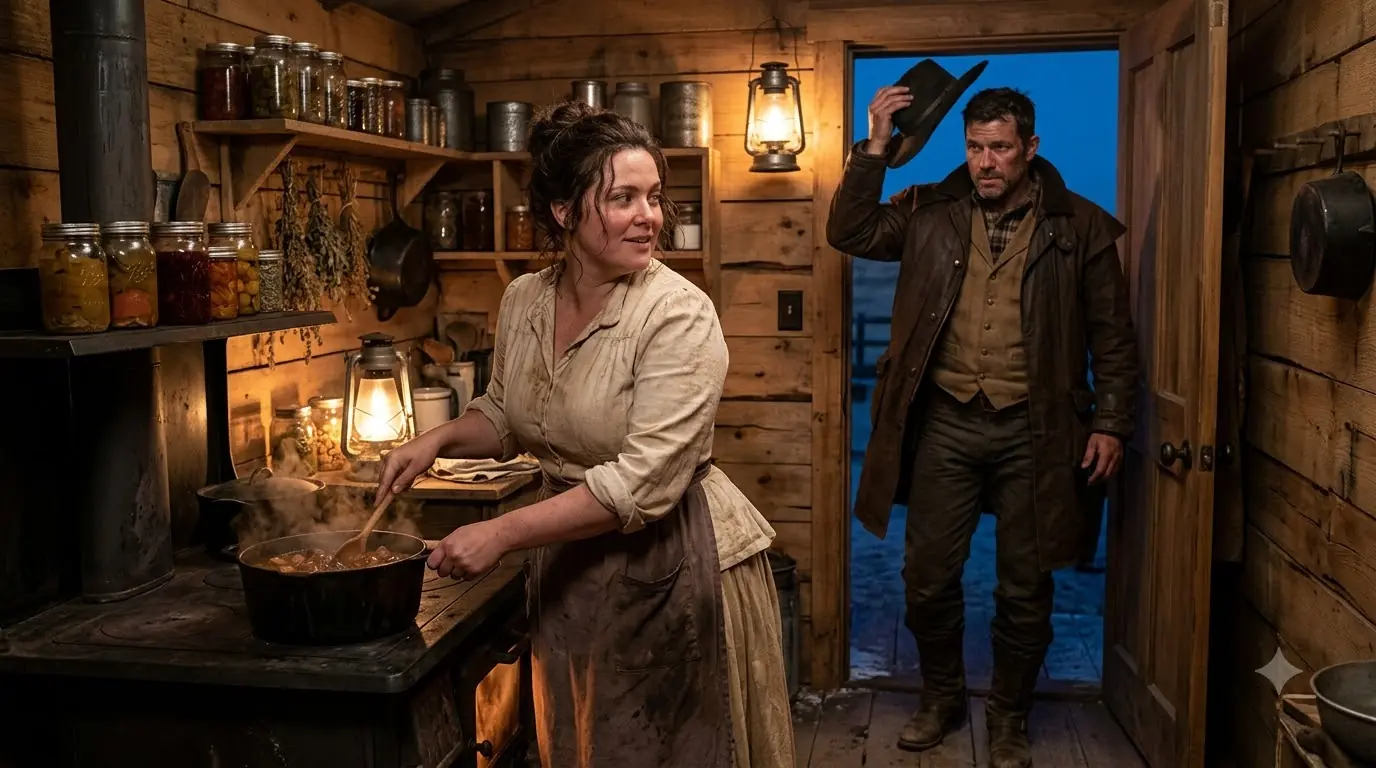
Wade put down the post-hole digger.
His rifle rested against the fence twenty feet away.
He did not reach for it yet.
People did not wander onto isolated ranches accidentally. A stranger could mean desperation, theft, trouble, or sometimes all three, and Wade had survived long enough in Wyoming to understand that kindness without caution got men buried.
But the woman stopped well outside the fence.
She looked toward him.
Her lips were cracked.
“Water.”
Not please.
Not a story.
Not a plea.
Only the thing she needed most.
Wade stared at her for a moment.
Then he nodded toward the house.
“Come on.”
Black Hollow Ranch had once been the kind of place Sarah Mercer kept so clean that Wade could find his boots in darkness.
Eight months after Sarah’s death, it looked like a house losing a war.
Laundry covered two chairs.
Dishes filled the basin.
A pan smoked on the stove.
Something smelled burned.
Something else smelled sour.
And from the back bedroom came the relentless crying of Wade’s six-month-old daughter, Rose.
His ten-year-old daughter Ellie stood at the stove with both fists clenched.
She looked at the stranger entering behind her father.
“Who’s that?”
“Someone who needs water.”
“That doesn’t answer anything.”
“Cup, Ellie.”
“Get it yourself.”
But Ellie was already reaching.
She shoved the tin cup toward the woman without smiling.
The stranger drank slowly.
That impressed Wade.
A truly desperate person sometimes drank so quickly that the water came straight back up. This woman controlled every swallow, waited, then held the cup toward him again.
Wade filled it twice more.
Finally she whispered, “Thank you.”
Then Rose screamed louder.
The stranger’s eyes moved toward the bedroom.
“How old?”
“Six months.”
“Teething?”
“Maybe. She cries most of the time.”
Wade hated admitting it.
Sarah had died giving birth to Rose.
Since then, every sound the baby made seemed to remind him that he had no idea how to replace the woman who had known instinctively what each cry meant.
The stranger looked toward the doorway.
“May I?”
Wade frowned.
“May you what?”
But she was already moving.
“Wait.”
Wade followed her.
Ellie followed Wade.
The woman entered the bedroom and walked toward the cradle. She paused long enough to look back at Wade for permission, and when he gave the smallest nod, she lifted Rose carefully against her shoulder.
Rose kept screaming.
The woman supported the baby’s head with one hand.
Her other hand began rubbing slow circles between Rose’s shoulders.
Then she hummed.
It was barely music.
Just a low sound.
Steady.
Patient.
Rose’s crying changed.
One scream became a whimper.
The whimper became a small unhappy sound.
Then silence.
Wade stopped breathing.
Ellie grabbed his sleeve.
“Pa.”
“I see.”
The woman continued rocking.
Rose’s tiny fist opened against her shoulder.
Her eyelids lowered.
Within two minutes, she slept.
Wade had spent the previous evening walking the floor until his arms shook.
This stranger had done in moments what he had failed to do for hours.
She placed Rose back in the cradle.
Then she turned.
“You’re burning supper.”
Ellie gasped.
Smoke was rolling from the kitchen.
The girl ran.
The stranger followed.
Wade stood beside the sleeping cradle for another second, staring at his daughter as if someone had just performed a miracle.
Then he followed too.
The beans were black along the bottom.
Ellie looked into the pan.
Her face crumpled.
“I ruined it.”
“You burned part of it,” the woman said.
“That means ruined.”
“No.”
She took the pan from the stove.
“The top is still good.”
Ellie wiped at her eyes angrily.
“Everything I cook turns bad.”
The stranger looked at her.
“Then you’re learning.”
Ellie frowned.
“That’s something grown people say when children fail.”
The woman almost smiled.
“Fair enough.”
She took a spoon.
“We scrape off what can be saved, add water, find something in the pantry to stretch it, and don’t scrape the burned bottom into the rest.”
Ellie watched.
“Will it taste good?”
“No.”
The woman glanced at her.
“But it’ll taste better than hunger.”
That answer finally made Ellie smile.
Small.
Very small.
But Wade saw it.
The first real smile since Sarah died.
That alone should have frightened him more than anything.
Hope was dangerous when a man had just learned how thoroughly life could punish it.
The woman opened a cabinet.
“What do you have?”
“Salt.”
“Good.”
“Dried onions.”
“Better.”
“Some bacon.”
The woman turned.
“Now we’re rich.”
Ellie laughed.
Wade leaned against the kitchen doorway.
The sound struck him harder than he expected.
He had forgotten what his daughter sounded like when she was not angry or grieving.
The stranger began cutting bacon.
Ellie watched closely.
Wade finally said, “You have a name?”
The woman paused.
“Clara.”
“Clara what?”
Something passed through her eyes.
“Bennett.”
Ellie caught it immediately.
“That your real name?”
“Ellie.”
Wade’s warning came too late.
Clara looked at the girl.
“It’s the name I’m using.”
Ellie considered that.
Then nodded.
“Good enough.”
Wade almost laughed.
Apparently his ten-year-old daughter had become the final authority on identity.
Supper was ugly.
It was also the best meal the Mercers had eaten in weeks.
Clara rescued the beans, fried bacon, mixed stale bread with drippings, and turned three shriveled potatoes into something warm enough that Ellie ate two servings.
Afterward, Wade found Clara washing dishes.
“You don’t have to do that.”
“I know.”
“You need somewhere to go?”
She kept washing.
“No.”
“Family?”
“No.”
“Money?”
“No.”
He waited.
“You running from something?”
Clara’s hands stopped in the water.
Then resumed.
“Yes.”
Wade appreciated the honesty.
“What?”
“That’s harder.”
“I’m not asking tonight.”
Clara looked at him.
That clearly surprised her.
Wade nodded toward the back door.
“Barn’s dry except near the north wall.”
She smiled faintly.
“I’ve slept worse.”
“I can’t pay you.”
“I didn’t ask.”
“What are you asking?”
“A place to stay.”
“For how long?”
“As long as you can tolerate me.”
Wade looked toward Ellie, who was wiping the table.
Then toward Rose, still sleeping.
“What do I get?”
Clara glanced around.
The laundry.
The dirty floor.
The clutter.
The cracked pantry shelf.
The expression on Wade’s face.
“Apparently everything needs doing.”
He laughed despite himself.
“That obvious?”
“Painfully.”
“And you can do it?”
“I can try.”
“That isn’t an answer.”
Clara dried her hands.
“Mr. Mercer, I have cooked in houses richer than yours and worse than yours. I can sew, clean, preserve food, manage children, keep accounts if they’re not too complicated, and I know enough about illness to recognize when a fever is dangerous.”
She glanced toward the stove.
“And I’m excellent at rescuing disasters.”
Ellie looked up.
“Then you came to the right house.”
Wade rubbed his face.
He was too tired to make intelligent decisions.
“Fine.”
Clara stared.
“What?”
“You can stay.”
“For tonight?”
“Let’s survive tonight before discussing tomorrow.”
It was the most generous promise Wade knew how to make.
Clara slept in the barn.
At least that was the plan.
But Wade came into the kitchen before sunrise and found her already there.
Bread dough sat beneath her hands.
Coffee simmered.
The dishes were clean.
The table had been cleared.
He stopped.
Clara looked over.
“Morning.”
Wade grunted.
Conversation before coffee was against his personal religion.
He poured a cup.
Tasted it.
Then looked suspiciously at her.
“What did you do to this?”
“Made coffee.”
“This tastes good.”
“That is generally the intention.”
He drank again.
Clara folded the dough.
Her dress had been cleaned somewhat, but the frontier had left permanent marks. She was a beautiful woman beneath the exhaustion, soft-faced and strongly built, with a heavy full figure that filled space without apology even though her posture suggested she had spent much of her life trying to make herself less noticeable.
Wade realized he was staring.
Clara noticed.
“Problem?”
“No.”
“You’re staring.”
“Thinking.”
“That can be dangerous.”
He almost smiled.
“Barn all right?”
“There are holes in the roof.”
“I warned you.”
“Yes.”
Clara looked down at the bread.
“I’ve slept in places where holes were the least concerning thing.”
Wade believed her.
“You serious about staying?”
Her hands stopped.
“Yes.”
“I could actually use help.”
Clara looked up.
“I thought you couldn’t pay.”
“Can’t pay much.”
He sat.
“But I can give you a room.”
Her expression changed.
“Inside?”
“Small one beside the kitchen.”
Clara said nothing.
“Meals too.”