Hazel Carter turned back toward the iron pot before Cole Mercer could see how deeply his words had cut. Steam rose into her flushed face as she stirred the beans, though the food had been ready for several minutes. Behind her, Cole held his seven-month-old son awkwardly against his chest while four older children watched from the scarred table. None of them spoke, but the kitchen had gone so quiet that Hazel could hear the lantern flame trembling inside its glass.
Cole had not intended to insult her.
That almost made it worse.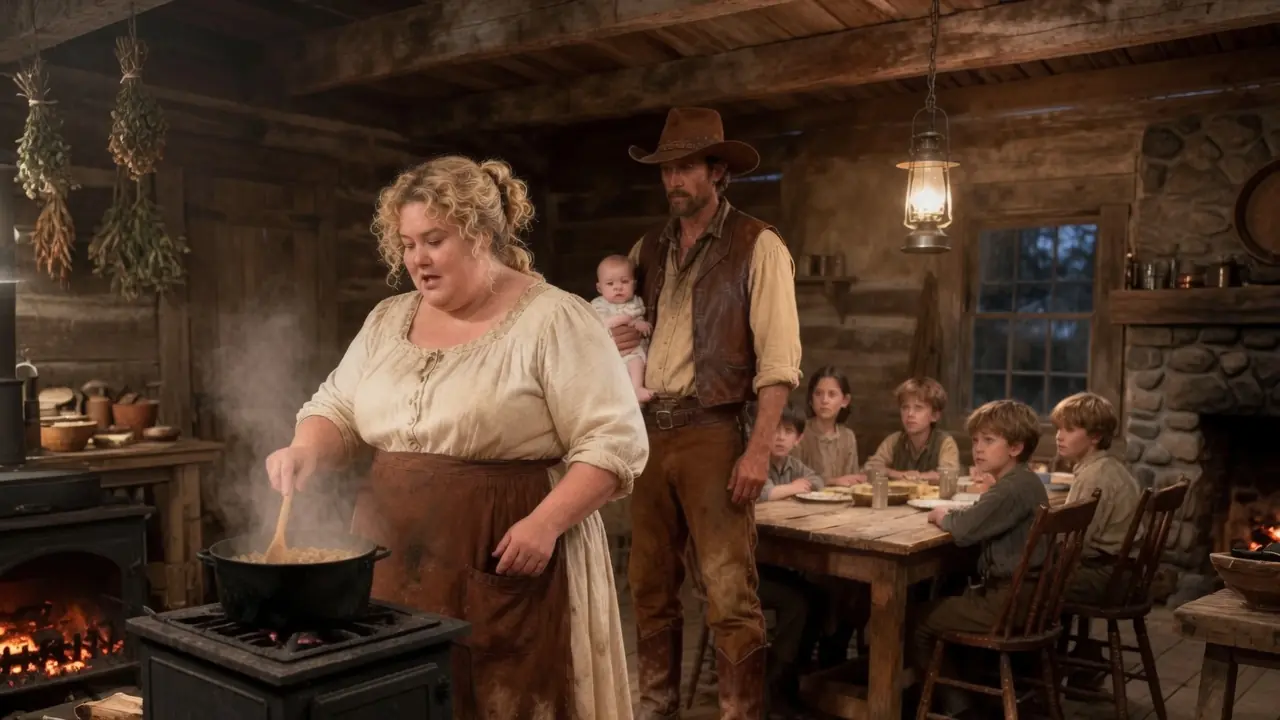
For three months, Hazel had cooked, cleaned, repaired clothing, managed lessons, tended fevers, and coaxed laughter back into a house that had forgotten how it sounded. She had carried baby Samuel through nights when he screamed for a mother he could not remember, held eight-year-old Emma through nightmares, and reminded twelve-year-old Ruth that she was still a child rather than the replacement woman of the house. Yet Cole had spoken about marriage as though choosing a wife meant hiring a more permanent housekeeper.
Hazel placed the wooden spoon beside the stove.
“Supper is ready,” she said.
Cole shifted Samuel in his arms. “Hazel—”
“Your children need to eat.”
She filled five bowls, cut the cornbread, and placed the smallest portion before Emma, who always claimed she was not hungry before eating everything. Hazel moved with controlled efficiency, but the children recognized the difference. Her kindness remained, yet the warmth had withdrawn from it.
Cole sat at the head of the table.
The chair across from him had belonged to Catherine, his late wife. Hazel had never used it. She always sat between Emma and Samuel, close enough to help both children without occupying a place that grief had kept untouched.
That evening, she did not sit at all.
She carried her bowl to the small pantry and ate alone.
The Mercer ranch stood seven miles east of Cimarron, where New Mexico Territory opened into miles of dry grass, red earth, and distant mountains. Cole’s father had built the original cabin, and every addition revealed a different decade of survival. The kitchen leaned slightly north, the barn door closed only when lifted from beneath, and half the fence posts had been repaired with wire.
When Hazel first arrived, the home had looked less like a place where people lived than a place they had failed to escape.
Catherine Mercer died giving birth to Samuel seven months earlier. Her death left Cole with five children and a grief so heavy that basic responsibilities became impossible. Fourteen-year-old James grew angry, Ruth tried to become a mother, nine-year-old Nell disappeared into drawings, Emma stopped speaking to strangers, and Samuel cried until exhaustion silenced him.
Cole spent hours beside the creek pretending to inspect cattle.
In truth, he sat on the same rock and stared at the water.
The letter he sent east had lied about everything except the wages. He described an orderly household and well-managed children because three previous housekeepers had abandoned the ranch after seeing the truth. Hazel had arrived with thirty-two dollars, one carpetbag, and no home waiting behind her.
She should have left.
Instead, Emma took her hand.
The little girl had stood barefoot beside a juniper tree, hair tangled around her frightened face. She reached toward Hazel without asking permission and held on as if loosening her fingers might make the stranger disappear. Hazel looked at the collapsing porch, the hollow-eyed children, and the widower who appeared only partly alive.
She stayed because someone had once left her when she needed them most.
Both Hazel’s parents died during the same winter. Her father’s illness took him first, and her mother followed before the ground thawed enough for burial. Their small home was sold to pay debts, leaving Hazel dependent on distant relatives who offered sympathy but no permanent place at their tables.
At thirty-four, she had learned what happened to women without husbands, property, or beauty praised in drawing rooms.
They became useful.
If usefulness disappeared, so did their welcome.
Hazel was broad-hipped, full-bodied, and stronger than fashionable dresses were designed to flatter. Her blonde curls refused discipline, and travel dust settled into every crease of her old cream dress. Men had called her pleasant, capable, dependable, and once—when they thought she could not hear—built for work.
Nobody had called her beautiful.
Cole’s careless words beside the stove reopened every memory she had buried beneath labor.
He did not need a beautiful wife.
He needed someone who could cook.
By the time the children slept, Hazel had made a decision.
She packed her carpetbag.
Ruth found her folding the blue dress she wore only to church. “Are you leaving?”
Hazel continued folding. “I have not decided.”
“That means yes.”
The girl stood in the doorway wearing the same expression she had carried when Hazel first arrived: exhausted, guarded, and preparing to survive another loss.
“I cannot stay where I am valued only for what my hands can do,” Hazel said gently.
Ruth’s chin trembled. “Father says stupid things.”
“He does.”
“He doesn’t mean them.”
“That does not make them harmless.”
Ruth entered and sat on the edge of the narrow bed. “If you leave, I’ll have to take care of Samuel again.”
“No.” Hazel knelt before her. “You are twelve. Your father must take responsibility.”
“He doesn’t know how.”
“He can learn.”
“What if he doesn’t?”
Hazel had no honest reassurance.
Ruth stared at the carpetbag. “Mother used to say Father loved hard but spoke poorly.”
“Your mother knew him longer than I have.”
“She also said grief could make a good man selfish.”
Hazel looked at the child.
“Did she know she was dying?”
Ruth nodded. “She told me not to let Father disappear.”
The burden inside that request explained more than Hazel wanted to understand. Catherine had placed the survival of the household on a twelve-year-old girl because she trusted Cole’s grief less than her daughter’s endurance.
Hazel closed the carpetbag without fastening it.
“Go to bed,” she said. “We will speak in the morning.”
After Ruth left, Hazel heard Cole moving downstairs. He entered Catherine’s unused chair, judging by the scrape across the floor, and remained there for almost an hour.
Hazel waited for him to knock.
He never came.
At dawn, she carried the carpetbag toward the porch.
Cole stood beside the gate.
He wore no hat, and his dark hair had been hastily pushed away from his face. Samuel slept against his shoulder inside a blanket, while Emma held one of his hands. The other children waited near the doorway.
Cole looked at the bag. “You decided.”
“I did.”
Emma tightened her grip on him.
Hazel’s heart ached, but she kept walking.
Cole stepped between her and the road. “I asked myself your question.”
“What answer did you find?”
“That I have spent seven months looking for someone to carry what I dropped.”
Hazel said nothing.
“I wrote for a housekeeper because I needed cooking and laundry,” he continued. “You gave my children more than that. You made them feel safe in their own home.”
“Safety is not marriage.”
“I know.”
“Do you?”
Cole looked toward the farmhouse. “I asked you badly because I have forgotten how to speak about anything that matters.”
“You did not ask me at all. You described a position.”
“You’re right.”
The words surprised her.
Cole had been stubborn about fences, cattle, grief, and nearly every suggestion Hazel offered during her first month. Apologies did not come easily to him, particularly when his pride felt threatened.
He shifted Samuel carefully. “I do not want another Catherine.”
Hazel’s face hardened. “I could never be her.”
“That is what I mean.”
He looked directly at her.
“Catherine was my wife, and I loved her. You are Hazel. You argue when I disappear, make James finish what he starts, and somehow convince Emma that carrots taste better when cut like stars. You repaired this family without asking us to pretend nothing broke.”
Hazel’s fingers tightened around the carpetbag handle.
Cole continued, “I do not need a woman to cook because I can learn. I do not need someone to raise my children because they are mine to raise. What I want is the woman who forced me to remember I was still their father.”
The children listened from the porch.
Hazel glanced toward them. “This should not be said in front of an audience.”
“They refused to stay inside.”
James folded his arms. “You made it sound like she was leaving because of us.”
“I did not.”
“You make most things sound wrong,” Ruth said.
Cole closed his eyes briefly. “That appears to be the family judgment.”
Emma released his hand and approached Hazel. “If you marry Father, can you still be Hazel?”
Hazel crouched. “I will always be Hazel.”
“Could I call you Mama?”
The question struck her harder than Cole’s proposal.
“You may call me whatever feels true,” she answered. “But nobody should replace your mother.”
Emma looked toward the graves beneath the cottonwood tree. “Mama Catherine can be my first mama.”
Cole’s face tightened with grief.
Hazel rose and faced him. “Marriage will not solve this household.”
“No.”
“You cannot return to the creek every time pain becomes inconvenient.”
“I know.”
“Ruth will go to school. James will not become your unpaid ranch hand. Nell’s drawings are not foolish, and Emma needs shoes that fit.”
“I agree.”
“You must learn to hold your own son without waiting for me to rescue you.”
Cole looked at Samuel sleeping against him. “I am trying.”
“And my wages remain mine until we marry, should I ever agree.”
His eyebrows lifted. “You’re negotiating?”
“I have nowhere to return to. That does not mean I have no choices.”
“No,” he said. “It doesn’t.”
Hazel placed the carpetbag on the porch.
“I will stay through winter.”
Hope moved across the children’s faces.
“That is not an acceptance,” she warned.
Cole nodded. “It is more than I deserved this morning.”
Winter preparations gave them little time for romance.
The ranch faced a water crisis that threatened every animal and crop. Aldis Brigg, a wealthy land speculator controlling property upstream, diverted Red Willow Creek through an illegal trench. The reduced flow left the Mercer pasture dry and threatened four neighboring ranches.
Cole had written one complaint months earlier.
When no answer arrived, he surrendered.
Hazel refused to accept it.
“You have five children and a man stealing their water,” she told him. “A letter is not resistance.”
“What do you suggest?”
“Speak to everyone losing water.”
“They are afraid of Brigg.”
“So are you.”
Cole bristled. “Fear and wisdom are different.”
“Not when both make you sit beside a creek that is being stolen.”
The argument ended with Cole storming toward the barn. Ten minutes later, he returned and admitted she was right.
They organized a meeting inside the Mercer kitchen.
Nine ranchers attended. Brigg had pressured each separately, convincing them that resistance would cost more than surrender. Hazel placed maps on the table and demonstrated how the illegal trench reduced flow across the valley.
Cole spoke after her.
His voice shook at first but strengthened when James entered carrying records of cattle losses. The neighbors agreed to petition the territorial water office together.
The following evening, two armed riders appeared at the ranch.
Cole met them beside the gate. Hazel watched through the kitchen window as one man warned him to withdraw the complaint. When the rider mentioned the children, Hazel stepped outside carrying the heavy iron skillet.
“Mrs. Carter,” Cole warned.
“I heard a threat against this household.”
The rider looked her over and laughed. “Go back to your stove.”
Hazel raised the skillet slightly. “This came from the stove.”
James almost smiled behind the barn door.
The men left without violence, but their message remained. Brigg possessed money, hired riders, and friends inside the territorial office. The Mercer family had only evidence and neighbors whose courage might fail.
The danger increased when Catherine’s sister, Eleanor Voss, arrived from Santa Fe.
Eleanor stepped from a hired carriage wearing a tailored traveling coat and the expression of a woman prepared to confirm her worst fears. She walked through the house, examined the repaired windows, checked the children’s clothing, and asked Ruth questions as though conducting an investigation.
Hazel remained polite.
Eleanor barely acknowledged her.
That evening, she told Cole she intended to take the three youngest children to Santa Fe. “They need stability.”
“They have stability here,” Cole answered.
“They have a hired woman keeping this place from collapsing.”
Hazel stood near the stove, hearing every word.
Eleanor continued, “What happens when she finds a better position?”
Cole looked toward Hazel. “She is not merely an employee.”
“Has she agreed to marry you?”
Silence followed.
Eleanor understood immediately.
“You are building their future around a woman who has not promised to remain.”
Hazel stepped forward. “The children’s future should not depend entirely on me.”
“At least you understand that.”
“But removing them from their father will not heal them.”
“A father who sat beside a creek while his children went hungry?”
Cole lowered his head.
Eleanor’s accusation was cruel because it was true.
Hazel expected him to become defensive. Instead, he said, “I failed them.”
Eleanor paused.
“I cannot change those months,” he continued. “I can only become someone they can trust now.”
“You expect me to believe that happened because a housekeeper arrived?”
“No. It happened because she told me the truth after everyone else decided grief excused me.”
Eleanor studied him.
Over the following week, she watched Cole wake before dawn, prepare Samuel’s bottle, help Emma dress, and work beside James rather than ordering him from a distance. She saw Ruth attending school and Nell drawing openly at the table.
The home was imperfect.
It was also alive.
Eleanor’s judgment softened, but she remained concerned about Hazel’s position. One afternoon, she found her hanging laundry and asked the question directly.
“Do you love my brother-in-law?”
Hazel clipped a shirt to the line. “He is not your brother.”
“You understand what I mean.”
“I care for him.”
“That was not the question.”
Hazel looked toward the pasture where Cole repaired a fence with James.
“Yes.”
“Does he love you?”
“I believe he is trying to understand the difference between loving me and needing me.”
Eleanor nodded slowly. “Catherine worried about that too.”
“She did?”
“Cole loved her deeply, but he allowed her to carry the household because she appeared capable. By the time he noticed she was exhausted, Samuel was already coming.”
Hazel looked toward the graves.
“Did Catherine resent him?”
“Sometimes.”
The honesty surprised her.
“She also believed he could become better,” Eleanor added. “She simply ran out of time to demand it.”
That evening, Hazel told Cole what Eleanor had said.
He remained quiet for a long time.
“I thought working the ranch meant I was caring for the family,” he finally said.
“You were providing money and food.”
“Is that not care?”
“It is part of it. Care is also knowing Ruth stopped reading because she was too tired. It is seeing Nell hide drawings because James mocked her. It is recognizing Emma has outgrown her boots.”
Cole looked toward the children.
“I did not see any of that.”
“You were not looking.”
He accepted the judgment without retreating.
The next morning, Cole took Ruth into town and purchased a book she had admired in the general store. He helped Nell build a box for her drawings and made James apologize for calling them useless.
For Emma, he measured her feet himself.
He returned with boots one size too large.
Hazel laughed until tears filled her eyes.
Cole smiled despite himself. “She’ll grow.”
“She cannot walk properly today because of how tall she may become next year.”
They exchanged the boots.
That ordinary mistake showed Hazel more than a grand promise could have. Cole was learning to participate, fail, and try again without waiting for her to repair everything.
Brigg struck before the water hearing.
Someone set fire to the Mercer hay shed during the night. Flames rose above the barn while the household slept. James smelled smoke first and sounded the alarm.
Cole and the older children formed a bucket line. Hazel carried Samuel outside, wrapped him in blankets, then returned to help despite Cole ordering her away.
The fire destroyed half the winter feed.
Near the fence, Hazel found a brass tobacco tin bearing Brigg’s initials. It was too obvious to prove he had personally started the fire, but it suggested someone wanted the family frightened.
Cole held the tin in his palm.
“I should ride to his house tonight.”
“And do what?”
“End this.”
“With a gun?”
“If necessary.”
Hazel stepped between him and the saddle. “Your children already lost one parent.”
“He threatened them.”
“Do not answer by making them lose you too.”
“He burned our feed.”
“He wants you angry enough to become the criminal.”
Cole’s hand tightened around the tin.
Hazel held his gaze. “Be their father, not Brigg’s weapon.”
Slowly, he released the saddle.
They rode to town at dawn and delivered the evidence to the territorial marshal. More importantly, the neighboring ranchers refused to withdraw from the water complaint. Each donated part of their winter hay to replace what the Mercers lost.
Brigg’s intimidation had created the unity he feared.
At the hearing, Hazel presented maps showing the original creek path. Cole testified about reduced flow and livestock losses. Three laborers admitted Brigg paid them to dig the diversion at night.
The territorial commissioner ordered the trench closed and restored the ranchers’ water rights.
Brigg was fined and placed under investigation for threatening witnesses. His power did not vanish instantly, but he could no longer treat the valley’s water as private property.
When Red Willow Creek began flowing fully again, the children ran beside it shouting.
Cole stood next to Hazel on the bank.
“You saved the ranch,” he said.
“We saved it.”
“You began the meeting.”
“You attended.”
“You forced me.”
“I encouraged you loudly.”
He smiled.
Eleanor returned to Santa Fe without taking the children. Before leaving, she handed Hazel Catherine’s small sewing box.
“This belongs in the house,” Hazel said.
“That is why I’m giving it to you.”
Hazel hesitated.
Eleanor added, “Catherine would not ask you to become her. She would ask you to make certain Cole never mistakes a strong woman’s endurance for permission to neglect her.”
“I can promise that.”
“I believe you.”
Winter arrived with hard wind and thin snow.
The family gathered nightly around the stove. James taught Emma to read simple words, Ruth helped Samuel walk between chairs, and Nell drew Hazel standing beside the creek with one hand raised toward Brigg’s riders.
Cole stopped disappearing for hours.
When grief overwhelmed him, he spoke Catherine’s name aloud instead of leaving the family to guess where his mind had gone. Hazel listened without jealousy.
Love for the dead did not reduce what could grow among the living.
On Christmas morning, Cole asked Hazel to walk with him to the cottonwood graves.
He cleared snow from Catherine’s marker and placed evergreen branches beside it. Hazel remained several feet away until he invited her closer.
“I asked you once because I needed someone,” he said.
Hazel remembered the kitchen, the baby in his arms, and the words that made her pack.
“I am asking now because I know who you are.”
Cole removed no expensive ring. He had sold little that season and refused to begin their future by borrowing money for appearances. Instead, he held out a simple iron key.
“The deed and the bank papers are in town. If you agree, half the ranch becomes yours before the wedding.”
Hazel stared at the key.
“You are offering property?”
“I am offering proof that you will never live here only by my permission.”
Her throat tightened.
“If I die,” Cole continued, “this remains your home. If we disagree, you remain an owner. If you decide not to marry me, I will still pay every dollar of the wages I promised.”
“You planned this.”
“Eleanor helped with the papers.”
Hazel laughed softly. “I wondered why she stopped insulting you.”
“She has not stopped.”
Cole took a breath.
“I love you. Not because you cook, though your cornbread has probably saved lives. Not because the children need you, though they do. I love you because you look directly at broken things and refuse to pretend they are beyond repair.”
Hazel’s eyes filled.
“I am not asking for a servant,” he said. “I am asking for a partner who will tell me when I become less than the man this family deserves.”
“That may happen often.”
“I know.”
“And I will not spend my life doing every household task while you sit at the creek.”
“I know.”
“You must continue learning to cook.”
His face tightened. “I feared that condition.”
Hazel closed her fingers around the key.
“Yes.”
Cole stared at her. “Yes?”
“Yes, I will marry you.”
He stepped forward, then stopped. “May I kiss you?”
The question mattered.
Hazel answered by taking his face between both hands.
Their kiss was quiet, interrupted moments later by Emma shouting from behind the tree that everyone had been waiting long enough. All five children emerged from hiding, including James, who denied having participated in the spying.
Samuel clapped without understanding.
They married in the small Cimarron church at the beginning of spring.
Hazel wore the blue dress she had once packed to leave. Ruth placed Catherine’s pearl comb in her curls, while Nell carried wildflowers gathered near the restored creek.
Cole wore a clean shirt and the expression of a man astonished by his own good fortune.
He did not promise to protect Hazel from every hardship.
He promised to stand beside her inside them.
The ranch improved slowly.
Hazel used her share of ownership to establish a kitchen garden and begin selling preserves in town. Cole repaired the barn, James chose to continue ranching, Ruth returned to her books, and Nell’s drawings eventually appeared in the window of the general store.
Emma called Hazel “Mama Hazel.”
Samuel simply called her “Ma.”
Years later, visitors sometimes repeated the romantic story of the fourteen-dollar housekeeper who rescued a broken widower and became his wife.
Hazel always corrected them.
“I did not rescue him,” she said. “I showed him the work he had abandoned. He chose whether to rise and do it.”
Cole corrected the story differently.
“She came here for fourteen dollars,” he would say. “Before I understood her worth, I nearly let my pride send her back down the road.”
The original employment letter remained inside Catherine’s sewing box. Hazel kept it beside the ranch deed bearing both names.
One document promised room, board, and fourteen dollars each month.
The other recognized her as an equal owner.
Between those two pieces of paper lay the true distance their family had traveled.
Cole first believed he needed a woman who could cook and care for his children.
What he needed was to become a man capable of caring beside her.
Hazel first believed usefulness was the only reason any household would keep her.
What she found was a home where her labor mattered, but her voice, dignity, choices, and love mattered more.
She arrived as a housekeeper with nowhere else to go.
She stayed only after the door became one she could freely open—or leave.