The little girl did not scream when Mason Reed leaned toward the open rear door of the rusted sedan.
That was the first thing that bothered him.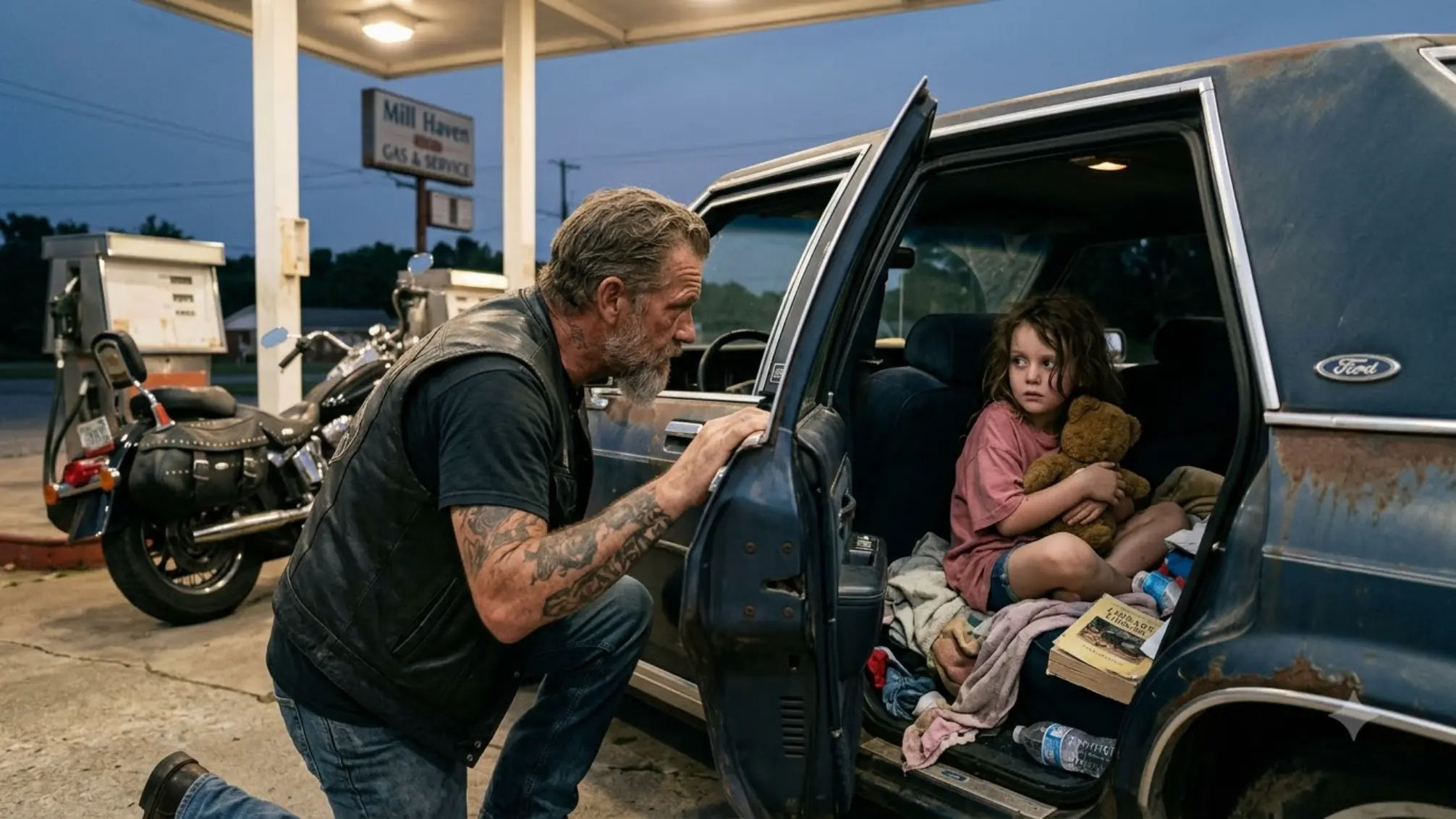
Most seven-year-olds would have recoiled from a man who looked like Mason. He was fifty-two, six-foot-three, broad through the shoulders, with a thick gray beard, tattooed arms, and a black leather vest worn shiny along the edges from two decades of motorcycle rides. Even grown adults sometimes moved aside when he entered a room.
But the child only tightened both arms around her battered teddy bear and stared at him with enormous brown eyes.
The sedan sat beneath the fluorescent canopy of a gas station outside Mill Haven, Tennessee. One rear window was covered with clear plastic where the glass had been broken, and blankets were wedged along the doors in an attempt to block the evening chill.
Mason had stopped for coffee and fuel.
He had nearly walked past the car.
Then he saw the small face in the back seat.
“Hey there,” he said gently.
The girl said nothing.
Mason lowered himself until his face was level with hers.
“You okay?”
She looked toward the front seat.
Nobody was there.
Mason noticed a library book near her feet, half a loaf of bread in a grocery bag, two water bottles, and several pieces of clothing folded inside an old cardboard box.
This was not a child waiting while someone paid for gasoline.
Someone was living here.
“What’s your name?”
The girl hesitated.
“Lucy.”
“I’m Mason.”
She looked at his vest.
“Are you a bad man?”
Mason almost smiled.
“Depends who you ask.”
Lucy considered that answer very seriously.
Then she whispered, “I sleep in the car because there’s no room for me anywhere else.”
The sentence went through Mason harder than any insult ever could.
He crouched lower.
“Baby girl, no child should ever have to say that out loud.”
Lucy pressed the teddy bear beneath her chin.
“Are you gonna make me leave too?”
Mason’s expression changed.
“No, sweetheart.”
He placed one hand over his heart.
“I’m gonna make one call, and by tonight you’ll know what it feels like to be wanted.”
Lucy did not smile.
Children who had heard too many promises rarely did.
Instead she asked, “Where’s my mom?”
Mason froze.
“You don’t know?”
“She went inside.”
“How long ago?”
Lucy shrugged.
“A long time.”
Mason looked toward the convenience store.
Through the glass, a young cashier was stacking cups.
He stood.
“Stay right here.”
Lucy’s eyes widened immediately.
“Are you coming back?”
The fear in that question stopped him.
Mason leaned toward her again.
“I’m not going anywhere without telling you.”
That seemed to settle her.
He walked inside.
The cashier looked up.
“You with the woman in that sedan?”
“No.”
The young man frowned.
“She came in earlier.”
“How much earlier?”
“Maybe two hours.”
Mason felt something tighten in his stomach.
“Where’d she go?”
“Bathroom first. Then she bought cigarettes and asked if there was a bus stop nearby.”
Mason stared.
“She left?”
“Walked toward Highway 12.”
“Without the kid?”
The cashier looked toward the window.
“What kid?”
That answered everything.
Mason pulled out his phone.
His first call was not to his motorcycle club.
It was to Deputy Sheriff Elena Vargas.
He had known Elena for fifteen years. She had once arrested three members of his club after a bar fight and later helped Mason organize a Christmas toy drive for children whose parents were incarcerated.
Their relationship was complicated but respectful.
“Elena.”
“What did you do?”
“Nothing.”
“That makes me nervous.”
“I found a kid.”
Silence.
“A child?”
“Seven, maybe. Alone in a car at Benton’s Gas off Highway 12.”
Her voice changed immediately.
“Don’t move her unless there’s immediate danger. I’m coming.”
“Her mother walked off two hours ago.”
Another pause.
“I’ll be there in ten.”
Mason hung up.
Then he made the second call.
“Ray.”
His club vice president answered through heavy wind noise.
“What?”
“Where are you?”
“Diner.”
“How many guys?”
“Maybe twelve.”
“Bring food.”
Ray laughed.
“You calling me for delivery now?”
“There’s a seven-year-old sleeping in a car.”
The laughter stopped instantly.
“What does she need?”
Mason looked through the window at Lucy.
“Everything.”
Twenty minutes later, the gas station no longer felt empty.
Deputy Vargas arrived first.
She approached Lucy carefully, introduced herself, and asked permission before sitting beside her in the back seat.
Lucy answered questions quietly.
Her full name was Lucy Parker.
Her mother was Nicole.
They had been sleeping in the car for three weeks.
Before that, they stayed with Nicole’s boyfriend.
Before that, a motel.
Before that, another friend.
Lucy did not know addresses.
She knew landmarks.
A yellow house.
A grocery store with a red sign.
A dog named Beans.
Children remembered life differently.
Vargas contacted child services and began searching for Nicole.
Then motorcycles arrived.
Not twelve.
Seventeen.
Mason closed his eyes when he heard them.
Raymond “Ray” Walsh led the line into the station, followed by members of the Mill Haven Riders.
One carried two bags of hamburgers.
Another brought hot chocolate.
Someone had stopped at a drugstore and purchased children’s socks, a toothbrush, a pink blanket, and a ridiculous stuffed giraffe nearly as tall as Lucy.
Mason stared at them.
“I said food.”
Ray shrugged.
“We got distracted.”
Lucy watched through the window as tattooed men quietly gathered several yards away.
None approached without permission.
That mattered to Mason.
Ray eventually crouched near the door.
“That your bear?”
Lucy nodded.
“What’s his name?”
“Captain.”
Ray looked impressed.
“Captain what?”
“Just Captain.”
“Strong name.”
Lucy glanced at the stuffed giraffe in his arms.
“What’s that?”
Ray looked down as though surprised to discover it.
“I think this guy got lost.”
For the first time, Lucy smiled.
It was tiny.
But every biker standing nearby saw it.
Ray handed her the giraffe.
“Maybe Captain needs backup.”
Lucy placed the giraffe beside her.
Mason looked away for a moment because his eyes had suddenly become inconvenient.
Deputy Vargas received the first update forty minutes later.
Nicole Parker had been located walking along Highway 12.
She was alive.
But something was very wrong.
When deputies approached, she appeared confused and exhausted. She told them she had been trying to find help, then said she could not remember leaving the gas station.
An ambulance took her to the county hospital.
Lucy listened while Vargas explained that her mother was sick and doctors were helping her.
“Did she leave because she doesn’t want me?”
The entire gas station went silent.
Vargas sat beside her.
“No, sweetheart.”
Lucy looked unconvinced.
Mason stepped closer.
“Your mom being sick doesn’t mean she stopped loving you.”
“She said people get tired of us.”
Mason’s jaw tightened.
“Who told her that?”
“Everybody.”
Mason looked toward the dark highway.
He knew exactly what kind of exhaustion could make someone believe they were a burden simply because they needed help.
His own daughter had once said something similar.
Her name was Emily.
She would have been twenty-eight now.
Cancer took her at nineteen.
Mason had spent the nine years since her death avoiding conversations about children whenever possible. He could ride through thunderstorms, repair engines in freezing garages, and stand between angry men without hesitation.
But seeing a little girl clutching a teddy bear in a broken-down sedan opened something he had spent years welding shut.
Child services arrived just before ten.
The caseworker, Mara Willis, was kind but tired.
She explained that Lucy needed temporary placement while Nicole was evaluated.
Lucy immediately grabbed Mason’s sleeve.
“No.”
Mason crouched.
“They need somewhere safe for you tonight.”
“I’m safe here.”
“You can’t sleep in this car.”
“I can.”
“I know you can.”
He softened his voice.
“That doesn’t mean you should.”
Lucy’s eyes filled.
“You said I’d know what being wanted feels like.”
Mason swallowed.
“I meant it.”
“Then why do I have to go?”
He had no answer that would satisfy a seven-year-old.
Mara stepped closer.
“There’s an emergency foster home available.”
Lucy buried her face against Captain.
Mason looked at Mara.
“Can we visit?”
She studied him.
“The club?”
“No.”
He glanced toward seventeen bikers.
“Probably not all at once.”
Ray muttered, “Coward.”
Mason ignored him.
Mara smiled faintly.
“We can discuss approved contact.”
Lucy looked up.
Mason held out his pinkie.
She stared.
“What?”
“It’s serious business.”
Lucy hooked her pinkie around his.
“I’ll see you again.”
“When?”
“Tomorrow.”
“Promise?”
Mason hated promises.
He had made one to Emily once.
He had promised she would come home from the hospital.
She never did.
Still, he looked into Lucy’s eyes.
“Promise.”
The next morning, Mason arrived at Mara’s office at 8:03.
She raised an eyebrow.
“Appointment was nine.”
“I like punctuality.”
“You’re fifty-seven minutes early.”
“Very punctual.”
Lucy entered carrying Captain and the giraffe.
She ran toward him.
Mason barely had time to kneel before her arms wrapped around his neck.
He closed his eyes.
Something inside him broke cleanly open.
Nicole remained hospitalized.
Doctors determined she was severely dehydrated, malnourished, and suffering from untreated depression combined with exhaustion. She had not deliberately abandoned Lucy in the way everyone initially feared.
She had simply reached the edge of what one human being could carry.
Her life had collapsed slowly.
First she lost her job after the restaurant where she worked closed.
Then rent fell behind.
Then came eviction.
The boyfriend who offered them a room expected things Nicole eventually refused to provide.
She took Lucy and left.
Shelters were full.
Friends helped until they could not.
The car became temporary housing.
Temporary became three weeks.
Nicole had been trying to keep Lucy in school, keep her fed, stay clean enough that nobody noticed, and search for work while sleeping upright behind a steering wheel.
Eventually her body stopped cooperating.
Mason learned all of this through Vargas and Mara.
Then he called Ray.
“Club meeting tonight.”
“What about?”
“Lucy.”
Ray sighed.
“I knew this was coming.”
The Mill Haven Riders met inside their clubhouse behind an old motorcycle repair shop.
Forty-three members attended.
Mason stood in front.
“A woman and her kid are homeless.”
One member interrupted.
“How much?”
Mason frowned.
“How much what?”
“To fix it.”
Mason had expected discussion.
He had prepared an entire speech.
Ray smiled.
“Looks like your meeting’s over.”
But Mason shook his head.
“No.”
The room quieted.
“We don’t just throw cash at this.”
He explained Nicole’s situation.
She needed housing.
Employment.
Childcare.
Transportation.
Counseling.
Stability.
If they gave her money without structure, it might disappear into motel bills and emergency expenses until nothing remained.
One biker named Charlie owned a small apartment building.
“I’ve got an empty one-bedroom.”
Mason looked at him.
“Rent?”
“First three months free.”
Another member objected.
“No.”
Charlie frowned.
“What?”
“Six.”
Someone else said twelve.
Within seconds they were arguing over how generous Charlie should be with his own property.
Charlie shouted over everyone.
“Fine! Twelve months!”
The room erupted.
Mason laughed despite himself.
Ray raised his hand.
“My sister runs daycare.”
Another member owned a body shop.
“I can fix the sedan.”
A retired electrician volunteered to inspect the apartment.
A grocery-store manager offered food vouchers.
Someone’s wife worked for a staffing agency.
Another member knew a counselor.
The list grew.
Mason stood silently at the front.
He had expected help.
He had not expected an entire system to appear in twenty minutes.
But there was one condition.
Nicole had to want it.
They would not make decisions over her head.
Three days later, Mason visited the hospital.
Nicole Parker looked much younger than he expected.
Thirty-one.
Thin.
Dark circles beneath her eyes.
She immediately became defensive when he introduced himself.
“You’re the biker.”
“Mason.”
“Lucy keeps talking about you.”
“That’s probably unfortunate.”
Nicole almost smiled.
Then suspicion returned.
“What do you want?”
“Nothing.”
“Nobody wants nothing.”
Mason sat.
“That’s what my daughter used to say.”
Nicole looked at him.
He told her about Emily.
Not everything.
Enough.
Then he explained the club’s offer.
Apartment.
Job assistance.
Childcare.
Car repair.
Nicole stared at him.
“What’s the catch?”
“No catch.”
“There’s always a catch.”
“You’d pay rent after the first year.”
She laughed bitterly.
“There it is.”
Mason smiled.
Nicole covered her face.
“I can’t take charity from hundreds of strangers.”
“Why?”
“Because I’m not helpless.”
“I didn’t say you were.”
“I got my daughter taken away.”
“You got sick.”
“I left her in a car.”
“You were trying to find help.”
Nicole’s voice broke.
“I failed her.”
Mason leaned forward.
“Then fail differently tomorrow.”
She stared.
“What?”
“That’s all any parent does.”
He looked toward the hospital window.
“You mess something up. You learn. You get another morning.”
Nicole began crying.
Mason waited.
After a while, she asked quietly, “Why are you doing this?”
He answered honestly.
“Because somebody should’ve found you three weeks ago.”
Nicole accepted.
Not comfortably.
But she accepted.
The apartment became ready in four days.
What happened next turned into a joke across Mill Haven.
Mason told Ray they needed six volunteers.
Four hundred fifty bikers eventually appeared over the course of the weekend.
Not all were Mill Haven Riders.
Word had spread through motorcycle clubs across Tennessee, Kentucky, Mississippi, and Alabama.
Some arrived carrying furniture.
Others brought kitchen supplies.
One group delivered a new mattress.
Another brought children’s books.
Someone built a small wooden desk for Lucy.
A women’s riding club arrived with clothes for Nicole.
An elderly biker hauled in a box containing exactly twenty-seven stuffed animals.
Mason stared.
“Why twenty-seven?”
The man shrugged.
“They were on sale.”
By Sunday afternoon, the apartment barely had room for people.
Lucy stood in the center of her new bedroom.
Her walls were pale yellow.
There was a bed covered with a quilt sewn by riders’ wives.
A bookshelf stood under the window.
Captain sat beside the stuffed giraffe.
Lucy touched the bed.
“This is mine?”
Nicole covered her mouth.
Mason nodded.
“Yours.”
“For how long?”
The question hurt.
Nicole knelt beside her.
“As long as we need it.”
Lucy looked toward Mason.
“Nobody can make me sleep in the car?”
“No.”
“Promise?”
Mason smiled.
“This one I’m very confident about.”
Lucy hugged him.
Over the following months, Nicole rebuilt.
Slowly.
The staffing agency found her work at a medical supply company.
It was not glamorous.
It was stable.
Ray’s sister arranged childcare during shifts.
The sedan received a new alternator, tires, brakes, rear window, and enough mechanical work that the body-shop owner finally complained it would have been cheaper to replace the car.
So they replaced it.
A used Honda appeared outside Nicole’s apartment with a red bow on the hood.
Nicole cried for ten minutes.
Lucy asked whether she could name it.
She called it Betty.
Nobody knew why.
Mason became part of their life almost accidentally.
Wednesday dinners.
Saturday library trips.
Occasional school pickups.
Lucy began calling him Uncle Mason.
The first time she did, he had to pretend something was wrong with his motorcycle because he needed five minutes alone.
One year after the gas-station night, Nicole invited the entire club to Lucy’s eighth birthday.
Mason immediately refused.
“Four hundred people cannot fit in your apartment.”
So they held it at the clubhouse.
Lucy arrived wearing a pink dress and carrying Captain.
The parking lot was filled with motorcycles.
Not four hundred fifty this time.
Only around one hundred.
Mason called that restraint.
Lucy stood on a chair while everyone sang.
When she blew out the candles, Mason asked what she wished for.
“You can’t tell wishes.”
“Fair.”
Later, she found him outside.
“Can I tell you anyway?”
“Sure.”
She leaned close.
“I wished nobody else has to sleep in a car.”
Mason looked at her.
That wish became something bigger.
The Mill Haven Riders created a small emergency housing fund.
Not a charity with expensive offices.
Just a legally organized local program designed to pay short-term motel or rental costs for families facing sudden homelessness while community agencies worked on permanent solutions.
Other clubs contributed.
Local businesses joined.
Mara Willis helped establish guidelines.
Deputy Vargas connected families with services.
Nicole eventually became one of the program’s volunteers.
Three years after Mason found her daughter, Nicole stood inside the clubhouse explaining emergency-housing procedures to thirty bikers who were paying much more attention than anyone would expect from their appearance.
Lucy sat near the back doing homework.
Mason watched both of them.
Ray stepped beside him.
“You realize you caused this.”
“I stopped for gasoline.”
“That’s how these things start.”
Mason looked toward Lucy.
She had grown taller.
Captain had lost another eye and most of one ear.
The giraffe remained inexplicably intact.
“You ever think about Emily?” Ray asked.
“Every day.”
“Lucy help?”
Mason considered the question.
“No.”
Ray looked surprised.
Mason continued.
“She didn’t replace anything.”
He watched Lucy laugh at something Nicole said.
“But she reminded me losing one person didn’t mean I had to stop caring about everybody else.”
Ray nodded.
“That sounds annoyingly healthy.”
“I hate it.”
Years later, Lucy barely remembered the original gas station clearly.
She remembered the teddy bear.
The cold car.
A giant bearded stranger crouching outside the door.
And one sentence.
No, sweetheart.
She remembered believing him before she had any logical reason to.
Mason remembered everything.
The broken window.
The blankets.
The library book.
The child asking whether he would make her leave.
But what stayed with him most was not what happened afterward with hundreds of motorcycles filling the street.
It was how small the first decision had been.
He could have looked away.
Someone else would handle it.
Police.
Child services.
The mother.
A stranger.
Anybody.
Instead, he stopped.
That was all.
Sometimes changing a life did not begin with having the solution.
It began with refusing to walk past the problem.
Lucy Parker had once believed there was no room for her anywhere except the back seat of a rusted sedan.
Then one biker stopped beside the window.
Another brought dinner.
Seventeen brought blankets.
Hundreds eventually showed up carrying furniture, food, tools, and whatever else they thought a seven-year-old girl might need.
But what Lucy remembered most was simpler.
Someone had looked directly at her and made her feel, for the first time in a very long while, that taking up space was allowed.
And from that night forward, she never again had to ask whether there was room for her.
People made room.