The dust hung in the air like it had nowhere else to go, drifting slow under the pale afternoon sun.
In that quiet town where the wind carried more stories than people did, a lone rider came down the road, his hat pulled low and his shadow stretching long behind him.
Folks noticed him, of course. They always did. A man like that did not belong to places. He passed through them like a storm that never quite broke.
He had the look of someone who had ridden too far and stayed nowhere long enough to be missed. His coat was worn, his boots carried the marks of miles, and his eyes held something heavier than the saddle he carried.
The kind of man who spoke little, not because he had nothing to say, but because words had stopped mattering to him a long time ago.
The town was small, the kind that barely made a mark on a map. A few wooden buildings, a dusty main street, and a silence that settled in the bones.
But that day, something was different. Maybe it was the way the sunlight caught on the windows, or the way the wind softened for just a moment.
Or maybe it was her.
She stood by a simple wooden table just outside a small shop, her sleeves rolled up and flour dusted across her apron. There were pies laid out before her, golden crusts catching the light. Each one made with care you could almost feel from a distance.
People passed by, some stopping, most not. It was not a busy town, and she was used to that.
Still, she stood there, steady and quiet, like she believed someone would come.
The cowboy slowed his horse when he saw her.
It was not the pies that caught his eye first. It was her stillness.
In a place where everything felt worn down and tired, she stood with a kind of quiet strength that did not belong to the dust or the wind. She did not call out to him, did not wave or try to sell him anything.
She just looked at him, calm and unafraid.
He stepped down from his horse, boots hitting the ground with a dull thud. For a moment, neither of them spoke. The air between them felt heavier than the heat.
“You selling those?” he finally asked, his voice rough from disuse.
She nodded.
“Fresh this morning.”
He looked at the pies, then back at her. There was something in his gaze, something searching, like he was trying to find something he had lost long ago.
“How much?”
She told him the price, simple and fair. Not a bargain, not a plea.
He reached into his pocket, pulling out a handful of coins. More than enough. Without counting, he placed them on the table.
“I’ll take them all,” he said.
For the first time, she hesitated. Her brow tightened just slightly, not in fear, but in confusion.
“All of them?”
“All,” he repeated.
She looked down at the pies, then back at him.
“You planning to feed the whole town?”
He shook his head.
“No.”
That was all he said.
She gathered the pies carefully, placing them into a crate. Her hands moved with quiet precision, like this work meant something more than just selling food.
He watched her the entire time, not in a way that made her uneasy, but in a way that felt deliberate.
When she finished, she slid the crate toward him.
“There you go.”
But he did not reach for it right away.
Instead, he leaned slightly forward, resting his hand on the edge of the table. His eyes met hers, steady and unflinching.
“From now on,” he said slowly, “you bake only for me.”
The words hung in the air, heavier than the dust, heavier than the silence that followed.
“I don’t think you understand. I sell to whoever comes by.”
He did not move.
“I understand just fine.”
There was no anger in his voice, no force, just a certainty that made the ground beneath her feel a little less steady.
“You can’t just decide that,” she said, her tone calm but firm.
He straightened, finally picking up the crate.
“I already did.”
Something about the way he said it made her pause. Not because she agreed, but because she sensed something deeper behind it. Something unspoken.
He turned to leave, carrying the pies as if they weighed nothing at all. He mounted his horse, adjusting the crate with ease.
But before he rode off, he looked back at her.
“Be here tomorrow,” he said.
It was not a request.
The sound of hooves faded into the distance, leaving her standing there alone, the empty table before her, the coins still resting where he had placed them.
The wind picked up again, stirring the dust around her feet.
She could have walked away, could have taken the money and forgotten the strange man who passed through like so many others.
But she did not move.
Because deep down, she knew something had just changed.
And she was not sure if she was ready for what would come next.
She stood there long after the sound of hooves had faded, her hand still resting on the empty table. The coins lay untouched, catching bits of sunlight as the wind stirred dust across the street.
A few townsfolk slowed their steps, casting curious looks her way, but no one asked questions. In a place like this, people learned to mind their own business, especially when something did not feel right.
By the time the sun dipped lower, she gathered the coins and stepped inside her small shop. The door creaked shut behind her, cutting off the restless breeze.
Inside, the smell of baked apples and cinnamon still lingered, warm and steady, like it always had. It was the only thing in her life that never changed.
She set the coins on the counter and stared at them.
It was more money than she usually made in two days, maybe three. Enough to buy extra flour, more sugar, maybe even fix the broken hinge on the back door.
But the weight of it did not feel right in her hands.
That man had not come for pies alone. She knew it, even if she could not explain why.
She moved toward the small kitchen in the back, tying her apron tighter as if it could ground her thoughts. The wooden table there was worn from years of use, marked with faint cuts and flour stains.
Her hands moved out of habit, reaching for a bowl, measuring out ingredients.
Baking had always been simple. You followed steps, trusted the process, and in the end, something good came out of it.
People were not like that.
As she worked the dough, her mind drifted back to the look in his eyes. It was not hunger. Not for food, anyway. It was something quieter, something heavier.
Like a man who had made a promise to himself long ago and had finally decided to keep it.
She pressed the dough harder than she meant to, then stopped. Took a breath.
Outside, the town settled into evening. Lanterns flickered to life one by one, and voices drifted faintly through the wooden walls. Somewhere, a piano played a slow tune.
It all felt normal, the same as every other night, except it was not.
A knock came at her door.
She froze for a moment, her hands still dusted in flour.
Another knock followed, firmer this time.
Wiping her hands on her apron, she walked back through the shop and opened the door just a crack.
An older man stood there, his hat tilted back, his expression lined with concern.
“You all right?” he asked, glancing past her into the shop.
“I’m fine,” she said, though her voice did not sound as certain as she wanted it to.
“I saw him,” the man said quietly. “That rider. He stopped at your table.”
She nodded.
The man shifted his weight, lowering his voice.
“Folks have seen his kind before. Men who keep to themselves don’t stay long. But there’s something different about that one.”
She leaned against the doorframe, waiting.
“He rode through a town east of here last month,” he continued. “Bought up goods the same way. Paid more than fair. Didn’t cause trouble, but didn’t leave much behind either. Just questions.”
Her grip on the door tightened slightly.
“What kind of questions?”
The man hesitated.
“Why he keeps coming back to places like this. Why he picks one thing, one person, and holds on to it like it’s the only thing that matters.”
A chill ran through her, though the air was still warm.
“He say anything else to you?” the man asked.
She thought about it. The way he had stood there, calm and certain. The way he had told her to be there tomorrow.
“Nothing much,” she said.
It was not a lie, but it was not the whole truth either.
The man studied her for a moment, then nodded slowly.
“Just be careful.”
“I will.”
He tipped his hat and walked away, his footsteps fading into the quiet street.
She closed the door and turned the lock, her heart beating a little faster now. The shop felt smaller somehow, the walls closer than before.
She moved back to the kitchen, but did not return to the dough right away. Instead, she stood there, staring at the half-finished pie.
Tomorrow.
The word lingered in her mind.
She could choose not to be there, could pack up early, close the shop, avoid whatever it was he wanted. No one would blame her. In a place like this, survival often meant knowing when to step away.
But something held her in place.
Maybe it was the way he had looked at her, like she was not just another stop along the road. Maybe it was the strange certainty in his voice, as if he already knew what she would do.
Or maybe it was something else entirely.
She returned to the table and finished shaping the dough, placing it carefully into a pan. Her hands were steady again, but her thoughts were not.
One pie turned into two, then three.
She worked late into the night, longer than she usually did, until the shelves were lined once more with fresh pies cooling in the dim light.
When she finally stopped, she looked at them all and felt a quiet unease settle in her chest.
Morning would come soon enough.
And when it did, she would have to decide.
Outside, the wind picked up again, brushing against the windows like a warning.
Somewhere out beyond the edge of town, a lone rider waited.
And for reasons she could not yet understand, she had the feeling he was not going anywhere this time.
Morning came slower than usual, as if the sun itself was unsure about rising over the quiet town.
She had barely slept. Every small sound in the night had pulled her awake. Every shift of wind made her think of hoofbeats returning sooner than expected.
Still, she opened the shop like she always did.
The table was set outside again, lined with fresh pies, their crusts golden and perfect. She had made more than usual, though she was not sure why. Maybe it was habit. Maybe it was something else.
The street was quiet at first, just a few early risers passing by with slow steps and tired eyes.
A couple of them stopped, bought a pie, and moved on without much talk.
But the air felt different.
People lingered longer than they needed to. They glanced down the road more often than before.
They were waiting, too.
By midmorning, the sun had climbed high enough to cast sharp shadows across the wooden buildings.
That was when the sound came.
Hooves, steady and unhurried, echoing down the street like a drumbeat that did not belong.
He appeared at the far end of town, just as he had the day before.
Same hat, same posture, same quiet presence that made conversation fade wherever he went.
This time, more eyes followed him. Doors stayed half open. Voices dropped low.
She did not move from her place behind the table.
He rode straight toward her, not looking left or right, as if nothing else existed.
When he reached her, he slowed his horse and stepped down without a word.
Dust settled around his boots as he came closer.
“You’re here,” he said.
“I said I would be,” she replied, though she had never actually promised.
His gaze moved over the pies, taking in each one.
For a moment, it seemed like he might say something more, something that explained why he was doing this.
But instead, he reached into his pocket again.
“I’ll take them,” he said.
“All of them?” she asked, though she already knew the answer.
“All.”
She watched him place the coins down, same as before, more than enough.
Her fingers hovered near the edge of the table, but she did not start gathering the pies right away.
“You planning to keep doing this?” she asked.
He met her eyes.
“Yes.”
“That’s not how this works,” she said, her voice steady but firmer now. “I sell to whoever comes by. I’ve got regulars. People depend on this.”
His expression did not change.
“They’ll find something else.”
The simplicity of his answer stirred something sharp inside her.
“That’s easy for you to say. You’re not the one living here.”
For a brief moment, something flickered in his eyes. Not anger, not exactly. Something closer to recognition.
But it passed quickly.
“I’m asking you,” he said, his tone lower now, more deliberate. “Bake for me. Only me.”
Behind her, she could feel the weight of the watching eyes. A few townsfolk had gathered at a distance, pretending not to listen, but clearly doing just that.
This was no longer just between the two of them.
“You’re not asking,” she said quietly.
He did not deny it.
A man stepped forward from the edge of the crowd, the same older one who had come by the night before. His voice carried enough to break the tension.
“Now, hold on,” he said. “You can’t just come in here and claim a person’s work like that.”
The cowboy turned his head slightly, acknowledging him without fully facing him.
“I paid.”
“That don’t make it right,” the older man replied.
Silence stretched for a moment, thick and uneasy.
The cowboy finally turned to look at him.
“I’m not taking anything that ain’t given.”
Those words settled strangely in the air. Not forceful, not threatening, but not entirely true either.
She felt it, too.
“You’re putting me in a spot,” she said, drawing his attention back to her. “This is my shop. My choice?”
He nodded once, slow.
“Then make it.”
Her chest tightened slightly.
For the first time, there was space in his words, a kind of opening. But it did not make things easier. It made them harder, because now it was on her.
She looked down at the pies, then back at him.
“Why?” she asked. “Why me? Why this?”
He did not answer right away.
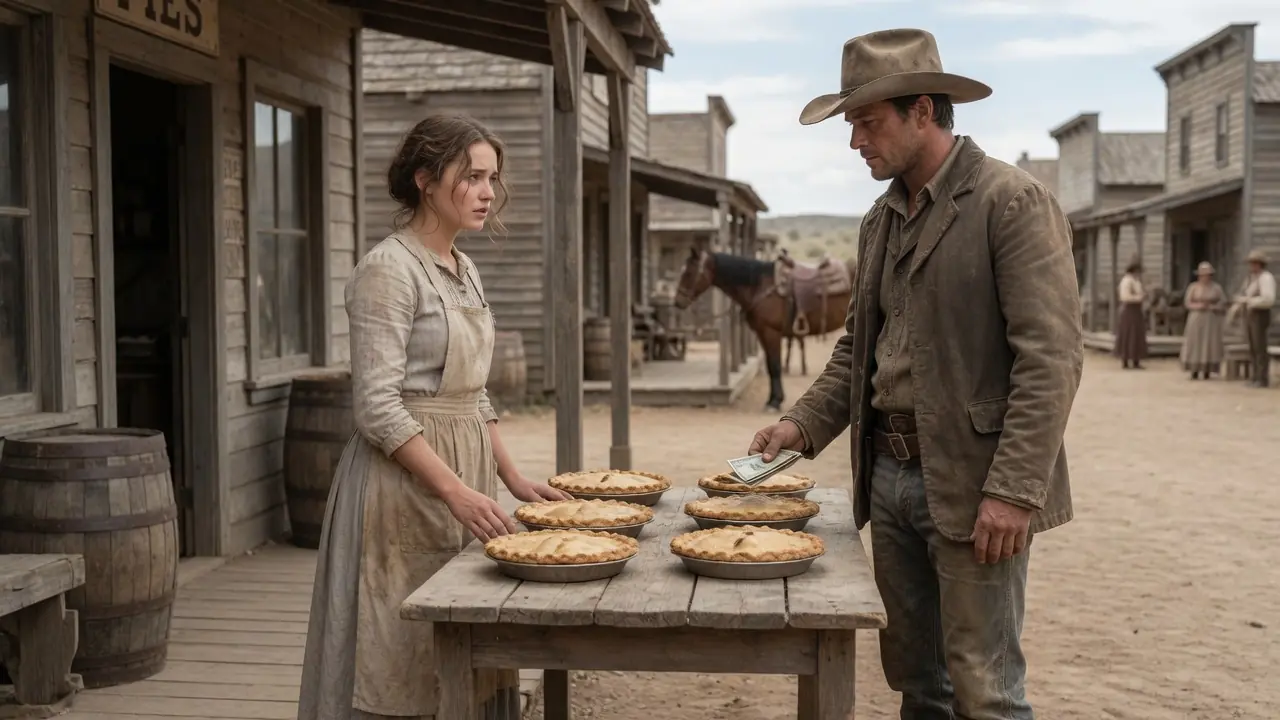
His gaze drifted past her for a moment, toward the shop behind her, the quiet space filled with the scent of baked goods and something softer, something almost like home.
“When you bake,” he said finally, “you don’t rush it.”
She frowned slightly.
“That’s your reason?”
“It’s part of it.”
“That doesn’t explain anything.”
“No,” he agreed. “It doesn’t.”
The honesty of that answer caught her off guard more than anything else he had said.
From the side, another voice spoke up, younger this time.
“You going to let him buy everything again?”
It was one of her regulars, a boy who came by nearly every morning with a few coins clutched tight in his hand. He looked uneasy now, shifting from foot to foot.
She hesitated.
That hesitation was all it took for the moment to shift again.
What had started as something strange between two people was turning into something bigger, a choice that would ripple through the whole town.
The cowboy noticed it, too.
His posture remained calm, but there was a quiet tension in the way he held himself now, like he understood the weight of what was happening.
“I’ll pay double today,” he said, not looking away from her.
A murmur spread through the small crowd.
Money like that mattered here, but so did everything else.
She swallowed, her thoughts racing.
The shop behind her, the people in front of her, the man standing across the table with eyes that held more than he would ever say.
Two paths, both uncertain.
And somehow, neither one felt safe.
The wind picked up again, brushing past them all, carrying dust through the space between choices.
She took a slow breath, knowing whatever she said next would change things in a way that could not be undone.
And for a moment, she wondered if that was exactly what he had been waiting for all along.
The street held its breath, as if the whole town had leaned in at once.
She could feel every eye on her, waiting for her to speak, to choose, to settle something that had grown bigger than a simple table of pies.
Her fingers curled slightly against the edge of the wood.
She looked at the boy, still standing there with his coins, then at the older man, then back at the cowboy.
He had not moved. He did not push.
He just stood there, steady as ever, like he knew time itself would bend before he did.
“I won’t sell them all,” she said at last, her voice clear enough to carry. “Not like that.”
A ripple passed through the small crowd. Some relief, some tension still hanging on.
The cowboy studied her, his gaze calm but sharper now.
“You sure?”
“I am,” she said. “I won’t turn people away. That’s not how I run things.”
For a moment, nothing happened.
Then he nodded once, slow and thoughtful, as if weighing her words against something only he understood.
“All right,” he said quietly. “Then I’ll take what’s left.”
The shift was small, but it changed everything.
She let out a breath she did not realize she had been holding.
It was not a victory, not really. More like a line drawn, one she hoped would hold.
People began stepping forward, one by one. Coins changed hands, pies were passed across the table, and for a while, things almost felt normal again.
But the tension never fully left.
It stayed there, just beneath the surface, like a storm waiting its turn.
The cowboy did not leave.
He stood off to the side, watching as the pies slowly disappeared. He said nothing, did nothing, but his presence lingered heavier than before.
Every now and then, his eyes drifted toward her, not demanding, not impatient, just present.
By the time the last few pies remained, the street had thinned out again. The boy walked away with a small smile, clutching his purchase carefully.
The older man lingered a little longer, then gave her a nod before heading off.
Now it was just the two of them again.
She gathered the remaining pies, placing them into a crate without looking at him.
“These are yours,” she said.
He stepped forward, setting down the coins without counting, just as before.
But this time, he did not pick up the crate right away.
“You meant what you said,” he said.
“I always do.”
He gave a faint nod.
“Most people don’t.”
She finally looked at him.
“Most people don’t try to buy everything in front of them either.”
That earned the slightest hint of something in his expression. Not quite a smile, but close enough to notice.
“Fair,” he said.
Silence settled again, but it felt different now. Less sharp, more uncertain.
“You still haven’t told me why,” she said. “And don’t give me that same answer again.”
He rested his hand lightly on the crate, his fingers tracing the edge like he was thinking through something carefully.
“I’ve been moving for a long time,” he said.
“Town to town?”
“Nothing ever sticks.”
“That’s not unusual,” she replied. “Plenty of folks pass through.”
He shook his head.
“Not like this. I don’t stay because there’s nothing worth staying for.”
The words landed heavier than he probably intended.
“And pies change that?” she asked, a touch of disbelief in her tone.
He looked at her then, really looked at her, like he had the day before.
“It’s not just the pies.”
Her breath caught slightly, though she could not say why.
Before she could respond, a sudden sound cut through the quiet.
A loud crack from somewhere down the street, like wood snapping under strain.
Both of them turned at once.
At the far end of town, a wagon had tilted awkwardly, one of its wheels broken clean through. A man was struggling to steady it, calling out for help. A couple of others rushed over, voices rising in concern.
The moment shifted again.
She glanced back at the cowboy, expecting him to turn away, to keep to himself like he had before.
But he did not.
Without a word, he moved past her, heading straight toward the commotion. His steps were quick, purposeful.
By the time he reached the wagon, he was already rolling up his sleeves.
She watched as he helped lift the side, steadying the weight while others worked to fix the wheel.
He spoke little, but he listened, adjusted, carried more than his share without hesitation.
It was not what she expected.
The man she had seen until now, quiet and distant, moved differently when something needed doing. Like he knew exactly where to stand, exactly what to do.
The tension inside her shifted, not gone, but changed.
When the wagon was finally righted and the man thanked him with a firm handshake, the cowboy simply nodded and stepped back, as if it meant nothing at all.
He walked back toward her, dust clinging to his clothes, his expression the same as ever.
“You didn’t have to do that,” she said.
“Didn’t hurt,” he replied.
She studied him for a moment longer.
“You’re not what people think you are.”
He paused at that, then looked down briefly before meeting her eyes again.
“Neither are you.”
The words lingered between them, heavier now, filled with something unspoken.
The sun had started to dip, casting long shadows across the street again, just like the day before.
But nothing felt the same.
She glanced at the empty table, then back at him, then toward her shop.
“Tomorrow,” he said, quieter this time.
It sounded different now. Less like a command, more like a question he was not fully asking.
She hesitated.
The town was watching again, even from a distance. Not as closely as before, but enough.
Everything had shifted, but nothing had settled.
And standing there, caught between what she knew and what she was beginning to see, she realized the hardest choice was still ahead of her.
Because tomorrow was not just about pies anymore.
It was about whether she was willing to let someone in who clearly did not know how to stay.
And whether he was finally ready to try.
That night felt different from the ones before.
The town settled into its usual quiet, but something had shifted in a way that could not be ignored. She closed her shop later than usual, her hands slower with each task, her thoughts circling the same question over and over.
Tomorrow.
She had spent years building a simple life, one pie at a time, one customer at a time. It was steady, honest, and hers.
No one told her how to run it. No one tried to take it from her.
Until now.
But he had not taken it.
That was what troubled her most.
He had stepped back when she held her ground. He had stayed when others would have left. And when something needed doing, he had not turned away.
None of it fit the idea she had first formed about him.
She blew out the lantern and stood for a moment in the dark, listening to the quiet.
For the first time in a long while, she did not feel alone in it.
Morning came with a soft light and a cool breeze that carried the smell of fresh earth.
She stepped outside with a calm she had not expected, setting up her table once again.
The pies were ready, just like always, lined up with care and patience.
People came as they always did. Some greeted her with quiet smiles, others with curious looks that still lingered from the day before.
The story had spread, of course. In a small town, it always did.
But there was something else, too.
A kind of respect in the way they looked at her.
She had not given in, and she had not turned away either.
She had chosen her own way.
The sound of hooves came again, steady and familiar now.
He arrived just as the sun climbed higher, but this time, fewer heads turned.
The tension was still there, but softer, like something that had been understood, even if not fully accepted.
He stepped down from his horse and walked toward her, the same as before.
But there was a difference in his eyes. Something less guarded, though still careful.
“You’re here,” he said.
“So are you,” she replied.
He gave a slight nod, then glanced at the pies, then back at her.
“Same as yesterday?”
She shook her head.
“No.”
That caught his attention.
“I’ll sell like I always do,” she continued. “To anyone who comes by. You can buy what’s left.”
She paused, choosing her words carefully.
“Or you can sit and have one like everyone else.”
The offer hung in the air, simple but meaningful.
He looked at her for a long moment, as if weighing something far beyond the words.
Then, slowly, he nodded.
“All right.”
It was the first time he had agreed without pushing for more.
She handed a pie to a waiting customer, then another.
The morning moved forward, steady and familiar.
And when the rush slowed, she noticed him sitting on the edge of the wooden walkway, a pie in his hands, eating quietly like any other traveler passing through.
It felt strange, but not wrong.
She walked over after a while, wiping her hands on her apron.
“How is it?”
He looked up at her, a small pause before he answered.
“Good.”
She crossed her arms lightly.
“That’s all you’ve got?”
He almost smiled this time.
“It’s better than good.”
She sat down a short distance from him, not too close, not too far.
For a while, they said nothing.
The town moved around them, steady and calm.
“You don’t have to keep moving,” she said after a while.
He stared ahead, his hands resting loosely now.
“That’s all I’ve known.”
“That doesn’t mean it has to stay that way.”
He let out a slow breath, like the thought itself was unfamiliar.
“Staying isn’t easy.”
“Neither is leaving,” she replied.
He glanced at her then, something softer in his gaze.
“You always this stubborn?”
She shrugged slightly.
“Only when it matters.”
That seemed to settle something in him.
The days that followed did not change all at once.
He did not suddenly become someone new, and she did not give up the life she had built.
But things began to shift in small, steady ways.
He stayed.
At first, it was just for another day, then another.
He helped where he could, fixing a loose board here, carrying supplies there. He did not say much, but his actions spoke enough.
The town noticed.
People who had once watched him with caution began to nod when he passed.
The older man spoke with him one afternoon, their conversation quiet but easy.
Even the boy who came for pies started lingering a little longer, asking questions that he sometimes answered.
And every morning, he came to her table.
Not to buy everything.
Just to be there.
She kept baking, just like always. The same care, the same patience.
But now, there was someone who noticed the small things. Someone who stayed long enough to understand them.
One evening, as the sun dipped low and painted the sky in warm colors, she stood outside her shop, watching the quiet street.
He stepped up beside her, his presence no longer unfamiliar.
“You ever think about leaving?” he asked.
She shook her head.
“This place is enough for me.”
He nodded, taking that in.
After a moment, he spoke again.
“I think I was just looking for a reason to stop.”
She looked at him, really looked at him this time.
“And did you find one?”
He met her gaze, steady and certain in a way that felt different from before.
“Yeah,” he said. “I did.”
The wind moved softly through the town, carrying with it the scent of fresh pies and something else, something quieter but stronger.
Not loneliness.
Not anymore.
And for the first time in a long while, the road ahead did not feel like something he had to follow alone.