The woman knocked only once.
By the time Levi Boone opened the cabin door, she had already turned away.
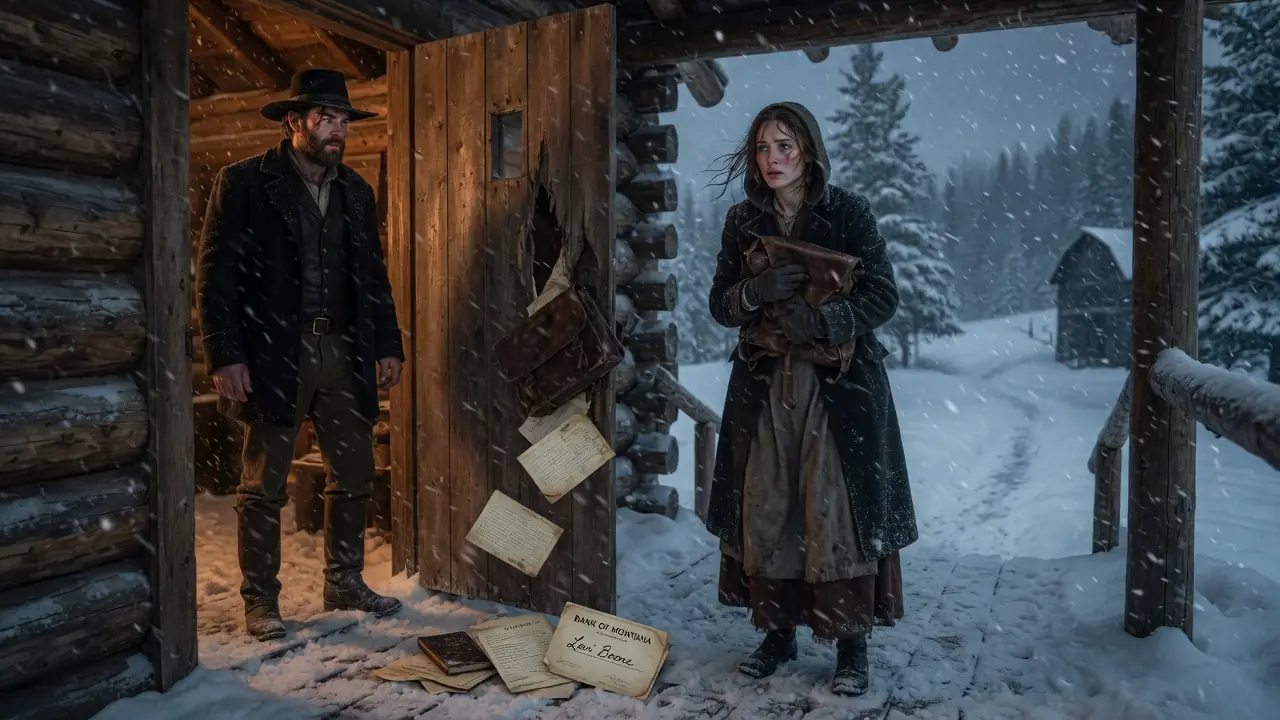
She was walking back into the Montana blizzard with one hand pressed against the side of her face and the other gripping a leather satchel that looked older than she was.
Snow gathered along the shoulders of her threadbare coat. Her boots sank nearly to the ankles with every step.
Levi stared at her retreating figure.
“Ma’am.”
She stopped.
The wind swept between them, sharp enough to steal breath.
The woman turned slowly.
Her hair had escaped its pins and clung damply to her cheeks. A bruise darkened one side of her jaw. Ice crusted the hem of her dress. She looked exhausted, frightened, and ashamed of needing anything from anyone.
“I am sorry,” she said. “I saw the smoke from your chimney.”
Levi stepped onto the porch.
The mountains beyond his ranch had vanished beneath white darkness. The road to Cinder Creek was already buried. No stagecoach would pass until morning. Perhaps not for several days.
The woman’s lips trembled from cold.
“May I warm up by your fire?” she whispered. “Only for a few minutes. I will not trouble you after that.”
Levi looked at her carefully.
Five years earlier, people in Cinder Creek had called him dangerous.
Some still did.
He lived alone at the edge of the Bitterroot Mountains, raised cattle, spoke only when words were useful, and wore a scar across one eyebrow from a gunfight he never discussed.
People who feared Levi Boone usually feared the silence around him first.
The woman standing in front of him feared something else.
Not him.
The possibility that he might say yes and later decide his kindness had purchased something.
Levi understood that look.
He opened the door wider.
“You can warm yourself by the fire,” he said.
She hesitated.
“You can eat supper too. There is a guest room beside the kitchen. The lock is on the inside.”
Her eyes lifted to his.
“I cannot pay you.”
“I did not ask for money.”
“I do not want to owe…”
“You will not owe me anything.”
The storm pressed against the porch roof.
Levi’s voice softened.
“Warmth is not something you have to earn.”
For one suspended moment, the woman simply stared at him.
Then her face crumpled.
Not dramatically.
Not loudly.
One tear slipped down her cheek before she looked away as though even grief required permission.
Levi stepped aside.
“Come in before the mountain makes the decision for you.”
She crossed the threshold carrying her battered satchel close against her chest.
The buckle caught on the doorframe.
The leather tore.
A small notebook fell onto the floorboards and opened near Levi’s boots.
Flour-stained recipe cards scattered across the entryway.
Cinnamon bread.
Apple hand pies.
Honey biscuits.
Beneath them lay a folded document marked with the seal of Cinder Creek Bank.
Levi crouched and picked it up.
His name appeared near the bottom.
LEVI BOONE
PROPERTY TRANSFER AUTHORIZED UPON DEFAULT
His expression hardened.
He had never signed a loan with Cinder Creek Bank.
The woman saw the page in his hand.
All the color left her face.
Levi looked toward the storm outside.
Then back at the stranger standing beside his fire.
“Who gave you this?”
She swallowed.
“No one.”
Her voice barely rose above the wind.
“I stole it from the man who killed my husband.”
The cabin seemed to go quieter than the storm should have allowed.
Levi did not move.
The fire snapped once behind him, throwing orange light across the worn floorboards. Snow hissed against the windows. Somewhere in the barn, one of the horses stamped against the cold.
The woman stood just inside the door, still holding her torn satchel, still wet with snow, still trembling from the mountain air.
Levi looked at the bruise on her jaw again.
Then at the document in his hand.
“What is your name?” he asked.
She hesitated long enough for him to understand that names had become dangerous for her.
“Eliza Bell,” she said at last.
“Your husband?”
“Samuel Bell.”
Levi knew the name.
Not well, but enough.
Samuel Bell had worked as a bookkeeper for Cinder Creek Bank. A thin man with spectacles and careful hands. Levi remembered seeing him once outside the bank, carrying a stack of ledgers under one arm while trying to keep his hat from blowing away in the spring wind.
Three weeks ago, word had spread that Samuel Bell had died in a wagon accident near Miller’s Cut.
The town had called it bad luck.
Cinder Creek was good at calling things bad luck when powerful men wanted silence.
Levi unfolded the document fully.
The language was legal, polished, and cruel.
It claimed that Levi Boone had borrowed eight hundred dollars against his ranch, failed to repay it, and authorized the bank to transfer ownership of his property upon default. There was a signature at the bottom.
His signature.
Except it was not his.
Levi had signed enough cattle bills and feed orders to know his own hand. The forger had copied the shape, but not the weight. His real signature pressed hard at the first letter and dragged slightly at the end. This one floated across the paper like a nervous snake.
Levi looked up.
“Who forged this?”
Eliza hugged the satchel tighter.
“Gideon Voss.”
The name brought a different kind of cold into the room.
Gideon Voss owned Cinder Creek Bank.
He owned more than that, though the town was too polite to say it plainly. He owned mortgages. Debts. Store accounts. Men’s pride. Women’s fear. Half the ranches west of town owed him money, and the other half knew he was waiting for them to need it.
Levi had never borrowed from Voss.
He had avoided the man deliberately.
That made the document in his hand more than fraud.
It made it a warning.
Levi closed the door and slid the heavy bolt into place.
Eliza flinched at the sound.
He noticed.
“The lock is for the storm,” he said. “Not for you.”
Her shoulders lowered a fraction.
Levi walked to the table and set the document down beneath the oil lamp.
“Sit by the fire,” he said.
Eliza did not move.
“Mrs. Bell.”
She looked up.
“You are half frozen. If you fall over in my doorway, I will have to carry you, and that will be trouble for both of us.”
Something almost like a smile moved across her mouth, but it disappeared before it became real.
She crossed to the hearth slowly.
Levi took the quilt from the back of his chair and held it out to her without stepping too close.
She accepted it with both hands.
“Thank you.”
He nodded toward the rocking chair near the fire.
“My mother used to sit there. It is the warmest place in the cabin.”
Eliza lowered herself into the chair, wrapping the quilt around her shoulders. Her hands remained tight around the satchel.
Levi went to the stove. Supper had been simple: beans, salt pork, and biscuits hard enough to make a man grateful for coffee. He ladled beans into a bowl, sliced the last biscuit in half, and set both on the small table beside her.
She stared at the food.
“I cannot…”
“You can.”
“I have not earned it.”
Levi looked at her.
“What did I say at the door?”
Eliza’s eyes filled again.
She looked down quickly, picked up the spoon, and ate one small bite.
Then another.
Hunger overcame manners soon enough.
Levi did not watch her directly.
He moved to the table and began gathering the scattered recipe cards from the floor. Cinnamon bread. Apple hand pies. Honey biscuits. Molasses cake. Wild plum jam. Each card was written in a neat hand and stained with years of flour, butter, and use.
Some had notes in the margins.
Samuel likes extra cinnamon.
Let dough rest longer in winter.
Do not trust the stove if wind comes from the north.
Levi placed them carefully beside the notebook.
Eliza noticed.
“My mother wrote some of those,” she said quietly.
“Baker?”
“She had a boardinghouse in Helena. I learned there.”
“And you married a banker’s bookkeeper.”
“I married a kind man who thought numbers could protect the truth.”
Levi glanced at the forged document.
“Numbers do not always get that chance.”
“No,” she whispered. “They do not.”
For a while, the only sounds were the storm, the fire, and the scrape of her spoon against the bowl.
When she finished, she placed the spoon down carefully, as if afraid one wrong movement might make the meal disappear retroactively.
Levi poured coffee into a tin cup and set it near her.
“Tell me what happened.”
Eliza’s fingers tightened around the cup.
“You do not want to be involved.”
“I am already on the paper.”
She closed her eyes.
“Yes.”
The firelight made the bruise on her jaw look darker.
Levi sat across from her, not too close, elbows resting on his knees.
Eliza took a breath.
“My husband kept the ledgers at Cinder Creek Bank for eight years. He was careful. Quiet. Too trusting, maybe, but not foolish. About two months ago, he found duplicate accounts. Payments recorded in one ledger but missing from another. Mortgages marked overdue after being paid. Properties transferred through defaults that did not exist.”
Levi listened without interrupting.
“Samuel thought it was a mistake at first,” she continued. “Then he found signatures. Forged signatures. Ranchers. Widows. Men who could not read well. Men who drank too much and signed what was placed before them. A few had truly borrowed money, but most had not borrowed what the bank claimed.”
“Why?”
Eliza looked up.
“The railroad spur.”
Levi’s expression changed.
Cinder Creek had been whispering about a rail spur for months. Nothing official. Nothing confirmed. But land had begun changing hands quietly west of town. Too quietly.
Eliza nodded.
“Gideon Voss knows where the spur is planned. Or believes he does. He has been taking land before word becomes public.”
Levi looked toward the window.
His ranch lay along the old west trail. Good grazing land. Water access. A clean pass toward the foothills.
Worth enough now.
Worth far more if a railroad came through.
“My land,” he said.
“Yes.”
“And others?”
“Yes.”
“How many?”
Eliza looked at her satchel.
“Enough to ruin him if the papers reach the right hands.”
Levi leaned back.
“Where are they?”
She touched the satchel.
“Here.”
The answer shifted the room again.
Levi looked at the leather bag. Worn, torn at the buckle now, pressed close to her as if it were a child.
“Why bring them to me?”
“I did not mean to.”
“That is not an answer.”
Eliza swallowed.
“I was trying to reach the stage road before the storm buried it. I thought if I could make Helena, I could find a territorial judge Samuel once trusted. But the storm turned me around. Then I saw your chimney.”
“And knocked once.”
She looked ashamed.
“I should not have knocked at all.”
“Why?”
“Because I knew whose ranch this was.”
Levi studied her.
“You knew my name was in the papers.”
“Yes.”
“So why walk away?”
Her voice lowered.
“Because every person I have asked for help has either been afraid of Gideon Voss or already bought by him.”
Levi said nothing.
“And because I had heard stories about you.”
“There are many.”
“That you killed a man in a gunfight.”
“One man.”
Her eyes lifted.
“Did you?”
“Yes.”
The answer did not come with pride. It came like a nail placed on a table.
Eliza waited.
Levi looked into the fire.
“His name was Carter Wills. He was drunk. He was beating a stable boy behind the livery. I told him to stop. He drew first. I drew faster.”
“And the town called you dangerous.”
“The boy lived. Carter did not. People remember what makes a better story.”
Eliza’s expression changed, not fully, but enough.
“You do not explain yourself much, do you?”
“No.”
“Why?”
“People who want the truth can ask for it. People who want gossip are not improved by facts.”
For the first time since entering the cabin, Eliza gave a small, tired laugh.
It lasted only a second.
Then the weight returned.
“Samuel asked too many questions,” she said. “He copied pages. Hid them behind our stove. Told me if anything happened to him, I was to take them to Helena.”
Her voice trembled.
“The next day, Gideon came to our house with two men. He said Samuel had been stealing from the bank. Samuel denied it. They argued. I was in the kitchen. I heard Samuel say he had proof. Then I heard…”
She stopped.
Levi did not force the rest.
The storm battered the cabin wall.
Eliza stared at the coffee cup in her hands.
“They said his wagon overturned at Miller’s Cut. But Samuel was afraid of horses. He would never have driven out there alone at night. And when they brought his body back, Gideon told me grief makes women imagine things.”
Levi’s jaw tightened.
“He hit you?”
“Not then.”
Levi’s eyes moved to her bruise.
“Tonight.”
She nodded once.
“I went back to the bank after closing. I knew where Samuel kept the spare key. I took the documents from Voss’s locked cabinet. He caught me in the alley.” Her hand rose unconsciously toward her jaw. “I ran before he could call his men.”
“How far?”
“From Cinder Creek.”
Levi looked toward the window.
Cinder Creek was nine miles through rough country.
In a blizzard.
With a bruise on her face and a satchel full of evidence.
“You walked nine miles?”
“I did not have a horse.”
Levi stood.
Eliza flinched again.
He moved slowly this time, taking a spare blanket from a peg near the wall.
“You are either brave or foolish.”
She looked up.
“Is there a difference?”
“Sometimes only whether a person survives.”
He placed the blanket beside her.
“You survived so far.”
She pulled it around herself, gaze lowered.
“For now.”
Levi moved to the window and pushed the curtain aside.
Nothing but white.
“Voss will not come tonight,” he said.
“How do you know?”
“Because even devils prefer roads they can see.”
Eliza looked toward the satchel.
“He will come when the storm breaks.”
“Yes.”
She waited for fear to come into his face.
It did not.
That seemed to trouble her more than comfort her.
“Mr. Boone,” she said, “if those papers are found here, Voss will claim you stole them. He will say I am mad with grief. He will say you forced me. He will say whatever keeps him standing.”
Levi turned from the window.
“Then we best make sure he is not standing when the story is told.”
Eliza went very still.
“I do not want blood.”
“Neither do I.”
“You own guns.”
“I own hammers too. Does not mean every problem is a nail.”
She stared at him.
A little of the fear left her face.
Levi walked to the table, picked up the forged document, and studied it again.
“Who else is in these papers?”
Eliza opened the satchel reluctantly.
Inside were ledgers, copied sheets, folded deeds, letters, and Samuel’s small notebook tied with twine. She laid them out one by one on the table. Her recipe cards sat beside them, flour and cinnamon beside fraud and ruin.
For the next hour, they worked beneath the oil lamp while the storm sealed the cabin away from the world.
Levi read slowly. He was not educated like Samuel had been, but he understood land. He understood dates. He understood when a man’s name appeared beside debt he had never taken.
The names struck harder than he expected.
Martha Pike, widow with two sons, whose late husband’s ranch had supposedly defaulted last spring.
Eli Rawlins, a cattleman who had gone south for medicine and returned to find his grazing rights challenged.
Jonas Bell, no relation to Eliza, an old blacksmith who could barely sign his name but had somehow authorized a complex land transfer.
Levi Boone.
There were more.
Too many.
Eliza showed him Samuel’s notebook. It listed the false entries, corresponding page numbers, real payment receipts, and initials beside each manipulated record.
At the bottom of one page, Samuel had written:
Voss is not working alone.
Levi tapped the line.
“Who?”
Eliza’s eyes darkened.
“Harland Crowe.”
That name Levi knew better.
Crowe owned the largest freight outfit in the county and half the muscle in Cinder Creek. He ran wagons, hired guards, collected debts for men who preferred clean hands, and smiled like a preacher while doing it.
“Crowe’s men came to my house with Voss,” Eliza said.
Levi nodded slowly.
Banker and freight boss.
Paper and muscle.
A familiar kind of partnership.
By midnight, Eliza’s eyes were closing despite herself. Her shoulders sagged. Twice she started to speak and lost the sentence halfway through.
Levi gathered the papers carefully.
“You need sleep.”
“I cannot.”
“You can. The guest room is there.”
He pointed to a narrow door beside the kitchen.
“The bed is clean. There is a latch on the inside. Put a chair under it too if you need.”
Eliza looked toward the door.
“I do not mean to insult you.”
“You are not insulting me by wanting a lock.”
Her eyes returned to him.
Something passed through them then.
Not trust.
Not yet.
But the first fragile recognition that he did not need to be convinced of her fear in order to respect it.
“What about the papers?”
“I will put them where fire and thieves cannot reach them.”
“Where?”
Levi looked at her.
“You do not trust me that far yet.”
She flushed.
“I…”
“Good,” he said.
She blinked.
“Good?”
“Trust should not come cheap after what you have survived.”
Eliza looked down, then nodded.
Levi packed the papers into a tin strongbox beneath the floorboards near the hearth. He left the recipe cards out, stacked neatly by her notebook.
Eliza watched him.
When he handed her the notebook, she held it against her chest.
“Thank you.”
“For the room?”
“For not making kindness feel like another danger.”
Levi did not know what to say to that.
So he only nodded.
When the guest room door closed and the latch slid into place, Levi sat alone by the fire with his rifle across his knees and the storm pressing white against the windows.
He did not sleep.
Just before dawn, the blizzard softened.
The world outside emerged slowly: fence posts wearing caps of snow, the barn roof heavy and white, the pines bowed low, the trail to Cinder Creek erased.
Levi went out before sunrise to feed the horses and check the cattle.
The cold bit through his coat.
By the time he returned, Eliza was awake.
She stood in the kitchen wearing one of his old wool coats over her dress, sleeves rolled back twice. Her hair was pinned more neatly now. The bruise on her jaw remained, but the fire had put color back into her face.
She had found flour.
And she was making biscuits.
Levi stopped in the doorway.
Eliza turned, embarrassed.
“I am sorry. I should have asked. I woke early and did not know what to do with my hands.”
He looked at the dough on the table.
“Your hands seem to know.”
She glanced down.
“I bake when I am afraid.”
“Then you must have baked plenty.”
Her mouth softened.
“More than I should have.”
The biscuits were better than anything Levi had eaten in years.
Light, buttery, with honey brushed on top from a jar he had forgotten was in the cupboard. She made coffee too, strong enough to stand a spoon in. They ate at the table in silence for several minutes.
Then Levi said, “We need to get those papers to people who cannot be bought by Voss.”
Eliza nodded.
“Helena.”
“Too far in this weather.”
“Then what?”
Levi looked toward the window.
“Cinder Creek first.”
Her face tightened.
“No.”
“Yes.”
“He owns half that town.”
“Not all of it.”
“You do not know that.”
“I know enough.”
She pushed back from the table.
“Mr. Boone, Samuel believed people would do the right thing if shown the truth. He is dead.”
Levi accepted the blow of that sentence.
“I am not Samuel.”
“No,” she said. “You are one man with a ranch they are trying to steal.”
“And you are one woman with papers they will kill for.”
Her breath caught.
He softened his voice.
“Which means neither of us should walk into town alone.”
Eliza looked away.
“Who would stand with you?”
Levi thought of names.
Not friends exactly.
Levi Boone had few of those.
But there were people who owed him truth, or at least had not yet sold theirs.
Martha Pike.
Jonas Bell.
Eli Rawlins.
Pastor Henry Webb.
And Doc Mercer, who had once stitched Levi’s eyebrow after the gunfight and told half the town to go to blazes when they said Carter Wills had been a good man.
“We start with the people named in the papers,” Levi said.
Eliza shook her head.
“If they are afraid…”
“They will be.”
“And if they refuse?”
“Then we keep riding.”
She looked at the snow outside.
“The trail is gone.”
Levi stood.
“Then we make one.”
By late morning, Levi hitched his strongest horse to the small sleigh he used in heavy winter. He wrapped the strongbox in oilcloth and secured it beneath a false plank. Eliza tucked her recipe cards back into the satchel and fastened the torn buckle with twine.
Before they left, Levi handed her a small revolver.
She stared at it.
“I told you I do not want blood.”
“Then do not use it unless blood is the only thing between you and death.”
“I do not know how.”
He showed her the basics. Slowly. Without pride. Without making her feel foolish.
Her hands trembled when she took it.
“Do you think it will come to that?”
“I think men like Voss trust fear. I prefer not to arrive empty-handed.”
They rode into the white world.
The road to Cinder Creek had disappeared beneath snowdrifts, but Levi knew the land by memory. He guided the sleigh through draws, along fence lines, past frozen creek beds, and over ridges where the wind had scoured snow thin enough for passage.
Eliza sat beside him, satchel in her lap.
For the first mile, she said nothing.
Then she asked, “Why do you live alone?”
Levi kept his eyes on the trail.
“People talk less out here.”
“Do you dislike talking?”
“Depends on who is doing it.”
A small smile touched her face
“I see.”
He glanced at her.
“Why did you not go to family?”
“I have none close. My mother died three years ago. My father before that. Samuel was…” She stopped. “Samuel was my home.”
Levi understood that kind of sentence.
“You?”
He shook his head.
“My mother died when I was twenty-two. My father before I could remember him.”
“No wife?”
“No.”
“Because of the stories?”
“Because I never asked.”
Eliza studied him.
“That is not an answer.”
“It is the only one I have.”
The first stop was Martha Pike’s ranch.
Smoke rose from her chimney, thin but steady. Two boys peered from the barn as Levi drove in. Martha came to the door holding a shotgun, her gray hair tucked beneath a scarf, eyes narrowed against the glare.
“Levi Boone,” she called. “If you are here to bring trouble, it can wait until after breakfast.”
Levi climbed down.
“Trouble did not ask my schedule.”
Martha’s eyes moved to Eliza.
“And who is she?”
“Eliza Bell. Samuel Bell’s widow.”
Martha lowered the shotgun slightly.
“I heard about Samuel. Sorry for it.”
Eliza nodded.
“Thank you.”
Inside Martha’s kitchen, with the boys listening from the hall despite being told not to, Levi opened the strongbox and showed her the forged document tied to her land.
Martha read it twice.
Her face went pale.
“I paid that note.”
Eliza placed Samuel’s ledger page beside it.
“Yes.”
Martha’s mouth hardened.
“Voss told me the bank lost record of one payment. Said if I made another, he could keep things quiet. I sold three head of cattle to pay twice.”
Her older son swore from the hallway.
Martha snapped, “Language.”
Then she looked at Levi.
“What do you need?”
“Your voice.”
“My voice has been waiting years for the right target.”
By noon, Martha Pike and her two sons were riding behind the sleigh.
At Jonas Bell’s blacksmith shop, the old man wept when he saw his mark beside a transfer he had never understood.
“I thought I signed for a tool loan,” he whispered.
“You signed nothing valid,” Eliza said gently.
Jonas wiped his face with a soot-blackened hand.
“My grandson said I was foolish.”
“You were tricked,” Levi said.
Jonas looked up.
There was a difference.
He straightened slowly.
“Then I will say so.”
By afternoon, the small group had grown.
Eli Rawlins joined them from his winter pasture, furious enough to forget the cold. Pastor Webb joined after reading Samuel’s notes and removing his spectacles with shaking hands. Doc Mercer joined without asking many questions, bringing his medical bag and a shotgun he claimed was for “emotional support.”
They entered Cinder Creek as the sun began to lower.
Word traveled fast.
It always did in small towns.
By the time Levi stopped the sleigh in front of the bank, curtains had shifted in half the windows. Men stepped onto boardwalks. Women paused near shop doors. The town had the fearful stillness of a place watching a match approach dry grass.
Cinder Creek Bank stood at the center of Main Street, red brick, polished windows, gold lettering.
GIDEON VOSS, PRESIDENT
Levi helped Eliza down.
Her face had gone pale again, but she did not step back.
“You do not have to go in first,” he said.
“Yes,” she said. “I do.”
Martha Pike stood beside her.
“No, honey. We do.”
Together, they walked into the bank.
Gideon Voss looked up from behind his desk.
He was a narrow man in a fine black suit, with silver hair, pale eyes, and hands too clean for the country around him. Harland Crowe stood near the back wall with two of his men, pretending to discuss freight documents.
The moment Voss saw Eliza, his face changed.
Only briefly.
But everyone watching saw it.
“Eliza,” he said smoothly. “Thank heavens. We have been worried sick.”
Levi stepped in behind her.
Voss’s eyes flicked toward him.
“Mr. Boone. This is unexpected.”
“Most theft is.”
A murmur moved through the bank.
Voss smiled thinly.
“I hope you are not bringing wild accusations into a respectable institution.”
Eliza’s hands tightened around the satchel.
Levi leaned close enough for only her to hear.
“Breathe.”
She did.
Then she opened the satchel.
“My husband kept records,” she said.
Voss’s expression hardened.
“My dear, grief has unbalanced you.”
“No,” Eliza said. Her voice shook, but it held. “Grief made me quiet. Truth brought me here.”
Martha stepped forward and slammed her forged document onto the counter.
“Did grief forge my name too?”
Jonas Bell placed his paper beside it.
“And mine?”
Eli Rawlins added his.
“And mine?”
Pastor Webb laid down Samuel’s copied ledger pages.
Doc Mercer stood near the door, arms folded.
Harland Crowe’s men shifted.
Levi turned his head slightly.
“Stay where you are.”
One of them laughed.
Then looked at Levi’s eyes and stopped.
Voss stood.
“This is nonsense. Stolen documents. Misunderstood accounts. A dead man’s scribbles brought in by a widow desperate for money and a rancher with a known violent history.”
Levi did not move.
Voss continued, louder now, addressing the growing crowd outside the bank windows.
“You all know Levi Boone. You know what he is capable of.”
A few people looked toward Levi’s scar.
Levi said nothing.
Eliza looked at him, then at the crowd beyond the glass.
And something in her changed.
Perhaps she remembered Samuel.
Perhaps she remembered walking through snow.
Perhaps she remembered Levi telling her warmth was not something she had to earn.
She lifted Samuel’s notebook high enough for everyone inside to see.
“My husband is dead because he would not let this man steal from you,” she said.
The bank went silent.
Voss’s jaw tightened.
Eliza’s voice strengthened.
“Samuel copied every false account. Every forged mark. Every payment removed. Every property Voss meant to seize before the railroad spur was announced.”
Crowe moved then.
Just one step.
Levi’s hand dropped near his holster.
Doc Mercer lifted his shotgun slightly.
Martha Pike’s sons blocked the door.
For a second, violence stood in the room with its coat on.
Then a voice came from outside.
“What railroad spur?”
It was Mayor Whitcomb, red-faced, pushing through the crowd with his hat crooked.
Pastor Webb turned.
“The one Mr. Voss appears to have known about before the rest of us.”
The mayor looked at Voss.
Voss’s face remained controlled, but his eyes were not.
Levi saw it.
So did Eliza.
So did half the town.
That was the moment power began changing hands.
Not all at once.
Not cleanly.
But visibly.
The territorial judge did not arrive for two days because the roads remained poor. By then, the bank ledgers had been locked under guard in the church office. Voss was confined to his home under watch from men who had once feared him. Harland Crowe attempted to leave town and was stopped at the livery when his own driver refused to hitch the team.
Truth, once people saw it with their own eyes, spread faster than fear.
Eliza gave testimony in the church.
So did Martha.
Jonas.
Eli.
Pastor Webb.
Levi too, though he spoke the fewest words.
When asked whether he had signed the loan document, he said, “No.”
When asked whether he owed Cinder Creek Bank money, he said, “No.”
When asked why Voss might target his ranch, he looked toward the map of the proposed railroad spur and said, “Land.”
That was enough.
Samuel Bell’s records did the rest.
Gideon Voss was taken under guard to Helena to face charges. Harland Crowe followed two days later after more evidence surfaced in his freight accounts. Properties were frozen. Transfers halted. False debts challenged. Families who had lived under quiet threats began speaking openly.
Samuel Bell’s name, once whispered as the man who died in a wagon accident, became something else.
A man who had kept the truth.
A man who had died protecting it.
The town held a service for him one week later.
Eliza stood in the church wearing the same repaired coat. Levi stood near the back, hat in hand. He had intended to remain unnoticed, but when Pastor Webb spoke of courage, half the town turned toward Eliza.
Then some turned toward Levi.
He looked down.
After the service, Eliza found him outside near his horse.
“You are leaving?”
“Cattle do not feed themselves because justice had a busy week.”
She almost smiled.
“Thank you.”
He nodded.
“I did not do much.”
“You opened the door.”
“Storm would have done worse if I hadn’t.”
“Levi.”
He stopped at the sound of his name.
She had not used it before.
“You opened the door,” she said again. “And you did not make me pay for warmth with fear.”
He looked toward the mountains.
“You brought me the papers that saved my ranch.”
“I brought trouble to your porch.”
“Same thing, some days.”
This time, she did smile.
Small.
Real.
For the next month, Eliza stayed in Cinder Creek, working with the judge, sorting through Samuel’s records, and helping families identify which papers were false. She could have left for Helena. No one would have blamed her. But she stayed until every page was copied, every testimony recorded, and every victim named.
Levi returned to his ranch.
Winter settled harder.
Snow fell, melted, froze, and fell again.
He saw Eliza twice in town.
Once outside the church, where she was carrying a basket of bread for Martha Pike.
Once near the bank, now temporarily managed by a gray-haired clerk sent from Helena.
Each time, they spoke briefly.
Each time, Levi walked away feeling as if the world had shifted half an inch and not told him why.
In late February, a rider came to Levi’s ranch with a letter.
The handwriting was Eliza’s.
Mr. Boone,
I have been offered a position in Helena assisting with records tied to the investigation. It is respectable work, and I should probably accept it.
However, Martha Pike has suggested that Cinder Creek needs a bakery more than Helena needs another clerk.
I do not know whether that is wisdom or her desire for cinnamon bread.
I am writing because I have been told the small building beside the old tack shop belongs to you.
If you are willing to rent it, I would pay fairly once the bakery begins earning. If you are not willing, I will understand.
Either way, I wanted you to know that I no longer walk past warm doors without remembering yours.
Eliza Bell
Levi read the letter three times.
Then he saddled his horse and rode to town.
The building beside the old tack shop did belong to him. He had forgotten, mostly, because it had come with a small parcel he bought years earlier for storage. It was dusty, narrow, and badly in need of repairs.
When he unlocked it for Eliza, she stepped inside and looked around.
There was a cracked window.
A crooked shelf.
A stove that needed work.
A floor in need of sweeping.
Eliza’s face lit with something Levi had not seen before.
Possibility.
“It is perfect,” she said.
“It is half ruined.”
“So was I.”
Levi had no answer for that.
She turned to him.
“I will pay rent.”
“When you can.”
“No. Properly.”
“When you can properly.”
She studied him.
“You are a difficult man to argue with.”
“I have been told.”
“Martha?”
“Mostly.”
Eliza laughed.
That laugh did something to the empty building.
It made the room feel less abandoned.
Levi repaired the stove.
Jonas Bell fixed the door hinges.
Martha’s sons carried flour sacks.
Pastor Webb painted the front step badly and was forbidden from painting anything else.
Doc Mercer claimed he was supervising everyone’s health and ate six test biscuits in the process.
By spring, the sign went up.
BELL’S BREAD AND PIES
On opening morning, people lined up before sunrise.
Eliza stood behind the counter wearing a clean apron, her hair pinned neatly, her mother’s recipe cards tucked safely in a wooden box behind her. For a moment, before she unlocked the door, Levi saw her hands tremble.
He stood outside near the hitching rail.
She saw him through the window.
He nodded once.
You can.
She opened the door.
By noon, she had sold every loaf.
By evening, half the town had flour on their sleeves and cinnamon on their minds.
Levi came in near closing.
The shelves were nearly bare.
Eliza looked exhausted in a way that no longer seemed hopeless.
She wrapped one small honey biscuit in paper and set it on the counter.
“For you.”
“I can pay.”
“I did not ask for money.”
Their eyes met.
The words returned between them.
Warmth is not something you have to earn.
Only now it was not snow outside.
It was spring rain.
Months passed.
The railroad spur came, but not as Voss intended. With the false transfers exposed, landowners negotiated honestly and on their own terms. Cinder Creek grew carefully. Not without conflict, not without greed trying new clothes, but with enough memory to recognize old tricks.
Levi kept his ranch.
Eliza kept her bakery.
Samuel’s notebook was eventually placed in the town hall inside a glass case, not because anyone wanted to display grief, but because Cinder Creek needed to remember the cost of silence.
People stopped calling Levi Boone dangerous quite so loudly.
Some still did, but mostly when they needed a story to sound interesting.
Children waved to him now when he rode into town.
Martha Pike made him sit at her table twice a month and said it was because her sons needed “better male influence,” though Levi suspected she simply enjoyed ordering him around.
Eliza’s bakery became the warmest place in town after the church.
Travelers stopped for bread.
Ranchers bought pies for wives they had offended.
Widows gathered near the back table.
Children pressed noses to the glass display case.
And every winter, when storms rolled down from the mountains, Eliza left a small sign in the window.
IF YOU ARE COLD, COME IN.
The first time Levi saw it, he stood outside the bakery for a long while.
Eliza came to the door.
“You are letting the heat out,” she said.
“You wrote that?”
“Yes.”
“People may take advantage.”
“People already do that without signs.”
He smiled faintly.
She stepped beside him.
“I thought of your cabin.”
He looked toward the mountains.
“So did I.”
Another year passed before Levi asked her to supper without pretending it was about repairs, rent, or ranch business.
He arrived at the bakery one evening after closing, hat in hand, looking as uncomfortable as a man facing a firing line.
Eliza wiped flour from her hands.
“Is something wrong?”
“No.”
“You look as though something is wrong.”
“I am asking you to supper.”
She blinked.
“Oh.”
“If you do not want to come, say so.”
“That was fast.”
“I can repeat it slower.”
She laughed.
Then she grew quiet.
“Levi.”
He braced himself.
She stepped around the counter.
“I would like supper.”
He nodded once, too sharply.
“Good.”
“But I have one condition.”
“What?”
“You cannot act as if you are inviting me only because the horse needs shoeing or the roof leaks.”
“I do not have a horse with me.”
“That is a start.”
Their courtship was slow.
Careful.
Built not from grand declarations, but from ordinary trust.
Walks after closing.
Suppers at the ranch.
Fresh bread left on Levi’s porch.
A repaired fence behind the bakery.
Shared coffee before sunrise.
Silences that did not frighten either of them.
Eliza told Levi more about Samuel over time. Not because she loved Samuel less, but because love did not vanish when life continued. Levi listened. He never treated Samuel like a rival. That mattered.
Levi told Eliza more about the gunfight, his mother, his loneliness, and the years he had allowed the town’s fear to become a wall he hid behind. Eliza listened. She never treated his silence like emptiness. That mattered too.
On the second winter after the storm, another blizzard came down from the Bitterroot Mountains.
Hard.
Silent.
Everywhere at once.
Eliza was at Levi’s ranch when it began, delivering bread because Martha had insisted Levi would otherwise eat “beans and stubbornness.” The road disappeared before she could return to town.
Levi stood at the cabin door, watching snow thicken.
“Guest room is ready,” he said.
Eliza smiled.
“The one with the inside lock?”
“Yes.”
“Do you think I still need it?”
“Need is not the measure.”
She looked at him.
He continued.
“A person should have safety whether fear asks for it or not.”
Eliza’s eyes softened.
Outside, the storm howled.
Inside, the fire burned steady.
She walked to the hearth, removed her gloves, and held her hands toward the warmth.
Levi watched her for a moment.
The first night she came, she had stood in that same room trembling, ashamed of needing fire.
Now she stood there as if warmth belonged to her too.
Because it did.
Later, after supper, she took something from her satchel.
Not the old torn one. That one was carefully stored in her bakery, repaired but retired. This satchel was new, brown leather, strong stitching.
She laid a folded paper on the table.
Levi looked at it.
“What is that?”
“The final deed correction from Helena.”
He opened it.
His ranch title.
Fully cleared.
Every fraudulent claim removed.
Every false debt void.
His land legally secure.
He looked at the paper for a long time.
“I thought that was finished.”
“It was almost finished. Now it is finished.”
He looked up.
“You rode through early snow to bring this?”
“No. I rode through early snow to bring bread. The deed was just a better excuse.”
He smiled.
Then his expression grew serious.
“Eliza.”
“Yes?”
“You saved my ranch.”
She shook her head.
“You opened your door.”
“You brought proof.”
“You gave me fire.”
“You gave me my land.”
“You gave me a reason to believe help could be clean.”
He looked at her across the table.
The firelight moved over her face, over the faint place where the bruise had once been, over the woman who had walked through snow carrying truth in a torn bag.
“I have little practice saying things,” he said.
“I know.”
“I am better with fences.”
“I know that too.”
He took a breath.
“I would like you here when the storms come.”
Her eyes glistened.
“At the ranch?”
“Yes.”
“And when there are no storms?”
He held her gaze.
“Then too.”
For a moment, the cabin was very still.
Then Eliza reached across the table and placed her hand over his.
“Yes,” she said.
No one in Cinder Creek was surprised when they married the following spring.
Or rather, everyone claimed not to be surprised, which is how small towns admit they had been discussing something for months.
Martha Pike cried openly and denied it.
Pastor Webb performed the ceremony and only stumbled over Levi’s name once.
Doc Mercer brought a cake from Eliza’s own bakery and declared it medicinal.
Jonas Bell made them a sign for the ranch gate.
BOONE RANCH
Beneath it, in smaller letters, at Eliza’s insistence, he carved:
WARMTH FREELY GIVEN
Levi pretended to object.
Eliza ignored him.
Years later, when travelers asked how a bakery widow came to marry the loneliest cowboy in the Bitterroot foothills, people in Cinder Creek told the story in pieces.
Some said it began with forged bank papers.
Some said it began with a murder disguised as an accident.
Some said it began when a dangerous man proved gentler than the respectable men in town.
Some said it began when a woman walked nine miles through a blizzard with a satchel full of truth.
Eliza always corrected them.
“It began at the door,” she would say.
Levi, if nearby, would pretend not to hear.
But he heard.
He remembered everything.
The single knock.
The woman turning away before he could answer.
Snow on her shoulders.
The bruise on her jaw.
The way she asked for only a few minutes by the fire, as if warmth were a luxury reserved for people whose lives had not broken.
He remembered what he told her.
Warmth is not something you have to earn.
At the time, he had thought he was only speaking to her.
Years later, he understood he had been speaking to himself too.
Because some men live so long in cold silence that they forget they are also allowed to come near the fire.
Eliza changed that.
Not all at once.
Not by saving him dramatically, though she did save his ranch.
She changed it by staying.
By laughing in his kitchen.
By filling the cabin with bread and cinnamon.
By placing flowers in jars he had used for nails.
By sitting beside him on the porch after long days without needing to fill every silence.
By making warmth feel less like a risk.
And Levi changed her life too.
Not because he rescued her from the storm.
That was only the beginning.
He changed her life because he gave help without ownership.
Shelter without demand.
Protection without debt.
A fire without a price.
In time, the Boone ranch became known not only for cattle, but for the small lamp always left burning in the front window during bad weather. Ranch hands knew it. Travelers knew it. Widows knew it. Lost boys driving cattle through early snow knew it.
If you reached Boone Ranch in a storm, you would find food.
You would find fire.
You would find a bed with a lock on the inside if you needed one.
And no one would ask what you had done to deserve it.
Because Levi Boone had learned from the woman who knocked once and nearly walked away.
And Eliza Bell Boone had learned from the lone cowboy who opened the door.
Some kinds of warmth save the body for a night.
Other kinds save the rest of your life.