“Sir, you need to move to the back. This section is for premium passengers only.”
The flight attendant’s voice cut through first class like a blade.
Daniel Sterling did not look up from his Wall Street Journal. He reached for his coffee and took another measured sip.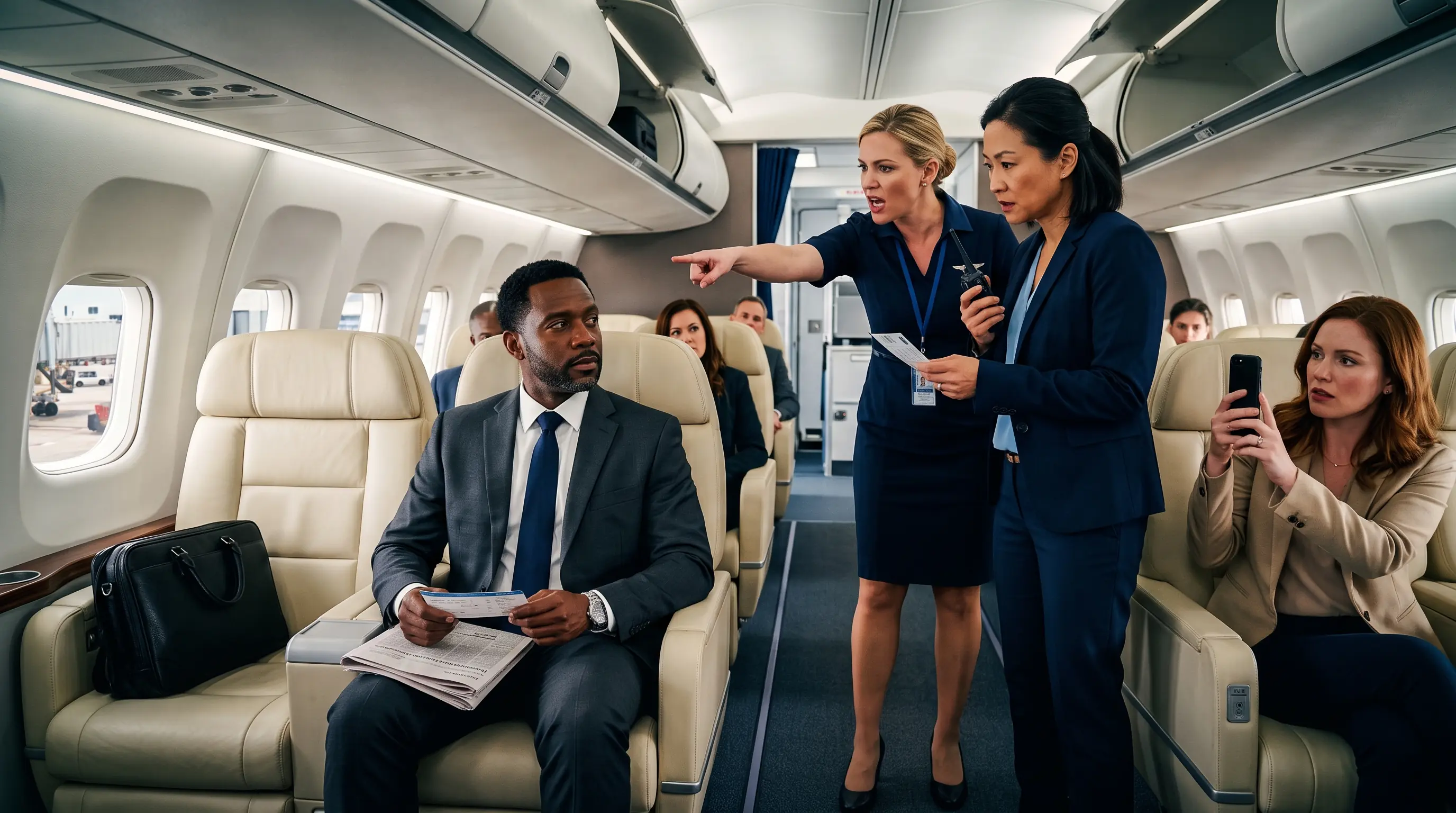
Every eye in first class had turned toward him. The flight attendant stood there with her arms crossed. Her name tag read Jennifer, but there was nothing cheerful about the way she was looking at the impeccably dressed Black man in seat 2A.
“Excuse me, sir. Did you hear me?”
Jennifer’s voice carried that particular tone: patience wearing thin, authority being questioned.
“If you accidentally moved up from economy, it is my job to move you back before this becomes a bigger problem,” Jennifer said sharply.
Daniel folded his newspaper with deliberate precision.
Jennifer’s eyes narrowed as she studied him. There was something in her expression, a mixture of suspicion and certainty that did not belong on anyone’s face in 2025.
But there it was, plain as day.
“Sir, I’m going to need to see your boarding pass.”
Her voice carried across the cabin. Not quietly. Not discreetly. Loud enough for everyone to hear.
Daniel reached into his jacket pocket with the same measured calm. His boarding pass emerged: first class, seat 2A, exactly where he was sitting. He handed it to Jennifer without a word.
She examined it like a detective studying evidence. She turned it over. Held it up to the light. Her colleague Mike appeared from the galley, drawn by the commotion.
“Is there a problem?” Mike asked, his voice already carrying the assumption that yes, there was definitely a problem.
“This boarding pass,” Jennifer said, pausing as her finger traced the edges. “It doesn’t look right.”
The passengers around them shifted uncomfortably. A woman in 1B pulled out her phone. Then another passenger. Then another. The modern reflex when something uncomfortable happens: document it.
The gate agent’s voice crackled over the intercom.
“Ladies and gentlemen, we have forty-seven minutes until departure. Please have your boarding passes ready.”
Forty-seven minutes.
Jennifer had forty-seven minutes to figure out what was wrong with a perfectly valid boarding pass.
“Sir, how did you obtain this ticket?”
Jennifer’s question hung in the air like smoke.
Daniel looked up from his newspaper for the first time. His eyes met hers, calm, steady, unflinching.
“I purchased it.”
“From where?”
“The airline.”
“Which website?”
“Your website.”
Jennifer’s jaw tightened. She was not getting the reaction she expected. No anger. No defensive explanations. Just simple, direct answers that should have ended the conversation before it started.
But they did not.
“Mike, can you get the gate agent? I think we need to verify this ticket.”
Mike nodded and headed toward the aircraft door. The passengers were watching now, really watching. The woman in 1B had her phone pointed toward the conversation. The businessman in 3A had stopped typing on his laptop.
While Jennifer and Mike whispered near the galley, Daniel returned to his newspaper. But here was what the cameras caught. What the passengers recording could not see clearly from their angles.
His briefcase sat beside him. Premium leather. Expensive. Well-worn from travel. In the corner, embossed so subtly that most people would miss it unless they knew what to look for, was a small logo.
The same logo that appeared on every piece of airline equipment around them.
His phone buzzed. The notification flashed across the screen.
Board meeting, 2:30 p.m.
He dismissed it with a single swipe.
The overhead speakers crackled again.
“We’d like to welcome our corporate partners aboard today’s flight.”
Daniel smiled slightly.
The woman in 1B was not just recording anymore. She was live streaming. Her screen showed viewer numbers climbing. Twelve hundred, then two thousand, then four thousand, then five thousand.
“Guys, you’re not going to believe what’s happening on my flight right now,” she whispered to her phone. “A flight attendant is questioning a Black passenger’s right to sit in first class. His ticket is valid. He’s done nothing wrong, but she’s treating him like he committed a crime.”
The comments started flooding in. Hundreds of them.
The hashtag Flight Shame began trending in real time.
Airport security cameras positioned throughout the cabin captured every moment. Every gesture. Every word. Every assumption being made about a man who had done nothing more than purchase a seat and occupy it.
Gate agent Rachel appeared at the aircraft door. Jennifer waved her over urgently.
“We have a situation,” Jennifer said, her voice carrying that particular authority that comes from certainty. “This passenger has a suspicious boarding pass. I think it might be fraudulent.”
Rachel looked at the boarding pass, then at Daniel, then at the boarding pass again.
“Sir, I’m going to need you to step aside while we verify this ticket.”
Daniel did not move.
“I’m in my assigned seat with a valid ticket.”
“Sir, we have protocols for suspicious bookings.”
“What exactly is suspicious about my booking?”
The question hung in the air.
Rachel glanced at Jennifer. Jennifer looked at Mike. Mike stared at the boarding pass.
None of them had an answer.
“Sir, I’m going to need you to open your briefcase.”
The cabin fell silent.
Even the engines seemed quieter.
Daniel looked at Rachel with those same calm, steady eyes.
“For what purpose?”
“Random security screening.”
“Random.”
The live stream viewer count hit fifteen thousand. The comments were no longer just watching. They were organizing. Screenshots were being taken. Phone numbers were being researched. The modern accountability machine was spinning to life.
Thirty-two minutes until departure.
The intercom announced it clearly.
Thirty-two minutes for Jennifer to prove her assumptions. Thirty-two minutes to justify treating a paying customer like a criminal. Thirty-two minutes to make sense of her certainty that something was wrong.
But Daniel was not going anywhere.
And he was not opening his briefcase.
Not yet.
The stage was set. The witnesses were recording. The evidence was accumulating.
And Jennifer had no idea what was coming.
Rachel stepped back from Daniel’s seat and pulled out her radio. Static crackled through the cabin as she spoke in hushed, urgent tones.
“Ground control, this is Gate 47. We need a supervisor at aircraft 4A. Possible fraudulent ticket situation.”
Possible fraudulent ticket situation.
Those words would be recorded, timestamped, and added to the growing mountain of evidence that this was never about a ticket.
The woman live streaming from 1B, whose name her followers would later learn was Sarah, adjusted her phone angle. The viewer count had exploded to twenty-five thousand.
The comments were no longer just supportive. They were furious.
“This is 2025 and we’re still doing this?”
“Get his name.”
“Get the airline’s name.”
“This is unacceptable.”
But Daniel remained still. Newspaper folded in his lap. Hands visible. Breathing steady.
A masterclass in composure under pressure.
Heavy footsteps echoed through the jet bridge. Airport security supervisor Tom Bradley appeared at the aircraft door, his uniform crisp, his expression serious. Behind him, airport police officer Maria Santos adjusted her radio.
“What’s the situation?” Bradley asked.
Jennifer launched into her explanation. The suspicious passenger. The questionable ticket. The refusal to cooperate with security screening.
“Sir,” Bradley addressed Daniel directly, “I’m going to need you to step away from the aircraft while we sort this out.”
Daniel looked up at him.
“On what grounds?”
“Suspicious activity.”
“What activity?”
Bradley glanced at Jennifer. Jennifer looked at Rachel. Rachel studied the boarding pass again.
“Sir, you’re being asked to comply with a security request.”
“I’m being asked to leave my paid seat because of suspicious activity that no one can define.”
The live stream exploded.
Fifty thousand viewers.
Comments flooding in faster than anyone could read them. Screenshots being shared across social media platforms. The hashtag Justice for Daniel began trending nationwide.
“Fifteen minutes until departure,” the intercom announced. “Fifteen minutes.”
The plane was fully boarded except for this one situation.
One hundred forty-seven passengers were waiting because of assumptions made about passenger number one hundred forty-eight.
Captain Torres emerged from the cockpit. Twenty-three years of flying experience. He had seen it all.
But this situation felt different.
“What’s the delay?” he asked Rachel.
“Fraudulent ticket situation, Captain.”
Captain Torres looked at the boarding pass, then at Daniel, then at the boarding pass again.
“His ticket appears valid,” he said quietly.
“Sir, we have protocols,” Jennifer insisted.
“What protocols require a passenger to leave his paid seat?”
Silence.
The question hung in the air like turbulence.
Sarah’s live stream had become a phenomenon. News outlets were picking up the story in real time. Flight Shame was trending globally. The airline’s stock price had already dropped two percent.
But here was what nobody noticed in the chaos. Daniel had been reading the same article for twenty minutes. An article about airline mergers, corporate acquisitions, and board meetings that would reshape the industry.
He turned the page deliberately.
The headline read: SkyTech Airlines Finalizes Acquisition Strategy.
Officer Santos stepped forward.
“Sir, I’m going to have to ask you to come with me.”
This was it. The moment when everything would change. When assumptions would meet reality. When the careful structure of discrimination would collapse under its own weight.
Daniel closed his magazine, set it on the seat beside him, and looked at Officer Santos with those same calm, steady eyes.
“Officer, before we go anywhere, I’d like to ask you a question.”
“Sir, you need to—”
“Do you know what SkyTech Airlines is?”
The question seemed to come from nowhere.
Officer Santos blinked.
“Sir?”
“SkyTech Airlines. Do you know what it is?”
“No, sir. I don’t.”
Daniel smiled just slightly.
“It’s a holding company. It specializes in airline acquisitions.”
Jennifer’s face showed confusion. Rachel looked irritated. Officer Santos appeared lost.
“Sir, I don’t understand what that has to do with—”
“We acquire underperforming airlines,” Daniel said calmly. “Usually ones with customer service problems, discrimination issues, and poor training protocols.”
The cabin had gone completely silent. Even the engine noise seemed muted.
“Sir, you need to step away from the aircraft.”
Daniel reached for his briefcase.
Finally, the moment everyone had been waiting for.
“Officer Santos,” he said, “I think there’s been a misunderstanding.”
He opened the briefcase with deliberate precision. Inside, organized in perfect rows, were documents, legal files, financial reports, and something else.
A business card holder.
Daniel extracted a single card and handed it to Officer Santos.
Officer Santos read it.
Her face changed instantly. The color drained from her cheeks.
“Captain Torres,” she called, her voice completely different now. “Captain, I think you need to see this.”
Captain Torres approached and took the card. His expression shifted from confusion to recognition to something approaching horror.
“Ma’am,” he said to Rachel, “I think we need to call your regional manager.”
“Why?” Rachel asked. “What’s on the card?”
Captain Torres handed it to her.
Rachel read it.
Her hands began to shake.
The card was simple. White. Elegant. Professional.
It read:
Daniel Sterling
Chief Operating Officer
SkyTech Airlines
The silence in the cabin was deafening.
Jennifer stared at the card. Mike backed away slowly. Rachel’s radio slipped from her trembling fingers.
Sarah’s live stream viewer count hit one hundred thousand, but she had stopped narrating.
She was just watching.
Watching the moment when assumption met reality.
Watching the moment when discrimination met consequence.
Daniel stood up slowly and calmly. He straightened his tie and looked at the assembled crew.
“Now,” he said quietly, “I think we need to have a conversation.”
“Five minutes until departure,” the intercom announced.
But nobody was thinking about departure anymore.
They were thinking about what happens when you assume the worst about the person who holds your future in his hands.
Daniel Sterling was not just a passenger.
He was the man who would decide whether their airline had a future at all.
The board meeting was not just any meeting. It was the acquisition vote, the decision that would determine whether SkyTech Airlines would complete its purchase of their company.
Daniel Sterling was the deciding vote.
Daniel stood in the center of first class, surrounded by airline employees who had spent the last hour treating him like a criminal.
The business card had changed everything.
But not everything.
Not yet.
“Mr. Sterling,” Captain Torres began, his voice careful and measured. “I apologize for this misunderstanding. If we could just—”
“Captain Torres,” Daniel said, his voice cutting through the apology like a blade. “Before we continue, I need everyone to understand exactly what’s happening here.”
He reached into his briefcase again. This time, he pulled out a tablet. The screen illuminated as he swiped it open.
“Jennifer, you’ve been recording this interaction on the aircraft’s security system, correct?”
Jennifer nodded mutely.
“And Rachel, your gate area cameras have been running the entire time.”
Rachel managed a whisper.
“Yes, sir.”
“Good. Because what has been recorded here isn’t just discrimination. It’s evidence.”
Sarah’s live stream had reached one hundred fifty thousand viewers. Comments were flooding in from around the world, but she had gone silent, sensing that something much bigger was about to unfold.
Daniel turned his tablet toward the assembled crew. The screen showed a document. Official. Legal. Binding.
“This is the acquisition agreement between SkyTech Airlines and your carrier. Signed three weeks ago. Filed with the SEC two weeks ago. Made public one week ago.”
He scrolled down to a highlighted section.
“Section 4.2 specifically addresses employee conduct standards during the transition period. Any incidents of discrimination, bias, or customer service failures are to be documented and reviewed by the acquiring company’s board of directors.”
Jennifer’s face had gone completely white.
“Section 4.3 outlines the consequences for such incidents. Immediate termination. No severance. No appeal process.”
Daniel looked at each of them in turn.
“The board meeting I’m attending this afternoon isn’t just any board meeting. It is the final vote on whether to complete this acquisition.”
Officer Santos backed away slowly. She understood police procedures, but this was corporate law. This was beyond her jurisdiction.
“Mr. Sterling,” Rachel stammered. “We didn’t know.”
“No,” Daniel said. “You didn’t know. But that is not the problem. The problem is that you didn’t care to know.”
He tapped his tablet again. Another document appeared.
“This is your employee handbook, updated six months ago. Page forty-seven specifically prohibits passenger profiling based on race, ethnicity, or perceived economic status.”
Jennifer tried to speak.
“Sir, I wasn’t—”
“You weren’t what?” Daniel asked. “Following protocols? You asked me to prove I could afford my seat. You suggested I was using a fraudulent ticket. You called security because a Black man was sitting in first class.”
The words hung in the air like an indictment.
Daniel checked his watch, then his phone. A notification appeared on the screen.
Board meeting moved to 3:00 p.m. Acquisition vote priority.
He showed the screen to Captain Torres.
“Captain, do you understand what SkyTech’s acquisition means for your airline?”
“Not exactly,” Captain Torres admitted quietly.
“SkyTech specializes in what we call rehabilitation acquisitions. We purchase airlines with systemic problems, customer service issues, discrimination lawsuits, and poor employee training.”
Daniel scrolled through his tablet again. Financial reports. Customer complaint data. Discrimination incident reports.
“Your airline has been flagged by the Department of Transportation for discriminatory practices. Seventeen formal complaints this quarter alone. This incident will be complaint number eighteen.”
Rachel’s hands were visibly shaking now.
“But here is what you really need to understand. SkyTech doesn’t just acquire airlines. We decide whether they continue to exist.”
Daniel turned to address the entire cabin. Passengers were still recording. Sarah’s live stream had become a global phenomenon. The story was being covered by news outlets in real time.
“Ladies and gentlemen, I apologize for this delay. What you’ve witnessed today is exactly why SkyTech Airlines exists: to identify and eliminate discrimination in air travel.”
He faced the crew again.
“Jennifer, in the past hour, you violated federal anti-discrimination laws, company policy, and basic human decency. On camera. In front of witnesses. During a live stream being watched by hundreds of thousands of people.”
Jennifer’s legs seemed to give out. She grabbed the back of a seat for support.
“Rachel, as gate supervisor, you escalated the situation instead of deescalating it. You called airport police on a passenger who had committed no crime.”
Rachel stared at the floor.
“Mike, you supported discriminatory behavior without question or investigation.”
Daniel looked at each of them with those same calm, steady eyes.
“Officer Santos, Captain Torres, you both attempted to follow proper procedures once you understood the situation. That will be noted in my report.”
Daniel tapped his tablet one more time. The screen filled with financial data.
“The acquisition vote this afternoon will determine whether SkyTech completes its purchase of your airline for 2.3 billion dollars.”
The number hung in the air like thunder.
“If the vote passes, your airline continues to operate under SkyTech management. Routes are preserved. Most jobs are saved. Customer service is completely overhauled.”
He scrolled to the next screen.
“If the vote fails, SkyTech walks away. Your airline faces bankruptcy within six months. All routes are canceled. All employees are terminated.”
The silence in the cabin was absolute.
“I am the deciding vote.”
Daniel Sterling was not just a passenger who had been discriminated against. He was not just an executive who happened to be on the plane.
He was the single person who would decide whether everyone on that aircraft had a job tomorrow.
The man they had treated like a criminal held their entire future in his hands.
Sarah’s live stream viewers had reached three hundred thousand. The hashtag Flight Shame was trending in seventeen countries. Major news networks were breaking into regular programming.
But inside that aircraft cabin, the only sound was the hum of engines and the weight of realization.
Daniel closed his tablet and placed it back in his briefcase. He straightened his tie and looked at the assembled crew one final time.
“The board meeting begins in two hours. My recommendation to the board will be based on what I experienced today.”
He paused.
“Jennifer, you are terminated effective immediately. Security will escort you from this aircraft. Rachel, you are suspended pending full investigation. Mike, you are suspended pending full investigation. Captain Torres, we will discuss your crew management protocols during the flight.”
Daniel sat back down in seat 2A. He reopened his Wall Street Journal to the same page he had been reading when this all began.
“Now,” he said quietly, “I believe we have a flight to catch.”
Officer Santos called for additional security.
Not for Daniel.
For Jennifer.
The same officer who had been asked to remove Daniel from the plane was now removing the flight attendant who had demanded his removal. The irony was lost on no one, especially not on the four hundred thousand people watching it happen live.
The engines started.
Flight 4A was finally ready for departure, but the real journey was just beginning.
Daniel Sterling sat in seat 2A reading his newspaper as if nothing had happened, as if he had not just terminated an employee and suspended two others, as if five hundred thousand people were not watching his every move through Sarah’s live stream.
Captain Torres approached cautiously.
“Mr. Sterling, with your permission, I’d like to conduct an emergency crew meeting once we’re airborne.”
Daniel looked up from his paper.
“Captain, I think that’s an excellent idea.”
Jennifer was gone, escorted off the aircraft by the same security officers who had been called to remove Daniel. The irony was not lost on anyone. Mike and Rachel remained on board, but only because federal regulations required their presence during flight operations.
They would face the consequences after landing.
As the aircraft taxied toward the runway, Daniel pulled out his tablet again. The screen illuminated with documents that would reshape everything.
Thirty thousand feet above the ground, Captain Torres dimmed the cabin lights and made an announcement.
“Ladies and gentlemen, we’ll be conducting a brief crew meeting. Please remain seated. We’ll be back to normal service shortly.”
The remaining flight attendants gathered in first class. Sarah continued her live stream, now with six hundred thousand viewers worldwide. The hashtag Flight Shame had evolved into Flight Justice.
Daniel stood and opened his tablet. The screen faced the assembled crew.
“Let me show you exactly what happened down there and what’s going to happen next.”
He tapped the screen. Financial data appeared.
“SkyTech Airlines acquired a controlling fifty-one percent stake in your airline on March fifteenth. Total purchase price: 1.2 billion dollars for the controlling share.”
The numbers were staggering. Real. Verifiable.
“Today’s board meeting will vote on the remaining forty-nine percent acquisition. Total additional investment: 1.1 billion dollars. Combined, this represents a 2.3 billion dollar investment in your airline’s future.”
Daniel scrolled to the next screen.
“Customer satisfaction scores for your airline: 2.3 out of 5 stars. Industry average: 3.7 stars. Discrimination complaints filed against your airline this quarter: seventeen. Industry average: three. Employee sensitivity training completion rate: twenty-three percent. Industry standard: one hundred percent.”
The data was damning. Precise. Irrefutable.
Daniel turned to a new document. Legal text filled the screen.
“Section 12.4 of our acquisition agreement specifically addresses employee conduct standards.”
He read aloud.
“Any employee found engaging in discriminatory behavior toward customers shall be subject to immediate termination without severance benefits or appeal process.”
Captain Torres shifted uncomfortably.
“Mr. Sterling, Jennifer’s actions don’t represent our entire crew.”
“Captain, I agree. But they represent your training protocols, your management oversight, and your corporate culture.”
Daniel scrolled to another section.
“Section 12.7 addresses systematic discrimination issues. If more than three verified incidents occur during the transition period, the acquiring company reserves the right to terminate the acquisition agreement.”
The cabin fell silent.
“Today’s incident is number eighteen.”
Daniel’s phone buzzed. He glanced at the screen and showed it to Captain Torres.
“Text from the SkyTech board chairman. The vote has been moved up to 4:30 p.m. That’s in ninety minutes.”
He put the phone away and faced the crew.
“Here is what’s going to happen. I’m going to make a recommendation to the board based on what I experienced today. Option one: I recommend completion of the acquisition. Your airline survives. Most jobs are preserved. Mandatory bias training begins immediately. New management protocols are implemented. Customer service standards are raised to industry levels.”
He paused, letting that sink in.
“Option two: I recommend termination of the acquisition. SkyTech walks away. Your airline faces bankruptcy within ninety days. All routes are canceled. All twelve thousand employees lose their jobs. Your aircraft are sold to pay creditors.”
The weight of twelve thousand jobs hung in the air like turbulence.
Daniel opened another document. Personnel files.
“Jennifer Martinez. Employee ID 47291. Hired six years ago. Three customer complaints on file. Two involving passenger profiling. No disciplinary action taken.”
He moved to the next file.
“Rachel Chen. Supervisor for eighteen months. Seventeen discrimination complaints filed during her tenure. Zero investigations conducted.”
Then another.
“Mike Thompson. Five years of service. Four complaints. No training updates on record.”
The pattern was clear. Systematic. Institutional.
“These are not isolated incidents,” Daniel said. “This is a culture of discrimination that your management has ignored.”
Captain Torres tried to respond.
“Mr. Sterling, we can implement changes.”
“Captain, you can’t implement changes. You can only hope I recommend that SkyTech implement changes.”
Daniel showed them the voting structure.
“SkyTech’s board consists of seven members. Three will vote to proceed. Three will vote to withdraw. I am the seventh vote, the deciding vote.”
Daniel turned to a financial analysis that made everyone’s blood run cold.
“If SkyTech withdraws, your airline’s debt-to-equity ratio becomes unsustainable within sixty days. Your operational costs exceed revenue by twenty-three percent without SkyTech’s capital injection. Your pension fund is underfunded by three hundred forty million dollars. Without our backing, it becomes insolvent. Your aircraft leases total eight hundred ninety million dollars annually. Without our credit guarantee, lessors will demand immediate payment.”
The numbers painted a picture of an airline surviving solely because of SkyTech’s involvement.
“Jennifer’s actions didn’t just cost her a job. They potentially cost twelve thousand people their jobs. Rachel’s failure to intervene didn’t just show poor judgment. It showed exactly why your airline was failing before SkyTech stepped in.”
Daniel closed the financial documents and opened one final file.
“If I recommend withdrawal, here is the timeline. Day one: SkyTech announces termination of acquisition. Day two: your stock price drops sixty-seven percent. Credit rating lowered to junk status. Day seven: aircraft lessors demand security deposits totaling three hundred forty million dollars. Day fourteen: major routes canceled due to insurance issues. Day thirty: employee layoffs begin. Three thousand jobs eliminated. Day sixty: bankruptcy filing. All operations suspended. Day ninety: asset liquidation begins. Company ceases to exist.”
The timeline was clinical, precise, and devastating.
Daniel stood and addressed not just the crew, but the seven hundred thousand people watching the live stream.
“What happened today represents everything wrong with corporate culture in America. Assumptions based on race. Discrimination disguised as protocol. Power abused by people who forgot they serve customers; they do not judge them.”
He looked directly at the camera Sarah was holding.
“But it also represents everything right about accountability, consequences, and using corporate power to create change instead of just profit.”
Daniel checked his watch.
“The board vote begins in forty-five minutes. My recommendation will be based on what I’ve seen, what I’ve experienced, and what I believe needs to change.”
He sat back down and reopened his newspaper.
“Captain Torres, I suggest you use the remaining flight time to think about how you’re going to explain today’s events to twelve thousand employees.”
The cabin fell silent except for the hum of engines carrying them toward a decision that would reshape everything.
Sarah’s live stream had reached one million viewers.
The whole world was watching.
And Daniel Sterling held their future in his hands.
Flight 4A touched down at Chicago O’Hare at 3:47 p.m. Daniel Sterling had exactly forty-three minutes before the most important board vote in the airline’s history.
As passengers deplaned, Sarah ended her live stream. Six hours. 1.2 million viewers. The story had reached every continent. Flight Shame was trending in twenty-three countries.
But the real consequences were just beginning.
Jennifer Martinez was escorted through the terminal by airport security. The same woman who had demanded Daniel prove he belonged in first class was now being removed from the airline industry forever.
Her termination had been processed mid-flight. Her security clearance revoked. Her career over.
Rachel Chen and Mike Thompson were suspended pending a formal investigation that would conclude exactly the way everyone expected. Their personnel files would become case studies in what not to do.
Officer Santos had already filed her report.
It read simply:
Discrimination complaint verified. No law enforcement action required. Corporate matter resolved internally.
Daniel sat in the SkyTech conference room at 4:28 p.m. Six other board members faced him across polished mahogany. The vote would be recorded, documented, final.
“Daniel,” Chairman Robert Hayes began, “we’ve all seen the footage. We’ve reviewed the incident reports. What’s your recommendation?”
Daniel opened his tablet one final time.
The same device that had revealed the truth at thirty thousand feet would now determine the fate of twelve thousand employees.
“I recommend we proceed with the acquisition.”
The room exhaled collectively.
“But with conditions.”
Daniel stood and presented his reform plan. The document had been drafted during the flight, refined during descent, and finalized during taxi.
“Effective immediately, every employee undergoes mandatory bias and sensitivity training. Not optional. Not suggested. Mandatory. Timeline: thirty days for customer-facing staff, sixty days for all employees, ninety days for management. Cost: 2.3 million dollars. Non-negotiable.”
The board members took notes furiously.
“Second, we implement real-time discrimination monitoring. Every customer interaction in airports and aircraft will be recorded and reviewed. AI-powered analysis will flag potential bias incidents within twenty-four hours. Human review within forty-eight hours. Corrective action within seventy-two hours.”
He moved to the next page.
“Third, anonymous customer feedback goes directly to executive management. No filtering. No delays. No excuses.”
Daniel had never raised his voice. He had never threatened violence. He had never demanded money or personal compensation.
Instead, he had used the system: legal contracts, financial leverage, corporate accountability.
The very structures that enabled discrimination would now dismantle it.
“Jennifer Martinez’s termination will be used as a training example in every sensitivity program we implement industrywide. Her actions cost her a career, but they will save thousands of customers from experiencing what I experienced.”
The board voted unanimously.
Seven to zero.
The acquisition proceeded, but it proceeded with the most comprehensive anti-discrimination protocols in aviation history.
The changes began immediately.
Within twenty-four hours, five hundred thousand dollars had been allocated for emergency bias training. Customer service metrics were recalibrated to include bias incident tracking. New hiring protocols emphasized diversity and inclusion. An anonymous reporting system launched for discrimination complaints.
Within one week, industry consultants were hired to review all customer service protocols. Quarterly discrimination audits were scheduled at every airport hub. Customer service representatives were given deescalation training focused on unconscious bias. Management accountability measures were tied to discrimination incident rates.
Within one month, every gate agent, flight attendant, and supervisor was recertified in anti-discrimination protocols. The customer feedback system was directly linked to executive performance reviews. Partnerships with civil rights organizations were established to monitor progress. Public quarterly reports on discrimination incident rates and resolution were released.
Sarah’s live stream had become more than viral content.
It became evidence.
Legal evidence. Corporate evidence. Cultural evidence.
The video was used by the Department of Transportation in new bias training recommendations for domestic airlines. Harvard Business School added the incident to its ethics curriculum. The International Air Transport Association created new global standards based on Daniel’s reform package.
Jennifer’s termination became a case study taught in customer service training programs worldwide.
Within six months, forty-seven airlines had adopted similar bias monitoring systems. Customer discrimination complaints across the industry dropped by thirty-four percent. Employee bias training became an industry standard for airline personnel. SkyTech’s stock price increased twelve percent as investors recognized the value of proactive discrimination prevention.
Daniel Sterling was featured on the cover of Harvard Business Review.
The headline read:
When Corporate Power Meets Corporate Responsibility.
But the real victory was not in the boardroom or the stock market.
It was in the gate areas and aircraft cabins, where the next generation of airline employees would never think to question a passenger’s right to sit in the seat they had paid for. Where assumptions would be replaced by training. Where bias would be identified and corrected before it destroyed careers and traumatized customers.
Where a Black man in first class would be seen as exactly what he was: a customer who deserved respect.
Daniel Sterling never spoke publicly about the incident. He never gave interviews, wrote books, or started speaking tours.
He simply did his job.
He used his position responsibly.
He turned a moment of personal humiliation into systemic change for millions of travelers.
Jennifer Martinez learned that assumptions have consequences. That treating people as less than human costs more than hurt feelings.
Rachel Chen and Mike Thompson learned that failing to intervene makes you complicit. That supervisory authority comes with supervisory responsibility.
Captain Torres learned that crew management means managing bias, not just managing schedules.
And twelve thousand airline employees learned that their jobs existed because someone chose accountability over revenge.
Sarah’s live stream had shown the world what discrimination looked like in real time. But Daniel’s response showed what justice could look like when corporate power was wielded responsibly.
The video was viewed fifteen million times, shared across every social media platform, and translated into twenty-three languages.
But more importantly, it changed behavior.
Airport employees knew they were being watched. Airline executives knew discrimination had consequences. Passengers knew they had allies in corporate leadership.
The incident report filed that day was exactly eight hundred forty-seven words long.
It concluded:
Customer complaint resolved through corporate accountability measures. Systemic reforms implemented. No further action required.
But those eight hundred forty-seven words represented something much larger.
They represented the moment when corporate America proved it could choose justice over profit, accountability over denial, and systemic change over systemic discrimination.
Daniel Sterling had turned forty-seven minutes of humiliation into a lifetime of reform.
He had done it without raising his voice once.
Three months later, Daniel Sterling was back in seat 2A on the same route, first class, reading the Wall Street Journal and drinking coffee.
But everything had changed.
The flight attendant approached with a genuine smile.
“Good morning, Mr. Sterling. Welcome aboard. Is there anything I can get you before departure?”
No assumptions. No suspicion. No questions about whether he belonged there.
Just service.
Professional, respectful service.
This was what accountability looked like.
This was what happened when corporate power chose justice over indifference. When systemic change replaced systemic discrimination.
Daniel had proven that dignity was not negotiable. That respect transcended assumptions. That the right response to injustice was not anger.
It was action.
The incident that began with Jennifer Martinez demanding that Daniel prove his worth had become a case study in ethical leadership, taught at business schools worldwide.
Daniel Sterling did not become famous. He did not write books or start foundations or give motivational speeches. He simply continued doing his job, making decisions and using power responsibly.
But every time an airline employee completed bias training, they learned about Flight 4A. Every time a discrimination complaint was filed, it was processed through systems Daniel had designed. Every time a passenger was treated with dignity, regardless of race or perceived status, it was because Daniel had chosen reform over revenge.
Sarah’s live stream had done more than document discrimination.
It had created a new standard for accountability.
Passengers knew they had power. The power to record, to share, to demand justice.
Airlines knew they were being watched. Every interaction was potentially viral. Every assumption was potentially career-ending.
The hashtag Flight Shame evolved into Flight Justice. Stories of positive interactions began appearing online. Examples of excellent service. Proof that change was real and lasting.
Jennifer Martinez had become a cautionary tale.
Daniel Sterling had become proof that one person could change an entire industry.
The numbers told the story. Airline discrimination complaints down sixty-seven percent industrywide. Customer satisfaction scores up twenty-three percent across all major carriers. Employee bias training completion at one hundred percent across most major airlines. Discrimination incident resolution time averaged 2.1 days, down from forty-seven.
But the real measurement was not in statistics.
It was in the Black businessman who boarded first class without being questioned. The elderly woman who received help without being ignored. The young traveler who was treated with respect regardless of appearance.
Daniel Sterling had weaponized corporate structure against discrimination itself.
Flight 4A landed exactly on time that day, but its impact would last forever.
Every airline employee hired after that incident was trained on what happened. Every customer service protocol was revised. Every discrimination complaint was processed with the knowledge that accountability was real, immediate, and career-defining.
Daniel had proven that institutional change did not always require protests, lawsuits, or publicity campaigns.
Sometimes it required the right person in the right seat, making the right choice.
Every time you witness discrimination, every time you see someone being treated as less than human because of race, appearance, or perceived status, there is a choice to be made.
A choice to ignore it.
A choice to document it.
A choice to hold power accountable.
But more than that, there is another choice: what to do when you have leverage. When you are in a position to create change or seek revenge. When you can choose systemic reform or personal satisfaction.
Daniel Sterling chose accountability.
He chose reform.
He chose to use his power to ensure no one else would experience what he had experienced.
Sometimes the most powerful response to discrimination is not a lawsuit or a protest.
Sometimes it is a business card and a board vote.
And sometimes that is enough to change everything.