On a freezing Thursday evening in late November, Ethan Carter fixed a stranger’s broken car for free, not knowing the woman standing in his repair bay would soon change every piece of his life.
She did not leave her last name.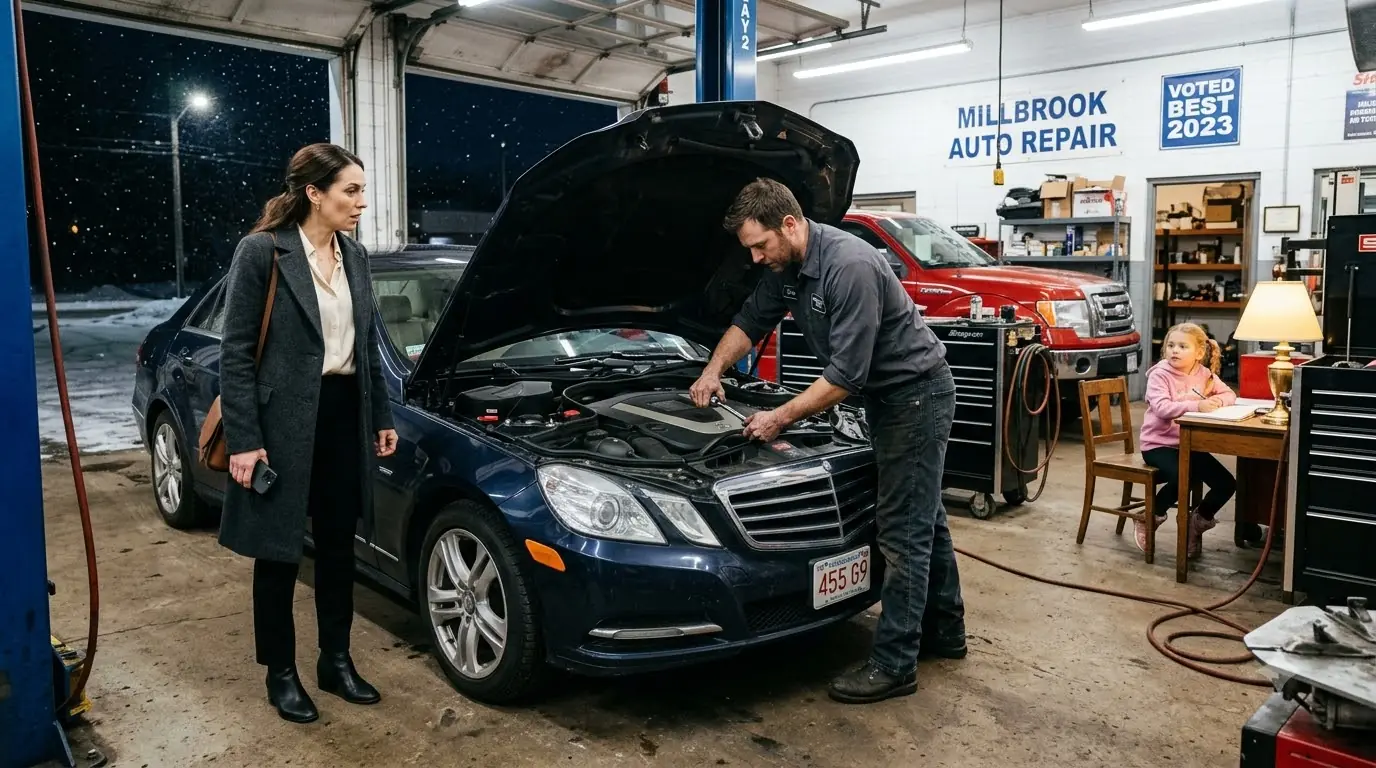
She did not hand him a business card.
She only gave him a quiet thank you, the kind that sounded too heavy for two simple words, and looked at him a little longer than a customer usually looked at a mechanic.
Hours later, the entire auto shop would freeze in silence when a black luxury car pulled into the lot. Security would step out first. Then her.
The same woman.
Except then everyone would be calling her Ms. Harper, the new CEO, and the owner of everything Ethan thought he understood about his life.
But none of that had happened yet.
At 5:36 p.m., the thermometer outside Carver & Sons Auto Repair read twenty-three degrees, but Ethan Carter had long stopped noticing the cold.
He noticed other things.
The flicker of the fluorescent tube above Bay Three, which blinked every eleven seconds. He had counted it during long evenings when the shop had gone quiet and only his thoughts kept him company.
The faint smell of burnt rubber that never quite left the concrete floor, no matter how many times he scrubbed it.
The way the old heater coughed before it kicked on, as if it resented being asked to work as hard as everyone else in the building.
The way invoices never added up to enough, not for the shop, not for him, not for anyone who lived paycheck to paycheck and still tried to pretend they were not afraid of the next emergency.
And he noticed Lily.
She was six years old, sitting cross-legged on an old army cot he had wedged between the parts shelves and the back wall. He called it her office, and Lily had accepted that title with tremendous seriousness.
A plastic pencil box sat beside her. A half-eaten granola bar rested on a paper towel. Her math worksheet was spread across her knees, and she gripped her pencil with the same intensity Ethan used when loosening a bolt that had rusted into place.
She wore his old Red Sox cap with the brim turned sideways.
It swallowed most of her head.
“Dad,” she said, without looking up, “what is seven plus eight?”
“Fifteen.”
“Are you sure?”
“Pretty sure.”
She stared at the page as if considering whether her father was qualified to answer.
Then she wrote it down.
Ethan smiled to himself and returned to the wheel bearing on the 2017 Chevy Silverado in Bay Two.
He was thirty-eight years old, with grease under his fingernails that no soap ever fully removed, a bad shoulder from a slipped compression fitting two winters ago, and a mortgage on a tiny house four blocks east that had seemed manageable when he first signed the papers.
Back then, he had been married.
Back then, he had believed that two incomes, hard work, and love could survive most things.
Then Rachel left.
She had not disappeared suddenly. It had been slower than that. She grew quieter. Then colder. Then restless. Then one day she said she could not live inside a life that felt too small for her anymore.
Lily had been two.
Rachel moved to Arizona with a man Ethan had met once and did not care to remember. She sent birthday cards when she remembered. Christmas gifts when guilt found her early enough. Short phone calls where Lily tried too hard to sound cheerful and Ethan stood nearby pretending not to listen.
Ethan never told Lily that her mother had chosen another life.
He only told her that sometimes adults made sad choices they did not know how to fix.
It was not enough.
But it was kinder than the truth.
Since then, Carver & Sons Auto Repair had been the place that kept them standing.
Ethan had worked there for eleven years. Longer than almost everyone except Marcus Webb, the senior technician who complained about everything but still showed up half an hour early every morning.
Old Ray Carver had hired Ethan when he was twenty-seven, broke, newly married, and willing to work any shift offered to him.
Ray had liked him immediately.
“You’re quiet,” Ray had said after watching him work for two hours. “Quiet men either know what they’re doing or they’re hiding something.”
“Which one am I?” Ethan had asked.
Ray had shrugged.
“We’ll find out.”
They had.
Ethan knew engines the way some people knew music. He could hear a failing belt before it snapped, feel a loose bearing through the vibration in the wheel, and smell a coolant leak before the hood opened. Customers trusted him because he did not talk them into repairs they did not need and did not shame them for the repairs they could not afford.
If a woman came in with a rattling exhaust and fear in her eyes, Ethan explained the problem slowly and never made her feel foolish.
If an old man asked whether a repair could wait until next month because his wife’s medicine had gone up again, Ethan looked under the hood twice before answering.
If a college kid brought in a car that barely ran and said, “I only have seventy dollars,” Ethan found out what seventy dollars could fix and what could wait.
He had learned from Ray Carver that a shop could be more than a place where cars came apart and went back together.
It could be a place where people came in afraid and left able to breathe.
Then Ray had a stroke last spring, and everything changed.
Ray’s sons took over on paper, but neither wanted the day-to-day work. They had grown up around the shop, but they had never loved it. To them, Carver & Sons was not a family business. It was an asset that should have produced cleaner numbers.
They hired Derek Pullman as general manager, a man with polished shoes, a salesman’s smile, and no meaningful affection for cars, customers, or mechanics.
Derek called the shop a service center.
Ethan still called it a shop.
There was a difference.
Derek liked upsells, packages, warranty language, premium maintenance plans, and service tiers with names like Platinum Road Protection. He printed charts showing average transaction values and placed them in the breakroom beside the time clock. He told technicians they needed to “think like revenue partners.”
Marcus had stared at the chart for one full minute before saying, “I think like a man who fixes cars.”
Derek had not laughed.
Ethan did not like Derek, but he tried to keep his head down. He had Lily. He had the mortgage. He had no safety net. A man raising a child alone could not afford pride every time pride wanted to stand up.
That Thursday evening, Ethan had already stayed an hour later than scheduled because Mrs. Alvarez needed her brakes checked before driving to see her sister in Worcester. Then a delivery van had come in with a dead starter. Then Lily’s babysitter canceled, which was why she was doing math homework beside the parts shelves instead of at home.
Ethan was torquing the Silverado’s wheel bearing when headlights swept across the bay doors.
He paused.
Not unusual.
People pulled in after hours all the time, saw the light still on, and tried their luck.
Sometimes it was nothing. A tire pressure light. A question about a noise. A person hoping someone could say whether they were safe enough to drive home.
Sometimes it was a real emergency.
He heard the car before he saw the woman.
Not the engine. The engine had stopped.
What he heard was the soft, expensive clunk of a door that cost more than his own truck, followed by the sound of heels on frozen asphalt. Hurried, but controlled. Too measured for panic, too tense for calm.
Ethan slid out from under the Silverado and stood.
The woman stood just inside the bay door, one hand holding a phone, the other tucked around herself against the cold.
She wore a charcoal wool coat that was too thin for the weather. Her dark hair was pulled back simply. She looked late thirties, maybe, with tired eyes and the kind of posture that suggested she was used to standing in rooms where people listened.
She was not flashy.
No obvious jewelry. No loud designer logo. No dramatic entrance.
But there was something about her.
Not arrogance exactly.
More like restraint.
Like she was used to having power and was currently trying very hard not to use it.
“I’m sorry,” she said. “I saw the light. My car died about half a block up.”
She stopped, glancing back toward the lot.
“I pushed it most of the way. A man walking his dog helped me steer the last bit.”
Ethan looked past her.
A dark blue Mercedes sat just outside the bay, angled slightly, hazard lights blinking weakly.
Even from where he stood, he could tell it had been maintained. No neglect. No cheap parts. No warning signs a careless owner had ignored for months.
“What happened?” he asked.
“It stopped at the light on Beaumont. It made a sound like a cough, and then everything went dead.”
“Battery light come on recently?”
She thought about it.
“Yes. A few days ago.”
Ethan grabbed his jacket from the hook by the office, then walked out into the cold.
The wind cut through the open lot. He barely reacted.
He had lived in New England long enough to know the cold did not care whether you complained about it.
He opened the Mercedes, popped the hood, grabbed his flashlight, and leaned in.
The problem was obvious.
The alternator belt had snapped clean through. It had been fraying for a while, probably long enough to give a warning, but not long enough that a busy person would notice if the dashboard did not scream at her.
The battery had run on reserve until it had nothing left.
He returned to the bay.
“Alternator belt,” he said. “I’ve got the part in stock. Common size. Forty-five minutes, maybe less.”
The woman looked at him carefully.
“How much?”
“Part is eleven dollars.”
“And labor?”
Ethan paused.
He looked at her hands. She held the phone tightly, but the screen was black. Dead battery, maybe. Or turned off. Her face was composed, but exhaustion lived underneath it.
There was a difference between a person who had money and a person who was all right.
She had money.
She was not all right.
“Don’t worry about the labor tonight,” Ethan said.
She blinked.
“I’m sorry?”
“It’s late. The job’s simple. I’ll write it up as a favor.”
Her expression shifted, like he had said something she did not know how to categorize.
“I can pay you.”
“I’m sure you can.”
“I don’t need charity.”
“I didn’t say you did.”
“Then why?”
Ethan wiped his hands on a rag, then glanced toward Lily, who was watching them from behind her worksheet with enormous interest.
“Sometimes people need a hand more than they need a transaction,” he said. “And she’s watching.”
The woman followed his gaze.
Lily raised one hand in a tiny wave.
“Hi,” Lily said.
The woman stared for half a second, then waved back.
“Hello.”
“I’m Lily.”
“Olivia.”
“Are you a princess?”
Ethan closed his eyes.
“Lily.”
“What?” Lily asked. “She has a princess coat.”
Olivia looked down at her coat, then back at Lily.
“I’m not a princess.”
“Oh,” Lily said, clearly disappointed. “Are you sure?”
A sound escaped Olivia. Not quite a laugh, but close.
“I’m fairly sure.”
“My coat has a dog on it,” Lily said, pointing to a little pink jacket hanging on the wall. “Daddy picked it. He’s good at presents.”
Olivia looked at Ethan.
“Is he?”
Lily nodded before Ethan could answer.
“He got me the pencil case with the zipper that works. Other ones don’t work.”
“High praise,” Olivia said.
“It is,” Ethan replied.
Olivia sat on the metal stool Ethan dragged over for her. She set her phone face down on her knee.
Ethan noticed that too.
People who lived through their phones usually struggled to put them down.
She watched him work.
Not in an impatient way. Not like customers who hovered because they did not trust him or because they wanted to hurry the clock. She watched like she was trying to remember something, or understand it.
Ethan worked efficiently. He removed what needed removing, checked the tensioner, replaced the belt, charged the battery enough to start the engine, then let the car idle until he was satisfied the system was stable.
While he worked, Lily asked Olivia increasingly specific questions.
“Do you have kids?”
“No.”
“Do you have a dog?”
“No.”
“Do you have a cat?”
“No.”
“Do you have snacks?”
Olivia paused.
“Not currently.”
Lily looked concerned.
“That’s a problem.”
“I’m beginning to realize that.”
Ethan hid a smile under the hood.