Dust choked the air of Oak Haven the day Harlon Boone realized he had made a catastrophic mistake.
He did not want a wife.
He needed a partner to survive the brutal mountain winters.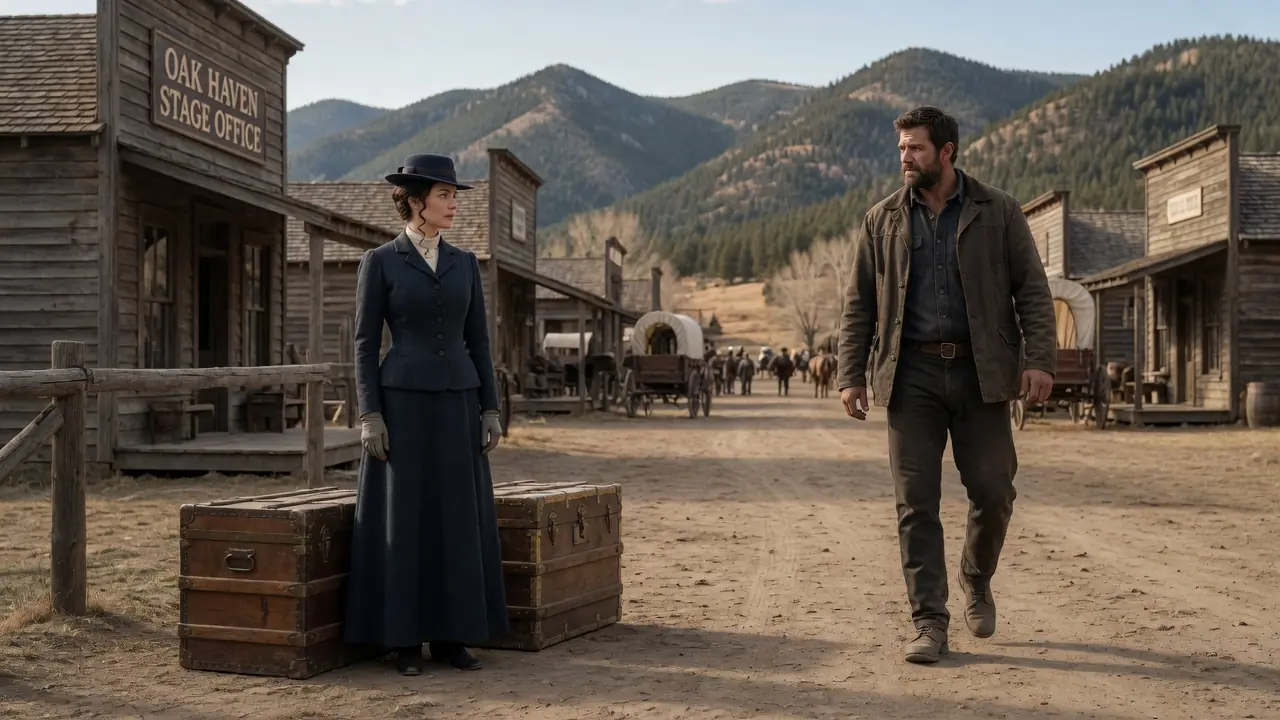
He had expected calloused hands, a sturdy back, and a face hardened by reality.
What he got instead was a woman who stepped down from the Denver stagecoach in a tailored wool travel suit, looking like she belonged in a high-society parlor.
Harlon froze, his calloused hands gripping his rifle strap.
That cannot be my bride.
Harlon Boone hated town.
He hated the smell of unwashed bodies mingled with cheap whiskey, the clatter of loose floorboards on the boardwalk, and the way men looked at him as if he were a wild animal that had wandered too far from the timberline.
Today, he hated it more than usual.
Today, he was waiting for a mail-order bride.
He stood in the narrow sliver of shade offered by the livery stable’s awning.
The sun beat down on the main street of Oak Haven, baking the rutted mud into jagged concrete. Harlon pulled his pocket watch from his vest.
Two o’clock.
The stage was late.
He snapped the watch shut and shoved it back into his pocket, his jaw tight.
He was a fool.
A lonely, desperate fool.
Three winters alone on the ridge had nearly killed him.
Not the cold.
Not the wolves.
It was the silence.
The kind of silence that rang in a man’s ears and made him start talking to the rusted coffee pot just to hear a voice.
He had penned a letter to the matron back east during a particularly bitter blizzard in January, asking for a practical woman.
A widow, maybe.
Someone who knew how to skin a rabbit, haul water, and not break apart when the snowdrifts hit the roofline.
A distant rumble broke his thoughts.
The stagecoach crested the southern ridge, a wooden box kicking up a massive plume of yellow dust.
Harlon shifted his weight.
His heavy canvas coat felt suddenly stifling.
He wiped a dirt-streaked hand across his jaw, feeling the rough scrape of a three-day beard.
He had not bothered to trim it.
If she could not handle a beard, she would not last a week in the cabin.
The coach clattered down the main thoroughfare, the six-horse team foaming with sweat. It ground to a halt in front of the assayer’s office, tossing a fresh cloud of grit into the air.
The driver, a leathery man with a chew of tobacco tucked in his cheek, wrapped the brake handle and climbed down.
Harlon did not move.
He watched from the shadows.
First off the stage was a traveling salesman complaining loudly about his bruised kidneys.
Then came a miner coughing up trail dust.
Harlon’s chest tightened.
Maybe she had not come.
Maybe she had taken one look at his stark, poorly spelled letter and thrown it in the fire.
A wave of relief, sharp and bitter, washed over him.
He could go back to the ridge.
Back to the silence.
Then the driver opened the door wider and offered his hand.
A gloved hand reached out.
It was small.
The pale gray fabric of the glove was pristine, completely incongruous with the grime of the stagecoach.
Harlon stepped out of the shadow of the livery awning.
A foot appeared on the iron step.
Not a sturdy work boot.
A polished black leather boot with a narrow heel and a row of tiny, absurd buttons.
Harlon stopped breathing.
She stepped down onto the boardwalk.
The dust seemed to settle around her, as if afraid to soil the hem of her dark blue traveling dress.
The fabric was heavy wool, impeccably tailored, hugging a slender frame that looked like it might snap in a stiff mountain breeze.
She wore a modest hat pinned securely over dark pinned-up hair, but a single stray curl had escaped, clinging damply to the side of her neck.
She turned to face the street.
Harlon felt a cold sweat break across his shoulder blades.
She was stunning.
It was not the soft, painted beauty of the saloon girls, nor the weathered, tired prettiness of the pioneer wives.
It was a sharp, striking elegance.
High cheekbones.
A strong jaw.
Eyes that scanned the dilapidated buildings of Oak Haven with a piercing, analytical calm.
She did not look frightened.
She looked deeply, profoundly out of place.
She looked like a porcelain teacup sitting on a butcher’s block.
That cannot be my bride, Harlon thought, his mind rejecting the sight.
The agency had promised a sturdy farm girl.
Someone who knew hardship.
This woman looked like she had never lifted anything heavier than a silver spoon.
She stood perfectly still as the driver unloaded a pair of massive brass-bound trunks onto the dirt.
She did not look at the trunks.
She looked at the faces of the few men loitering on the street.
She was searching for someone.
She was searching for him.
Harlon looked down at his own hands.
His knuckles were scarred white from a trapping accident.
His fingernails were permanently stained with pine pitch and earth.
He smelled of wood smoke, old leather, and horse.
He could just turn around.
He could walk to the hitching post, mount his gelding, and ride back up the mountain.
He could leave her there.
She could buy a return ticket.
It would be a kindness.
Taking a woman like that up to the ridge was practically a death sentence.
She would freeze.
She would starve.
Or the isolation would drive her mad.
He took a step backward toward his horse.
Just then, her eyes found him.
Across fifty yards of dusty street, their gazes locked.
Harlon froze.
Her eyes were dark, and from that distance, he could not read them.
But he could read her posture.
When she saw him, this massive, ragged man standing half in the shadows, her spine stiffened just a fraction.
Her chin tipped up.
It was a micro-expression of pure, unadulterated defiance.
She knew exactly what he was.
She knew exactly what she was looking at.
And she was not turning away.
Harlon cursed softly under his breath, a foul, bitter word.
He let go of his rifle strap.
He stepped off the boardwalk and into the street, his heavy boots kicking up dust as he walked toward the ruin of both their lives.
The distance between the livery and the stagecoach felt like a mile.
Harlon kept his eyes locked on her as he walked, his long, uneven stride eating up the ground.
Up close, the reality of her was even more staggering.
The blue wool of her dress was frayed slightly at the cuffs, a detail he had not noticed from afar.
The pristine gloves were carefully mended at the thumb.
The wealth was an illusion, or at least a relic of a past she was rapidly leaving behind.
He stopped a few feet from her.
He towered over her, casting a long, dark shadow that swallowed her entirely.
“You Clara?”
His voice was a low rumble, rough from disuse.
It sounded harsh to his own ears.
She did not flinch.
She looked up.
Her eyes were not just dark.
They were a deep storm-cloud gray, ringed with exhaustion.
Up close, the pale skin beneath her eyes betrayed sleepless nights and bone-deep fatigue.
“I am Clara,” she said.
Her voice was quiet, clipped, and devoid of any Southern drawl or Midwestern twang.
It was an Eastern city voice.
Sharp.
Educated.
“Are you Mr. Boone? Harlon?”
He did not offer his hand.
She did not offer hers.
He looked past her to the two massive trunks resting in the dirt.
A muscle feathered in his jaw.
“I told the matron one canvas bag. Nothing you cannot carry on your own back if the wagon breaks down.”
Clara glanced at the trunks, then back to him.
“The letter I received stated I should bring provisions necessary for building a life. These are my provisions.”
“What is in them? Bricks?”
“Books, fabric, medical supplies.”
She held his gaze.
“I was informed there is no doctor within fifty miles of your claim.”
“There ain’t.”
Harlon shifted his weight.
“There also ain’t room in the wagon for parlor trinkets. The trail up the ridge is washed out. The mules will struggle as it is.”
“They are not trinkets, Mr. Boone. They are the sum total of my existence.”
She did not sound angry.
She sounded utterly exhausted.
Yet her tone allowed no argument.
“If the trunks do not go, I do not go.”
Harlon stared at her.
He wanted to tell her to get back on the stage.
He wanted to point out how ridiculous she looked in this harsh, unforgiving sunlight.
But beneath the velvet trim of her hat, he saw the faint, rapid pulse in her throat.
She was terrified.
She was standing in the middle of a frontier town, facing a giant of a stranger, betting her entire life on a few scribbled letters, and she was terrified.
But she was not breaking.
He respected that.
Against his better judgment, he respected it.
“Wait here,” he grunted.
He turned and walked toward the livery to fetch his wagon.
When he returned, driving a battered buckboard pulled by two mean-tempered mules, she was standing in the exact same spot.
She had not sought shade.
She had not spoken to the townsfolk who were now openly staring at her.
Harlon jumped down and hoisted the first trunk.
He grunted at the sheer weight of it, his broad shoulders bunching beneath his coat as he heaved it into the bed of the wagon.
The second trunk followed with a heavy thud that made the mules pin their ears back.
He walked around to the passenger side and offered his hand.
Clara looked at it.
It was scarred, thick-fingered, and rough as sandstone.
She reached out and placed her gloved hand in his.
Her grip was surprisingly firm.
He pulled her up onto the high seat with effortless ease, feeling the stark fragility of her bones for a fleeting second before she settled onto the wooden bench.
He climbed up beside her, took the reins, and clicked his tongue.
The mules lurched forward.
They left Oak Haven in silence.
The town quickly gave way to rolling foothills, the sagebrush baking in the afternoon heat.
Harlon kept his eyes on the trail, keenly aware of the woman beside him.
She sat rigidly upright, holding on to the edge of the seat as the wagon bucked and swayed over the ruts.
“It’s a four-hour ride,” Harlon said, not looking at her. “Gets colder the higher we go. Better wrap up.”
“I am quite all right, thank you,” Clara replied.
Ten minutes later, the trail pitched upward, entering the shadow of the great pines.
The temperature dropped ten degrees in an instant.
Harlon saw her shiver out of the corner of his eye.
He reached behind the seat, grabbed a thick, heavy wolf pelt, and tossed it onto her lap.
“Put it on.”
Clara looked at the pelt.
It smelled of wildness and old smoke.
She hesitated, then pulled it around her shoulders, sinking slightly into its warmth.
“Why did you come?” Harlon asked abruptly.
The question had been burning in his chest since he saw her boot hit the boardwalk.
“A woman like you. You do not belong out here.”
Clara stared straight ahead at the rhythmic bobbing of the mules’ ears.
For a long time, the only sound was the creak of the wagon wheels and the crunch of hooves on gravel.
“A woman like me,” she finally said, her voice barely carrying over the rattling wagon, “has run out of places to belong.”
She turned her head to look at him.
The gray eyes were utterly devoid of illusion.
“You wrote that you needed a wife to help you survive,” she continued softly. “I needed a husband to help me disappear. It seems, Mr. Boone, we both have a vested interest in keeping each other alive.”
Harlon held her gaze for a second before turning back to the steep, treacherous road ahead.
He tightened his grip on the reins.
She was right.
But looking at the delicate curve of her jaw wrapped in the fur of a dead predator, he knew one thing for certain.
The winter was not the most dangerous thing on the mountain anymore.
Steep grades tested the mules long before they reached the timberline.
The trail narrowed until it was little more than a jagged scar cut into the flank of the mountain, flanked on one side by a sheer wall of granite and on the other by a dizzying drop into a sea of bruised purple pines.
Harlon drove with ruthless focus.
He knew every loose stone and treacherous rut on this path, but the wagon was heavy today.
Too heavy.
Beside him, Clara remained perfectly still.
The wolf pelt swallowed her small frame, leaving only her pale face exposed to the biting wind.
The temperature had plummeted as the afternoon bled into early evening.
Frost began to rim the edges of the dead leaves gathering in the shadowed crevices.
Harlon waited for her to complain about the cold, the jolting ride, or the terrifying proximity to the cliff edge.
She said nothing.
A sharp crack echoed like a rifle shot over the grinding wheels.
The wagon lurched violently to the right.
Clara gasped, her hands flying out to grip the iron rail of the seat as the buckboard tilted toward the precipice.
The left rear wheel had found a deep hidden washout beneath the dirt.
The mules panicked, scrambling for footing on the loose gravel, their hooves striking sparks.
“Hold on!” Harlon roared.
He did not wait to see if she obeyed.
He threw the reins into her lap and vaulted over the side of the wagon, landing heavily in the dirt.
He scrambled to the rear axle, his boots sliding in the loose scree.
The wheel was buried past the hub, and the wagon box was groaning under the shifting weight of Clara’s massive trunks.
If the mules bolted now, they would drag the whole rig, Clara included, over the edge.
“Pull back on the leathers!” Harlon yelled over the screaming animals. “Do not let them step forward. Keep their heads up.”
He wedged his shoulder under the muddy rear corner of the wagon bed.
He did not look up to see if the city woman knew what to do with a team of panicked mules.
He just braced his boots against a solid slab of embedded rock and shoved upward.
Pain tore through his back, a hot ripping sensation that made his vision swim.
The wagon did not budge.
The wood groaned with a sickening sound of impending structural failure.
“I need you to whip them,” Harlon shouted, straining until he tasted copper in the back of his throat. “When I count to three, you lay that leather across their rumps and do not stop pulling up.”
Silence from the front seat.
Harlon gritted his teeth, assuming she had frozen in terror.
He adjusted his stance, preparing to try and unload the trunks by himself before the axle snapped.
“I have the reins, Mr. Boone.”
Her voice drifted back to him.
It was not screaming.
It was tight, strained, but remarkably steady.
“Tell me when.”
Harlon blinked sweat out of his eyes.
He dug his shoulder deeper into the splintering wood.
“One. Two. Three.”
He drove his legs upward with everything he had, lifting the heavy corner of the wagon an agonizing inch.
A sharp crack of leather snapped through the thin air.
The mules surged forward, screaming in protest.
The wheel bit into the edge of the washout, spun uselessly for a fraction of a second, and then caught hard dirt.
The wagon vaulted out of the rut and slammed down onto level ground with a bone-jarring thud.
Harlon stumbled forward, falling to his knees in the dirt, gasping for the thin mountain air.
His shoulder throbbed with a dull, vicious ache.
He stayed in the dirt for a long moment, waiting for his heart rate to slow.
He expected to hear her sobbing.
Most folks who stared down a three-hundred-foot drop did not walk away with dry eyes.
Slowly, he pushed himself up and walked to the front of the wagon.
Clara was sitting rigidly on the bench.
Both hands were wrapped around the leather reins, her knuckles bone white.
The heavy whip lay across her lap.
She was staring straight ahead, her chest rising and falling in shallow, rapid breaths.
She looked terrified.
Absolutely petrified.
But she had held the team steady.
Harlon reached up and took the reins from her cramped, trembling fingers.
“You did good,” he said roughly.
Clara did not look at him.
She just nodded once, tightly, and pulled the wolf pelt closer around her throat.
They rode the rest of the way in heavy silence.
The sun dipped below the jagged peaks, plunging the world into a deep, bruised twilight.
By the time the trees finally broke, revealing a small, stark clearing nestled against the rocky spine of the ridge, the cold was a physical weight pressing against them.
Harlon pulled the mules to a halt.
“We’re here.”
He watched her face closely as she took in her new home.
It was a single-room cabin built of thick, unpeeled pine logs, chinked with mud and dried moss.
The roof was pitched steep to shed the snow, covered in rough cedar shakes.
There was a small lean-to for the animals, a chopping block surrounded by a mountain of firewood, and nothing else.
No neighbors.
No fences.
Just the looming, oppressive silence of the high country.
It looked like a place where people went to be forgotten.
Clara slowly turned her head, scanning the desolate clearing, the dark tree line, and finally the small solitary window of the cabin.
She did not gasp.
She did not shrink back.
She simply took a long, slow breath, her breath pluming white in the freezing air.
“It is very quiet,” she observed, her tone utterly neutral.
“It is about to get a lot colder,” Harlon grunted, swinging down from the seat. “Let’s get you inside.”
He unhitched the tailgate, preparing to wrestle the trunks into the cabin.
He expected her to wait for him to help her down.
Instead, Clara turned, grasped the iron rail, and climbed down backward.
Her polished boot hit the frozen mud.
She wobbled slightly, her legs stiff from the long ride and the biting cold, but she caught her balance.
She stood in the freezing mud, adjusting her tailored skirts, looking at the crude wooden door of the cabin.
This was her sanctuary.
This was her prison.
Harlon watched her shoulders square under the heavy fur.
She stepped forward, lifting her chin, and walked toward the dark, empty cabin without looking back.
Shadows stretched long across the rough-hewn floorboards as Harlon struck a sulfur match against the stone chimney.
The flare illuminated the stark reality of the cabin.
It was aggressively practical.
A heavy cast-iron stove dominated the center of the room, radiating a faint residual chill from days of disuse.
A rough plank table sat near the only window, flanked by two stools fashioned from tree stumps.
In the far corner, pressed against the logs, sat a single narrow bed frame layered with heavy woolen blankets and a bear hide.
Harlon touched the match to a pile of shaved kindling in the stove.
The dry wood caught instantly, casting flickering light across the small space.
He stood up and turned around.
Clara stood dead center in the room.
The wolf pelt had slipped from her shoulders, pooling on the floor behind her.
In the dancing firelight, the fine tailoring of her dress looked completely absurd against a backdrop of hanging traps, dried herbs, and rifle racks.
She was looking at the bed.
Harlon tracked her gaze.
He felt a sudden, unfamiliar prickle of heat climb the back of his neck.
When he had written the letter, the concept of a wife had been entirely abstract.
A partner in labor.
Now a living, breathing woman was standing in his space, and the cabin suddenly felt incredibly small.
“I’ll bring the trunks in,” Harlon muttered, stepping past her and out into the freezing night.
It took him three trips.
The trunks were unnaturally heavy, and his wrenched shoulder screamed with every step.
When he hauled the final box inside, slamming the heavy wooden door shut against the wind, Clara had removed her hat.
Her hair was dark, rich mahogany, pinned up in complex coils, but the rough journey had loosened it.
A few heavy strands fell across her collarbone.
Without the hat, she looked younger.
And somehow more exhausted.
She was standing by the stove, holding her gloved hands out toward the growing heat.
“Water bucket is by the door,” Harlon said, gesturing with his chin. “Pump is outside. It freezes overnight, so you have to crack the ice with the iron bar next to it. Coffee is in the tin on the shelf.”
He was testing her.
He wanted to see if she expected to be waited on.
Clara turned away from the fire.
She unbuttoned her gloves, pulling them off finger by finger, and laid them neatly on the edge of the table.
Her hands were pale, the skin unblemished, the fingers long and elegant.
Not a single callus.
She picked up the tin bucket and walked out the door without a word.
Harlon watched the door click shut.
He stood there for a moment, listening to the wind howl around the eaves.
He walked over to one of her trunks.
It was bound in heavy brass and locked with a stout padlock.
Books and medical supplies, she had said.
He wondered what a woman running from high society needed with bandages.
The door opened, letting in a swirl of snow.
Clara stepped back inside carrying the bucket.
It was half full, and water sloshed over the rim, soaking into the mud on the hem of her dress.
She was shivering violently, her jaw clenched tight.
She hauled the bucket to the table, her breath coming in ragged gasps.
She found the coffee tin, scooped grounds into the enameled pot, and set it directly onto the iron stove.
It was a sloppy, unpracticed motion.
But it was done.
“There’s dried venison in the larder box,” Harlon said, watching her carefully. “And some hardtack biscuits. Not much of a wedding supper.”
“It is sufficient,” Clara replied quietly.
They ate in silence.
The only sounds were the crackle of the fire, the wind tearing at the roof, and the clinking of tin forks.
Harlon sat on a stump, his broad shoulders hunched over his plate.
Clara sat on the other, eating methodically.
She did not grimace at the tough, salty meat or the stale biscuits.
She ate like someone who knew she needed calories to survive, forcing it down with black, bitter coffee.
When she finished, she gathered the tin plates and set them in a basin.
She looked around the cabin, her gaze finally landing back on the single bed in the corner.
The silent stretch pulled taut like wire.
Harlon stood up.
He walked to the wooden chest at the foot of the bed, opened it, and pulled out a heavy canvas bedroll and a single scratchy gray blanket.
He kicked his boots off, leaving them by the stove, and tossed the bedroll onto the floorboards nearest the fire.
He did not look at her as he unrolled the canvas.
“You take the bed,” Harlon said, his voice flat. “It is closer to the draft, but the bear hide is heavy. Keep your wool on.”
Clara watched him arrange the thin blanket on the hard planks.
Her gray eyes widened slightly, a flash of genuine surprise breaking through her guarded expression.
“Mr. Boone,” she started, her voice faltering just a fraction. “That is not necessary. We are legally married. I understand the expectations.”
Harlon stopped.
He looked up at her from the floor.
She was standing rigidly by the table, her hands clasped tightly in front of her.
She looked like a prisoner awaiting a sentence she had long accepted.
A surge of irritation flashed through him.
Not at her.
At whatever world had taught her to look like that.
“I do not know what kind of men you are used to dealing with back east,” Harlon growled, his voice dropping an octave. “But I did not drag you up a mountain to force myself on a woman who looks like she is about to shatter. I need a partner to work this claim, not a captive.”
He lay down on the hard floor, pulling the gray blanket up to his chin, turning his back to her.
“Lock the door,” he added softly. “And blow out the lantern. Kerosene is expensive.”
For a long time, nothing happened.
Harlon lay still, listening to the crackling fire, feeling the ache in his shoulder throb in time with his heartbeat.
He waited for the sound of crying.
He waited for the inevitable breakdown.
Instead, he heard the heavy iron latch slide into place on the door.
He heard the rustle of heavy wool as she moved across the room.
The yellow light in the cabin extinguished, leaving only the dim, flickering orange glow of the stove.
He heard the squeak of the rope springs as Clara climbed into the bed.
“Good night, Harlon.”
A quiet voice floated through the dark.
Harlon closed his eyes.
It was the first time someone had said his name like that in five years.
Not like a curse.
Not like a transaction.
Just a simple acknowledgment that he was there.
“Good night, Clara.”
Frost climbed the inside of the windowpane in jagged crystalline spikes.
Harlon woke before dawn, his internal clock set by years of trapping.
The fire had died down to a dull glowing bed of embers, and the air inside the cabin was sharp enough to ache in his lungs.
He lay still on the hard floorboards, listening.
From the bed in the corner, a soft, rhythmic breathing pattern emerged from beneath the mountain of furs.
Clara was still asleep.
Harlon rolled out of his canvas blankets, moving with a silent grace that belied his massive size.
He stoked the stove, adding fresh kindling and blowing gently until the flames caught.
He did not make coffee.
He pulled down his heavy boots, grabbed his rifle, and slipped out the door into the freezing blue-black morning.
He had snare lines to check on the lower ridge, but mostly he wanted to be gone when she woke up.
He wanted to see what she would do when left entirely to her own devices.
A woman used to servants and parlor fires would likely stay under those blankets until noon, waiting for someone to bring her warm water.
If she did, he would pack her back in the wagon by midday and drive her straight down to Oak Haven.
Three hours later, the sun broke over the peaks, painting the snow-dusted pines in harsh, blinding gold.
Harlon returned to the clearing with two fat rabbits slung over his shoulder.
He stopped at the edge of the tree line, his boots crunching softly in the frost.
The cabin door was ajar.
A figure was at the water pump.
Clara.
She had shed the heavy wolf pelt and was wearing just her tailored wool dress, though she had pinned the skirts up in a crude, bulky bundle around her waist to keep them out of the mud.
Her pristine gloves were nowhere in sight.
She was holding the heavy iron bar Harlon used to break the ice in the trough.
She lifted it with both hands, her narrow shoulders straining under the weight, and brought it down hard.
Clang.
The iron struck the solid sheet of ice, vibrating violently.
Clara dropped the bar with a sharp hiss of pain, clutching her hands to her chest.
The vibration had shocked her bare palms in the freezing air.
Harlon watched her from the shadows of the pines.
He waited for the tears.
He waited for her to turn around, go back inside, and admit defeat.
Clara stood there for a long moment, staring at the frozen trough.
Her breath plumed in white clouds around her head.
She did not cry.
Instead, she bent down, picked up a discarded burlap sack from the dirt, and wrapped it around the center of the iron bar to dampen the shock.
She lifted it again.
She swung.
Ice cracked.
She swung again, harder this time, putting the entire meager weight of her body behind the blow.
Black water surged up through the fracture.
Clara dropped the bar, grabbed the heavy tin bucket, and plunged it into the freezing water.
She hauled it out, water sloshing over her boots, and dragged it painfully toward the cabin door.
Harlon stepped out of the tree line.
He walked across the clearing, the dead rabbits swinging against his hip.
Clara stopped dragging the bucket and looked up.
Her hair was a mess, falling around her face in damp strands.
Her cheeks were bitten red by the wind.
Her bare hands were scraped, and a thin line of fresh blood marked one split knuckle where the iron bar had caught her skin.
She looked absolutely wretched.
She looked beautiful.
“You’re late for breakfast, Mr. Boone,” Clara said.
Her voice shook slightly from the cold, but her tone was entirely composed.
Harlon looked at the bucket.
He looked at her bleeding knuckle.
He reached out, taking the heavy wire handle of the bucket from her grip.
He expected her fingers to be entirely numb, but they were hot with the furious circulation of physical exertion.
“I’ll gut the rabbits,” Harlon grunted, carrying the water inside with one hand. “You put the coffee on and bandage that hand. Blood attracts wolves.”
It was a test passed.
She followed him inside, unpinning her skirts and letting them fall back to the floorboards.
She did not complain about the cold water, the heavy iron, or the bleeding cut.
She just went to the stove and began to work.
They moved around each other in the small space like two weary animals sharing a cage.
Harlon skinned and dressed the rabbits on a stump just outside the door, tossing the meat into a cast-iron pot.
Clara managed to get the water boiling.
She found a sack of dried root vegetables in the larder box and began chopping them with a heavy, dull hunting knife she found on the table.
She was terribly inefficient.
Her cuts were uneven, and she nearly took her own thumb off twice.
Harlon watched her struggle out of the corner of his eye while he wiped down his rifle.
“Hold the knife closer to the hilt,” he finally said, breaking the long silence. “You are trying to muscle it. Let the weight of the blade do the work.”
Clara paused.
She adjusted her grip, sliding her hand up until her index finger rested against the heavy brass crossguard.
She pressed down on a hard, dried turnip.
The blade slid through with half the effort.
She looked up at him, her gray eyes catching the firelight.
“Thank you.”
“Do not thank me,” Harlon muttered, turning his attention back to the oiled rag in his hand. “If you lose a finger, you are useless to me. I need someone who can work.”
“I am learning, Harlon,” she replied quietly. “I assure you, I am a very fast learner.”
He did not doubt it.
For the rest of the morning, they worked in tandem.
She washed his meager collection of clothes in a tin tub, her knuckles turning raw in the harsh lye soap.
He split a cord of wood, the rhythmic thwack of the axe echoing off the ridge.
When midday came, they sat at the rough plank table and ate a crude stew of rabbit and root vegetables.
It was underseasoned and slightly burnt on the bottom, but Harlon ate three bowls.
He realized with a strange, unsettling jolt that it was the first time in three years he had not cooked his own meal.
He looked across the table at Clara.
She was staring out the small window at the imposing granite peaks, her face utterly unreadable.
She was surviving.
But Harlon knew the mountain.
Surviving the morning was easy.
Surviving the dark was something else entirely.
Pain flared in Harlon’s right shoulder, a blinding, white-hot spike that traveled from his collarbone all the way down to his wrist.
He was out behind the lean-to, wrestling a massive deadfall pine log onto the chopping block.
He had ignored the dull ache from lifting the wagon the day before, pushing his body through the familiar routine of brutal labor.
But as he swung the heavy splitting maul, the joint in his shoulder finally gave way with a sickening pop.
The maul slipped from his grip, the heavy steel head glancing off the edge of the wood and striking his left calf.
Harlon dropped to the freezing dirt, a harsh guttural sound tearing from his throat.
He grabbed his leg.
The thick canvas of his trousers was already turning dark, wet, and heavy.
He gritted his teeth, squeezing the wound with his massive hand to slow the bleeding, but it kept welling quickly between his fingers.
He needed to get inside.
If the cold set into the muscle before he could bind it, he could lose the leg.
He dragged himself across the frozen yard, leaving a stark, dark trail in the frost.
Every movement sent a wave of nausea rolling through his stomach as his dislocated shoulder shifted loosely in its socket.
He hit the cabin door with his good shoulder, kicking it open with a heavy thud.
Clara dropped the shirt she was mending and spun around.
Harlon collapsed against the doorframe, his face gray beneath the dirt and beard.
He was breathing in short, harsh gasps.
Blood dripped steadily from the hem of his trousers, pooling onto the wooden floorboards.
Clara did not scream.
She did not freeze.
In a terrifying blur of motion, she was across the room.
She grabbed him under his good arm and leveraged her weight against him, guiding his massive frame toward the nearest stump.
“Sit,” she ordered.
The polite, quiet city woman was gone.
Her voice was a whip crack.
Harlon slumped onto the stump, his head falling back against the log wall.
The room spun wildly.
“Under the bed,” he rasped. “Clean rags. Whiskey on the shelf.”
Clara ignored him.
She did not go for the rags.
She went straight to the massive brass-bound trunk at the foot of the bed.
She pulled a small key from a chain hidden beneath her collar, jammed it into the padlock, and threw the heavy lid open.
Harlon squinted through the haze of pain.
He expected dresses.
Lace.
Books.
Instead, Clara pulled out a dark leather roll bound tightly with a strap.
She carried it to the table, unfurled it, and revealed rows of gleaming, terrifyingly sharp silver instruments.
Scalpels.
Forceps.
Curved suturing needles.
Small dark glass bottles of carbolic acid and laudanum.
She turned back to him, a pair of heavy iron shears in her hand.
She knelt in the blood pooling around his boot and grabbed the fabric of his trousers.
“What are you doing?” Harlon grunted, trying to pull his leg away.
“Hold still, you idiot,” Clara snapped.
She drove the shears into the heavy canvas and ripped upward, slicing his trousers open to expose the wound on his calf.
It was deep.
The maul had cut hard, stopping just short of the bone.
Harlon looked down at the damage and felt his stomach heave.
Clara did not flinch.
Her hands, which had trembled holding the iron bar that morning, were now entirely, unnervingly steady.
She reached for a cloth, doused it in a clear liquid from one of her bottles, and pressed it hard into the wound.
Fire exploded in Harlon’s leg.
He roared, his good hand clamping down on her shoulder to push her away.
“Stop it!” Clara barked, slapping his hand away with startling violence. “It is carbolic acid. It burns, but it stops infection. If you do not let me clean this, you will be dead of sepsis in a week. Now hold still.”
Harlon ground his teeth together, gripping the edges of the stump until his knuckles cracked.
He watched her work.
She was fast.
Clinical.
She cleaned the blood, inspected the depth of the cut, and reached for a curved needle and a spool of black silk thread.
“This is going to hurt,” she said, not looking at his face.
She drove the needle through the torn flesh.
Harlon groaned, squeezing his eyes shut.
She worked with ruthless efficiency, her stitches tight, even, and perfect.
It was not the clumsy work of a frontier wife patching up a scrape.
It was the precise, practiced art of a surgeon.
“Where did you learn to do that?” Harlon breathed out, his voice rough with pain.
“Philadelphia,” Clara said simply, tying off a knot and snipping the thread.
She reached for a clean bandage and began to wrap the leg tightly.
“They do not teach parlor girls how to sew meat.”
Clara paused.
She tied off the bandage and finally looked up at him.
Her gray eyes were utterly dark, completely devoid of warmth.
“My father was a physician,” she said, her voice dropping to a dangerous, quiet register. “When the war broke out, he set up a field hospital in Virginia. I was fourteen. He could not afford nurses, so he used me. I spent three years up to my elbows in shattered bone and gangrene, helping farm boys who screamed for their mothers while they bled on wooden tables.”
She stood up, her skirt stained with his blood.
She wiped her hands on a rag, her face a rigid mask.
“I am not a parlor girl, Mr. Boone. I am a woman who knows exactly how fragile a human body is, and I know how to put it back together.”
She turned away, walking back to the table to clean her instruments.
Harlon stared at her back.
The fragile porcelain teacup illusion shattered completely, leaving only cold, hard steel in its wake.
He looked down at the immaculate stitches binding his leg.
“My shoulder,” Harlon rasped.
Clara stopped wiping a scalpel.
She turned around.
“The joint is out,” he confessed, gesturing to his right arm hanging uselessly at his side. “Popped when I swung the maul.”
Clara walked back over to him.
She did not ask for permission.
She grabbed his right wrist, feeling the unnatural angle of the limb.
She stepped in close, her chest pressing against his good arm, her face inches from his.
He could smell lye soap and the metallic tang of his own blood on her skin.
“Take a deep breath,” Clara commanded softly.
Harlon inhaled.
Clara violently wrenched his arm upward and twisted inward.
A loud, wet crack echoed in the cabin.
The joint slammed back into the socket.
Harlon saw stars.
He slumped forward, his forehead coming to rest against her shoulder as he gasped for air.
He fully expected her to step back in disgust.
She did not move.
She stood there, her bloody hands hovering near his back, bearing his weight.
For a long, silent moment, the only sound in the cabin was his ragged breathing.
“Better?” she asked, her voice barely a whisper.
“Yeah,” Harlon muttered into the wool of her dress. “Better.”
Fever hit him on the second night.
It did not creep in quietly.
It slammed into his blood like a runaway freight train, hot and devastating.
Sweat soaked the heavy canvas bedroll beneath him.
He lay on the hard floorboards, shivering so violently his teeth clicked together in a rapid, sickening rhythm.
Every pulse of his heart hammered a searing spike into his injured calf.
Clara did not panic.
When Harlon woke from a fitful, hallucinatory sleep, thrashing against the blankets, she was already there.
She knelt beside him, a cool damp rag in her hand, wiping the grime and sweat from his burning forehead.
The sharp medicinal scent of carbolic acid hung heavy in the stifling air of the cabin.
“Drink,” she ordered.
Harlon blinked against the stinging salt in his eyes.
A small tin cup hovered near his mouth.
He could smell the bitter, earthy tang of willow bark tea mixed with the heavy sweetness of laudanum.
He tried to push it away.
His massive hand barely lifted off the floor before his strength gave out.
“I don’t need—”
“Drink it, Harlon, or I will pinch your nose shut and pour it down your throat.”
Clara’s face was pale in the dim light of the stove. Dark circles bruised the skin beneath her eyes, but her hands were entirely steady.
“Your body is fighting infection. You need to sleep.”
He drank.
The liquid was vile, coating his tongue in a thick, numbing film.
Within minutes, the heavy dark weight of the medicine dragged him down into unconsciousness.
Time lost its meaning.
Days bled into nights, measured only by the agonizing changes of his bandages and the relentless rhythmic sounds of survival outside his fever dreams.
Sometimes Harlon woke to the brutal, echoing crack of the splitting maul.
He would open his crusted eyes, stare at the log ceiling, and listen.
Thwack.
Pause.
Thwack.
Clara was out there in the freezing air, swinging the heavy axe.
He knew how much the maul weighed.
He knew it was tearing her soft hands to shreds.
But the wood stove never went out.
The cabin stayed warm.
Other times, he woke to the smell of boiling meat and the scrape of the iron poker in the ashes.
He would watch her through slitted, fever-bright eyes.
She moved around the cabin with grim, mechanical efficiency.
Her expensive blue wool dress was ruined, stained with his blood and the dark ash of the fire.
She had taken to wearing one of his spare canvas hunting shirts over it to keep warm, the heavy fabric swallowing her small frame.
She looked nothing like the porcelain teacup that had stepped off the stagecoach.
She looked forged.
On the fourth night, the fever broke.
Harlon woke suddenly.
The oppressive, suffocating heat in his skin was gone, replaced by a deep, hollow ache in his bones.
He took a full breath.
His lungs did not rattle.
He turned his head.
The cabin was quiet, lit only by the glowing grate of the stove.
Clara was sitting on the stump next to his bedroll.
She had fallen asleep sitting up, her chin resting against her chest, her arms wrapped tightly around her torso.
Her breathing was shallow and ragged.
Slowly, wincing as his muscles pulled, Harlon pushed himself up onto his good elbow.
He reached out with his left hand.
Her fingers were resting on her knee.
They were wrapped in strips of torn white linen spotted with dried blood from the axe handle.
He did not touch her.
He just stared at those bandaged hands.
For three years, he had survived this mountain purely on his own savage grit.
He had killed, trapped, and endured.
He thought he knew what strength looked like.
It looked like broad shoulders, calloused skin, and a lack of hesitation when pulling a trigger.
He was wrong.
Strength was a terrified city woman refusing to let the fire die.
Clara stirred.
Her head snapped up, her gray eyes flying open, instantly alert.
She looked down at him, her body tensing as if expecting him to be in the throes of another fit.
“Water,” Harlon croaked.
Clara let out a long, shuddering breath.
The rigid posture she had maintained for four days finally cracked.
Her shoulders slumped, and she scrubbed a bandaged hand across her tired eyes.
She stood up, grabbed the tin dipper from the water bucket, and knelt back down beside him.
She supported the back of his neck with one hand, lifting his head gently as she brought the dipper to his cracked lips.
The water was ice cold and tasted like rust.
It was the best thing he had ever consumed.
He drank it dry and fell back against the canvas.
“The swelling is down,” Clara said quietly, her voice entirely devoid of its usual sharp edge. “The red streaks on your calf have faded. You get to keep the leg.”
Harlon looked up at her.
She was exhausted, battered, and wearing his dirty shirt over her ruined finery.
“You chopped the wood,” he said.
“Someone had to.”
“You could have hitched the mules, driven back down to Oak Haven while I was out, saved yourself.”
Clara looked away, staring into the orange embers of the stove.
“I told you, Harlon. I have nowhere to go. And I do not abandon my patients.”
Harlon reached out.
This time, he did not stop.
He wrapped his thick, rough fingers lightly around her bandaged wrist.
She flinched slightly at the contact, but she did not pull away.
“Thank you,” he said.
It was not a grunt.
It was not a begrudging acknowledgment.
It was a vow.
Clara looked back at him.
In the quiet dark of the cabin, the heavy wall between them, the mountain man and the society bride, finally crumbled into dust.
She nodded once slowly.
“Go to sleep, Harlon. We have a lot of work to do tomorrow.”
Winter finally broke over the ridge in a screaming white sheet.
Blizzard winds battered the cabin, howling through the pines like a choir of the damned.
Snow piled rapidly against the single window, burying the glass and plunging the room into perpetual twilight.
They were completely, utterly trapped.
Harlon sat at the plank table, a heavy iron needle pushed through a piece of oiled leather.
Two weeks had passed since the fever broke.
He was healing fast, his mountain-hardened body knitting flesh back together with stubborn refusal to die.
He still walked with a heavy limp, favoring his good leg, but he was no longer confined to the floor.
Clara sat across from him.
She was grinding dried coffee beans in a small iron mill.
The repetitive crunch filled the silence between gusts of wind.
Harlon reached for the bottle of cheap whiskey he kept for medicinal purposes.
He poured two fingers into a clean tin cup and slid it across the rough wood toward her.
Clara stopped turning the handle.
She looked at the amber liquid, then up at him.
“Drink it,” Harlon said quietly. “It will chase the chill out of your bones.”
She hesitated, then picked up the cup.
She did not sip it delicately.
She threw it back like a veteran cavalryman, wincing only slightly as the harsh liquor burned down her throat.
She set the cup down with a sharp clack.
“You did not run from a war, Clara.”
It was not a question.
He kept his eyes on his leatherwork, pulling the heavy wax thread taut.
Silence stretched across the table, thick and heavy.
“The war ended years ago,” he continued, his voice a low, steady rumble over the wind. “A woman with your skills could have opened a clinic in any city back east. Could have married a rich doctor and lived in a mansion with steam heat. You did not come to a mud-chinked shack in the Rockies because you were tired of society.”
He finally looked up, pinning her under a hard, unyielding stare.
“Who are you hiding from?”
Clara stared at the empty tin cup.
Her jaw tightened.
He could see the familiar protective wall slamming back into place behind her gray eyes, but the whiskey, the weeks of shared survival, and the absolute isolation of the blizzard had eroded her defenses.
“Charles Montgomery,” she said.
Her voice was flat, devoid of emotion, which somehow made it worse.
“A city alderman in Philadelphia. A very wealthy, very powerful man.”
Harlon set his leather down.
He leaned back in his chair, waiting.
“My father died three years ago,” Clara continued, her fingers tracing the rim of the tin cup. “He left me nothing but debt and his medical bags. Women cannot practice medicine in Pennsylvania, Harlon. Not legally. But the slums do not care about the law. Prostitutes, factory workers, Irish immigrants, they bleed just like soldiers. So I set up a clandestine practice in the basement of a boarding house.”
She let out a dry, bitter laugh that held no humor.
“Montgomery found out. He did not turn me in to the police. He came to my practice. He told me I was wasting my unique talents on filth. He offered to clear my father’s debts. He offered me a townhouse.”
She paused, her grip on the cup tightening until her knuckles turned white.
“He offered to make me his private property. In exchange, I would stitch up the men he had beaten, fix the mistakes his enforcers made, and keep his illicit business running without drawing attention from the real hospitals.”
Harlon felt a cold, dark fury settle deep in his gut.
“You said no.”
“I told him to go to hell,” Clara whispered.
“He did not like that. He told me that if I did not belong to him, I would belong to the state. He drew up papers to have me committed to the state asylum for female hysteria. The doctors there owe him favors. They would have locked me in a lightless room, strapped me to a bed, and thrown away the key. Legally. Cleanly.”
She finally looked up at him.
Her eyes were bright with unshed, furious tears.
“He sent his men to collect me on a Tuesday. I climbed out the coal chute with nothing but the clothes on my back and my father’s surgical trunk. I ran to the matrimonial agency because a married woman on the frontier is practically invisible to Eastern law.”
She swallowed.
“I did not come here to find a husband, Harlon. I came here to vanish.”
Harlon sat perfectly still.
The wind screamed against the roof, rattling the cedar shakes, but inside the cabin, the air was dead quiet.
He looked at this woman.
He looked at the bruised, bandaged hands that had dragged water, split wood, and sewn his flesh back together.
She was not a runaway teacup.
She was a fugitive.
He picked up the whiskey bottle and poured himself a measure.
He drank it slowly, letting the heat settle in his chest.
Then he reached across the table.
He did not grab her wrist this time.
He opened his massive, scarred hand and laid it palm up on the rough planks.
An offering.
Clara looked at his hand.
Slowly, she reached out and placed her palm against his.
His fingers dwarfed hers, rough and heavy, but the heat of his skin was grounding.
“Charles Montgomery,” Harlon rumbled, committing the name to memory.
His voice was completely calm, devoid of bluster or bravado.
It was the voice of a man who killed wolves for a living.
“Yes,” she whispered.
“If he ever comes up this mountain,” Harlon said, his dark eyes locking onto hers, “he ain’t going back down. They will never find the pieces.”
Clara let out a breath that sounded like she had been holding it for three months.
A single tear escaped, cutting a clean track through the dust on her cheek.
Harlon closed his fingers gently around her hand.
“You ain’t invisible here, Clara,” he told her softly. “You are my wife. And what is mine, the mountain keeps.”
Winter held the ridge in a suffocating grip for six more weeks.
Days were measured in cords of wood burned and pounds of salted meat consumed.
The cabin, once a sprawling prison of silence, shrank.
It became a crucible, forging something entirely new in the fires of absolute isolation.
Harlon’s limp faded to a dull stiffness.
He took over the heavy labor again, though Clara fought him for the axe every morning.
She had changed.
The tailored wool dress was packed away in the brass trunk, replaced by canvas trousers cinched tight with a leather belt and a heavy flannel shirt.
Her mahogany hair, once pinned in elaborate coils, was now braided tightly down her back to stay out of the way.
Her hands told the truest story.
The soft, unblemished skin of the Philadelphia doctor was gone.
Calluses padded her palms.
Scars crisscrossed her knuckles.
She looked exactly like a woman who belonged on the mountain, and Harlon realized with a quiet, terrifying certainty that he could no longer imagine the mountain without her.
March arrived not with a warming sun, but with a final vicious plunge in temperature.
The thermometer nailed to the porch post dipped so low the mercury seemed to vanish entirely.
The cast-iron stove, stoked to the brim with pitch pine, fought a losing battle against the seeping frost.
Harlon sat on his canvas bedroll near the fire.
He was carving a new handle for the splitting maul, his heavy hunting knife shaving long, curled ribbons of hickory onto the floorboards.
Across the room, Clara was huddled under the bear hide on the bed, her breath pluming in the freezing air.
She was shivering.
It was not the dramatic, violent shaking of a fever, but a deep, bone-rattling tremor she could not suppress.
He set the knife down.
He looked at the dying embers in the stove.
The wood box was empty.
Going out to the lean-to in this dark, in this wind, meant risking frostbite in minutes.
He stood up, his heavy boots silent on the floorboards.
He walked over to the bed.
Clara peered up at him from beneath the heavy fur.
Her lips were a faint shade of blue.
“Move over,” Harlon said.
She did not argue.
The pride that had defined her first weeks on the claim had long since burned away, leaving only the raw pragmatic truth of survival.
She slid toward the log wall, pulling her knees tightly to her chest.
Harlon did not take off his clothes.
He climbed into the narrow rope bed, his massive frame taking up most of the available space.
He reached down, grabbed the heavy canvas from his own bedroll, and threw it over the bear hide, trapping the meager heat beneath layers of fur and cloth.
He lay on his back, stiff, acutely aware of the narrow gap between them.
“You are freezing,” he muttered to the ceiling.
“I’m fine,” Clara lied, her teeth chattering audibly in the dark.
Harlon closed his eyes.
He broke the final rule he had set for himself the day she arrived.
He rolled onto his side, reached out, and pulled her against him.
Clara gasped softly as her back hit his chest.
She went rigid for a fraction of a second, her instincts bracing for a threat.
But Harlon did not push.
He simply wrapped his heavy, scarred arms around her, enveloping her smaller frame in the massive, furnace-like heat of his body.
He pulled the blankets up to her chin, resting his face against the thick braid of her hair.
“Just sleep, Clara,” he rumbled, his voice a low vibration against her spine.
Slowly, the tension drained from her limbs.
The shivering subsided as his body heat soaked into her frozen skin.
She let out a long, quiet sigh, her hands coming up to rest over his thick forearms where they crossed her waist.
She leaned back, pressing fully into his embrace, trusting him completely.
They lay like that for hours, listening to the wind scream against the logs.
Sometime before dawn, the gale finally broke.
The oppressive roar faded to a hollow whistle, then slowly into profound silence.
Harlon woke to the soft gray light of morning creeping through the frosted windowpane.
He did not move.
Clara was still asleep, her breathing deep and even, entirely warm against him.
She had turned in the night.
Her face was buried in the hollow of his shoulder, her arm draped heavy across his chest.
He looked down at her.
He saw the dark lashes resting against her cheek, the stubborn set of her jaw relaxed in sleep, the silver scars on her fingers where she had bled to keep him alive.
He did not just need a partner anymore.
He did not just want someone to break the silence.
He loved her.
It was not a sudden, blinding revelation.
It was a slow, quiet realization, like the snow finally melting to reveal solid bedrock beneath.
He loved her grit.
He loved her sharp tongue.
He loved the terrifying, beautiful certainty in her eyes when she held a knife.
Clara stirred.
She opened her eyes, blinking against the dawn light.
She did not pull away.
She looked up, her gaze tracing the rough line of his jaw, the deep lines around his mouth, and finally meeting his dark eyes.
There was no fear in her expression.
No hesitation.
She reached up, her calloused hand gently tracing the scar above his collarbone.
“The wind stopped,” she whispered.
“Spring is coming,” Harlon replied, his voice rough with sleep and sudden, overwhelming emotion.
Clara smiled.
It was the first genuine, unburdened smile he had ever seen from her.
It reached her gray eyes, lighting them from the inside.
She shifted upward, bridging the small gap between them, and pressed her lips to his.
It was not a desperate kiss.
It was deliberate.
Grounded.
Intensely real.
Harlon let out a harsh breath, his hand coming up to tangle in her thick hair, pulling her closer.
He kissed her back with all the suppressed, aching need of three lonely winters, pouring every unspoken promise into the space between them.
When they finally parted, Clara rested her forehead against his.
“I am not disappearing anymore, Harlon,” she said fiercely, her voice anchoring him to the earth. “I am exactly where I belong.”
Harlon held her tight, staring at the golden morning light bleeding through the ice on the window.
The mountain was unforgiving.
It would always demand blood, sweat, and endless toil.
But as he held the woman who had saved his life, Harlon knew they would endure.
They were not just surviving the wilderness anymore.
They were conquering it together.