“This jet isn’t for women like you—get off the tarmac before security removes you.”
Captain Richard Hayes planted himself at the bottom of the aircraft stairs, one gloved hand raised as if he were stopping an intruder. Behind him, a silver Gulfstream gleamed beneath the clear Georgia sky, its polished fuselage carrying the discreet wing-shaped emblem of Morgan Global Holdings. Ground crew members stood beside the fuel truck pretending to inspect hoses while watching every second. None of them seemed willing to challenge the pilot.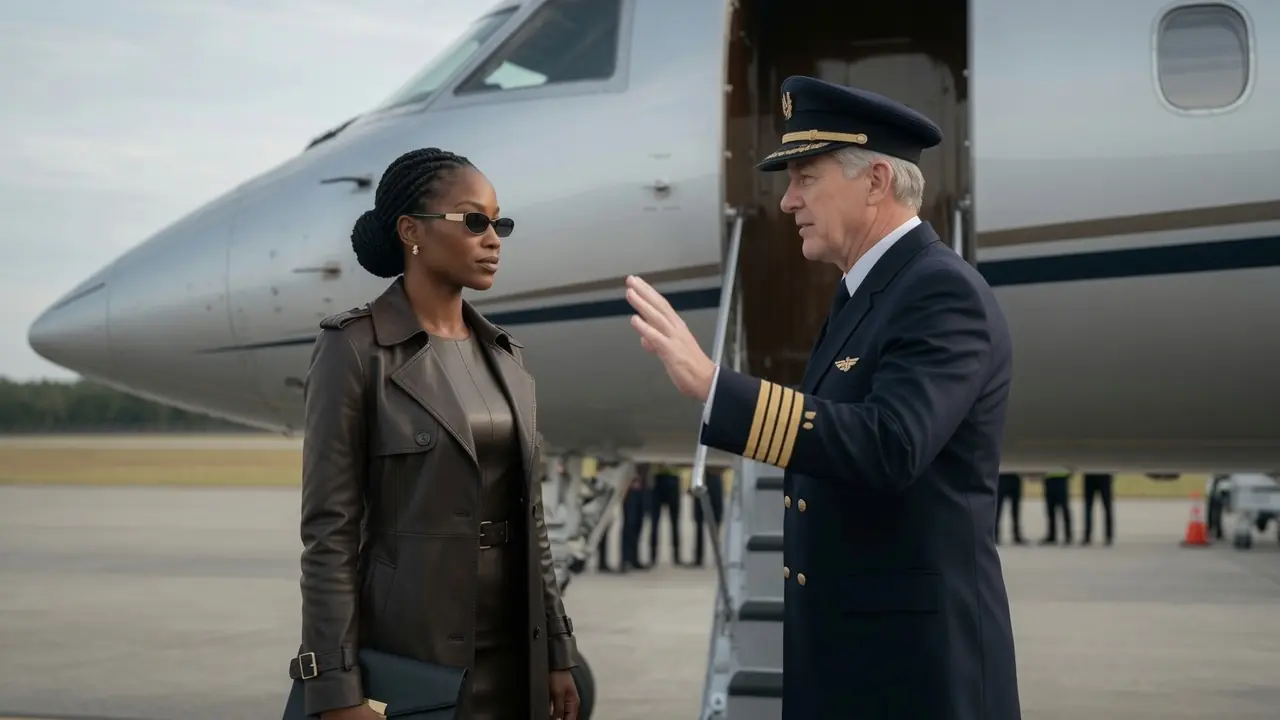
Ava Morgan stopped six feet from the stairs.
At thirty-eight, she had spent nearly fifteen years entering rooms where people decided what she was before learning her name. Her deep-brown skin, sharp dark eyes, and elegant braided hair gathered into a sleek low bun gave her a naturally commanding presence, though Captain Hayes appeared determined not to see it. She wore a fitted dark-chocolate leather midi dress beneath a matching belted trench coat, pointed heels, gold earrings, and narrow sunglasses. A structured designer clutch rested in one hand, while her assistant Clara stood behind her holding a document case and overnight luggage.
“Move,” Ava said calmly. “I own this aircraft.”
Hayes gave an exaggerated laugh and glanced toward the crew as if inviting them to enjoy the joke. He was fifty-four, tall and broad, with carefully combed silver hair beneath his captain’s hat and four gold stripes displayed on each sleeve. His uniform was immaculate, but the expression beneath it was openly contemptuous. “You don’t own anything here, and you’ll never give orders to my crew.”
Ava lowered her sunglasses just enough to look directly into his eyes.
“Turn around,” she said. “My husband came to fire you himself.”
Hayes did not turn.
The low rumble of approaching engines reached them from the access road behind the hangars. Three black SUVs passed through the secured gate in formation, their tinted windows reflecting the runway lights. The lead vehicle accelerated toward the private terminal before slowing near the jet. Ground workers who had remained silent began exchanging uneasy looks.
Hayes glanced over one shoulder, but his confidence returned quickly. “Those vehicles are probably meeting the owners.”
“They are,” Ava replied.
The SUVs stopped.
The rear door of the first vehicle opened, and forty-two-year-old Julian Morgan stepped onto the tarmac in a charcoal suit without a tie. He was tall, athletic, and composed, with closely trimmed black hair and the kind of stillness that appeared only when anger had moved beyond shouting. Two corporate security officers emerged from the second SUV, while Morgan Global’s general counsel and aviation director stepped from the third. Julian’s eyes moved from the blocked stairs to his wife’s expression and finally to Captain Hayes.
“What happened?” he asked.
Hayes straightened immediately. “Mr. Morgan, I was securing the aircraft against an unauthorized passenger.”
Julian looked toward Ava. “Unauthorized?”
“He refused to verify my name,” she said. “He threatened to call security and told me women like me did not belong on the tarmac.”
Clara stepped forward. “I offered him the passenger manifest twice. He would not look at it.”
The aviation director, Helen Mercer, removed a tablet from her bag. “Captain Hayes received the manifest last night. Mrs. Morgan’s name is listed as the principal passenger and aircraft owner.”
Hayes’s face tightened. “The photograph in the executive profile must be outdated.”
“There is no photograph attached to the operational manifest,” Helen replied. “Only her full name, security clearance, and authorization code.”
“I assumed—”
“That is the problem,” Ava interrupted. “You never asked.”
Julian walked closer until only several feet separated him from the captain. “Did my wife identify herself?”
“She claimed to own the aircraft.”
“Did you check?”
Hayes glanced toward Helen. “There was not enough time.”
“You spent four minutes insulting her,” Clara said. “You had time.”
The ground crew remained motionless. One younger worker lowered his eyes when Hayes looked toward him, and Ava recognized the fear behind the gesture. Richard Hayes was not merely a contracted pilot. He served as Morgan Global Aviation’s senior captain, controlled crew schedules, and wrote performance evaluations that could determine whether pilots ever flew for high-profile clients again.
He had expected everyone around him to protect his version of events.
Julian turned toward the ground crew. “Who witnessed the exchange?”
No one answered immediately.
Hayes folded his arms. “My crew knows I followed standard security procedure.”
Ava looked at the nearest worker, a twenty-six-year-old Black mechanic named Andre Lewis. She had seen his name on a maintenance report but had never met him in person. “You will not lose your job for telling the truth,” she said.
Andre hesitated, then stepped away from the fuel panel. “Captain Hayes told Mrs. Morgan she was probably someone’s guest trying to get photographs inside the jet.”
The captain’s head snapped toward him. “Be careful, Lewis.”
Julian’s voice became colder. “Do not threaten an employee in front of me.”
Another crew member spoke. “Mrs. Morgan’s assistant offered the documents. He told her the passenger was expected to be someone important.”
Ava’s mouth tightened.
Julian looked at Hayes. “My wife built the company that purchased this aircraft.”
Hayes removed his hat and held it against his chest. “Mr. Morgan, I recognize how this appears.”
“It appears exactly as it happened,” Ava replied.
He turned toward her with a strained expression. “Mrs. Morgan, I apologize if my tone seemed disrespectful. Private aviation faces serious security risks, and I have a responsibility to protect our clients.”
“You were not protecting me.”
“I did not know who you were.”
“That does not improve the apology.”
Hayes looked toward Julian, hoping another man would rescue him from the woman he had humiliated. “Sir, surely you understand the need for caution.”
Julian’s gaze hardened. “Caution would have meant checking her credentials. You chose contempt.”
The distinction silenced the tarmac.
Morgan Global Holdings had begun nineteen years earlier with one healthcare logistics contract and a small rented office outside Atlanta. Ava, then a nineteen-year-old accounting student, built financial models at night while helping her mother care for two younger siblings. By twenty-six, she had purchased a struggling medical transport company and rebuilt its regional network. By thirty-five, Morgan Global controlled logistics, aviation services, renewable infrastructure, and specialized manufacturing businesses across eleven states.
Julian joined the company five years after Ava founded it. He began as outside counsel, became chief legal officer, and eventually left daily management after they married. Though journalists often described him as the businessman behind Morgan Global, employees knew Ava remained its controlling shareholder, board chair, and chief executive.
The Gulfstream belonged to a corporate trust she personally controlled.
She had bought it not as a status symbol but because Morgan Global executives often needed to reach manufacturing plants, disaster sites, and international negotiations on schedules commercial aviation could not accommodate. That morning, Ava was flying to Dallas to finalize the acquisition of a medical refrigeration company employing eight hundred people. A delay of even two hours could allow a competing buyer to seize the deal.
Captain Hayes had been briefed on all of it.
Helen opened the aviation staffing records on her tablet. “Your operational notes state that the principal passenger is Ava Morgan, chair and CEO.”
Hayes attempted a different defense. “I believed Mrs. Morgan would arrive with a larger executive party.”
“Meaning what?” Ava asked.
He did not answer.
“Say it clearly.”
He shifted his weight. “I expected someone who looked more consistent with the profile.”
Ava removed her sunglasses completely. “And what does a chief executive look like?”
Hayes glanced at Julian again.
Julian shook his head once. “Do not look at me. She asked you.”
The captain’s face reddened. “I expressed myself poorly.”
“No,” Ava said. “You expressed yourself honestly.”
Corporate counsel Rebecca Sloan stepped closer. “Captain Hayes, surrender your company badge, cockpit access card, operational tablet, and aircraft keys.”
Hayes stared at her. “You cannot suspend a captain ten minutes before departure.”
“You are not being suspended,” Julian said.
Ava looked toward her husband.
He met her eyes, silently giving the decision back to the person who actually held the authority. The gesture was small, but everyone on the tarmac noticed it. Julian had arrived to defend his wife, not to replace her voice.
Ava faced Hayes. “Your employment is terminated for discriminatory conduct, refusal to follow passenger-verification procedures, threatening subordinates, and compromising an executive flight.”
“You cannot fire me without an investigation.”
“The investigation begins today,” Rebecca said. “Your access is being revoked immediately because you are responsible for passenger safety and have demonstrated that prejudice overrides procedure.”
“I have flown for this company for nine years.”
“And in four minutes,” Ava replied, “you proved that none of those years taught you whom your duty protects.”
Hayes’s professional mask finally cracked. “You are ending my career because I did not greet you properly?”
“You refused to verify my identity, blocked me from my own aircraft, threatened me with removal, and intimidated witnesses. Do not reduce your choices to a missing greeting.”
The younger crew members watched him differently now. His authority had always seemed permanent because no one with power had ever examined how he used it. Once Ava placed the conduct into plain language, the uniform stopped protecting him.
Hayes surrendered his badge but held the keys tightly. “There is no replacement captain available.”
Helen reached into her own bag and removed a second set of credentials. “Captain Renee Thompson landed from Miami forty minutes ago. She is rated for this aircraft and has already accepted the flight.”
A second vehicle approached from the private terminal. A Black woman in a navy captain’s uniform stepped out, accompanied by a first officer. Captain Renee Thompson was forty-six, experienced, and known throughout the company for an impeccable safety record.
Hayes looked at her with disbelief. “You brought her here before this happened?”
Helen’s expression remained neutral. “She was scheduled as reserve because the board was reviewing several complaints involving you.”
The words changed the meaning of the entire confrontation.
Ava glanced toward Rebecca. “What complaints?”
Rebecca opened a folder. “Six formal reports in twenty months. Three from flight attendants, two from ground personnel, and one from a client’s executive assistant.”
Hayes interrupted. “All of those were resolved.”
“They were closed by the aviation chain of command,” Helen said.
“You were the head of that chain,” Ava replied.
One complaint came from a Latina flight attendant who reported that Hayes repeatedly assigned her cleaning tasks outside her role and introduced white colleagues to passengers while ignoring her. Another involved a Black executive assistant whom Hayes questioned for nearly twenty minutes, though white guests boarding under the same security arrangement were welcomed without review. A third described him calling a female pilot “too emotional for command” after she challenged an unsafe scheduling decision.
The reports had never reached Ava or Morgan Global’s independent ethics office.
Hayes controlled how aviation complaints were categorized before submission. He labeled each incident a communication disagreement and recommended coaching rather than investigation. His position allowed him to bury the pattern one complaint at a time.
Ava looked toward Andre. “Did you know about these?”
“People knew there were complaints,” he said. “We also knew challenging him could cost us flight assignments.”
Captain Thompson approached the group. Hayes’s jaw tightened when he saw her take possession of the aircraft keys.
“You have wanted my position for years,” he said.
Renee did not react. “I wanted standards applied equally.”
“You went around me.”
“I used the reporting system after you changed my schedule to punish me for questioning a fatigue violation.”
Helen added, “The scheduling records support her account.”
Hayes looked toward Ava with sudden desperation. “Give me a hearing before you destroy everything.”
“You will receive a formal review,” Ava said. “Your immediate removal protects passengers and employees while evidence is preserved. What you will not receive is cockpit authority during that process.”
Corporate security escorted Hayes toward the terminal. He passed the crew members he once controlled, but none met his eyes. At the edge of the tarmac, he looked back toward the aircraft.
Ava had already turned away.
The Dallas flight departed twenty-three minutes behind schedule. Captain Thompson greeted Ava at the stairs, verified her authorization code, introduced the first officer, and reviewed the expected flight time. The process required less than a minute.
Inside the cabin, Ava removed her trench coat and sat beside the window. Julian occupied the seat across from her, while Clara and Rebecca reviewed documents farther back. For several minutes, neither husband nor wife spoke.
“You did not need to come personally,” Ava finally said.
“Yes, I did.”
“I could have handled him.”
“I know.”
“Then why the convoy?”
Julian leaned forward. “Because Clara’s message said a captain was blocking you from the plane and threatening security. I did not know whether the situation would remain verbal.”
Ava studied him. “You looked ready to fire him before hearing everything.”
“I was ready to stop him. Firing him was your decision.”
Her expression softened.
Julian continued, “I will never defend you by acting as though your authority comes from being my wife.”
“That is why I married you.”
“I thought it was my cooking.”
“You burned water last month.”
“The pan was defective.”
Ava smiled despite the tension.
The acquisition meeting in Dallas began less than half an hour late. Morgan Global secured the refrigeration company after Ava agreed to preserve its facilities, union contracts, and research division. The rival bidder had offered more money but planned to sell the patents and close two plants. Eight hundred employees kept their jobs because Ava arrived in time.
Yet the tarmac incident remained with her.
During the return flight, she asked Rebecca to reopen every aviation complaint from the previous five years. She also directed the ethics office to interview employees outside the presence of aviation management. No one accused would control the evidence, witness list, or classification of the complaint.
The review uncovered more than Hayes’s misconduct.
Two scheduling managers assigned preferred routes based on personal relationships. Flight attendants who rejected inappropriate comments received undesirable shifts. Ground workers were discouraged from reporting safety concerns when wealthy passengers might be delayed. The culture rewarded silence because the company treated private aviation as a luxury service rather than a safety operation staffed by human beings.
Ava accepted responsibility for failing to examine it earlier.
At the next board meeting, one director suggested releasing a short statement describing Hayes as a single bad employee. Ava rejected the proposal. Calling him an isolated problem would protect the system that allowed him to bury complaints.
“We bought aircraft, hired crews, and celebrated our safety statistics,” she told the board. “We never asked whether employees trusted the people collecting those statistics.”
Morgan Global established an independent aviation-standards office reporting directly to the board’s audit and ethics committees. Scheduling decisions became reviewable, fatigue complaints could not be overridden by one manager, and all discrimination reports bypassed the operational chain of command.
Passenger verification procedures were rewritten.
Every traveler would be checked according to the manifest, identification, and security status—not clothing, race, age, gender, perceived wealth, or proximity to someone important. Crews received scenario training using actors whose appearance intentionally conflicted with assumptions about their roles. Some arrived dressed casually as aircraft owners; others appeared wealthy but possessed no authorization.
The goal was not to teach employees how to recognize powerful people.
It was to teach them that recognition was unnecessary.
Hayes’s formal investigation concluded after seven weeks. Video from the jet’s exterior cameras captured the entire tarmac exchange, including his threats and refusal to examine the documents Clara held. Witness statements confirmed Ava’s account, and internal records proved he altered complaint classifications.
His termination became permanent.
The aviation regulator reviewed separate concerns about fatigue reporting and record integrity. Although Hayes retained his pilot certification after additional proceedings, no major corporate operator offered him a command position. His career had not ended because Ava’s husband arrived in black SUVs.
It ended because evidence finally reached people he could not intimidate.
Captain Thompson became Morgan Global’s chief pilot after an open selection process. She initially declined, worried employees would view the promotion as compensation for discrimination rather than recognition of her qualifications. Ava told her the company would publish the selection criteria and scores internally.
Renee ranked first in safety performance, leadership reviews, aircraft qualifications, and crew confidence.
She accepted.
Andre Lewis entered an aircraft-engineering certification program funded through the company’s professional-development plan. When Ava asked why he had remained silent at first, he answered honestly.
“Because I have watched truth lose to rank before.”
Ava carried that sentence into every leadership meeting afterward.
Six months later, she returned to the same Atlanta airfield for another flight. This time she wore an ivory blouse beneath a deep-burgundy suit and carried no entourage. A newly hired first officer met her near the terminal, checked the manifest, welcomed her by name, and walked her toward the jet.
A delivery driver approached the wrong gate while they passed. Instead of shouting, a ground supervisor checked his paperwork and calmly directed him to the correct hangar. The interaction lasted less than thirty seconds.
Nothing dramatic happened.
No one needed a husband, convoy, title, or public reversal.
Ava considered that the clearest proof of change.
Julian’s SUV arrived moments before departure. He stepped out holding two coffees and kissed her cheek near the bottom of the stairs.
“You were not required to come,” she said.
“I know.”
“You have a meeting downtown.”
“I moved it.”
“Why?”
“Because my wife owns a jet, and I am hoping she might give me a ride.”
Captain Thompson appeared at the doorway. “Mr. Morgan, your name is on the manifest. You may board after verification.”
Julian placed one hand over his heart. “No special treatment?”
“Not on my aircraft.”
Ava raised an eyebrow. “Your aircraft?”
Renee smiled. “Operationally.”
“Acceptable answer.”
They boarded together.
As the jet climbed above Atlanta, Ava looked through the window at the airfield shrinking beneath the clouds. Hayes had seen a Black woman approaching a private aircraft and decided she could not possibly own it. He treated her dignity as something that required proof, while treating his own authority as unquestionable.
Her husband’s arrival exposed how badly he had misjudged her identity.
But Ava knew that was never the most important lesson.
Hayes would have been equally wrong if she had been an assistant, flight attendant, guest, or traveler who approached the wrong aircraft by mistake. Respect should not have depended on discovering that she controlled the company paying his salary.
The SUVs did not make his conduct unacceptable.
They merely ensured he could no longer hide it.