The bank letter arrived on a Tuesday morning while Eleanor Whitaker still had flour on both hands.
She read it once beside the kitchen table, then again beside the stove, as though changing position might change what the words said. Thirty days remained before foreclosure proceedings could begin against Whitaker Ranch, two hundred acres of Montana land her father had spent thirty years turning from stubborn rock and wind-beaten grass into a working cattle operation. Eleanor folded the letter precisely, placed it beneath the sugar jar, and finished cutting biscuits because she had long ago learned that disasters rarely cared whether breakfast was ready.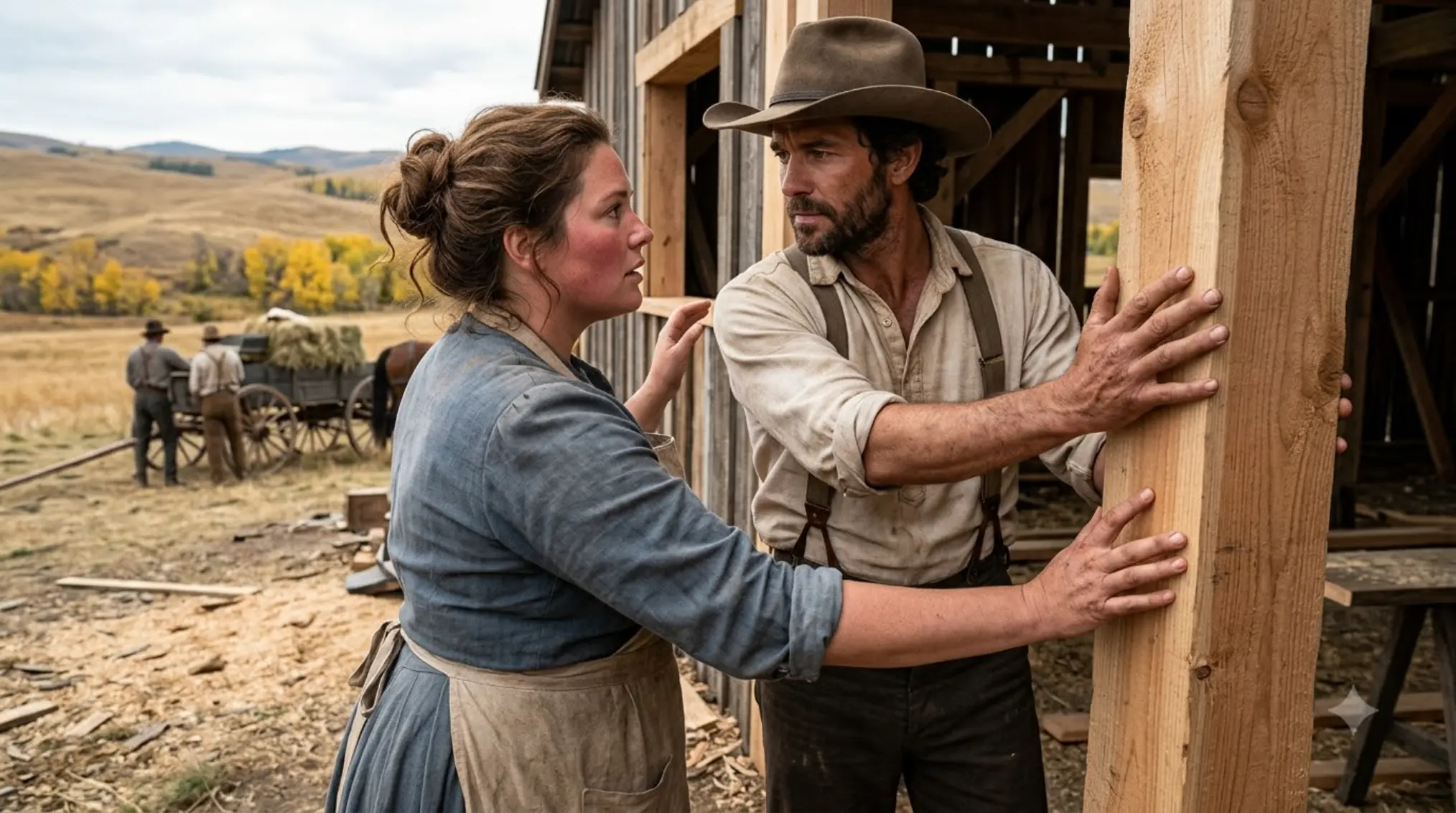
Only after dark did she permit herself to think about losing the ranch.
She sat in her father’s old porch chair beneath a sky brilliant with stars and listened to the cattle shifting beyond the barn. Robert Whitaker had died two springs earlier, leaving her land, livestock, an aging house, and a mortgage Eleanor had not known existed until after the funeral. Her mother had died when Eleanor was nineteen, there were no siblings to share the work, and every man in Harlow County who had ever considered courting her seemed to lose interest the moment his friends reminded him that Eleanor was a large woman who worked harder than most of them and possessed little talent for pretending otherwise.
She had survived their whispers.
The debt was harder.
Three weeks earlier, an August storm had collapsed part of the barn roof and exposed nearly half her stored hay. Eleanor had spent days climbing damaged rafters alone, repairing what she could with boards salvaged from fences and outbuildings. Her palms were blistered beneath cloth strips, her back burned constantly, and every sunrise revealed more work than the day before.
That was the condition of Whitaker Ranch when Thomas Reed walked through her gate.
Eleanor was forty feet above the ground when she heard the hinges creak.
She looked down and saw a lean, weathered man standing beside the barn with a battered tool bag in one hand. Thomas looked somewhere in his early forties, with dark hair, a short beard, dusty clothes, and a coat repaired along one shoulder with thread that looked suspiciously like baling twine. He studied the barn longer than he studied Eleanor.
“That center beam is cracked twice,” he called upward. “Fix the roofing without bracing it and the first heavy snow brings the whole east side down.”
Eleanor stopped hammering.
“I know.”
“Yes, ma’am.”
He set his bag down.
“The third rafter’s worse.”
That got her attention.
Eleanor climbed the ladder slowly, reached the ground, and walked directly toward him.
“You always arrive on strangers’ property criticizing their barns?”
“Only when they’re about to fall.”
“Who are you?”
“Thomas Reed.”
He offered his left hand.
Eleanor noticed his right immediately. Three fingers did not straighten fully, and two were missing beyond the first joint.
“Eleanor Whitaker.”
“This your ranch?”
“Every inch.”
“Your husband nearby?”
“No husband.”
Thomas simply nodded.
No pity.
No surprised glance at her body.
No uncomfortable smile suggesting that her unmarried status required explanation.
He looked back at the roof.
“I’m looking for work.”
“I don't have money.”
“Meals?”
“Yes.”
“Bed?”
“Storage room has a cot.”
“That’s enough.”
Eleanor narrowed her eyes.
“You haven't even asked what the work is.”
Thomas looked upward.
“Seems fairly obvious.”
For the first time in days, Eleanor almost laughed.
Almost.
Thomas earned the cot before sunset.
He walked Eleanor through the damaged structure, identifying failure points she had missed and confirming several she had already marked. He understood timber the way she understood cattle—by pattern, pressure, and instinct sharpened by years of experience. More importantly, he never used knowledge as a way to make her look foolish.
When she disagreed, he explained.
When she was right, he said so.
By evening, they had a repair plan.
At supper, Eleanor placed beans and biscuits in front of him.
Thomas ate quietly.
Halfway through the meal, he lifted his damaged hand.
“Threshing machine.”
Eleanor looked up.
“Six years ago. Hand went where it shouldn't. Doctor saved what he could.”
“Can you work?”
Thomas gave a dry smile.
“You watched me all afternoon.”
“I’m asking what you think.”
His expression changed slightly.
“Yes. I can work. Construction. Planning. Repair. Anything where knowing what comes next matters more than having ten perfect fingers.”
“Why haven't you stayed anywhere?”
“Eleven ranches in six years.”
“That bad?”
“Men hire me desperate. Let me go when they realize I can't do every job the way they expect.”
Eleanor leaned back.
“Why come here?”
Thomas looked toward the window.
“I saw your fence line.”
“My fence?”
“Seventeen kinds of repairs. Different boards, different wire, whatever was available.”
Eleanor waited.
“That doesn't look like incompetence,” Thomas said. “Looks like someone doing everything alone.”
The words struck harder than Eleanor expected.
Most people saw the mismatched fences and called the ranch poor.
Thomas saw the same thing and recognized persistence.
She stood quickly and carried her plate toward the washbasin.
“Coffee at five.”
“Yes, ma’am.”
That night Eleanor slept better than she had in months.
Not because the debt disappeared.
Not because the barn was fixed.
Because for the first time in two years, another person knew how much needed doing.
The barn changed rapidly.
Thomas reinforced the central frame while Eleanor replaced damaged boards. They worked from before sunrise until the light disappeared, developing a rhythm neither discussed. Eleanor handed him tools before he asked. Thomas measured lengths she had already estimated.
On the fourth day they needed long pine beams.
Eleanor drove into Harlow to purchase them.
Margaret Caldwell stood behind the counter at Caldwell Supply.
Margaret was fifty-two, narrow, carefully dressed, and possessed the polished confidence of a woman who had spent decades ensuring that nearly every important transaction in Harlow County passed within reach of her hands. She owned the supply store, held interest in the grain elevator, and, Eleanor had recently discovered, controlled the company that purchased Robert Whitaker’s mortgage after his death.
Margaret studied Eleanor’s lumber order.
“I’m afraid I'll require payment in full.”
“You've extended credit every season since my father was alive.”
“Circumstances change.”
Eleanor understood immediately.
The lumber cost nearly twice the cash she carried.
Margaret smiled pleasantly.
“I heard you’ve taken a man into your house.”
“I hired someone.”
“A stranger.”
“A skilled stranger.”
Margaret’s smile sharpened.
“A woman in your situation should be cautious.”
Eleanor took back the order sheet.
“I’m always cautious around people who talk about my situation.”
She left without lumber.
Thomas listened when she returned.
Then he pointed toward the northern tree line.
“Three pines fell beside the creek last winter.”
Eleanor followed his gaze.
Already down.
Already seasoned.
“The Garrison mill will cut them.”
“Fifteen miles.”
“Yes.”
She considered the weather.
“Two-day trip.”
“Then we strengthen what we can tonight and leave tomorrow.”
Eleanor stared at him.
He had said we again.
She was beginning to notice.
They worked until midnight.
The next morning they hauled the fallen timber to Garrison, arranged milling, and raced a storm back toward the ranch. Rain caught them during the final mile, soaking Eleanor’s dress and Thomas’s hat, but they reached the barn before the worst of it.
Inside, Eleanor leaned against a stall and began laughing.
Thomas stared.
“What?”
“I don't know.”
She laughed harder.
The repaired roof held above them while rain hammered against it.
Thomas started laughing too.
It was ridiculous.
Cold.
Exhausting.
Perfect.
Eleanor could not remember the last time she had laughed with another person.
That frightened her almost as much as the foreclosure notice.
The first threatening letter arrived three days later.
Margaret reminded Eleanor that the entire remaining balance could be demanded under an acceleration clause attached to the transferred mortgage.
Thomas read it twice.
“Where is the original loan?”
“My father’s lockbox.”
“Have you read it?”
“No.”
That evening Eleanor opened the box for the first time since Robert’s death.
His handwriting covered the documents.
The smell of pipe tobacco still clung faintly to the papers.
She nearly closed the lid.
Thomas waited across the table.
He did not touch anything.
Finally Eleanor found the original 1879 agreement.
Three hundred fifty dollars.
Seven percent interest.
Ten-year repayment.
No acceleration clause.
Then they found Margaret’s transfer notice.
Thomas placed both documents side by side.
“There.”
He pointed.
Margaret’s document suddenly contained a clause allowing immediate repayment demands after any change in ownership or management.
Eleanor read it slowly.
“My father never agreed to that.”
“And neither did you.”
“Can she legally add it?”
“No.”
“How do you know?”
Thomas gave her a small look.
“I've been poor in eleven different counties. You learn debt law.”
Eleanor almost smiled.
They needed proof from the original lender.
The man who wrote Robert’s mortgage was Aldis Price, formerly of Garrison Territorial Bank.
They rode there Saturday.
Price had retired.
Eleanor persuaded the new manager to provide his address after pointing out that fraudulent modifications involving the bank’s former loans could eventually become the bank’s problem too.
Thomas said nothing until they were outside.
“You enjoyed that.”
“A little.”
Price lived six miles away.
He remembered Robert instantly.
“Whitaker brought his daughter with him once,” the retired banker said. “Girl asked better questions than most borrowers.”
Eleanor swallowed.
“I was fourteen.”
Price examined the documents.
His face hardened.
“There was no acceleration clause.”
“Would you put that in writing?”
“I’ll do better.”
He wrote a sworn statement and had a neighbor witness his signature.
Before Eleanor left, Price placed the paper into her hands.
“Your father kept every promise he made to this bank.”
Her eyes burned.
“He deserved better than someone changing his agreement after he was gone.”
Eleanor managed to answer.
“Thank you.”
Thomas never mentioned the tears she refused to shed until they were halfway home.
Then he quietly said, “You were his daughter.”
She looked straight ahead.
“I still am.”
“Yes.”
Nothing more.
Exactly enough.
Margaret changed tactics.
By Monday, people in Harlow were whispering that Eleanor had taken an unknown man into her home because no respectable man would choose her willingly.
At the feed store, conversations stopped when she entered.
At church, women glanced away.
Then Hartley’s refused to sell Thomas supplies.
Margaret was isolating them socially and financially.
Thomas returned from town furious.
Eleanor sat at the kitchen table.
“She’s done this before.”
“To who?”
“The Pattersons. Greers. Holloways.”
Thomas became still.
“What happened?”
“They lost their farms.”
“Were their loans transferred too?”
“Yes.”
The question hung there.
If Margaret had modified Eleanor’s loan, perhaps she had done the same to others.
Eleanor wrote to the Billings Gazette.
Three drafts.
The first too angry.
The second too careful.
The third was simply evidence.
She described the original mortgage, the altered clause, Aldis Price’s sworn statement, and the families whose properties had already been taken through similar procedures.
Then she mailed copies to the territorial attorney general and the circuit judge.
Margaret arrived three days later.
She stepped from her buggy looking immaculate.
Thomas stood behind Eleanor near the barn.
“You have no idea what you've started,” Margaret said.
“I have a reasonable idea.”
“You will lose every merchant in this county.”
“Possibly.”
“Your cattle buyer.”
“Maybe.”
“Your reputation.”
Eleanor almost laughed.
“You spent thirty years making sure I never had the kind of reputation you think I should be afraid to lose.”
Margaret’s eyes hardened.
“You think that damaged drifter standing behind you is going to save this ranch?”
Thomas stepped forward.
Eleanor raised one hand.
He stopped.
She wanted this answer herself.
“No.”
Eleanor held Margaret’s gaze.
“I’m saving it.”
Margaret said nothing.
“And Thomas is helping.”
The difference mattered.
Margaret understood that too.
The Gazette printed a short notice announcing an investigation into potentially altered private loan transfers in Harlow County.
That four-sentence article changed the county.
Calvin Patterson arrived carrying documents from the foreclosure that cost his family their land.
Ruth Holloway brought a box she had hidden beneath her bed for three years.
Samuel Greer arrived with letters threatening his sick mother if she cooperated with investigators.
George Hartley discovered Margaret had invented twelve dollars of interest on a loan he had already repaid.
Twelve dollars.
That detail angered Eleanor more than almost anything else.
Margaret had not only taken farms when opportunities appeared.
She had become so comfortable altering numbers that she did it automatically.
Small theft.
Large theft.
Whatever people were too frightened or exhausted to challenge.
Eleanor’s kitchen became an unofficial records room.
Thomas organized dates.
Eleanor compared clauses.
Families began discovering they were never alone.
The circuit judge advanced his visit.
Six days.
Margaret responded by filing for immediate foreclosure in county court.
Eleanor rode to Billings with Thomas and found Gideon Cross, the lawyer who had prepared Robert Whitaker’s original property title twenty years earlier.
Cross was seventy-one.
He examined Eleanor’s evidence.
Then removed his glasses.
“Your father was one of the most honest men I represented.”
Eleanor waited.
“I’m taking your case.”
“I can't pay you.”
“You can when we win.”
“What if we don't?”
Cross shrugged.
“Then an old lawyer spent his time doing something worthwhile.”
He filed an emergency injunction that afternoon.
Margaret’s county action froze.
On the ride home, Eleanor asked Thomas the question she had been avoiding.
“Why are you still here?”
He looked at her.
“The barn is finished.”
“Yes.”
“You've earned more than meals and a cot.”
“Probably.”
“You could leave.”
“Yes.”
“Then why haven't you?”
Thomas rode several yards before answering.
“Somewhere around the third morning on that roof, this stopped being a barn.”
Eleanor looked toward him.
Neither said anything else.
There were truths that became weaker when explained too quickly.
Circuit court convened on an October Tuesday.
Half of Harlow County attended.
Margaret sat beside an expensive attorney from Billings.
Eleanor sat beside Gideon Cross.
Thomas took the chair to her right.
Judge Emmett Harland listened without expression.
Margaret’s lawyer argued that continued occupation of the property implied acceptance of the transferred mortgage terms.
Cross presented the original agreement.
Then Aldis Price walked into the room.
Margaret’s attorney stopped writing.
Price testified that he had personally drafted Robert Whitaker’s loan.
No acceleration clause had existed.
No borrower had consented to one.
Cross presented similar documents from six additional families.
Judge Harland read in silence.
Finally he looked up.
“The original terms govern.”
Nobody breathed.
“The acceleration clause has no legal basis.”
Eleanor gripped the edge of the table.
“The foreclosure action is suspended.”
Behind her, someone began crying.
Probably Adah.
Later she would deny it.
Judge Harland continued.
“Given evidence suggesting similar modifications across multiple accounts, this court formally refers Caldwell Holdings to the territorial attorney general for investigation.”
Margaret’s face went white.
For thirty years, power had protected her because every victim believed their problem was private.
Eleanor had changed that with paper.
Not vengeance.
Not violence.
Evidence.
Outside the courthouse, people surrounded Eleanor.
Calvin Patterson shook her hand.
Ruth Holloway hugged her.
George Hartley said only:
“Twelve dollars.”
Eleanor understood.
Then she saw Thomas standing slightly away from everyone.
Waiting.
She crossed toward him.
“We won.”
“You won.”
“We.”
Thomas looked at her.
Something open appeared in his face.
“Eleanor—”
“I know.”
His eyebrows lifted.
“You know what I'm going to say?”
“I have a reasonable idea.”
That finally made him smile.
Eleanor swallowed.
“You're the first man who ever looked at what this county said about me and decided the county was wrong.”
“It was wrong.”
“I know.”
She looked down briefly.
“That’s the difficult part.”
“Why?”
“Because I spent years making peace with being alone.”
Thomas stepped closer.
“And now?”
“You've made peace harder.”
He said nothing.
Eleanor looked back at him.
“I'd like to find out what that means.”
Thomas’s voice became quiet.
“So would I.”
The legal investigation continued through winter.
Margaret offered Eleanor a settlement.
Full mortgage forgiveness.
Immediate release of the ranch.
In exchange, Eleanor would withdraw cooperation with the territorial inquiry.
Cross gave her the offer without recommendation.
“You have earned the right to choose security.”
Eleanor looked at Thomas.
He said nothing.
That was why she loved him.
He never made her decisions easier by taking them away from her.
Eleanor thought about Ruth’s box of documents.
Samuel Greer’s father dying convinced he had failed his family.
Calvin Patterson arriving with his hat in his hands.
George Hartley’s twelve dollars.
“No.”
Cross nodded.
“I thought you might say that.”
“Tell Margaret the inquiry continues.”
Thomas waited until Cross left.
“That was either the bravest thing you've done or the second bravest.”
“What’s first?”
“Running this place alone for two years.”
Eleanor looked at him.
Then she smiled.
“Thomas Reed.”
“Yes, ma’am?”
“I need a straight answer.”
“Always.”
She folded her arms.
“The only job left on this ranch is husband.”
He became completely still.
Eleanor continued.
“You still interested?”
Thomas stared at her for several seconds.
Then his damaged right hand lifted slightly.
“If that position remains available, I'd like to apply.”
“References?”
“One retired banker.”
“Questionable.”
“One elderly lawyer.”
“Worse.”
“Several ranch families.”
Eleanor fought a smile.
“And approximately two months of barn repairs, fence lines, legal travel, bad weather, and surviving your cooking once when you were exhausted.”
“My cooking?”
“You burned the beans.”
“I was busy saving the ranch.”
“Reasonable excuse.”
Eleanor stepped toward him.
For thirty-six years, she had learned to expect men to look away.
Thomas did not.
She placed one hand against his chest.
His left hand covered hers.
“Your damaged hand doesn't bother me,” she said.
“I know.”
“Good.”
She lifted her face.
“You should probably kiss your prospective employer.”
Thomas smiled.
“I was hoping that was part of the position.”
It was.
Thomas proposed properly several weeks later while they were trying to calm an irritated steer in the barn.
Eleanor stared at him.
“Now?”
“The steer can wait.”
“No, it cannot.”
Thomas ignored her.
“Eleanor May Whitaker, marry me.”
The steer kicked the stall wall.
Eleanor laughed.
“You chose this moment?”
“I realized if I waited for some peaceful romantic moment, we'd be eighty.”
She looked around.
Cold barn.
Cattle.
Hay.
Mud.
The real life they actually lived.
“Yes.”
Thomas blinked.
“Yes?”
“Yes.”
The steer immediately became difficult again.
Thomas grinned.
“Excellent timing.”
They married before Christmas.
Gideon Cross came from Billings.
Aldis Price sent a letter.
Your father would have shaken his hand.
That sentence finally made Eleanor cry.
Thomas held her.
He did not tell her not to.
He did not promise everything would be fine.
He simply remained.
By February, the territorial investigation concluded that Caldwell Holdings had improperly modified numerous private loan agreements.
Margaret avoided prison, but her company was dissolved.
Active fraudulent foreclosures were canceled.
Several families received restitution.
The Pattersons regained their land under a legitimate repayment plan.
Ruth Holloway received compensation.
The county clerk resigned.
Caldwell Supply eventually changed ownership.
Margaret moved away.
Eleanor rarely spoke about her afterward.
Victory, she learned, was not watching Margaret suffer.
Victory was reaching spring and realizing Margaret no longer mattered.
Five years later, Whitaker Ranch was named among the most productive ranches in the region.
Thomas read the letter at the kitchen table.
“Huh.”
Eleanor stared at him.
“Huh?”
“I expected it last year.”
She slapped the paper against his shoulder.
He laughed.
The East Field now supported twenty-five additional cattle—the exact number Eleanor had predicted.
The barn remained solid.
The fences still contained repairs done seventeen different ways.
Thomas never replaced all of them.
He said they told the story of the ranch.
Eleanor pretended that sentimentality annoyed her.
It did not.
One January morning years later, Thomas entered the office and found Eleanor updating her father’s old ledger.
He stood in the doorway.
She looked up.
“What?”
“Nothing.”
“Thomas.”
“I wanted to see you.”
“You see me every day.”
“I know.”
He smiled.
“That's the part I like.”
Eleanor looked down at the ledger.
Thirty-six years of being told she was too large, too stubborn, too independent, too difficult, too unlikely to be chosen had failed to prepare her for how ordinary love eventually became.
Not easy.
Ordinary.
Someone across the breakfast table.
Someone beside her repairing fence.
Someone who knew when she needed advice and when she needed silence.
Someone who had arrived with a damaged hand believing his usefulness had already been decided by other people.
Perhaps that was why they understood one another.
Both had spent years being reduced to whatever strangers noticed first.
Her body.
His hand.
Neither had been allowed to be complete.
Until they met.
Eleanor closed the ledger.
“Come sit down.”
Thomas did.
Outside, snow covered the ranch Robert Whitaker had built, Eleanor had saved, and she and Thomas had continued together.
The land had never needed a hero.
Neither had Eleanor.
What she needed was something far rarer.
A partner who understood that standing beside a strong person did not require making them weaker first.
Thomas had understood that from the day he walked through her gate.
He never saved Eleanor Whitaker.
He simply saw her clearly.
And when she finally decided to let someone share the weight, he stayed long enough to prove he knew how to carry his half.