“Hey. What are you doing here?”
Reggie Holt looked up from the park bench, one arm resting lightly around his five-year-old daughter’s shoulders, and saw a police officer standing in front of him.
The officer was tall, broad, and already frowning.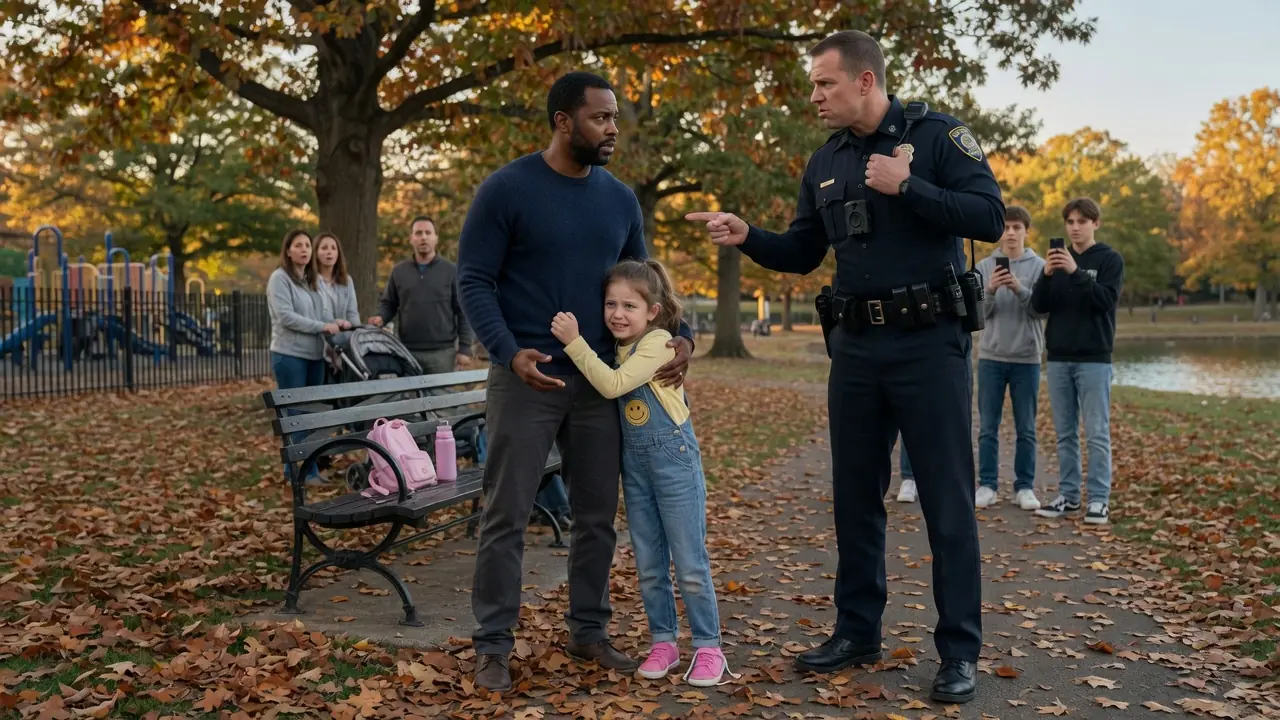
Not curious.
Not cautious.
Frowning.
Reggie felt his daughter Lily shift against his side. She had been half asleep a moment earlier, her cheek pressed to his sleeve after two hours of running, climbing, swinging, laughing, and asking why ducks walked like they were late for meetings.
Now she sat up a little, blinking at the man in uniform.
Reggie kept his voice calm.
“Good afternoon, officer.”
The officer did not return the greeting.
His eyes moved from Reggie’s face to Lily’s small backpack on the bench, then to Lily herself. She had one pink sneaker untied, curls falling loose from her ponytail, and a sticker from preschool still stuck crookedly on the front of her shirt.
The officer’s jaw tightened.
“And whose child is this?”
Reggie felt the air change.
That particular shift was familiar.
Not because this exact thing had happened before in this exact way.
But because Reggie Holt was a Black man in America, and he had lived thirty-eight years learning how quickly an ordinary afternoon could become a situation if the wrong person decided he did not belong in the frame.
He placed both hands where the officer could see them.
“She’s my daughter,” he said. “We’re waiting for her mother to pick us up.”
The officer’s eyes narrowed.
“Well, I don’t believe you.”
Lily’s little hand slid into Reggie’s.
The officer took half a step closer.
“I need to see proof of that, or I’m taking her with me and arresting you.”
Reggie stared at him.
For one second, he thought he must have misheard.
“What?”
“Proof,” the officer said. “Now. Or you’re under arrest.”
Lily looked up at Reggie, confused.
“Daddy?”
The officer’s head snapped toward her, then back to Reggie, as if her calling him Daddy had somehow made things worse.
Reggie squeezed Lily’s hand gently.
“It’s okay, baby.”
But it was not okay.
Not even close.
Riverside Park sat at the edge of a quiet residential neighborhood, twelve acres of clean grass, mature oak trees, walking paths, a duck pond, a fenced playground, and benches arranged in the places families naturally gathered.
On spring mornings, older couples walked laps around the pond. In summer, children ran barefoot through the splash pad near the playground. By early autumn, the park took on a softer beauty: yellowing leaves, cooler air, parents with coffee cups, and children wearing jackets they would abandon on the ground after ten minutes of playing.
That Thursday afternoon felt like the kind of afternoon where nothing bad should happen.
The sun was warm but no longer harsh. A breeze moved through the trees. Joggers passed with earbuds in. A woman pushed twins in a stroller. Two teenagers sat under an oak tree sharing fries from a paper bag. Parents clustered near the playground fence, talking while their children climbed and shouted.
Reggie Holt had brought Lily to this park almost every Thursday since she was old enough to walk.
It was their place.
The duck pond was where Lily had first learned the difference between ducks and geese and then announced, loudly, that geese looked like “angry old men with wings.”
The swings were where Reggie had pushed her so many times that she believed, with complete seriousness, that he was the strongest man in the city.
The bench near the main entrance was where they waited for Diana when she finished work at the courthouse.
Reggie was thirty-eight years old, an architect at a mid-size firm downtown, a man who made his living designing spaces where people were supposed to feel safe.
Schools.
Community centers.
Affordable housing projects.
Libraries.
He believed buildings spoke before people did. A good building told you that you belonged inside it. A bad one told you to move along.
He carried that belief into fatherhood too.
Home, to Reggie, was not just walls and a roof.
Home was the look on Lily’s face when he picked her up from preschool.
It was Diana’s keys hitting the bowl by the door.
It was bedtime stories with too many voices.
It was pancakes shaped badly like animals on Saturday mornings.
It was a place where Lily never had to wonder whether she was wanted.
He and Diana had married eleven years earlier.
They had met at a community housing forum, where Diana was speaking on tenant protections and Reggie had presented a redesign proposal for a neglected apartment complex. Afterward, she had challenged him on whether his design included enough lighting along the back walkway.
He had answered with a technical explanation.
She had interrupted and said, “That was not a yes.”
He fell in love with her somewhere between irritation and admiration.
Diana Holt was brilliant, exact, disciplined, and relentless when she believed something was wrong. She became a prosecuting attorney because she believed the law could either be a weapon or a shield, and she intended to spend her life making it more shield than weapon.
Their marriage was not perfect.
No real marriage was.
They argued about money early on. About Reggie working too late. About Diana bringing case files to the dinner table. About whether the living room should have a gray couch or a blue one.
But they had always been a team.
When they discovered Diana could not conceive, they grieved.
Quietly at first.
Then together.
There were doctor visits, tests, hope, disappointment, and the hollow ache of seeing baby announcements from friends while trying to be happy without breaking inside.
Then one night, Diana sat beside Reggie on the kitchen floor because she had been crying too hard to stand, and she said, “I don’t need a child to share my blood. I need a child to share my life.”
Reggie took her hand.
“Then we adopt.”
They started the process the next month.
Lily came into their lives as a newborn.
Tiny.
Red-faced.
Furious at the world.
Wrapped in a yellow blanket.
The first time Reggie held her, she stopped crying.
Not slowly.
Not gradually.
She simply stopped, opened her little eyes, and stared at him like she had been waiting for him to arrive.
The social worker smiled.
“Well,” she said, “that seems settled.”
Diana cried silently beside him.
Reggie whispered, “Hi, Lily. I’m your daddy.”
From that day forward, there was no “like” family.
No “almost” family.
No technical distance.
Lily was their daughter.
Completely.
Legally.
Emotionally.
Forever.
That Thursday afternoon, Reggie had picked Lily up from preschool at 2:45. She had run into his arms holding a construction paper apple tree with glue still wet on the trunk.
“Daddy, look! I made fall.”
“You made the whole season?”
“Yes. I’m very talented.”
He had laughed, kissed her forehead, and taken her to Riverside Park.
They spent two hours there.
He pushed her on the swings until his shoulders ached. He chased her across the climbing structure while she screamed, “The monster architect is coming!” He bought her a grape popsicle from the park vendor, and she managed to get purple juice on her chin, both hands, and somehow one elbow.
They walked to the pond.
Lily named three ducks.
Professor Waddle.
Banana.
Diana Junior.
“Why is that one named after Mommy?” Reggie asked.
“Because she looks like she’s in charge.”
Fair enough.
At 4:00, Diana texted.
Court ran late. I’ll be there around 5. Kiss our girl for me.
Reggie sent back a picture of Lily leaning against him on the bench, eyes half closed, backpack between them.
Waiting. She conquered the park.
Diana replied with a heart.
By 4:35, Lily had grown tired enough to rest against him, one small hand clutching the sleeve of his sweater.
Reggie sat with her beneath the trees and felt the deep contentment of an ordinary good day.
He had no way of knowing Officer Dale Simmons had just turned onto the park path.
Simmons was thirty-six years old and had been on the police force for nine years.
His supervisors had described him as “proactive.”
Sometimes “thorough.”
Sometimes, in language careful enough to avoid responsibility, “overly instinctive.”
There had been complaints.
Three formal ones over four years.
The first from a man questioned while walking through Riverside Park with his nephew.
The second from a father at a public swimming pool asked to prove his relationship to his own daughter.
The third from a man at a grocery store approached after Simmons saw him pushing a cart with a toddler inside.
Each complaint had followed the same pattern.
A man with a child.
No missing child report.
No suspicious conduct.
No legal basis.
Only Simmons deciding the situation “felt wrong.”
Each time, the complaint had been investigated lightly, explained away, softened in official language, and closed with a verbal warning.
No discipline.
No retraining that mattered.
No meaningful correction.
Patterns do not become harmless because institutions decline to name them.
They only grow.
That afternoon, Simmons saw Reggie and Lily on the bench.
A Black man.
A small white girl with blue eyes and light brown curls.
His mind made a decision before his training had time to intervene.
He slowed.
Stopped.
Turned toward them.
No call had come over the radio.
No parent had reported a missing child.
No one in the park had approached him with concern.
Reggie was not hiding, restraining, threatening, or behaving strangely.
He was sitting on a bench with his daughter’s backpack beside him and her head resting against his arm.
But Simmons had already chosen a story.
Now he only needed to force the facts to fit it.
“Can I ask what you’re doing here with this child?” he asked.
Reggie kept his voice even.
“We’re waiting for my wife. We spent the afternoon in the park. She’s my daughter.”
Simmons looked at Lily.
Then at Reggie.
“You look suspicious with this kid.”
The words struck Reggie with a familiar violence.
Suspicious.
Not because of what he had done.
Because of what Simmons had decided he was.
Reggie inhaled slowly.
“I’m her father. Is there a problem, officer?”
“I’m going to need proof of that.”
“I don’t carry adoption papers to the park,” Reggie said. “She’s my daughter. We’ve been coming here for years.”
“That’s not good enough.”
Lily lifted her head fully now.
Her face wrinkled in confusion.
“That’s my daddy,” she said.
Clear.
Simple.
Certain.
Simmons glanced at her, then looked back at Reggie as if she had made noise but not meaning.
“I’m going to need you to come with me to the station so we can sort this out.”
Reggie felt Lily’s fingers tighten around his.
“There’s nothing to sort out. I told you she’s my daughter. She told you I’m her father. My wife is on her way to pick us up right now. You can speak with her when she gets here.”
“For this child’s safety, I’m going to bring her to the station until the relationship can be properly verified.”
Lily’s face changed.
The word station meant nothing specific to her, but she understood enough from Reggie’s body.
Something was wrong.
Reggie stood slowly.
He kept himself between Simmons and Lily, not aggressively, but instinctively.
“You are not taking my daughter anywhere.”
“Sir, step back.”
“No.”
Simmons’s eyes hardened.
“You are interfering with a child safety check.”
“You don’t have a child safety issue. You have my daughter at the park with her father.”
“Turn around.”
Reggie saw the handcuffs.
Lily saw them too.
“Daddy?”
Reggie turned his head slightly.
“It’s okay, baby. Stay right there.”
But his voice had changed, and she heard it.
Children always hear it.
“I have done nothing wrong,” Reggie said clearly. “My name is Reggie Holt. This is my daughter, Lily Holt. My wife, Diana Holt, is on her way here right now.”
Simmons grabbed his arm.
Reggie did not pull away.
He understood exactly how quickly a man like him could be accused of resisting.
He understood how his body could be interpreted as a threat even when standing still.
So he did the safest thing available.
He kept speaking.
Loudly.
Clearly.
For witnesses.
For Lily.
For the body camera blinking on Simmons’s chest.
“This is my daughter,” he said as Simmons twisted his arm behind his back. “She has told you I am her father. I have told you I am her father. You have no legal basis to arrest me.”
The first cuff clicked.
Lily screamed.
Not cried.
Screamed.
It tore through the park, raw and terrified.
The second cuff clicked.
“Daddy!”
Reggie closed his eyes for half a second.
The sound of his daughter’s fear hurt worse than the metal around his wrists.
“I’m right here, baby,” he said. “I’m not going anywhere.”
Simmons looked down at Lily with an expression he probably believed was gentle.
“It’s okay, sweetheart. You don’t have to be scared of him anymore. You can tell the truth now.”
Reggie’s voice snapped with controlled fury.
“She is crying because you just put handcuffs on her father in front of her.”
Lily sobbed, reaching for him.
“That’s my daddy! Let go of my daddy!”
Several people nearby had stopped.
A woman with a stroller stood frozen.
A jogger pulled out his phone.
The teenagers under the oak tree stared, fries forgotten.
A father near the playground picked up his toddler and moved closer, uncertain whether to intervene or record.
Simmons reached for his radio.
“I need child services at Riverside Park. Possible custodial—”
The sound of tires braking sharply cut through his words.
A dark blue sedan pulled into the park entrance too fast, stopped hard, and the driver’s door opened before the engine fully settled.
Diana Holt stepped out.
She wore a charcoal suit, black heels, and the expression of a woman who had spent fifteen years in courtrooms learning how to turn fury into precision.
The first thing she saw was Lily screaming.
The second thing she saw was Reggie in handcuffs.
The third thing she saw was the police officer standing between them like he had authority over a family he had not bothered to understand.
Diana moved.
Not ran.
Not rushed.
Moved with purpose so direct that people instinctively made space.
Lily saw her mother and broke away from the bench.
“Mommy!”
Diana scooped her up without breaking stride, holding Lily against her hip as she came straight toward Simmons.
Her voice was low.
Precise.
Deadly calm.
“Why is my husband in handcuffs?”
Simmons looked at her, then at Lily clinging to her neck, and his face shifted.
For the first time, uncertainty entered his expression.
“Ma’am, I found this man with your daughter, and there was no way to verify—”
“You found this man?” Diana cut in.
Simmons blinked.
“That is my husband,” Diana said. “His name is Reggie Holt. I am Diana Holt. This is our daughter, Lily Holt.”
She shifted Lily in one arm and reached into her bag with the other.
Her credentials came out in one clean motion.
She held them up.
“I am also a prosecuting attorney with the district attorney’s office. Now answer carefully.”
Simmons looked at the credentials.
Color drained from his face.
Diana lowered them but did not put them away.
“Was there a missing child report that prompted this stop?”
Simmons said nothing.
“Was there a call from a concerned citizen?”
Nothing.
“Did you observe my husband restraining, threatening, hiding, or harming my daughter in any way?”
“Ma’am, I was conducting—”
“That was not my question.”
People in the park had gone silent.
Even Lily had quieted to hiccupping sobs against her mother’s shoulder.
Diana’s voice did not rise.
It did not need to.
“Did my daughter tell you that man was her father?”
Simmons swallowed.
“She appeared distressed—”
“Did my daughter tell you that man was her father?”
He hesitated.
Diana looked at Lily.
“Baby, did you tell the officer Daddy was your daddy?”
Lily nodded, face wet.
“I told him lots of times. He didn’t listen.”
Diana turned back to Simmons.
The temperature of her voice dropped.
“My five-year-old daughter told you multiple times that my husband was her father. My husband told you the same thing. You had no missing child report, no complaint, no suspicious behavior, no probable cause, and no legal basis for this stop. Then you handcuffed him in front of our child and told her she was crying because she was scared of her own father.”
Simmons tried to regain control.
“Ma’am, for the child’s safety—”
“Remove the handcuffs from my husband right now.”
The words landed like an order from a judge.
Simmons stared at her.
Diana did not blink.
“Now.”
Simmons moved behind Reggie and unlocked the cuffs.
The moment Reggie’s hands were free, Lily reached for him with both arms.
Diana passed her over.
Lily wrapped herself around Reggie’s neck and sobbed into his shoulder.
Reggie held her tightly, one hand on the back of her head.
“I’m here,” he whispered. “Daddy’s here.”
Diana watched them for one second.
Only one.
Then she turned back to Simmons.
“Badge number.”
He gave it.
“Full name.”
“Dale Simmons.”
“Rank.”
“Officer.”
“Supervisor.”
He gave the name reluctantly.
Diana repeated every answer back to him, memorizing it.
Then she stepped closer.
“I want you to understand something clearly, Officer Simmons. What you did to my family in this park was not a misunderstanding. It was not caution. It was not child safety. It was profiling.”
Simmons opened his mouth.
Diana raised one hand.
“No. You are done speaking unless I ask you a question.”
He closed his mouth.
“My daughter will remember this. My husband will remember this. And because you chose to record it on your own body camera, your department will remember it too.”
Her eyes moved briefly to the camera on his chest.
Then back to his face.
“I am going to make sure every decision you made in the last twenty minutes has consequences.”
She picked up Lily’s backpack from the bench, took Reggie’s hand, and walked her family toward the car.
No one in the park spoke.
They only watched.
As the Holt family drove away, Simmons remained near the bench, alone in the widening silence he had created.
In the car, Lily sat in her booster seat, still crying softly.
Reggie sat in the passenger seat with his wrists resting in his lap. Red marks circled both of them.
Diana drove.
For nearly two blocks, no one said anything.
Then Lily whispered, “Did I do something bad?”
Reggie turned so fast the seat belt locked.
“No, baby. No. You did nothing wrong.”
“But he didn’t believe me.”
Diana’s hands tightened on the steering wheel.
“That was his mistake,” she said. “Not yours.”
“I told him.”
“I know,” Reggie said, his voice breaking. “I heard you. Mommy heard you. You told the truth.”
“Why didn’t he listen?”
Neither parent answered immediately.
There were simple lies available.
Because he was confused.
Because grown-ups make mistakes.
Because police officers are supposed to help but sometimes get it wrong.
But Lily deserved truth.
Careful truth.
Diana pulled into their driveway and turned off the engine.
Then she turned around.
“Sometimes people make unfair assumptions about families,” she said gently. “They look at what they expect a family to look like, and if your family looks different, they think something is wrong. But nothing is wrong with us. He was wrong.”
Lily looked at Reggie’s wrists.
“Did it hurt?”
Reggie smiled softly.
“Not as much as seeing you scared.”
Lily’s face crumpled again.
“I was really scared.”
“I know.”
“I thought he was taking you away.”
Reggie unbuckled, opened the back door, and knelt beside her.
“No one is taking me away from you.”
“Promise?”
He looked at Diana.
Then back at Lily.
“I promise I will always do everything I can to come back to you.”
It was the most honest promise he could make.
Lily wrapped her arms around him again.
That night, Lily refused to sleep alone.
Reggie lay beside her in her small bed while Diana sat on the floor, still in her courthouse suit, one hand resting on Lily’s blanket.
Lily asked the same questions in different ways.
Why did he do that?
Was Daddy in trouble?
Would the officer come back?
Did she have to go to the police station?
Would Mommy arrest him?
Diana answered each one calmly.
Reggie answered when he could.
When Lily finally fell asleep, her small hand was gripping Reggie’s shirt.
He stayed until his arm went numb.
Only after midnight did he and Diana step into the hallway.
Diana closed Lily’s door halfway.
Then she turned and saw Reggie standing there with his hands trembling.
The control he had held in the park began to fracture.
Diana crossed the hallway and took his face in both hands.
“I am so sorry,” she whispered.
He shook his head.
“You didn’t do it.”
“No. But I wasn’t there.”
“You came.”
“I should have been there sooner.”
“Diana.”
“She was screaming.”
“I know.”
“He put cuffs on you in front of her.”
“I know.”
“He told her she was scared of you.”
Reggie’s face twisted.
That was the part he could not bear.
Not the cuffs.
Not the humiliation.
Not the people watching.
That sentence.
The attempt to rewrite his daughter’s fear into evidence against him.
“He tried to make her doubt me,” Reggie said.
Diana’s eyes filled.
“And he failed.”
Reggie leaned against the wall, breathing hard.
“I kept thinking if I moved wrong, if I pulled away, if I raised my voice too much—”
“I know.”
“I had to let him cuff me.”
“I know.”
“In front of my child.”
Diana pulled him into her arms.
For a long moment, he did not hug her back.
Then he did.
They stood in the hallway outside their daughter’s room, holding each other with the exhausted grief of parents who had learned that love could not always shield a child from the world.
But it could stand afterward and fight.
Diana Holt did not sleep that night.
After Reggie finally went to bed, she sat at the dining room table with her laptop, a notebook, and the controlled focus of a prosecutor building a case.
She wrote everything down before memory could blur.
Time of arrival.
Location.
Officer’s words.
Lily’s condition.
Reggie’s wrists.
Badge number.
Supervisor’s name.
Witnesses in the park.
The body camera.
She filed a formal complaint with Internal Affairs before 10:00 p.m.
Then she called Marcus Reed.
Marcus was one of the most respected civil rights attorneys in the state. He had spent twenty-five years suing police departments, school districts, housing authorities, and anyone else who believed institutional power made them untouchable.
He answered on the third ring.
“Diana?”
“I need you.”
His tone changed immediately.
“What happened?”
She told him.
He did not interrupt once.
When she finished, Marcus was quiet for a long moment.
Then he said, “First thing tomorrow. My office. Bring everything.”
By noon the next day, Marcus had reviewed Diana’s complaint, Reggie’s written statement, photographs of the marks on his wrists, Lily’s initial account written in the child therapist’s language Diana had carefully documented, and the names of three witnesses who had already contacted Diana through community networks after recognizing her at the courthouse.
Marcus leaned back in his chair.
“The body camera will make or break this,” he said.
“It will make it,” Diana said.
“You’re sure?”
“I watched him look at my daughter while she told him the truth, then ignore her. The camera was pointed straight at them.”
Marcus nodded slowly.
“Then the city has a problem.”
Internal Affairs obtained Simmons’s body camera footage within forty-eight hours.
The investigator assigned to the complaint, Lieutenant Andrea Bell, had reviewed hundreds of misconduct claims in her career. Some were exaggerated. Some were unclear. Some were impossible to prove because the truth lived in the space between perspectives.
This one was not unclear.
She watched the footage once.
Then again.
Then a third time without stopping.
The body camera showed Simmons turning toward the bench without any radio call or citizen report. It showed Reggie sitting calmly with Lily beside him. It showed Lily’s backpack, her water bottle, the sticker on her shirt, the ordinary tenderness of a child leaning against her father.
The audio captured Simmons saying, “You look suspicious with this kid.”
Bell paused the footage there.
She wrote it down.
Not, “Is everything okay?”
Not, “Can I help you?”
Not even, “I’m checking on the child.”
You look suspicious.
A conclusion, not a question.
She kept watching.
Lily said, “That’s my daddy.”
Clear as a bell.
Simmons ignored it.
Reggie explained.
Lily repeated herself.
Simmons ignored her again.
Then came the handcuffs.
The screaming.
The sentence that made Bell remove her glasses and rub both eyes.
“It’s okay, sweetheart. You don’t have to be scared of him anymore.”
Bell sat back.
She had two children.
One of them was six.
She imagined someone saying that to her child about her husband.
She restarted the clip.
By the end of the third viewing, she had already made her recommendation in her head.
Then she pulled Simmons’s personnel file.
That was where the case became larger.
Three prior complaints.
Same pattern.
Men with children.
No reports.
No probable cause.
Assumptions.
Escalation.
Dismissed with warnings.
Bell read each one slowly, anger building not only at Simmons, but at the chain of supervisors who had filed these warnings like receipts and then sent him back onto the street.
The first complaint had been from Aaron Mitchell, a Black uncle walking with his seven-year-old nephew near Riverside Park.
The second from David Ruiz, a Latino father at the public swimming pool with his mixed-race daughter.
The third from Jerome Parker, a Black father grocery shopping with his toddler son.
Different locations.
Different families.
Same instinct.
Same harm.
Same lack of consequence.
The Internal Affairs report was completed twelve days after Diana filed her complaint.
It was direct, detailed, and impossible to soften.
It found that Officer Dale Simmons had initiated a stop without reasonable suspicion, escalated without probable cause, ignored repeated credible statements from both child and parent, falsely framed the child’s distress as fear of her father, and placed Reggie Holt in handcuffs without lawful justification.
The report also found a documented pattern of similar conduct and stated plainly that prior failures to discipline Simmons had contributed to the incident.
The recommendation was termination.
The police chief received the report on a Monday morning.
By Thursday, Simmons was suspended pending final disciplinary review.
By the following week, he was terminated for cause.
But Diana was not finished.
Neither was Reggie.
The federal civil rights lawsuit named Simmons personally and the city for failure to act on known patterns of misconduct.
False arrest.
Unlawful detention.
Violation of civil rights.
Intentional infliction of emotional distress.
Negligent supervision.
Discriminatory enforcement.
The complaint included the prior incidents, the Internal Affairs findings, and the body camera transcript.
When the footage became public through the legal proceedings, the first clip to go viral was thirty-two seconds long.
Lily Holt, five years old, looking up at Officer Dale Simmons and saying:
“That’s my daddy.”
Then Simmons looking away like her truth was inconvenient.
The clip spread everywhere.
Parents shared it with fury.
Civil rights organizations amplified it.
Commentators argued about policing, bias, adoption, interracial families, and the danger of assuming parenthood had to look one certain way.
But the response that mattered most to Reggie came from other fathers.
Emails.
Letters.
Messages through Marcus’s office.
Men who had been questioned at playgrounds.
Men who had been asked where the mother was.
Men who had been followed in stores while carrying their own children.
Men who had learned to keep birth certificates on their phones because affection itself sometimes became suspicious if the wrong person saw it.
Reggie read every message.
Some made him angry.
Some made him cry.
One from a father in Arizona simply said:
My daughter is thirteen now. She still remembers the first time someone asked if I was really her dad. Thank you for fighting.
Reggie printed that one and kept it in his desk.
The city’s attorneys knew the case was unwinnable.
The body camera footage was too clear.
The prior complaints were too damaging.
Diana’s cross-examination would be too devastating if the case ever reached trial, even though Marcus was lead counsel.
The settlement came four months later.
1.8 million dollars.
A formal acknowledgement that Simmons had acted without legal justification.
A formal acknowledgement that the department had failed to respond adequately to previous complaints.
Mandatory policy reforms.
New standards requiring documented justification before officers could initiate child welfare detentions.
Mandatory supervisor review for any attempted removal of a child from a parent in a non-emergency public setting.
Implicit bias training with outside oversight.
A civilian review board given access to pattern complaints.
Annual public reporting on stops involving children and guardians.
Diana insisted on the public reporting.
“Private reform is where accountability goes to die,” she said.
Reggie and Diana donated four hundred thousand dollars of the settlement to organizations providing legal support to families experiencing profiling and to child trauma counseling programs for children affected by police encounters.
The rest went into trust for Lily, legal fees, and the kind of future security Reggie wished had not come from pain.
But money was never the point.
The real work happened more quietly.
In therapy rooms.
At bedtime.
On Thursday afternoons.
Lily had nightmares for weeks.
In them, someone took Reggie away.
Sometimes the officer had no face.
Sometimes the bench grew longer and longer, and she could not reach her father no matter how fast she ran.
Her therapist, Dr. Elaine Morris, helped her draw the park.
Then draw what happened.
Then draw what should have happened.
In the final picture, Lily drew herself between Reggie and Diana, holding both their hands. The officer stood far away, small and frowning. Above Reggie’s head, she wrote in careful letters:
MY DADDY
When Diana saw it, she had to step into the hallway.
Reggie stayed inside and helped Lily choose a purple crayon for the sky.
Children are resilient, but resilience does not mean untouched.
It means healing is possible when adults tell the truth and stay.
So Reggie and Diana stayed.
They answered questions again and again.
They never told Lily to forget it.
They never told her it was not a big deal.
They told her it was wrong.
They told her she had told the truth.
They told her Daddy had done nothing wrong.
They told her Mommy had come.
They told her they had fought.
And eventually, Lily stopped asking whether the officer would come back.
Dale Simmons was thirty-six years old when his career ended.
For years afterward, his name remained tied to the body camera clip. No other police department would hire him. Every application triggered the same search results, the same termination record, the same footage of a five-year-old being ignored.
He gave one interview six months after the lawsuit settled, claiming he had been trying to protect a child and that his actions had been misrepresented.
The interview aired once.
Then a news outlet played his claim beside the body camera footage.
Lily’s voice filled the screen.
“That’s my daddy.”
The public did not need further explanation.
Simmons disappeared from public view after that.
Reggie did not celebrate his downfall.
There was no joy in it.
Only the grim satisfaction of consequence.
A man who had used authority carelessly no longer had it.
That mattered.
Five years passed.
Lily turned ten.
She grew taller, sharper, funnier. She loved science projects, graphic novels, strawberry ice cream, and correcting adults when they said something technically wrong. She still liked Riverside Park.
Reggie had wondered, after the incident, whether they should stop going.
Diana had left the decision to him.
For two weeks, he avoided the park.
Then one Thursday, Lily asked, “Are the ducks mad at us?”
Reggie looked at her.
“What?”
“We stopped visiting. Professor Waddle might think we don’t love him.”
So they went back.
The first time was hard.
Reggie’s chest tightened when they approached the bench.
Lily held his hand.
Diana came too, even though court ran late and she had three case files in her bag.
They sat together.
They watched the ducks.
Nothing happened.
Then they came back the next Thursday.
And the next.
Slowly, the park became theirs again.
Not untouched.
But reclaimed.
At ten, Lily knew more about what had happened.
Not everything at once.
The truth had grown with her.
She knew she was adopted and loved completely.
She knew families did not all look the same.
She knew some people made unfair assumptions.
She knew the officer had been wrong.
She knew her parents had fought not only for themselves, but for other families too.
One Thursday afternoon, five years after the arrest, Reggie and Lily sat on the same bench near the main entrance.
She was eating apple slices from a container while Reggie reviewed sketches for a new community library project.
Lily looked across the park.
“Daddy?”
“Yeah, Bug?”
“Do you think he ever felt sorry?”
Reggie knew who she meant.
He set down his pencil.
“I don’t know.”
“Would it matter?”
He thought about that.
A little girl on a bench.
A crying child.
A man in handcuffs.
A mother walking across the grass like justice in heels.
“I think apology matters when it comes with understanding,” Reggie said. “But we don’t need his apology to know what happened was wrong.”
Lily nodded.
“Mommy says accountability is better than revenge.”
“Mommy says a lot of smart things.”
“Mommy also says you pretend not to know where the extra cookies are.”
“That is classified information.”
Lily laughed, and the sound loosened something in Reggie’s chest.
A police cruiser rolled slowly along the outer road beyond the park.
Lily noticed it.
So did Reggie.
For a moment, her body went still.
Then she reached for his hand.
He took it.
The cruiser kept going.
Lily exhaled.
Then she leaned against his shoulder like she had when she was five.
Reggie kissed the top of her head.
Diana arrived ten minutes later, still in her courthouse blazer, carrying her heels in one hand because she had changed into flats in the car.
“You two ready?” she asked.
Lily jumped up.
“Can we see Professor Waddle first?”
Diana looked at Reggie.
“Is he still avoiding his responsibilities?”
“He is a duck,” Reggie said.
“That’s not an excuse.”
They walked toward the pond together.
A family.
Not because a document said so, though the documents existed.
Not because anyone else approved, though many did.
Because love had made them one long before the world tried to question it.
The lesson of Riverside Park was painful, expensive, and permanent.
A father sitting on a bench with his daughter should never have to prove he belongs there.
A child saying, “That’s my daddy,” should be heard.
Not managed.
Not dismissed.
Not explained away to fit someone else’s fear.
Heard.
Officer Dale Simmons built an entire encounter on assumption, and the truth dismantled him piece by piece: through a daughter’s voice, a father’s restraint, a mother’s legal precision, a body camera he forgot would testify against him, and a city finally forced to answer for the warnings it had ignored.
Reggie never received a real apology from Simmons.
But he received justice.
Accountability.
Policy changes.
A public record that said exactly what had happened.
And every Thursday afternoon, he still went to Riverside Park with Lily.
They walked the path.
They watched the ducks.
They waited for Diana.
And every time Lily slipped her hand into his, Reggie held it with the quiet certainty of a father who had nothing left to prove.
He had been her daddy from the beginning.
No badge, no accusation, no stranger’s assumption could ever change that.